September 2010
S M T W T F S
« Aug    
 1234
567891011
12131415161718
19202122232425
2627282930  

Archives

  • 2010
  • 2009
  • 2008
  • 2007
  • 2006

Monsters of Webcomics

Saturday we went up to the Cartoon Art Museum in San Francisco, mainly because I wanted to see their Monsters of Webcomics exhibition before it departs later this month.

If you’ve never been to the Cartoon Art Museum, it’s definitely worth a trip. Admission is reasonable (currently $6 for adults), and you get a lot for your money: The museum consists of 5 rooms, each with a different exhibit. If you’re afraid that it’s full of superhero comics art, nothing could be further from the truth: I features all sorts of sequential art, and usually there are only a few pages of superhero comics. For example, we saw a collection of concept art, color test art, and animation cels from Disney’s Sleeping Beauty, many from the collection of one of the artists, Ron Dias. Another is an exhibition of an underground cartoonist from San Francisco, Spain Rodriguez. While underground comics aren’t my thing, there’s something for everyone (well, most people) here. The museum also has a bookstore in front with an eclectic selection.

The webcomics exhibit was pretty good, featuring ten webcomics, most of which I’d heard of, but only one of which (Girl Genius) I read. Though I probably should be reading Dicebox and Templar, Arizona (I’d never heard of the former, I’d come across the latter but not gotten into it). The other seven arguably have more in common with the underground comics I’m not fond of than with traditional cartoons or comic art, so I’m not sure any of them will be my thing (the art styles aren’t generally to my taste, and surrealistic stories and jokes aren’t for me). Still, it’s always good to see what’s out there.

The museum’s exhibits always feature copious notes, and this exhibit contained descriptions by the strip creators of how they got into webcomics, and how they produce their comics. The Dicebox exhibit contained a step-by-step illustration of how the creator produces a page, using both paper and digital techniques.

It’s been several years since I’d last visited the museum. I should wander by their web page more often and try to go once a year or so, because I always enjoy it. Plus, it’s an excuse to get up to the city, which us South Bay dwellers can be reluctant to do.

The 5 Stages of Internet Friendship

  1. You quietly follow their blog and/or Twitter feed (also known as lurking).
  2. You comment on their blog or respond to their tweets.
  3. You exchange e-mail with them.
  4. You friend them on Facebook.
  5. You add them to your instant messaging buddy list.

Things were a little different back in 1990, when I was new to the net:

  1. You read their posts on USENET.
  2. You send them e-mail about their posts.
  3. You publicly respond to their posts.
  4. You chat with them using talk, BITnet Relay, or perhaps IRC.
  5. You talk with them on the phone or meet them in person.

Thank goodness today we have enough social networking technology to avoid that last step! Hooray for progress, eh?

Social Media

So I joined Facebook yesterday. Giving in to subtle social pressure, I guess. But I don’t yet (or, if you prefer, still don’t) see what the big attraction is.

At least Facebook actually let me join. When I tried to join MySpace a couple of years ago they, well, technically they let me join, too, but something went wrong with the account set-up and I was never able to edit my account: Any changes I made were immediately lost. I couldn’t even delete the account and start over! And MySpace has (or had, at the time) nonexistent user support: I wrote them twice asking for help, and all they did was send me back entries from their FAQ that I’d already read. Useless.

What do I expect to get out of Facebook? Honestly, I have no idea. I mainly use the so-called “social media” for two purposes:

  1. To keep in touch with friends.
  2. To follow writers I find interesting or who are writing about subjects I enjoy.

For the most part, I get all of this through the blogs I follow (and I follow dozens of them), including LiveJournal, which has pretty much shown itself to be the best one-stop-shopping site for keeping up with friends and acquaintances.

I can count the number of times I’ve gone to sites like Digg on my fingers. I have a Twitter account which I use sporadically, but Twitter just doesn’t provide much depth or a decent signal-to-noise ratio. (Debbi sometimes teases me about Twittering when we’re out-and-about, but really I’m not very active there. Not compared to many people.)

So anyway, Facebook: I imagine I might encounter a few old acquaintances there, but honestly I’m already in touch with most of my old friends through e-mail and the Web. The mere existence of the Internet turned out to be the 90% solution for that. But maybe I’ll be surprised.

So Facebook might just end up being another account I created that ends up laying fallow. But hey, at least it’s free.

Not So Cuil

I decided to search for my name on the new search engine, Cuil (pronounced “cool”). The results were disappointing: The top hit was to my old web page, and the rest of the first page were either blogs I had commented on, or who had me in their blogroll. But this blog? Doesn’t show up.

Fail.

Twittering Away

A few weeks ago I gave in to peer pressure and joined Twitter. You can find me there under mrawdon. Okay, I wasn’t really being pressured, but I’d several of my cow-orkers were hanging out there making pithy remarks, so I decided to sign up.

I’ve joked that Twitter is “like blogging only without the pesky content”. I’ve also seen it called “microblogging”, which I take to mean, “There is content, but there isn’t very much of it.” Which seems about right: I see little tidbits of real content here and there, but most of Twitter consists of tiny, generic snippets of thought which are either devoid of depth, or devoid of meaning due to a lack of context.

It’s the lack of context that really makes Twitter a suboptimal experience compared to blogging: If I didn’t know the people I’m following personally, there’d be essentially nothing there for me. So it’s no surprise that the few times I’ve tried to go out and find new Twitterers to follow, I’ve come up empty because it’s all just random nattering without any context to give it meaning, or any depth to give it value in the absence of that context. (By contrast, I’ve found many fine journals and blogs over the years simply by poking around in one place or another on the Web, even if I didn’t know the author beforehand.)

If I were to use a single word to sum up Twitter, I think it would be “disposable”. It’s hard enough to build anything of lasting value in a blog format, and it looks to be nearly impossible on Twitter. I don’t expect to become educated or informed through Twitter, and I strongly doubt there’s anything of interest in “the archives”. Will I ever go back to look at my old tweets to recall what was, like I do with my journal? Probably not. I wonder whether anyone else does so with their tweets?

Clearly a lot of people are having fun on Twitter, though. A tool like Twitteriffic turns Twitter into something like a push-notification system, which means less effort on your part to keep up with what your friends are doing. (This isn’t very different from following a blog via an RSS feed, though.) But it seems like most of the fun is in following the snarky remarks and exchanges and the occasional raw outbursts that pepper the site.

So there’s some value in that; people have fun and get a few laughs. But there’s a lot of fun and plenty of laughs elsewhere in the world, and a lot of it is more rewarding when it’s not restricted to 140 characters.

O HAI GOOGLZ

I CAN HAS PRIVACY? (LOLCATS linketty goodness.)

Web Trickery

So I took a few minutes to learn how to use Dreamhost’s built-in stats package to see who’s hitting my Web site where. (I’ve also been using StatCounter for this, but naturally my hosting service can provide a much more complete picture.)

Having done that, I noticed that several of my images are being hotlinked from other sites. While I’m not really anywhere close to using my bandwidth allocation (not within an order of magnitude – maybe two), hotlinking is just obnoxious on principle. So I took a few more minutes to learn how to block hotlinks.

Useful Web trickery, all learned in just a few minutes. (Dreamhost has a really useful Wiki for learning these things.)

I wonder what else I ought to learn in this space?

(I should probably see about blocking hotlinks to my old site, too.)

Why FP Doesn’t Have a Full-Text Web Feed

J.D. Roth commented in a recent post that he’d like Fascination Place to have a full-text web feed. In principle, I’d like this too, but I have several problems with full feeds, and while none of them is compelling by itself, they add up to my decision to go with a partial feed. Here’s an edited version of the reasons which I sent to J.D. in e-mail:

  1. Loss of content. Some information doesn’t come through in a feed. For instance, an entry with a YouTube embedded video won’t show the video in the feed. This seems contrary to the promise of a “full feed”. At the least, the feed should include a placeholder for items it can’t render so that people can actually tell that there’s something missing.
  2. Loss of formatting. Feeds often don’t reflect the formatting, e.g. of embedded images or other typical CSS tricks, of the content they’re displaying. For instance, floating images of books I review end up showing up in odd places in a full feed, rather than floating to the right like they’re supposed to. I find this annoying as both a content provider and a content consumer; formatting does matter.
  3. Hit tracking. This is admittedly a completely selfish reason: I like to see who’s coming in and reading which entries, which is difficult to do if people are reading only the feed. (I know J.D. use Feedburner for this, but my experience as a consumer is that Feedburner goes down a lot, and/or has serious performance issues sometimes, so I see it as a mediocre solution at best. I’m also reluctant to use a third party for feeds.)
  4. LiveJournal syndication. LJ syndication is nifty in that it’s fairly well automated, but annoying in that there’s no way (that I know of) to subscribe to the comments on a syndication account. With full feeds, people can (and probably will) comment on my entries and I’ll probably never see them. Using summary feeds essentially sidesteps the issue.

    (Plus, of course, if I switch to a full feed, then the LJ syndication account for FP will get spammed with new copies of all the recent entries available in the feed. Although, that would be a one-time – if ugly – thing.)

Basically, I think that feeds are still a young technology, with issues yet to be worked out. They’re still tremendously useful, but still require some compromises to be made. So I’ve chosen the compromise that works best for me. (I could probably address some of these issues through coding of my own, but time rarely permits such efforts these days.)

If people know of simple solutions to some or all of these solutions, I would consider them.

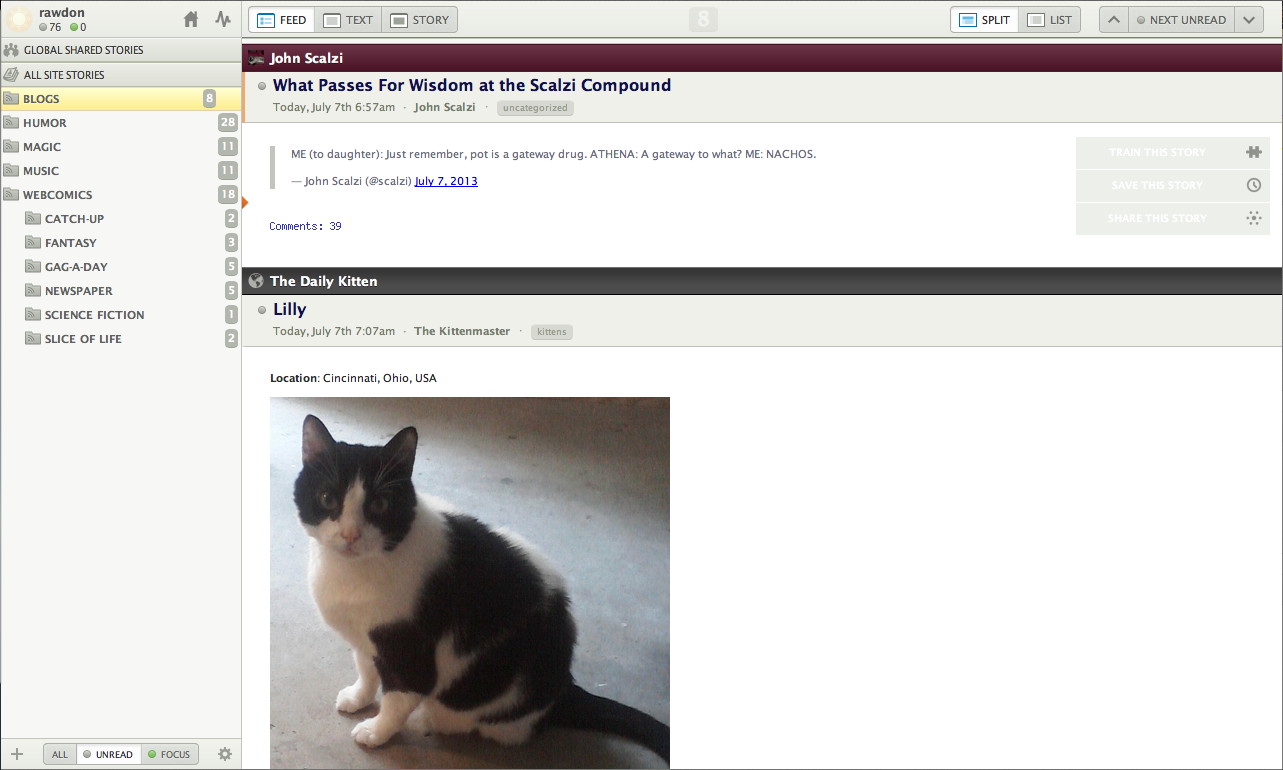
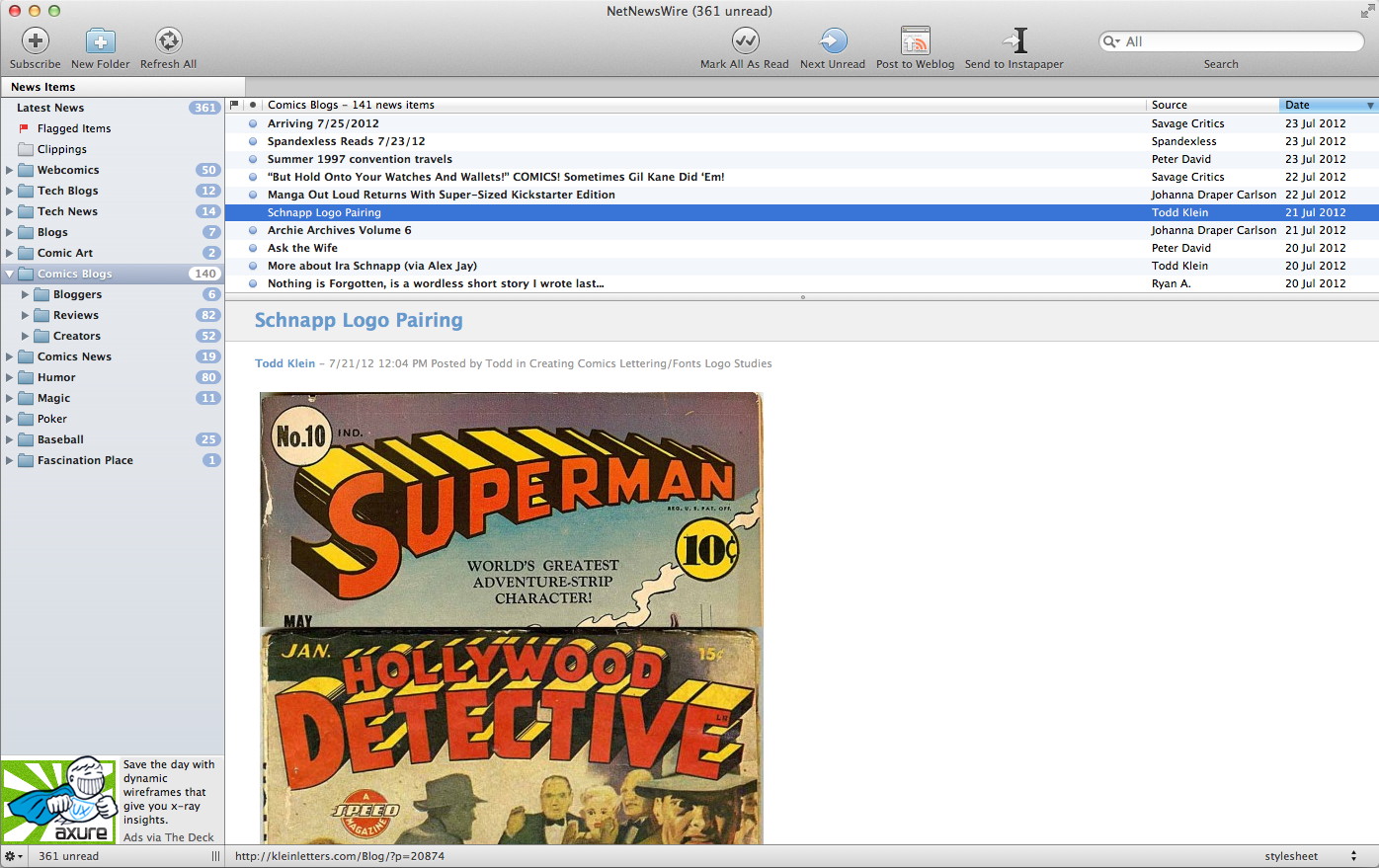
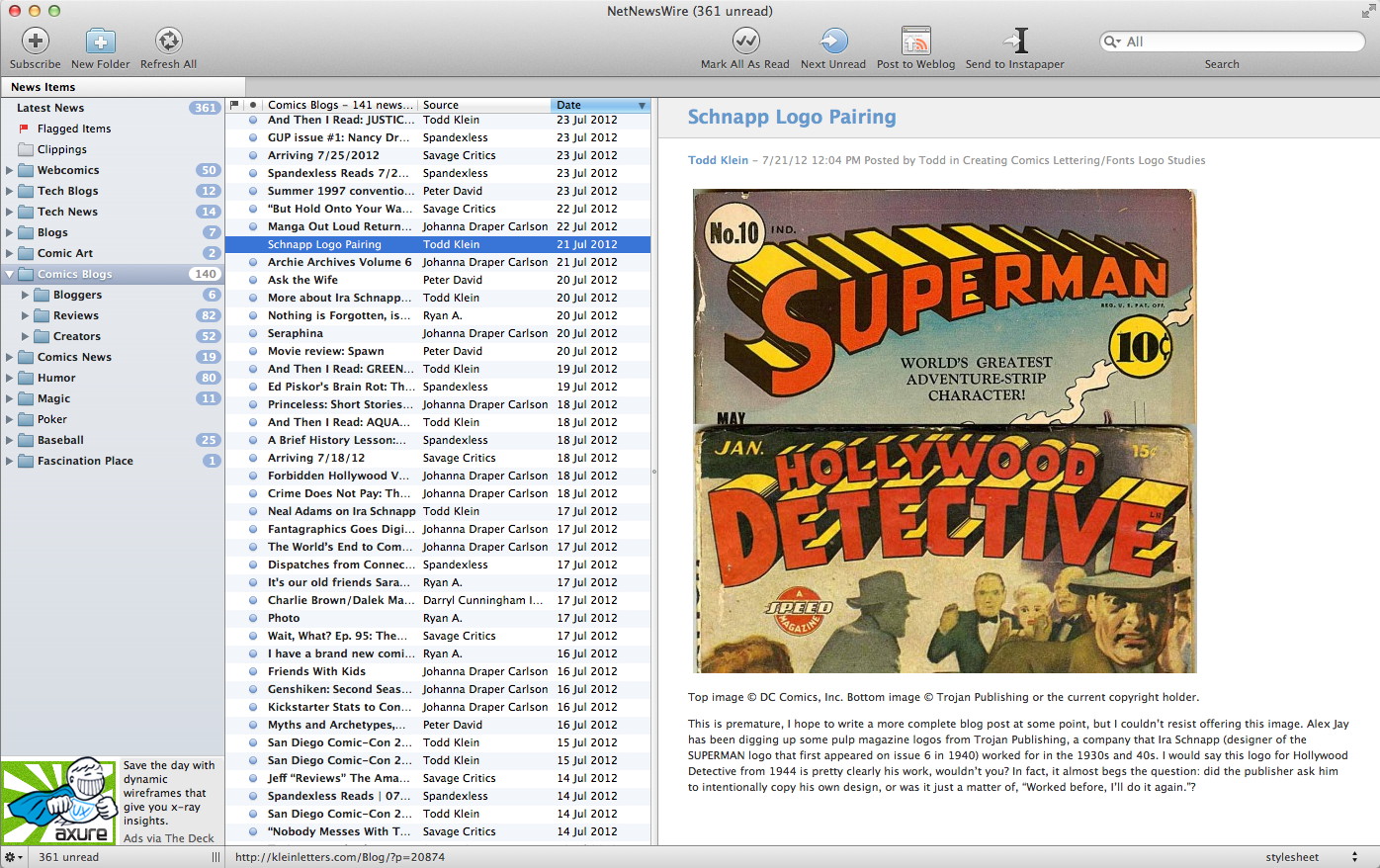
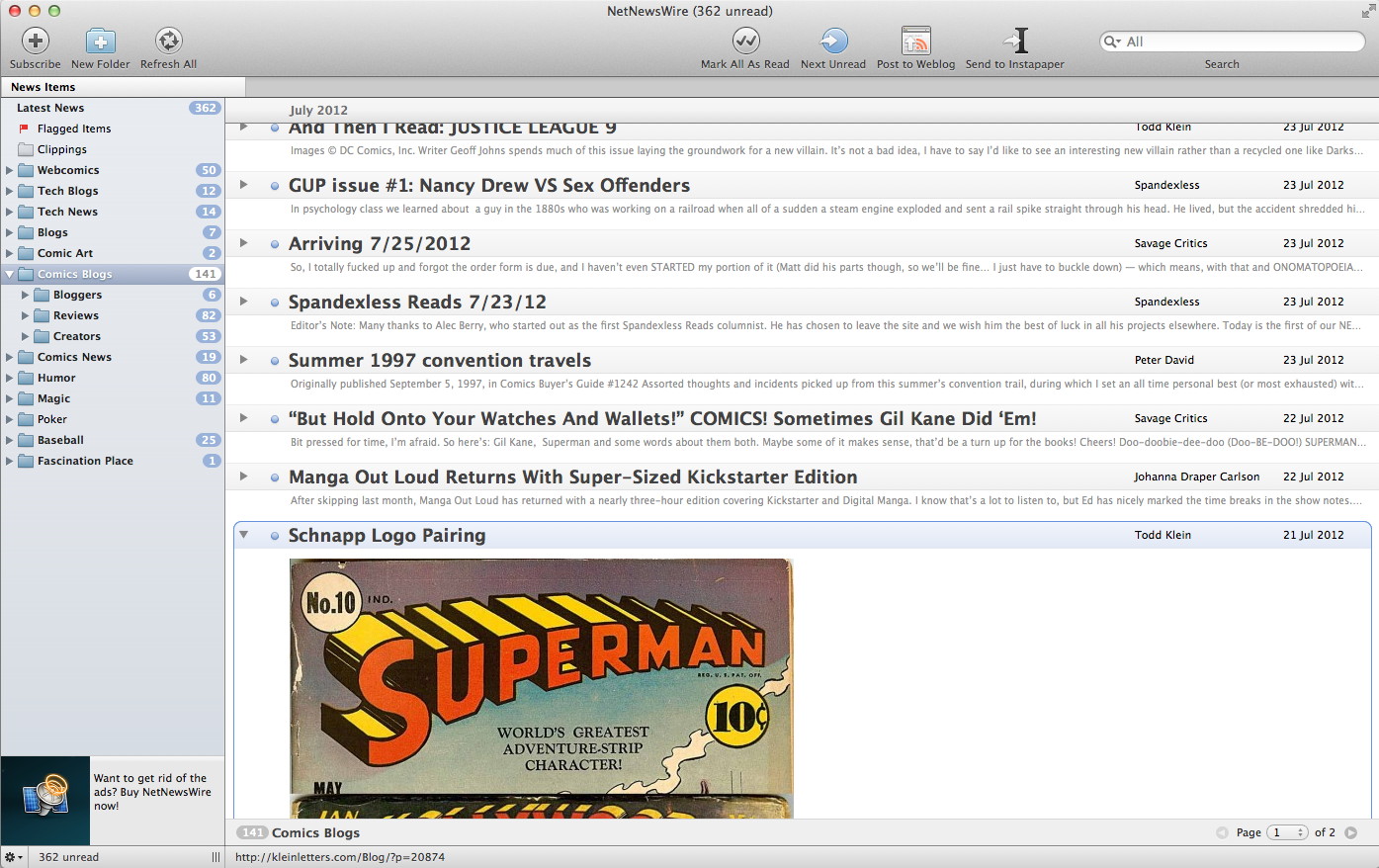
(BTW, if you have no idea what I’m talking about here, you can read the Wikipedia entry on web feeds. Two good ways to subscribe to feeds on the Mac are to use Safari RSS on Tiger – which is what I use – or to download NetNewsWire Lite.)

Quote of the Day

“There’s no one so nice that there isn’t an online app that will make them seem not so nice.” — me

(Also Twittered by Liz Henry, who also was at Whump’s Boxing Day gathering today.)

Amazon Christmas “Fun”

I’ve been using Amazon.com for a long long time. My oldest orders on record there are from 1998, but I’m sure I was ordering from them before that. I’ve always been very impressed with their business: Availability of items, fringe benefits like the Associates program and the free super saver shipping option, and their customer service, which has always been very helpful when I’ve had to contact them, which fortunately hasn’t been very often.

This Christmas season has eroded my faith in Amazon somewhat. Now, I’ll say up front that things turned out well overall, but my Christmas experience with Amazon resulted in more glitches in one month than I think I’ve seen since I started using them.

Here’s a rundown of what happened:

  1. I received a box from them which I opened and noticed that the gift cards were from “Mom” but to “Rachel”. The box was indeed addressed to me, so I opened the itinery to see that someone else’s order had been placed in a box addressed to me. I contacted my family, and the UPS tracking number was one my Dad had received. He contacted Amazon by phone and was told I would have to send the items back and would received a gift certificate for the value of the items Dad ordered. Dad’s comment: “That’s not very much like Christmas.”

    Well, instead I contacted Amazon customer service through e-mail, and after I provided them all the information they needed, they instead packed up a new box with the items Dad ordered and sent it to me. So all turned out well, and I didn’t need to send anything back. (Ironically, my aversion to calling people on the phone worked in our favor here.)

  2. I received another box with a wrapped item from my Mom, and another wrapped item addressed to someone else. Apparently someone else’s order got placed in the same box by mistake. Since there was no indication the first time around that they’d fix the other person’s problem unless that other person contacted them, I didn’t contact Amazon about this. (The item in question was a CD which actually looks kind of interesting.)
  3. My Dad received some items I ordered for him, and they were wrapped, but had no gift cards. The order didn’t show any gift note when I reviewed it, so in all fairness I might have screwed this up myself rather than Amazon losing my note. On the other hand, Dad says he received some gifts from someone else which were not wrapped but should have been.
  4. Finally, I received one CD from my Dad which should have been wrapped but was not. That’s not the fun part though: When I unwrapped presents from Dad, one of them was another copy of the same CD. However, if this was part of the order they had to re-ship, this might have just been a little fallout from the first problem. (Anyone want a copy of Shadow Gallery’s Tyranny?)

None of this is likely to make me stop using Amazon in the future (fat chance!), but it is an unfortunate set of events. The moral of the story is: Take a look at what you received, even if it’s wrapped, to make sure it looks like it’s correct, because the sooner you notice any problems the sooner you can work with Amazon to get them fixed.

And Amazon’s customer service still rocks, for getting things fixed in time.