Watchmen

Yesterday we went up to the city to see Watchmen on the IMAX screen at the Metreon. This was actually the first film I’ve seen on an IMAX screen, although other than being really quite big, it didn’t feel very different from watching a movie on a regular screen.

I read the comic book by Alan Moore and Dave Gibbons when it came out back in 1986-87. It was a big deal then, as Moore was probably the hottest – and arguably the best – pure writer in comics at the time, and Gibbons was a highly-regarded artist. Moore has said that the series was intended to be experimental and rule-breaking in many ways, and as far as how to use the form of sequential art to tell a story, it was. Few comics before or since have taken such a, well, cinematic approach to storytelling, while also mixing in the things which make the form unique. Gibbons eschewed the traditional approach of using visual effects to convey movement or emotion and instead the series depicted the progress of time in a simple panel-by-panel approach. At the same time scenes blended into one another, linked by dialogue from different scenes. While individual elements of Watchmen was been mimicked or used elsewhere, I don’t think anyone else has managed to quite capture the unique feel and nature of the book.

(The story, by the way, concerns a world in which superheroes emerged, changed the world – especially the big one who had actual powers – and were then forced into retirement. A decade later, one of them is killed, setting into motion a chain of events to learn why he was killed, which brings many of the surviving heroes back to solve the mystery and come to terms with their pasts and present.)

That said, the book is certainly not without its flaws. Steven Grant wrote an interesting critical account of the book which I recommend reading. I agree that the story by-and-large isn’t terribly novel, it’s how it’s told that’s fascinating. The story is also rather let down by a very hard-to-swallow ending, which Moore tries his level best (which is extremely good) to sell, trying to cajole and trick the reader into buying it, but it doesn’t quite work. (He manages to paper over most of the unbelievability with a compelling final page, but it’s just a papering-over, as if he doesn’t quite buy it himself.) But in sum its complexity, nuance, and believable characters make it one of the better graphic novels out there.

Making a movie of it: Hoo-boy.

The comic is strictly episodic in nature – using the periodical nature of the original comics for its own purposes as a chapter structure – with each issue featuring its own encapsulated segment of the story, its own tone and characters, and often its own resolution of a sort. It’s also a very low-key story, with only the occasional moment of action. Much of this is at odds with how superhero movies – or heck, any blockbuster movie – is constructed today.

Director Zack Snyder and screenplay writers David Hayter and Alex Tse give it a good try. With a running time of 163 minutes, that gives them about 13 minutes per issue (plus 7 minutes for credits), but of course it doesn’t work out that way. Naturally they cut the stuff that absolutely had to be cut (the “Black Freighter” sequences, which are not without their interesting elements but are ultimately the least essential part of the book), and pare down the issues that can be pared down. That still left them with some difficult decisions, and I think they cut some important material, but I went in knowing that Watchmen is probably impossible to film faithfully in a mere movie-length film.

The expected problems with the adaptation aside, the film starts going wrong in its focus on the violence of the story. Where the comic doesn’t exactly flinch from showing the horrible things that happen, it also rarely does so directly unless necessary, leaving some of the worst moments to the reader’s imagination – usually a good choice. The film emphasizes every punch with an extra-loud sound of impact. The heroes – most of whom have no true powers – get the living daylights beaten out of them and come back for more, quite different from how they’re portrayed in the book. There are some extremely gory scenes, some in which the camera lingers lovingly on the blood. The violence is mostly gratuitous, and only truly provides value in one scene, when two of the heroes are fighting their way through a gauntlet in a prison.

The film’s other big problem is the climax, in which everything is revealed, though it’s somewhat different from the book, but not really any more effective or believable. The book is full of moral ambiguity and goes to great lengths to try to portray every character as having both admirable and ignoble motivations and actions. The film mostly casts the characters as either “more good guys” or “more bad guys”, which sucks a lot of power out of the ending.

To the extent that the film works, it relies on the portrayal of the psychopathic Rorschach and his portrayal by Jackie Earle Haley. The acting is unexceptional throughout the film (none of the major actors are familiar to me), but Haley carries the day with an intense and spot-on performance, growling his way through the film in a full face-mask (whose constantly-shifting pattern is the film’s greatest visual triumph). With a lesser performance in this pivotal role, the film would have been limp indeed, violence or not.

The picture also looks impressive, although perhaps a little too art-deco and artificial in its appearance no matter the era being shown (it takes place in 1985 and has scenes dating back to the 1940s). This works well in the opening sequence, a series of nearly-still images (a neat effect in itself) about the history leading up to the main story, but gets a little wearing towards the end. But the characters and many of the settings and scenes look like they were lifted directly from the book; smartly, many of the iconic images are closely replicated in the film, sometimes to an uncanny degree. Considering how often films deviate across the board from their source material, this in itself is quite impressive.

Overall, I’d say Watchmen is a “pretty good” film – certainly not in the same league as the book. I do think it could have been a better film, by toning down the violence and sticking closer to the book in some key areas, but I appreciate that it’s a very challenging book to adapt. Perhaps I’m being too demanding, but I think the film’s greatest flaws were entirely correctable, yet they seemed to be conscious deviations to make the film more “exciting”.

Watchmen the movie is worth seeing once (if you’re not too squeamish about gore in movies), especially if you’ve already read the book. And if you’ve seen the film, though, then you definitely owe it to yourself to read the original. But I don’t think it’s going to hold up under repeated viewings.

Arm Trouble

I went to the doctor this afternoon about my arm.

A little over a week ago I got a pain in my neck. Nothing very unusual – I’ve gotten a stiff or sore neck once in a while dating back to high school. It always goes away in a few days at most.

This time it didn’t go away: The soreness seemed to spread down my right shoulder into my arm. By late this week it had settled into my upper arm, and I was getting occasional tingling down my arm, especially in my hand. It was uncomfortable to hold my arm in some positions, especially one I put it in when I sleep.

Today, with it not really getting any better, I called the doctor, and fortunately my regular doctor (okay, I’ve seen him once in eight years, but it’s the same one!) had an appointment open this afternoon.

After some tests, it turns out I have an impinged (pinched) nerve in my neck. This is what I figured it probably was, but I wanted to make sure it wasn’t, say, a circulatory problem, which probably would have been a lot worse. The treatment is a round of anti-inflammatory drugs to hopefully let the nerve get back into place, and then to see if it comes back after a week. So I picked up the drugs (I start tomorrow) and I’ll make an appointment for two weeks from now. Hopefully, it will all go as planned. (Plus, it will be a full physical, which I haven’t had in quite a while.) I also learned that I can feel it in my arm when I tilt my head back, so I’m going to try to do less of that for a bit (which may be a good trick as we’re going to see Watchmen tomorrow).

I really like my doctor, he’s quite funny, and also a good communicator. I’d been considering switching my PCP to a new building closer to both home and work, but I’m going to stick with him. It’s important to have a doctor you like, I think.

One other thing: The clinic, the Palo Alto Medical Foundation, uses software from my previous employer, Epic Systems. It was interesting to get a glimpse of how the software has evolved since I worked there, and also to see it in action. A little blast from the past, you might say.

Comic Shop Tragedy

I was stunned last weekend to read on Twitter that Ryan Higgins, the owner of my regular comics shop, Comics Conspiracy, had his apartment burn down last weekend. It sounds like he and his girlfriend lost nearly everything, although they and their dog managed to get out.

I’ve been going to CC for nearly the whole time I’ve lived here. Ryan’s been there the whole time, and bought the store a couple of years ago from the previous owner (who still works there, too). He’s done a great job with the store, doing a major renovation job and keeping everything looking clean and tidy. I started going there because its location was convenient to me, but I really do think it’s the best store in the South Bay.

Hopefully Ryan can bounce back from this, but I can only imagine what he’s going through.

Ten Years at Apple

Sunday marked (as the calendar turns) ten years of working at Apple for me. I guess yesterday – Monday – was slightly more relevant, since if course I didn’t start work on a Sunday (although I did go in the previous Friday to get some info from my manager, since I spent my first week in a training class). Yesterday was 522 weeks from that starting date.

But who’s counting?

I’ve spent most of that time working on the Xcode developer tools. Not only is 10 years a long time to work at a single company in Silicon Valley, but nearly-8-years is a long time to be in more-or-less the same role at that company. Of course, every year it seems like I’m working on something new and different, using new technology, so there’s a lot of variety within my job. There’s so much going on here that even if I switched teams every couple of years there’s still more neat stuff to work with and work on than anyone could fit into a lifetime. (Contrast with my previous company, where after 4 years I felt like I’d basically done everything there was to do, on a technical level.)

(Of course, I “celebrated” my anniversary by spending the whole day investigating a heisenbug, but that’s the way it goes sometimes!)

Although the job has its frustrations, there’s no substitute for working with smart people on a project that matters, even if it’s not the most visible or glamorous project around. And I know my work is appreciated, which helps a lot too.

It’s been an exciting decade for Apple, too; the company was just starting its upswing when I joined the company, about a year after the first iMac was introduced. It’s been fun to have been there through all of that.

When I told one of my closest friends at my old company that I was going to interview with Apple, she said, “Oh, you are so out of here.” Ten years later, I’m glad I got the offer, and I’m glad to have taken the job. And I’m glad to have stuck around this long. I hope to stick around a good while longer.

This Week’s Haul

  • Green Lantern #38, by Geoff Johns, Ivan Reis & Oclair Albert (DC)
  • Justice Society of America #24, by Geoff Johns, Jerry Ordway & Bob Wiacek (DC)
  • Madame Xanadu #8, by Matt Wagner, Amy Reeder Hadley & Richard Friend (DC/Vertigo)
  • The Starman Omnibus vol 2 of 6 HC, by James Robins, Tony Harris, Wade Von Grawbadger, Craig Hamilton, John Watkiss, Steve Yeowell & others (DC)
  • The Incredible Hercules #125 & 126, by Greg Pak, Fred Van Lente, Salva Espin, Clayton Henry, Rodney Buchemi, Greg Adams & Takeshi Miyazawa (Marvel)
  • Marvels: Eye of the Camera #4 of 6, by Kurt Busiek & Jay Anacleto (Marvel)
  • Nova #22, by Dan Abnett, Andy Lanning & Andrea Divito (Marvel)
  • Gigantic #3 of 5, by Rick Remender & Eric Nguyen (Dark Horse)
  • Mister X: Condemned #3 of 4, by Dean Motter (Dark Horse)
  • The Umbrella Academy: Dallas #4 of 6, by Gerard Way & Gabriel Bá (Dark Horse)
  • The Complete Peanuts: 1971-1972, by Charles M. Schultz (Fantagraphics)
Starman Omnibus vol 2 Man do I ever appreciate DC publishing James Robinson’s Starman in this nice hardcover omnibus series. Not only does it collect some issues which weren’t in the trade paperbacks, but it collects some odds-and-ends stories from other titles which I’ve never read at all! There are two Shade stories here which I’d never read before, one of which is actually relevant to later events in the series.

This particular volume has both one of my least-favorite stories in the series (Jack Knight and the Shade face a demon on the other side of a magical painting), but it also contains my hands-down favorite story, in which Jack meets Wes Dodds, the original Sandman – now a man in his 80s – and they investigate a series of murders. The story is sort of a sequel to Matt Wagner’s Sandman Mystery Theatre, and explores the relationships that heroes have to one another, the camaraderie which leads to a sort of friendship where a friendship wouldn’t otherwise exist. It’s also one of the most blatant examples of generational relationships in superhero comics, as Dodds is clearly at least one generation, if not two, removed from Jack Knight. (I don’t think it’s ever clearly stated, but I think Jack is himself in his 30s, rather old for a superhero, especially a novice one.)

There are many good standalone stories in here, too: The original Starman’s first battle with The Mist (which leads into the Sandman/Starman story), and “The Return of Bobo”, in which a small-time villain gets out of jail and returns to Opal City, to the worry of the police and Jack Knight. Bobo is one of the series’ best characters, as is immediately evident from this story. But Starman is similar to Neil Gaiman’s Sandman in that the standalone stories build up the background of the series and eventually contribute important pieces to the characters and ongoing storyline. And even if not every detail is crucial, most stories are enjoyable on their own.

James Robinson is sorely missed in comics – at least by me; these days I think he mainly works in Hollywood. But this volume of Starman reminds me that he really was one of the most sophisticated writers in the business. In some ways the best is yet to come, but in many ways the best is right here in this book.

Marvels: Eye of the Camera #4 I’ve been disappointed in Marvels: Eye of the Camera so far, and I think I know why: The strong character arc of the original Marvels, and the strong sense of time and place of each issue of that series, is missing here. Eye feels like it’s one brief glimpse of 1970s and 80s Marvel after another, without the depth that gives the glimpses meaning. Granted, the period covered so far is mostly not an iconic period in Marvel’s publishing history (the Claremont/Byrne X-Men aside), but I still think it would have been a much better series if it had been pared down to fewer incidents.

This issue primarily focuses on the wake of the Secret Wars series, especially the second one, in which the godlike Beyonder comes to Earth and trails destruction in his wake. It’s okay, but it still feels like a series of vignettes. It’s loosely connected by Phil Sheldon’s ongoing battle with cancer, but the series just isn’t working for me.

There’s still time for Busiek to pull it off, but it’s been a rather haphazard story so far.

Gigantic #3 Greg Burgas wonders why Gigantic isn’t a better comic book. I think the answer’s pretty simple: While it’s a high-concept action story (“The Earth’s just a setting for alien reality TV programming”), it’s really a very depressing one. The lead character is a man who was turned into a gladiator for the aliens when he was younger, and has come back to his homeworld a hunted man. Catastrophe, tragedy and a whole lot of punching ensues. The first three issues haven’t really expanded on the premise very much, it’s continued to just be a lot of tragedy and punching with no light visible at the end of the tunnel. I have a similar problem with the other Remender series I’m reading, The End League. I can deal with dark comics series, but these aren’t just dark, they’re bleak. So they’re not much fun.

For a much better take on a very similar premise, try Dan Vado’s The Griffin. While the art in that one is a little iffy, the story is first-rate. If you can find the original DC Comics prestige-format mini-series (6 issues), that’s even better, since the SLG collection is in black-and-white.

Ten Years in California

It was ten years ago yesterday that I moved to California from Madison, WI.

Back then I had just turned 30, interviewed with Apple, and accepted the job that brought me out here. The months of January, February and March 1999 went by in a whirlwind of travel, cleanup, preparation, packing, starting a new job, and finding an apartment. The upside of such a big move is that you’re just too busy lining up all the ducks to get too stressed out about the change – you’re too busy being too stressed out about getting it to work. It was just an insane time.

On the one hand I think I could have managed things better way back when – in particular, I wish I’d gotten better guidance from my friends about where to live, as I ended up living 15+ miles away from all of them, which made me miserable for a while – but on the other hand I did eventually correct the mistakes I made, I ended up at a company that was on the upswing and working on interesting stuff in a job I enjoy (ten years later, I’m still working at Apple), and my life in California has been enjoyable and productive and involved considerably less cold and snow than did my life in Madison.

Even ten years later, leaving Madison still feels bittersweet: I had and have a lot of friends there, and it’s a great city. But it’s also a small city, and I’ve appreciated the more and varied opportunities for all kinds of things here in the Bay Area. I guess I’m just a big city guy at my core.

(And I have lots of friends here, too!)

All-in-all, it’s been a good ten years. What will the next ten bring?

Rainy Day by the Ocean

We’re having another storm come through the area this weekend, bringing more much-needed water to the area. Now, for those of you who live in regions with actual weather, rather than mere climate, “storm” in this case really means “series of showers, and maybe some wind”. We almost never get the raging downpours and gale-force winds, never mind any thunder and lightning, that hit the northeast or midwest. Still, I’m happy for any showers we do get, since for eight months out of the year it’s Eternal Summer here.

We drove over to Half Moon Bay this morning for breakfast. We parked across the street from the Main Street Grill and noticed an ambulance and fire engine outside. We waited until they were done taking a guy away in the ambulance before heading in. (I wondered why an ambulance always seems to be accompanied by a fire truck; Debbi thinks it’s because the firemen have the equipment and knowledge to extract people from difficult spots if necessary, while the EMTs are there for their medical expertise. Seems plausible to me.)

While the Grill was reasonably busy (though hardly packed), the rest of downtown Half Moon Bay was pretty dead. We walked down Main Street and I don’t think we passed anyone else walking around, although there were a few people in stores. I think Half Moon Bay is driven by a vacationers economy, and it’s had plenty of turnover of retail stores since I started going there; I wonder how hard it’s going to be hit by the recession.

Afterwards we drove over to Half Moon Bay State Beach and just sat in the car for a couple of hours reading, listening to the rain, and watching the waves roll in. There were a handful of other cars in the parking lot, and one minivan disgorged a family who walked down to the beach – mostly in shorts and carrying beach shovels and buckets – and who later returned and left. The rain came in waves but never completely stopped.

Now we’re home and winding down for an afternoon and evening inside (assuming we can figure out what to do for dinner). Considering I went into work yesterday, that’s pretty much all I want to do today.

This Week’s Haul

  • The Brave and the Bold #22, by David Hine, Doug Braithwaite & Bill Reinhold (DC)
  • Tangent: Superman’s Reign #12 of 12, by Dan Jurgens, Carlos Magno & Julio Ferreira (DC)
  • Guardians of the Galaxy #10, by Dan Abnett, Andy Lanning, Brad Walker, Victor Olazaba & Livesay (Marvel)
  • Invincible #59, by Robert Kirkman & Ryan Ottley (Image)
Tangent: Superman's Reign #12 Tangent: Superman’s Reign had a promising start: The DC Universe heroes meeting their counterparts from “Earth Tangent”, and catching up with the main characters from that world was fun, since it’s spent the last few years under the supposedly-benevolent rule of their Superman, a powerful telepath and telekinetic.

Unfortunately the series ended up being a mess, padded by at least four issues. It didn’t help that each issue (save the last) featured a back-up story taking up a quarter of the pages, but doing nothing more than recounting the backstory of the Tangent characters (and ultimately going nowhere). There were too many characters so no one stood out as the protagonist, everyone got lost in the shuffle. Plus the game of musical artists started mid-way through, none of them quite working out as well as the original artist, Matthew Clark, did.

I think the series would have been better served by getting rid of the backup story and cutting it back to 6 issues or so. But ultimately I think the series just didn’t have a reason for being other than throwing the DC and Tangent heroes together, and frankly that just wasn’t enough to carry it.

The Brave and the Bold #22 On the other hand, the underrated series The Brave and the Bold wraps up its latest story arc and it turned out to be a perfectly enjoyable retro-style team-up of Green Lantern and the Phantom Stranger (with a side of Green Arrow) facing down a powerful creature trying to end all life in the universe. It includes a visit to a fairly alien world (by comic book standards) and themes of the value of life even in trying circumstances. I’ve never read anything by David Hine before, but this is a pretty good indication that I should check out his other work, if I come across any. Doug Braithwaite is a pretty good artist with a bit of Mike Grell and Norm Breyfogle in his style, and his work looks better here than it did in Alex Ross’ series Justice.

After this series of fill-in issues, I guess J. Michael Straczynski is taking over the series with the next issue. Although it sounds like it’s already running late, and as you saw in my review of Thor last week his previous comics work hasn’t thrilled me (although The Twelve has been quite good, though it’s running late, too). Anyway, we can cross that bridge when we come to it. If we come to it.

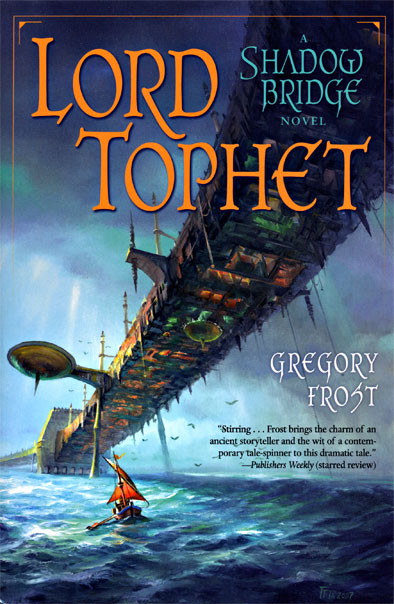
Gregory Frost: Shadowbridge & Lord Tophet

  • Shadowbridge

    • by Gregory Frost
    • TPB, Ballantine/Del Rey Books, © 2008, 255 pp, ISBN 0-345-49758-1
  • Lord Tophet

    • TPB, Ballantine/Del Rey Books, © 2008, 222 pp, ISBN 0-345-49759-8

This is a charming novel that was divided into two volumes – presumably by the publisher – but if you just read Shadowbridge you’ll be disappointed at the end, since it’s not a whole story. Fortunately I enjoyed the first half enough to be happy to head right into the second half. That’s a little unusual since I’m not generally a fan of fantasy, but it has elements reminiscent of both Tim Powers and Michael Swanwick, whose works I enjoy.

Shadowbridge is a world of a few small islands and a great many giant bridge spans across its ocean. Thousands of people live on the spans of the bridges, and their origins are lost to antiquity. Their medieval cultures are mixed with fantastic creatures living alongside the humans, demigods walking the world, and the gods dabbling in mortal affairs, especially through the Dragon Bowls on each span through which favors are visited on a few worthies.

Into this world strides Bardsham, the greatest storyteller of his age, through the use of shadow puppets. But that was years ago, and the story opens with his daughter, Leodora, taking up his legacy, with his puppets, and aided by his former assistant, Soter, a drunkard who helps her set up engagements. Leodora performs under the name of Jax to hide her gender, and gathers stories from the spans she visits. In time they’re joined by Diverus, a gifted musician who has been touched by the gods. But Soter is terrified that the horrible fate that was visited on Bardsham and his wife Leandra – Leodora’s parents – will find and doom her as well.

Shadowbridge has a touch of metatextual feeling to it, with regular asides in which a character tells a traditional story from somewhere on the bridge. Each of these stories is itself a rewarding vignette on its own, and it gradually develops that the stories have grains of truth as well as elements that have evolved over the centuries; which pieces are which is left up to the reader, and they give the reader something to mull over while reading the rest of the novel.

The story takes a little while to get going, spending a large chunk of the first volume on Leodora’s childhood, and the tragedies which led her to leave the island on which she grew up to follow in her father’s footsteps. It goes on a little too long for my tastes, though there’s some good stuff in there, especially her earliest years. And then another chunk of time on Diverus’ story, which is more exotic and ominous. But once the backstory is out of the way, things move along quickly, as Soter takes them further and further from Leodora’s childhood home and ultimately back to the span where the key events in Bardsham’s downfall occurred.

The second volume takes place mainly on this ancient span, as Leodora learns how Bardsham was seen by those living there, and also glimpses a mysterious span-beneath-the-span which she suspects has some role to play in the story. This is some of the best stuff in the novel, especially the city below, which has several layers the characters have to peel back. The general setting of Shadowbridge is not quite as exotic as I’d hoped – often it’s just a slightly quirky medieval world – but some of the specific ideas are quite well realized.

Frost has an accessible writing style with which he weaves some evocative tales. As far as the two authors whose work this novel resembles, the setting is more like Swanwick, but the storytelling is more like Powers, albeit not quite so tightly wound around a careful plot. Nonetheless the payoff is satisfying, even if the denouement left me feeling like we don’t really know whether the characters lived happily ever after.

All-in-all Shadowbridge is quite an entertaining novel, and if it’s slightly rough around the edges it makes up for that in pure enjoyment and the cleverness of the individual episodes. I don’t know whether Frost plans to write more books in this setting, but I’d read them if he does.