Goodbye to the Old House

I spent the last third of March back east getting my Mom’s house ready to sell. While not really a more difficult trip than any of my visits last month, it still kept me plenty busy.

I flew in the morning of Wednesday March 20, right after Boston had gotten about 9 inches of snow. I guess the snow must have been very light and fluffy, because there were only about 2-3 inches when I arrived. But it was also 28°F, which was more than a tad colder than I’m used to. I didn’t bring a heavy winter coat, optimistically hoping it would be closer to spring weather than winter, but at the beginning it didn’t work out that way.

I was staying with my Dad again, so I went to his place and we got breakfast. I took a nap (my red-eye plane was packed and I didn’t sleep much), and drove out to Mom’s house. I shoveled the walk from the driveway and the end of the driveway so my sister Katy and her boyfriend Andrew would be able to park when they arrived later that day (as they were going to stay at the house). I managed to break not one buy two shovels in the process! (To be fair to myself, all three shovels I had access to were pretty old.) I also turned on the heat in the house and turned up the hot water, and both had been turned down low for the winter. Katy and Andrew arrived and we had dinner with Dad.

Thursday we picked up Mom and met with the agents we’re using to sell the house, who we really like, and signed documents to put the house on the market once we’d finished taking things out of it. Then we spent the next couple of days mostly going through the house to figure out what was left that Mom wanted to take to her apartment, and what Katy and I each wanted to take with us.

Katy ended up taking a couple of oriental rugs, an end table, and some other stuff. She considered taking the dining room table but decided against it (it’s an okay table, but I don’t think either of us are sad that we didn’t take it; honestly the one I have at my house is nicer even though it’s nearly as old!). I took a rocking chair and a chest with a marble top, both of which I shipped through the Boston Packaging Store, who came and picked them up. Both items were very securely packed and arrived a week and a half later in the same condition they’d left, so I can certainly recommend them as packers for anyone in the area who needs a service like that.

I spent quite a bit of time over the next week helping Mom get everything she wanted, which mainly meant books. Andrew installed another bookcase in her apartment, but we brought over plenty of books to fill it. She also took some clothes and a few other items (and Katy made her take a few pieces of cookware). But since this was her last chance to get anything she wanted from the house, I was willing to do it all.

Katy and Andrew left on Saturday, and Sunday I took a break and went down to visit Debbi’s sisters and their family.

Andrew took a few pictures of the house, and of the three of us, before they left:

Family

It warmed up during the second week, going from highs in the mid-30s to highs in the high 40s, which is still cold by California standards, but got into the range where I was pretty comfortable wearing my jacket. The snow mostly melted during the week, and I spent some time raking leaves in the driveway and the yard, so the house would look a little better when it was being shown. (Debbi poked fun at me since I kept mentioning trying to make time to rake leaves.)

Also this week, I was having most lunches with Mom as we continued to get stuff from the house, and then most dinners with Dad as I went back to his place for the evening. Tuesday was the exception to both of these, as in the morning I was at the house waiting for the packing company to come pick things up, and then I went and had lunch by myself. In the evening I went into downtown Boston to have dinner with my friend Bruce, whom I hadn’t seen since my first trip last year in July, and we caught up on stuff over dinner and then coffee afterwards.

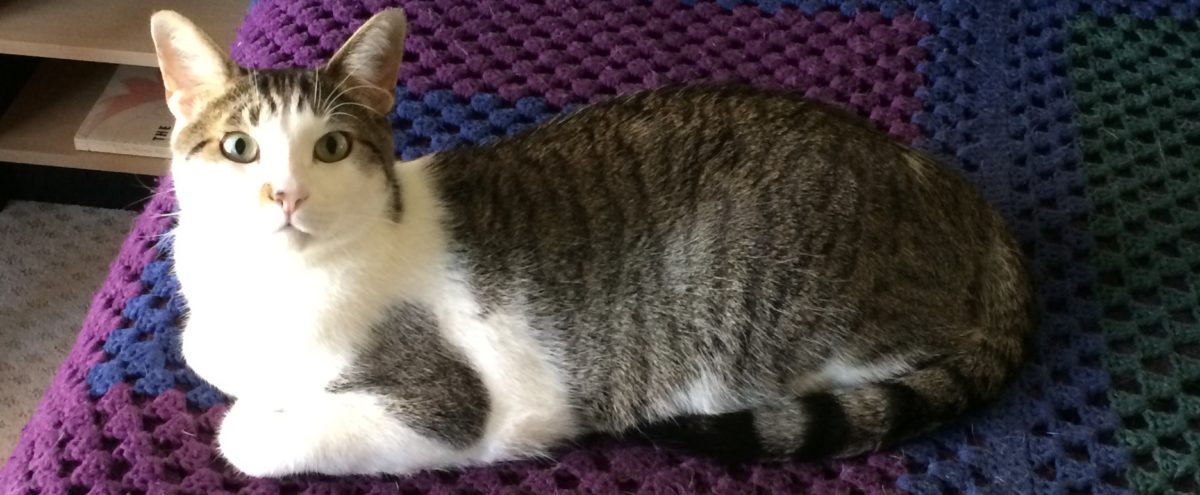
On Wednesday we took Mom’s cat Maggie in to the vet for her annual checkup, which I’d wanted to make time for while visiting. Catching Maggie was quite a trick, as she ran around the apartment for over 5 minutes before I finally managed to grab her. I think this soured her on me for the rest of my visit. Alas. Anyway, the vet is a nice place in Waltham who have a resident cat who is nearly as old as Newton! They checked Maggie out and the only issue was a bunch of wax build-up in her ears. She’s about 10 – which is how old Roulette is – and is in good shape for that age. Since she lives without other cats in Mom’s small apartment she’s not as active as Rou, but then she wasn’t as active as Rou back when I stayed at the house last July. Maybe it’s having other cats around that stimulates cats.

Mom and I also went to the Book Fair for her to buy some more books, and I took her to the pet store to pick up some stuff for Maggie.

By this point I was entering the endgame of my trip. I met with the agents again on Thursday to wrap things up with them, including plans to hire someone to empty the house after I left. And Mom and I took a whole bunch of pictures of the house with our cameras. I wished I’d had the presence of mind to take them when Katy and Andrew were there, so the house looked a little more lived in, but we were just too busy. Seeing the house closer to what it must have looked like when my parents moved in was interesting. It was emotional to know that this was the last time I’d visit the house.

Thursday and Friday I was also packing up the stuff I’d saved from the house that I wanted to keep – a few trinkets, and a lamp that Katy had found that I decided looked pretty neat and would work well in our guest room. Also some of Mom’s papers that I wanted to have with her financial records with me in California. I’d been very happy with FedEx’s packing job last October, so I used them again, and happily everything arrived in California intact a week later. I spent at least one evening going through some boxes of photos, and picking out some ones I wanted. There were fewer old photos than I’d expected, but then there are also at least four photo albums with pictures from the 1970s which I didn’t get to. Next time, assuming Katy hasn’t taken them by then.

Friday was my last day at the house, and the last visit with Mom, as I didn’t feel like driving all over on Saturday morning knowing I had to pack and catch the train to the airport in the early afternoon. So I had brunch with Dad, and then headed off. My flight home was delayed an hour because the refueling truck for our plane spilled some fuel on the tarmac, but we eventually made it into the air. Fortunately, the flight was not very crowded so I had a row to myself. Unfortunately, I’d started getting sick the night before and was a borderline zombie for the flight. Debbi picked me up and took me home and I collapsed into bed after we ate.

It was a successful trip. It was a sad trip. I was a lot busier on this trip than I’d expected (originally I’d thought I might end up working 2 or 3 days while there, but it didn’t come close to happening). I’m relieved that it’s over, and I’ll be relieved when Mom’s house is sold. But it was exhausting.

All told, Mom lived in that house for just short of 40 years, and owned it for a bit longer, I lived most of my childhood there, and Katy lived all of hers there. The house itself had its drawbacks, but it was a good house overall. And the location couldn’t be beat, as kids, as teenagers, and as adults going back to visit. It was a comfortable place.

Goodbye, house.

Goodbye house

On Daylight Savings Time

I’m a fan of Daylight Savings Time. Basically because I don’t like to get up in the dark, and I like it to stay light as late as possible. My ideal would be for the sun to come up about 15 minutes before my alarm went off every day, but that’s not very realistic.

Lots of people hate Daylight Savings Time. I recently tweeted that Daylight Savings Time is like the Designated Hitter for non-sports fans. (Non-sports fans didn’t seem to get the joke; the existence of the Designated Hitter has been a major controversy in professional baseball since it was introduced in the early 1970s, with both sides being so entrenched that it’s unlikely anything will ever change. Long, long ago I wrote a short essay in defense of it. But I digress.) I have some appreciation for why they hate it, but I don’t agree with them. And rants I read about it often make me feel like they have no appreciation at all for why I like it.

This article, Why I Like DST, has been making the rounds this week, but I think it obfuscates its point (in particular, I think all his talk about computers is just a sideshow; automation has nothing to do with whether someone likes DST or not). Being one of those “arrogant programmers” he talks about, I thought I’d try fixing his article. 🙂

I think Daylight Savings Time basically comes down to this: Here’s when the sun will will rise and set in San Francisco on the shortest and longest days of the year of 2013, on each Standard Time and Daylight Savings Time:

  Longest Day
(June 21)
Shortest Day
(Dec 21)
Pacific Standard Time
(Winter time)
Rise: 4:48 am
Set: 7:35 pm
Rise: 7:22 am
Set: 4:55 pm
Pacific Daylight Time
(Summer time)
Rise:5:48 am
Set: 8:35 pm
Rise: 8:22 am
Set: 5:55 pm

(Table from the United States Naval Observatory, from which the article above also got its table.)

I don’t want the sun coming up at 8:22 am in the winter – winter can be depressing enough (expecially for people with seasonal affective disorder, which I think I have a mild form of) without waking up in the dark every day. I’d rather the sun came up closer to 7 (around the time I get up). On the other hand, I don’t really want it coming up at 4:48 am, several hours before I get up, in the summer; I’d rather have it come up later and stay light until nearly 9 pm.

And I’m happy to change my clocks twice a year to get closer to those ideals.

Now, your mileage may vary: You might get up or go to bed at a very different time from me, you might always get up in the dark year-round (Debbi gets up at 4 am most weekday mornings, well before sunrise in any of the squares on the chart), you might just hate changing your clocks twice a year. It’s really a matter of opinion. But it seems like people who hate the switch just don’t understand why people might like it. For me, it serves a purpose: I’m a light fiend, and I want to have as much of it during my waking hours as I can.

If we do someday end it, I’d rather we land on Daylight time year-round, since it’s closer to what I’d want (more daylight later in the day). I guess it would be some consolation that in the dead of winter I could watch the sun come up when I’m sitting down to breakfast.

But switching between the two times, as we do, is even better.

Oh, and I’m also pretty happy with the change made a few years ago to start DST earlier in the year and end it later, since it means I can bike to work for a few more weeks without having to bike home in the dark.

Exiting Submarine Mode

I haven’t written here in over a month – just haven’t been in the mood, I guess. Also, not a huge amount going on in the month of February.

March has been a bit different: Debbi’s been back east for the last week and a half visiting her parents (with a side-trip to Disney World yesterday and today), so I’ve been on my own at home for the first time since her sabbatical in 2011. It was pretty lonely for the first couple of days, trying to figure out what to do with myself (not that I didn’t have plenty to do).

After the first weekend it got a bit easier. I hosted Magic last Monday, went to Dana Street for comic book night on Wednesday, and hosted a poker night on Friday.

The poker night had a notable hand: In the big blind I got dealt… well, it came around to me with a single raise and I said, “I don’t have any cards.” I’d been distracted and hadn’t grabbed them from the middle, and they were sitting mixed up in the muck. Without my saying anything, people agreed I could just take the top two cards off the deck (no, I wasn’t the dealer) and play them. So I got two cards, and they were… the Ace-King of diamonds. I called the raise and saw a flop of… three diamonds, for the nut flush. The small blind bet into me, and I called, and everyone else folded. The turn and river bricked, and I got it all in on the river. My opponent thought a while and called, then mucked to my flush. He said he had a set, which was the only hand that made sense to me, other than a lower flush. He said my call on the flop confused him into thinking I didn’t have the flush, which was more-or-less what I’d intended. It was a little funny since he slowplayed several big hands that evening.

I wonder what the two cards I didn’t get to play were?

I signed up to watch some friends’ cats this past weekend, and kept plenty busy besides, reading for our book discussion on Sunday, cooking meals, and running errands. As usual I didn’t get half as much done as I’d intended. I also took Newton and Roulette in for their annual check-ups on Saturday. Newton’s down to just 4-1/2 pounds or so, but the vet says he seems happy and fairly healthy otherwise. We’re giving him more subcutaneous fluids but otherwise keeping things about the same unless things change. I’m glad he’s happy. He’ll turn 19 next month, which is just mind-blowing.

The kittens are doing well. They sleep with me every night and usually snuggle with me in the morning. I think Roulette is very gradually coming to accept them, but it’ll probably be months yet before they snooze together. All the cats were happy that it was so warm this weekend that I opened up the windows until sundown.

Today, alas, I’ve come down with something, so I had to bail on hosting Magic tonight and I’m sitting quietly on the couch (having eaten too much hamburger and tater tots for dinner). Debbi’s back tomorrow, and then things will be back to normal for a while. It’ll be nice.

Feline Integration

The kittens have had the run of the house for about a month and a half now, and things seem to be going well. There are some expected bumps, though.

Sadie & Jackson

Jackson is turning out to be the troublemaker. He’s gone behind the A/V cabinet and chewed on some of the thinner cables, breaking both the AM and FM antennae for my receiver. (It turns out those are hard to replace – no one really carries replacements!) We’ve piled empty boxes back there, but he keeps trying to get back there anyway. Then we grab him and put him in time out (holding him against his will) and he mews pitifully. He tries to force his way into our food at meal time, and yesterday stood on a spoon covered in pesto sauce while licking a plate. He likes to “help” me scoop the litter, standing in the box and batting at the scoop.

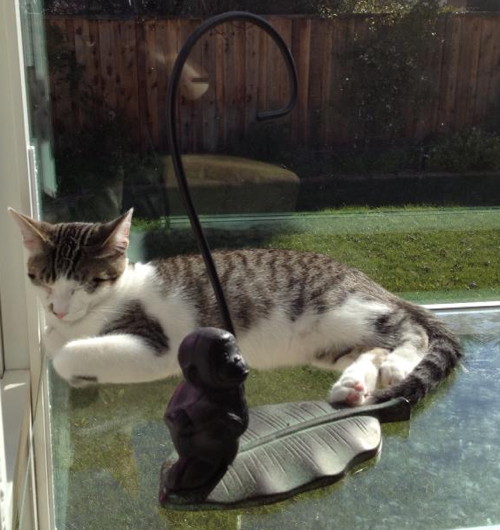
Sadie is not quite as rambunctious, and has gotten snugglier as she’s grown up. She likes getting attention in the middle of the night, which is not ideal, but she also likes to check out what people are doing. Sometimes I’ll be in the study and she’ll walk in meowing, and I think she just wanted to know where I am and make sure I’m okay. One morning she climbed through the shade in the front window to watch me leave for work.

Sadie is turning out to be a medium-long haired cat, which I would not have guessed from when she was a kitten. I’ll need to get her used to getting brushed. Jackson is definitely short-haired, and his fur is starting to soften a little. Jackson is going to be long and lanky, as I think I’ve said before, while Sadie will have a more compact body.

Jackson in the Sun Sunbeam Newton & Sadie
(click for larger images)

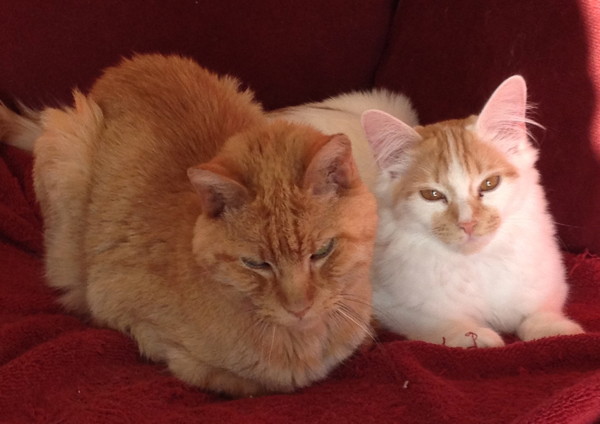
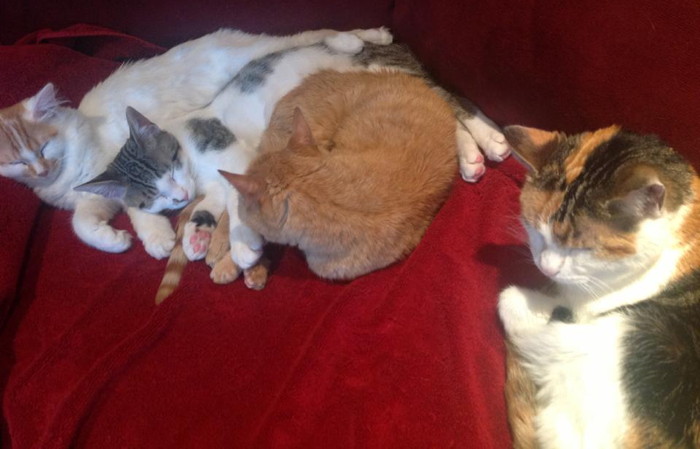
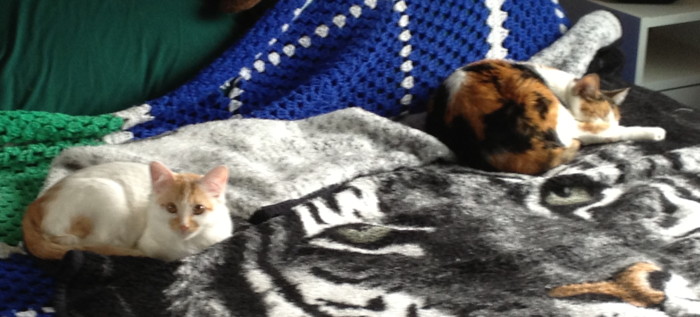
The kittens get along very well with Newton, and often sleep with him. I think Newton enjoys the attention, and I wonder if he was a little bored, lonely, or even feeling a little abandoned before the kittens, since he now spends time with them in group grooming sessions and seems a little perkier and happier (now that Sadie isn’t pouncing on him). I know he doesn’t like all the medicines and subcutaneous fluids he has to take, so the more innocent attention the kittens give him might make him happy. He’s also taught them about drinking out of the sink in the downstairs bathroom.

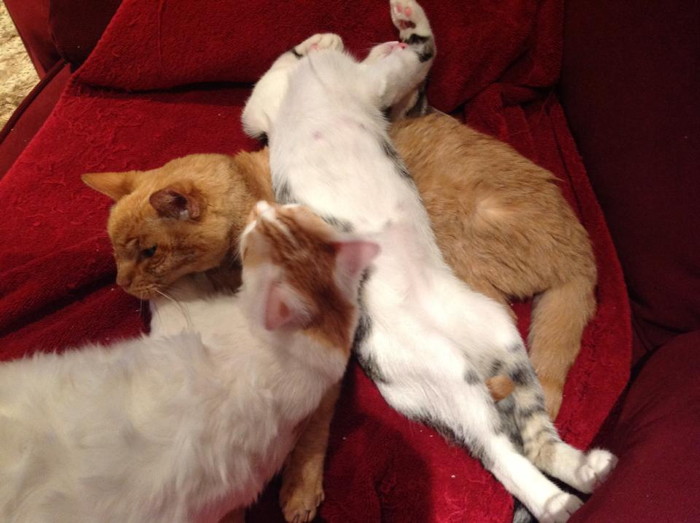
Kitten Pile

Getting along with Roulette is taking longer. There’s still some hissing, and Sadie sometimes chases her, which we can’t really tell whether she enjoys or not. Maybe sometimes she does and sometimes she doesn’t. Sadie really wants to be like Rou, and we often see her imitating the big cat. They don’t quite sleep together in the sun on the guest bed, but close. Jackson has tried to win her over by being snuggly like he was with Newton, but so far it hasn’t worked. But at least Roulette isn’t hiding under the bed all the time, and Debbi even saw her and Jackson playing next to each other in some brown packing paper we’d put on the floor.

Cats Together Sadie & Roulette

They’ve also been doing very well with guests: We had Chad & Camille and their kids over last weekend and the kittens were quite sociable. Today we had Subrata & Susan and their son over for part of the Super Bowl and they again were quite happy to check out everything everyone was doing. It’s nice not to have either cat running and hiding when people come over.

Yesterday we took the kittens to the vet for their last round of shots. When we were there a little over a month ago, Sadie was around 4 lbs and Jackson was a bit over 3 lbs. Jackson has passed Sadie and is now at 7 lbs, while Sadie is a little over 6 lbs. The vet thinks Jackson will be a 14-15 lb kitty, while Sadie will be 10-11. That’s gonna be a lot of Jackson to deal with!

Jackson is proofreading this post as I type, so I’ll sign off with a picture of the two of us. Carefully taken to crop out (most of) the horrible bed-head I had that morning before my shower:

Jackson & Me

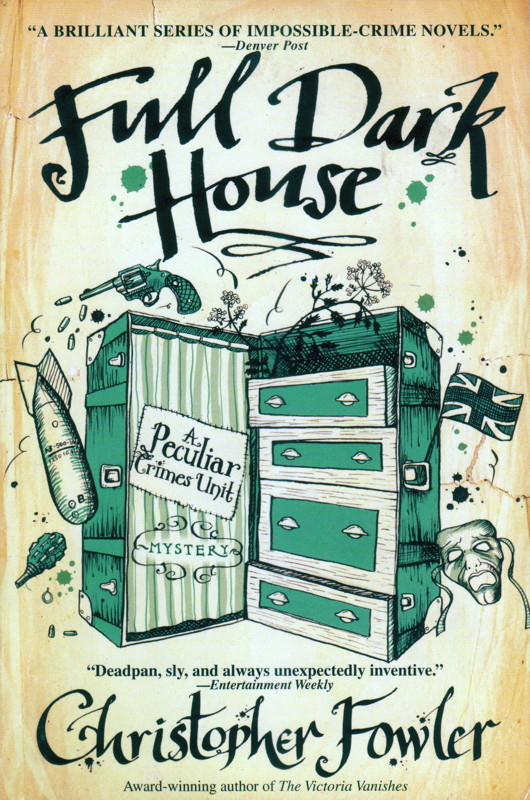
Christopher Fowler: Full Dark House

I picked up this mystery – the first in a series – because of its core hook: In the present day (around 2003, when the book was published, I guess), a bomb goes off in London destroying the headquarters of the Peculiar Crimes Unit, and its key investigator, Arthur Bryant. His partner, John May, is left to find out who killed him, and finds that Bryant was researching his memoirs and had recently been looking into the details of their first case together. The majority of the book chronicles that first case, when May first joined the unit and the pair searched for a killer at the Palace Theatre during the Blitz, at the end of 1940.

The story chronicles the assembly of the Peculiar Crimes Unit at a time when most able-bodied young men are fighting in World War II, and with some opposition from the police leadership. Bryant and May are introduced to the theater life and investigate the murders of several performers in a soon-to-open run of Orpheus in the Underworld. While the book features some detective work and some action, it’s at its best when it’s chronicling life during the Blitz, and in introducing us to the characters of Bryant and May.

The pair have a certain Holmes-and-Watson dynamic, with Bryant being the book-smart, eccentric one, while May is more the man of action. But Bryant is also highly eccentric, believing in spiritualism and being somewhat sickly, while May is a rationalist and merely Bryant’s sidekick. Both men are in their early 20s in 1940, and Bryant puts on an air of experience and competence, while May is greener and admits it to himself. Interestingly, Fowler eschews the “odd couple” approach and paints them as a pair of men with personal and professional respect for one another, united in their common cause rather than divided by their differences. Readers might find the story at times has echoes of Sherlock or Life on Mars, though the novel predates both of those series by several years.

For all that, the mystery – in both time periods – proves to be a little disappointing (the 1940 mystery’s culprit bears more than a passing resemblance to a considerably more famous – and older – work, which I won’t name since it would be a huge spoiler), both solutions feeling a little like they were pulled out of nowhere (the questions that I thought the reader could reasonably anticipate turned out to be red herrings). They serve, rather, to illuminate the characters of Bryant and May further, which works fairly well, but makes the book feel different from a standard mystery.

Fowler has a facility for a wry turn of phrase, and I found myself reading lines that amused me out loud to whomever was around when I was reading. It’s a sense of humor that is playful but understated, and it’s perhaps the best part of the book.

While overall a fun book, it felt a little lightweight when I got to the end. Still, I was entertained enough that I’ll head on to the next in the series and see if things get better fleshed out now that the characters are established.

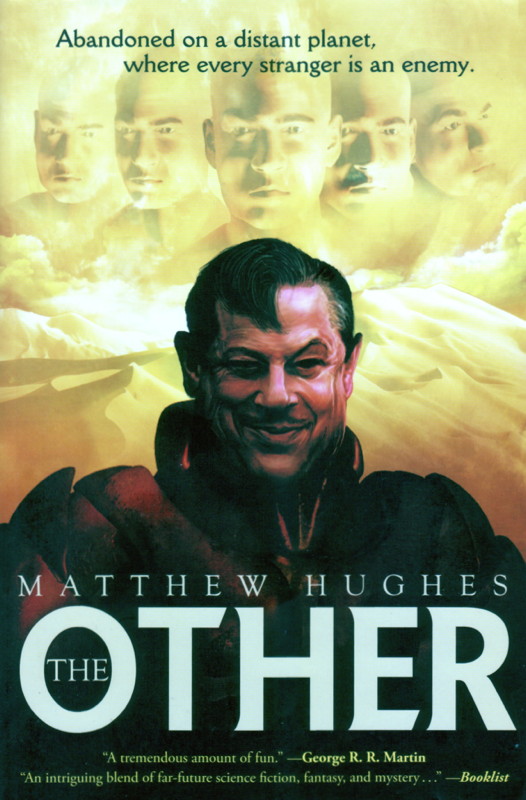
Matthew Hughes: The Other

In The Other, Matthew Hughes returns to his character of Luff Imbry from one of his early novels, Black Brillion. Imbry is a confidence man and handler of stolen goods, and the novel opens with one of his rivals getting the drop on him and shipping him off to the planet Fulda. This is a hardship for Imbry in several ways: Fulda is not very advanced, so he’s forced to put in real labor to support himself, and there’s something strange about the Fuldans which prevents Imbry from ever fitting in with them. Fulda is also very isolated from the rest of the galaxy so there’s no clear way for him to get off the planet.

He’s dropped on Fulda with a man named Tuchol, who is not very nice, but it’s unclear if he’s willingly in the employ of whomever nabbed Imbry. Tuchol turns out to be associated with what seems to be a small circus – at least, people who are able to perform various feats which they do for show – and Imbry falls in with them. Unfortunately Imbry soon comes to the attention of the police, one of whom takes a very strong disliking to him. So the story involves Imbry trying to stay alive, trying to avoid the police, trying to find a way off the planet, and trying to figure out the secrets of Fulda, four tasks which are all intertwined.

The challenge with writing a character like Imbry is to make the reader get behind him. Imbry has a jolly facade, but the reader is always aware that this guy is a criminal, albeit of the thieving rather than murdering variety. One of the reasons Black Brillion worked so well was that it played a more straightforward heroic protagonist off against Imbry, allowing Imbry’s amusing personality to shine without having to carry the book. Hughes mostly makes it work here, because what’s been done to Imbry is clearly so wrong that you can’t help but root for him to get out and exact his revenge. But I found it difficult to embrace him entirely. In a way, Imbry is the opposite number of Hughes’ Sherlock Holmesian character Henghis Hapthorn: Imbry is a criminal but is amusing and amiable, while Hapthorn is a good guy but also basically a jerk.

Imbry gets wrapped up in two different mysteries: First, what’s so queer about the Fuldans, and what makes some of them so irrationally hostile towards Imbry (if you’re familiar with Phil Foglio’s graphic novel Psmith then you might find some echoes of that here). Second, he gets dragged into a prophecy the Fuldans have circulated among themselves (with varying belief levels), leading to an even larger revelation which turns out to be rather clever.

Much of the enjoyment of the book comes from seeing how Imbry deals with the burdens placed upon him. He faces a variety of people who won’t listen to him, view him with suspicion, and to whom he cannot ingratiate himself. But his cleverness and personality often allow him to find a way to get by even among such people. The wit which works its way through all of Hughes’ work is in full flower here.

While I enjoyed The Other, I don’t think it measures up to some of Hughes’ other work, and I think Imbry’s status falling between hero and antihero is a big part of that. Though given how the book ends, I would be willing to read a sequel in which we see Imbry working a little more in his natural element. But I’m doubtful that Imbry is a strong enough character (without a significant development in his character beyond where he started) to carry a series of novels.

Birthday Week

My birthday was this past Wednesday, and Debbi and I took the day off to go do something fun.

We had breakfast at the Depot Cafe in San Carlos. It was quite there for a change (we usually go on a weekend), so I got to look at all their train photos and memorabilia. Afterwards I talked to my Dad before we headed up to San Francisco.

Our destination was the California Academy of Sciences, which I felt we hadn’t been to in long enough that a mid-week visit would make for a nice birthday trip.

As usual we got tickets for the planetarium as soon as we arrived, and then headed for the tropical rainforest, which is probably my favorite part of the museum. Since it was a Wednesday there were a bunch of school trips visiting too, and we spotted a couple of them trying to get butterflies to land on them (and a couple did!). None landed on me, but I did get some good pictures of butterflies (and slightly less good ones of birds):

Brown Butterfly Orange Butterfly
(click for larger image)

The elevator out of the rainforest drops you in the aquarium. I’ve always thought the aquarium is merely okay, but it does have a few nice sights:

Tropical reef

Jellyfish

The planetarium’s show this time is on earthquakes, with some pretty nifty CGI simulating the 1906 San Francisco quake, and good aerial views of fault lines and recent earthquakes. They had an exhibit on earthquakes and continental drift augmenting the show (or maybe the show was augmenting the exhibit), including a small shake room to demonstrate what the 1906 and 1989 quakes felt like. (The 1906 quake was long, about 90 seconds.) Someday I imagine we’ll get to feel one of these for real. I can wait, though.

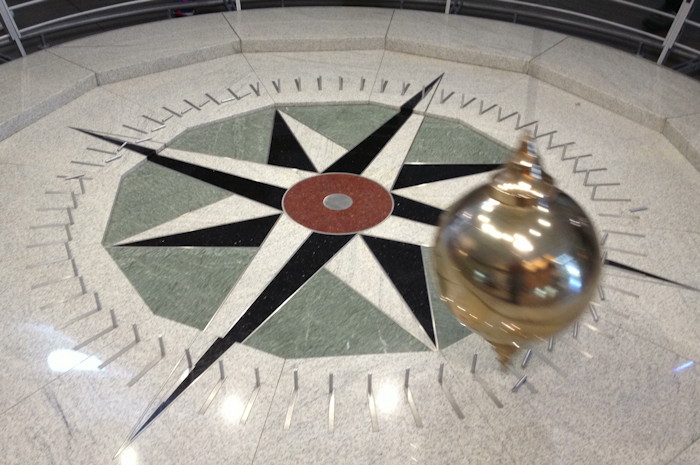
We spent a while looking at the museum’s Foucault pendulum, which I remember from the old museum:

Focault pendulum

I wish I’d gone to the old museum once more before they tore it down (it was replaced because it was not really earthquake-safe, as I recall); it was a pretty neat old building, and my memories of it are pretty fuzzy.

The new building has a living roof, which we always visit. They had a telescope with a solar filter on it which we looked through, and saw a couple of sunspots (they look like dirt on the lens, really). Then I remembered the panoramic photo feature on my iPhone and took one of the roof:

Rooftop panorama
(click to enbiggen)

That’s about a 180° view, by the way.

Since the Academy was pretty quiet on this mid-week midwinter day, we ate at the cafeteria, which was surprisingly good! They really need more seating there, though.

We also saw a short film called Dinosaurs Alive!, with CGI recreations of dinosaurs, plus some paleontological stuff. Having been a dinosaur fan since I was a little boy, I feel almost like I’ve spent my life watching the progress of animation of dinosaurs, and one thing that’s always the case is that in every film there’s never enough of it! But it was an okay film. Evolution is awesome.

All told we were there for about five hours, and we decided to become members for the year, so we’ll be going back a couple of times this year.

We had a quiet evening of pizza and comic books to wrap up my actual birthday.

Unfortunately Debbi – who had been fighting something off for much of the week – cratered that night and stayed home for the next two days. Thursday in particular she felt awful. By Friday evening she was feeling better and we went to one of my favorite restaurants, Amber India, for dinner.

Other than running some errands yesterday, we’ve had a pretty low-key weekend. We’re having our bizarre midwinter summer right now (highs in the 60s), doubly odd since it got quite cold shortly after Christmas and stayed that way for a couple of weeks. It’s been nice, but I am looking to the rain coming back sometime soon.

Anti-Psychopath

The Scientific American podcast recently had an episode titled “Psychopathy’s Bright Side: Kevin Dutton on the Benefits of Being a Bit Psychopathic”. In it, interviewee Kevin Dutton says:

Psychopaths in everyday life, if I’m talking about what kinds of psychopathic characteristics serve people well in everyday life, well, psychopaths are assertive, psychopaths don’t procrastinate, psychopaths focus on the positives, psychopaths don’t take things personally, they don’t beat themselves up when things go wrong, and they’re very cool under pressure.”

I listened to this bit and thought, “Wow, I’m pretty much the anti-psychopath.” Not completely (I’m assertive in many circumstances and I sometimes focus on the positives), but mostly.

Psychopaths probably make good poker players.

(Dutton’s book on the subject is The Wisdom of Psychopaths: What Saints, Spies, and Serial Killers Can Teach Us About Success.)

The End of Comics Buyer’s Guide

I read this morning that the owner of Krause Publications has announced that the venerable comics periodical Comics Buyer’s Guide is ending its long run.

CBG (as it’s commonly known) was a regular part of my life for a long time. I first discovered it back in the mid-80s when voting for the annual CBG awards (which, at one time, were a big thing in comics) was announced in places other than CBG. I believe everyone who voted received a free copy of CBG #600 – I did, at any rate, and I’m pretty sure I didn’t pay for it. This was an extra-sized issue, the cover sporting a Mike Grell illustration for the upcoming Batman/Jon Sable mini-series (which as far as I know never actually happened). CBG was published in tabloid newspaper format, which was a novel thing for a teenager like me. It contained a huge letter column and was chock-full of comics news not readily available to most teenaged fans in those pre-Internet days.

I subscribed immediately. My first regular issue was #607 (which of course triggered my collector-mania to want to find #601-606, but I never actually tried). As I recall, the front page of that featured an article on the upcoming DC series Hex, which did see print. That first issue of Hex was cover-dated September 1985, which means CBG #600 must have come out sometime in 1984.

CBG was a weekly publication, and was anchored by three things: News, that voluminous letter column, and a large ad section in the back. The letter column saw the publication of several controversial letters over the years, most memorably (for me) that by “Name Withheld” arguing that comics writers were not really needed anymore since comics artists could do the writing side of the job perfectly well. Much hilarity ensued. I believe the identity of “Name Withheld” (one of the rare times a letter-writer’s identity was not published at his request by CBG) was eventually sleuthed to be a fairly notable comics artist, though I was never certain of it myself.

I subscribed to CBG for a little over 15 years – a bit past issue #1600, I think, so over 1000 issues – and I read it promptly and regularly for almost that whole span. I had a few (astonishingly poorly written) letters published in it over the years (my comics letterhacking career is not one I look back on fondly, for the most part), but despite that I enjoyed the hell out of the paper.

One enduring contribution CBG made to my life was the discovery of amateur press associations, and I spent a good chunk of the 1990s participating in a variety of APAs. I made several enduring friends directly or indirectly through membership in APA Centauri (which I discovered directly through CBG because the central mailer of the time ran classified ads to drum up membership in 1987) and Capacity.

CBG was edited by a couple of long-time comics fans, Don and Maggie Thompson, when I first subscribed. They were level-headed and even-handed (in my opinion, anyway), and kept the paper from going off the rails through various instances of tumult in its pages. Don passed away in 1994, which was a Big Deal for readers at the time, even for someone like me who was never really involved in comics fandom. Maggie continued to edit the paper solo afterwards.

I think CBG was ultimately done in by the Internet, as news and conversations drifted off to bulletin boards. It lost me when it converted to a monthly magazine format in 2004, as it was the weekly dose of news and letters which kept me interested in it; a monthly – but larger – publication didn’t interest me, as I liked reading each issue in a single sit-down, and the letter column became much less lively. My subscription happened to run out (a coincidence because I was renewing for multiple years at a time at that point) about a year later, and I decided that 1000 issues was an adequate run.

Some CBG writers have been observed the magazine’s end online:

  • John Jackson Miller outlines the history of CBG in a meaty obituary.
  • Maggie Thompson looks back briefly, and then looks ahead at what’s next for her.
  • Heidi MacDonald of The Beat reminisces.
  • Tony Isabella calls writing for CBG “the longest and one of the most rewarding continuing relationships of my career.”

Peter David regularly runs his old CBG columns on his web site, although it may be a while before we see another one, or a reminiscence of his own, as he recently had a stroke.

Though it’s been nearly 8 years since I stopped subscribing to CBG, its cancellation after over 40 years of publication (hey, it’s almost as old as I am!) still feels like the end of an era.

How The Big Bang Theory Works

There’s an ongoing kerfuffle in geekdom (certainly not restricted to this recently-popular post) over the TV sitcom The Big Bang Theory. (If you’re not familiar with the series, you can either read up about it, or just ignore this post.) The usual objection to the series is that we (the viewers) are supposed to identify with the character of Penny, and to laugh at the four geeky friends, Leonard, Sheldon, Howard and Raj. I know at least one person personally who feels this way.

I think this is at best a superficial understanding of the series, and perhaps an outright misunderstanding of it.

Now, I’m a fan of the series. It’s rare that I’m a fan of any sitcom, since I generally dislike situational comedy. The last sitcom I enjoyed before this was Sports Night, whose humor was based more on wordplay than on situations. BBT also has a lot of wordplay-based humor, but most of its humor is based in its characters rather than in situations. (I think the archetypal situation comedy is Three’s Company, which I loathe.)

One thing to keep in mind is that, as with any series, there are good episodes and bad episodes. One interesting thing about BBT is that even the bad episodes serve to highlight what it is that makes the show work when it does work.

I agree wholeheartedly with Akirlu that Leonard is the central character of the show. The reason for this is that Leonard both fills the role of “everygeek”, and of the geek who can relate in a fairly normal way with non-geeks. The reason all of this is true is that Leonard is highly self-aware and has a strong empathy for others. This is also what causes him to be the character who makes the funniest scenes even funnier.

Penny is in many ways the least important character in the show. She essentially serves as a foil for the four friends by being generically “normal”. But her character actually develops fairly little during the show, and we don’t know a lot about her (we don’t even know her last name!). Really, it’s a testament to actress Kaley Cuoco’s comedic acting skills that the character works. (Like Johnny Galecki, who plays Leonard, she has an impressive array of funny faces.)

The core of the show, though, are the four geeky friends, who works well together because they’re not wildly different, but rather vary from each other in well-defined ways. Here’s how their characters work:

  1. Leonard, As I stated earlier, is geeky, but he’s also very self-aware. He’s also keenly aware of the foibles of his friends. He is for the most part well-adjusted to living in society (heck, he’s at least as well-adjusted as I am!), is familiar with social conventions, and is comfortable talking to a wide variety of people. His shyness around women is not particularly unusual; lots of men are uncomfortable talking to women they are strongly attracted to (as he is to Penny from the outset).

    What makes Leonard work is that he is a basically normal guy, but with strong geek interests. This is what makes some episodes poignant, such as the one where he decides to give away all of his geeky possessions after being criticized by Penny for being too attached to them: It’s two sides of his character at war with each other. But if he wasn’t well attuned to society at large then his reactions to Sheldon’s absurd behaviors – often the funniest moments in the show – wouldn’t ring true.

    Leonard is the guy we’re supposed to identify with. Heck, Galecki is listed first in the credits, so that even seems to have been the creators’ intent from the outset!

    The episodes of BBT that work the least tend to involve ones where Leonard’s self-awareness goes AWOL and he just goes along with someone’s cockamamie plan (or follows his own bad instincts) without realizing that what he’s doing is a bad idea. Sometimes Leonard falls prey to his own foibles and just can’t help himself from doing the wrong thing even when he knows it’s the wrong thing, but that’s just him being human. It’s a big source of the show’s dramatic (and comedic) tension – will Leonard figure it out in time to stop himself, or will he come to a bad end?

  2. Sheldon is essentially Leonard’s opposite: He has no self-awareness and no empathy for others. He has very little shame, and only a rudimentary grasp of social norms. His brilliance has allowed him to craft a bubble in which he lives most of the time, and he ignorantly bulldozes his way through anything which isn’t part of his normal world.

    Actor Jim Parsons has deservedly gotten a lot of credit for the show’s success due to his performance, and Sheldon is the character who drives many of the plots of the show. But it’s often Leonard’s reactions to Sheldon’s foibles that make the show funny: Either his expressions of amazement at Sheldon’s behavior, his attempts to keep other people from inadvertently pushing Sheldon’s buttons, his occasional triumphs over Sheldon’s own efforts, or his attempts to accomplish something by performing an end-run around Sheldon’s structures.

  3. Howard is a sort of alternate Leonard: He’s also aware of his own foibles, but he either chooses to ignore that they make him a jerk, or he feels that he just has no hope of ever overcoming them and gives in to them. (I think it’s the latter, since his mending of his ways through his courtship with Bernadette is one of the series’ major chunks of character development.) He puts on an air of self-confidence that he doesn’t really feel. It’s easy to see that Leonard could fall into the same behavior if he didn’t have a basic understanding of and respect for other people.

    (Howard has a minor axis of humor based around his being a “bad Jew” and his relationship with his mother. These are not central to his character, but often make for some good one-liners.)

  4. Raj is Leonard taken to a different extreme: He’s very insecure in anything not related to his work or his geeky interests, he can’t talk to women, and he doesn’t feel comfortable in non-geeky social situations. Raj is in many ways the weakest character of the four, the one who might most justify a “laughing at them rather than with them” criticism of the show. On the other hand, Raj’s brightest moments come when he stands up to Sheldon (or anyone else) on subjects he does feel comfortable with (Star Trek his work, etc.).

    Raj’s weakness as a character is evident in that the writers have not really developed him over the years. Sheldon and Howard have both gotten girlfriends, Leonard continues to court Penny, Sheldon has developed a better understanding of social norms, Howard has been forced to grow up, etc. Raj is largely the same (except for being able to talk to women some of the time). There’s been an implication that Raj is gay, but until the writers actually tackle the subject head-on, I don’t really believe it (we’ve seen Raj sleep with several women along the way, seemingly perfectly comfortably, too; maybe he’s bisexual).

So the show’s characters are rather complex. Even Sheldon, who often is the butt of laughter in the series, work in this way because he doesn’t really care (or even understand) that people are laughing at him, and frankly he’s so full of himself that it’s hard to tell whether he’d care. Early in the series we laugh at Howard for being a jerk (whose jerkitude gets him into some unfortunate situations), but over time we see that he is a much deeper character than that and he achieves some degree of redemption.

But it’s really Leonard who holds it all together. Indeed, Leonard often serves as the voice of reason for Penny, who has her own foibles, obsessions and blind spots. (I really wish the writers would just send Penny back to school to do something with her life, since it doesn’t seem likely she’s going to become an actress. If they’re planning to end the series with her finally getting that big acting job, then I think they’re doing a big disservice to the character.)

I wonder whether the fact that Sheldon has been the breakout character in the series caused a few of the writers to think, “geeks being ignorant of social conventions is what makes the show funny!” and bled some of Sheldon’s character traits into the other characters on occasion. Fortunately it doesn’t happen very often.

I could go on (Amy Farrah Fowler and Bernadette are interesting additions to the cast, and I think comic ship owner Stuart is a good character who has been extraordinarily poorly handled), but I think that’s enough for one entry.

One last thing: I can’t help but wonder, when people who think that The Big Bang Theory is somehow disrespectful to geeks or geek culture, if that doesn’t say more about the people who feel that way than it does about the show.