This Week’s Haul

The smallest week in recent memory:

  • Tangent: Superman’s Reign #5 of 12, by Dan Jurgen, Jamal Ingle & Robin Riggs, and Ron Marz, Fernando Pasarin & Matt Banning (DC)
  • Astro City: The Dark Age book 1 HC, by Kurt Busiek, Brent Anderson & Alex Ross (DC/Wildstorm)
  • The Perhapanauts #3, by Todd Dezago & Craig Rousseau (Image)
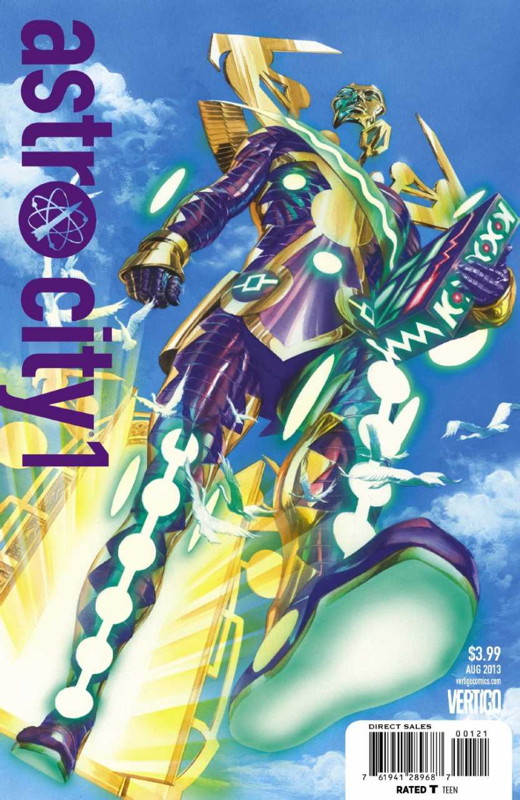
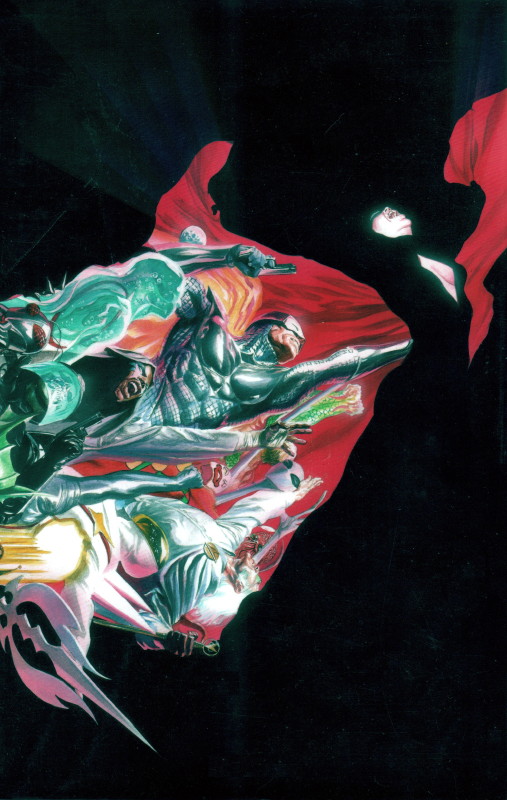
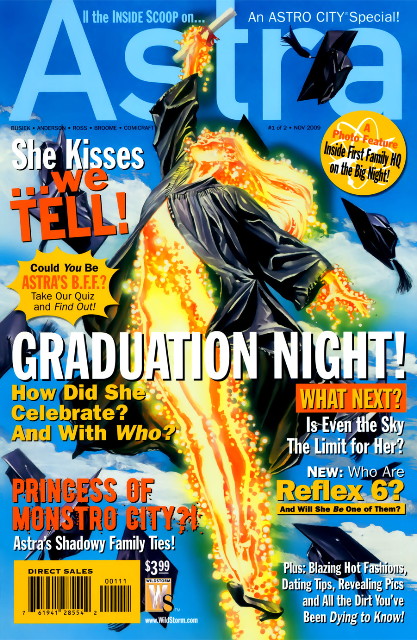
Astro City: The Dark Age book 1 HC On the bright side, the week did deliver the hardcover collection of Astro City: The Dark Age book 1, collecting the first half of this longest of Astro City stories.

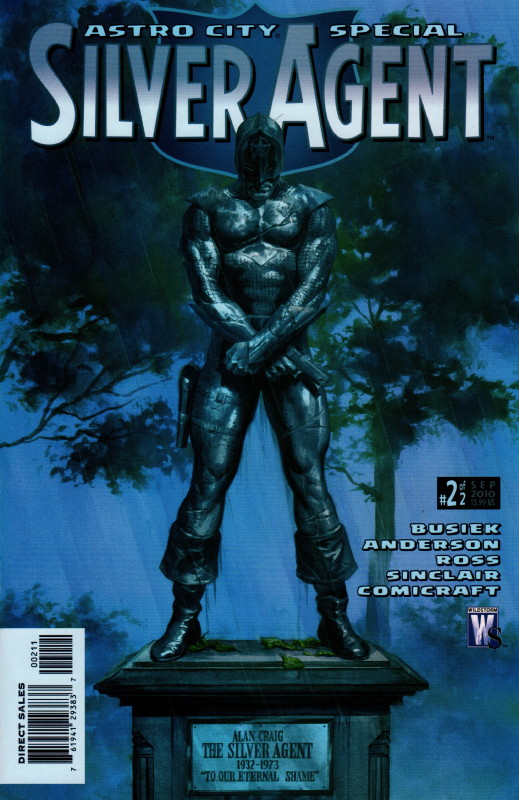
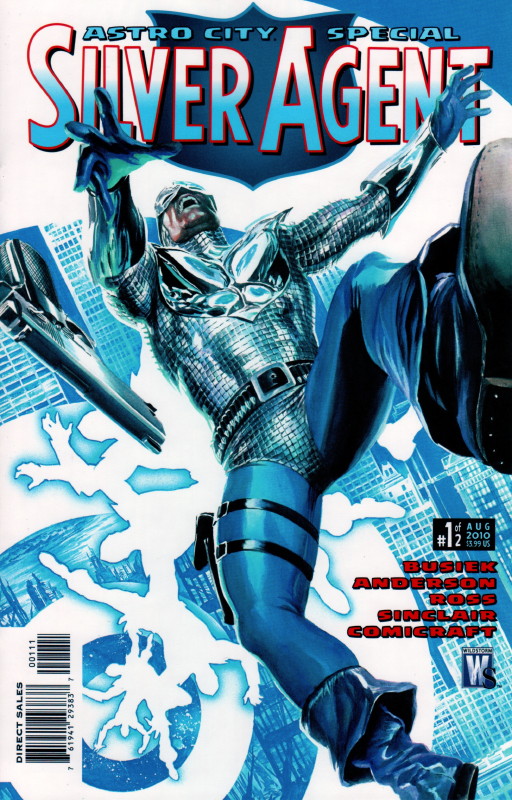
I won’t go into detail about what Astro City is about (after all, you can read about it yourself), but as for this volume: The story covers the 1970s, a period of Astro City largely skipped over by earlier stories, except for the hint of the hero the Silver Agent, a sort of Captain America figure who is featured on a monument in the city dedicated to “our eternal shame”. This story fills in some of the blanks in the Agent’s story, while raising new questions.

The prologue takes place in 1959, when the brothers Charles and Royal Williams witness a fight between the Honor Guard (Astro City’s equivalent of the Justice League or Avengers) and a crop of villains. We later learn that disaster befell the Williams family that evening. Jumping forward to 1972, Charles has become a cop who’s suspicious of the heroes, while Royal has become a small-time crook, and the two have a strained relationship. The book is nominally their story, although there’s so much more going on that they simply get more pages than any other set of characters, plus they narrate the tale, but it’s not entirely their story. They follow the tragedy which befalls the Silver Agent, and Charles gets wrapped up in a police corruption ring while Royal hooks up with one of the city’s crime lords. The second half of the volume grows increasingly complex with threats to the city and the world, mysterious figures pursuing strange agendas, and the big mystery of the Agent. This volume ends in 1977, and the second volume will likely cover the next 5 years.

Astro City has long been a favorite of mine, and it’s fair to say I think it’s the best superhero comic of the last 15 years. But The Dark Age isn’t the book at its best. There’s too much going on, and with tantalizing glimpses of neat stuff going on, but not a feel of a whole lot of progress. A big part of the problem is that neither of the Williams brothers are very compelling as characters, certainly nowhere near the protagonists of the two earlier long-form stories, Confession (my favorite volume in the series) or The Tarnished Angel. They’re realistic and sympathetic, but the story goes for scale and intricacy rather than depth and character, and that doesn’t play to the series’ strength. Indeed, the series has often used the feeling of scale and depth of “real” superhero stories as a mere springboard for a moving character piece, so turning the series’ formula on its head just makes it feel a little less special. And the intricacy probably makes it a lot less accessible to new readers.

All that said, there’s still a lot here to delight the regular readers of Astro City, as mysteries of the city’s past are brought to light. And the book reads much better in a single shot than as a serial, especially given how slowly the series has come out in recent years. Brent Anderson’s art is stylish and dynamic as always, chock-full of fun character designs and settings (by Anderson and Alex Ross) and a terrific coloring job.

I guess The Dark Age is only disappointing by comparison with earlier Astro City volumes, which frankly were often just plain amazing. It’s still pretty good and rewards re-reading. And as this is only the first half of the story, I have to allow for the chance that there will be a great payoff to all this set-up in the end. Meanwhile, this is all we’ve got, and with the series’ erratic schedule we can’t know when we’ll see the next set of issues in the series.

Hopefully it won’t be too long.

This Week’s Haul

  • Booster Gold #0, by Geoff Johns, Jeff Katz, Dan Jurgens & Norm Rapmund (DC)
  • Countdown to Final Crisis #11 of 52 (backwards), by Paul Dini, Justin Gray, Jimmy Palmiotti, Keith Giffen, Mike Norton & Mark McKenna (DC)
  • Salvation Run #4 of 7, by Matthew Sturges, Sean Chen & Walden Wong (DC)
  • Suicide Squad: Raise the Flag #6 of 8, by John Ostrander, Javier Pina & Robin Riggs (DC)
  • Astro City Special: Beautie, by Kurt Busiek, Brent Anderson & Alex Ross (DC/Wildstorm)
  • Nova Annual #1, by Dan Abnett, Andy Lanning, Mahmud A. Asrar, Klebs, Wellington Alves, Juan Vlasco & Nelson Pereira (Marvel)
  • B.P.R.D.: 1946 #2 of 5, by Mike Mignola, Joshua Dysart & Paul Azaceta (Dark Horse)
  • Atomic Robo #5 of 6, by Brian Clevinger, Scott Wegener, & Christian Ward (Red 5)
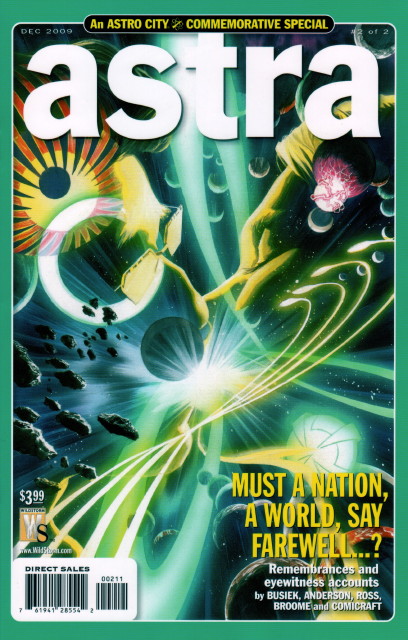
Astro City Special: Beautie I’ve felt for a long time that Kurt Busiek’s Astro City is the best comic book of the last 15 years, and it’s not even particularly close. Despite its erratic publishing schedule (for which there are good reasons, I understand), this chronicle of the heroes and ordinary citizens of the fictional city full of superbeings is always great human drama. Right now we’re in the middle of the 12-issue series The Dark Age, which is being told in 3 short series, each with an unrelated special between them. Beautie is the second such special, and it’s a great one.

Beautie is a member of the Honor Guard, the foremost group of superheroes in the Astro City world. What she is is a life-sized Barbie doll with super powers - really. She’s actually a robot, who mimics human form but has some frustrating limitations, and not just her problems relating to humans. She also has no memory of where she came from or why she exists, or why there are no others like her, or for that matter why she resembles a Barbie doll (which in the Astro City world is called a Beautie doll). This is the story of her quest to find out who she is, and what happens when she does.

After a fashion, this is the story of a character like Star Trek’s Data compressed into a single issue, and rendered more realistically: Beautie not only has Data’s emotional hang-ups, she also has physical problems which prevent her from blending in. And not only is she frustrated by her limitations, she’s also not quite sure how to truly react to being frustrated. It’s a satisfying tale both emotionally and in its depth, with a little twist before the story’s climax revolving around the fact that Beautie is an android.

This would be a good issue to introduce new readers to Astro City, as I think it embodies many of the best elements of the series. And it’s another fine entry into the ongoing series, which should make longtime readers happy. I know it did me.

Nova Annual #1 So once upon a time I used to sort each week’s comics alphabetically and read them in that order, which I know provoked a snarky comment from my Dad on occasion. These days I still sort them, but in the order I most want to read them. You can’t take all of the OCD out of the boy, it seems. Anyway, in any other week I would have put Astro City on top of this week’s stack, but this week I ended up reading Nova Annual first, since it’s one of my favorite comics and I thought it would be the conclusion of the current Phalanx story.

I was mistaken, it’s not the conclusion, but it was still a good read.

Rather than wrapping up the story, it instead featured Nova remembering his origin, when he was first recruited into the Nova corps, and also thinking forward to later in life when the restored Nova corps will fight the final battle against the Phalanx, who have completely taken over the Earth. It’s likely that the latter story was simply in Nova’s imagination, but it was still pretty chilling.

In a way this issue is a throwback to Marvel annuals of old, revisiting the hero’s origin, while throwing in some extra stuff on the side. It also explains one of the underlying principles of the Nova corps - they’re not the best and brightest, they’re average citizens empowered to do extraordinary things. It’s a good issue, and makes me wish anew that Nova hadn’t been largely excluded from the Phalanx storyline in Armageddon Conquest. But hopefully he’ll get his own satisfying conclusion when the current storyline ends.

This Week’s Haul

  • Countdown #31 of 52 (backwards), by Paul Dini, Sean McKeever, Keith Giffen, Manuel Garcia & Rodney Ramos (DC)
  • Countdown to Adventure #2 of 8, by Adam Beechen, Eddy Barrow & Julio Ferreira, and Justin Gray, Travis Moore & Saleem Crawford (DC)
  • Supergirl and the Legion of Super-Heroes #34, by Tony Bedard & Dennis Calero (DC)
  • Astro City: The Dark Age vol 2 #4, by Kurt Busiek, Brent Anderson, & Alex Ross (DC/Wildstorm)
  • Annihilation Conquest: Starlord #3 of 4, by Keith Giffen, Timothy Green II, & Victor Olazaba (Marvel)
  • Girl Genius: Agatha Heterodyne and the Golden Trilobite HC vol 6, by Phil & Kaja Foglio (Airship)
  • The Boys: The Name of the Game vol 1 TPB, by Garth Ennis & Darick Robertson (Dynamite)
  • Boneyard #26, by Richard Moore (NBM)

Astro City: The Dark Age vol 2 #4Wow, the last issue of Astro City came out back in April. I know there are many good reasons why it comes out so slowly, but it’s still frustrating considering this is one of the best comic book series ever published. This is a pretty good issue where the stuff hits the fan for our protagonists, the Williams brothers, as well as suggesting what the scoop with the Silver Agent is. One more special is up next, and then the third and final mini-series to conclude The Dark Age Can’t wait! I hope they can get it all out in the next year.


Girl Genius vol 6Speaking of excellent comics, I finally got my copy of volume 6 of Girl Genius. This is a hefty volume concluding Agatha Heterodyne’s adventures in Sturmhalten, including the truth about her mother, Lucretia Mongfish, the plans her mother left behind after she disappeared: Specifically, the plan to return her consciousness to life in the body of her daughter.

Unfortunately, though there’s a lot to like here, the story is both padded and confusing. Most of the padding is in the form of Agatha’s allies who spend much of the book wandering around in the sewers of Sturmhalten, an expedition which is sometimes amusing, but which does absolutely nothing to move the story forward. Most of the confusion comes in trying to figure out when we’re watching Agatha and when we’re watching Lucretia, and in trying to figure out exactly who did what, and why. The motivations here are slippery things, and I think the Foglios overextended themselves in trying to be too clever with what amounted to the mechanical aspects of the plot. I think I finally got it all figured out, but it shouldn’t have been this hard.

Those frustrations aside, the book is still tremendously entertaining, very funny, and full of action, adventure, and things blowing up real good. And the secrets of Agatha’s family history are slowly emerging, although - again - the issue of motivation is central to the goings-on, and it’s not at all clear to me what exactly happened in the war against The Other all those years ago. Are the revelations herein supposed to be taken at face value, or is it all a blind for something deeper? That’s the problem with a story that has games-within-games, you can never tell when you’ve reached the center, and that can be really annoying. Eventually the Foglios are going to have to make it absolutely clear in the story that “this is what happened, and there are no more secrets to be revealed”. I hope that’s where this is all going.

(I had a similar problem with Babylon 5: When it was revealed what the Shadows and the Vorlons were really up to, my reaction was, “Nah, that’s silly! It’s gotta be a blind for their real motivations. But in fact, silly or not, that was it. But directions had reversed so many times that it was hard to believe.)


The Boys vol 1The Boys didn’t really registered on my consciousness until the controversial decision by DC to cancel it from its Wildstorm line, resulting in the book moving to Dynamite. While I’ve enjoyed Darick Robertson’s artwork in various places, I’ve not read much by Garth Ennis, who is probably best known for his series Preacher, which, well, I haven’t read. However, the brouhaha and a flip-through in the store made me decide to pick up the trade paperback, which collects the first 6 issues.

The first three words that come to mind about this book are not for children. This is a grim, edgy, extremely violent, and often gratuitous story about a world in which superheroes are real, and their fights and whims take a huge toll on normal humans. Ennis doesn’t shy away from just about anything he can imagine super-powered people would do with their powers, and Robertson illustrates it in graphic detail. So if any of that is the sort of thing you wouldn’t be able to appreciate, then The Boys is not for you.

“The Boys” themselves are five people who work as a covert team to put the fear of god into superbeings, through threats, blackmail, and sheer force. Needless to say, some of them are powered themselves. Their leader, Billy Butcher, is assembling the team anew after it having disbanded some time previously, and he recruits three of his old mates as well as a new recruit, Wee Hughie, to start executing his plans. His first target is an out-of-control teen group of superheroes. Even as Hughie is getting his first taste of working with the Boys, a charming midwestern superheroine named Starlight is recruited to join the Seven, the country’s premier super-team (with the usual analogues to members of the Justice League), who learns that playing with the big boys isn’t at all what she’d expected.

The Boys reminds me strongly of Grant Morrison’s The Invisibles, not just in its approach of an undercover team fighting the forces which dominate the world, but in giving the story an “everyman” point of view: The story (almost) opens with Hughie seeing the woman he lives brutally killed during a fight between two superbeings, much as Jack Frost is the young ne’er-do-well who joins the Invisibles. Ennis is more deft at characterization than Morrison is, but then, Morrison had bigger fish to fry than following Jack through the series, while The Boys is fundamentally very much about the perceptions and reactions of the characters.

It’s probably inevitable that The Boys also be compared to Warren Ellis’ Transmetropolitan, as both books take place in which certain trands have resulted in a seriously damaged world in which our heroes (who are anti-heroes in both instances) operate, plus of course they’re both drawn by Robertson. Robertson’s artwork has advanced considerably since Transmet; it no longer feels like that of a darker Shawn McManus, it feels more realistic and more expressive, especially in his faces. I don’t think this book would have worked with anything less.

Does it work? Well yes, it does. As I said, there are many gratuitous elements: Nudity, sex, drug use, violence, which often don’t contribute directly to the story but serve merely as a backdrop. But every so often Ennis drops in that one “whoa, holy shit” moment which demonstrates that the book isn’t all about sex-and-violence, but that there are really things worth fighting for in this comic. The panoramic view of New York City part-way through was the moment that I realized the book is being serious. As I said, if you can’t get past the less-important moments, or if seeing horrible things done to good people with little immediate hope of justice being done is something you can’t stand, then this book is not for you.

Contrasting The Boys with Warren Ellis’ major works is I think most worthwhile: Ellis’ stories are, fundamentally, about people pursuing the right ends for the right reasons. His stories really are about heroes, although those heroes sometimes use questionable means to achieve their goals, but they are usually reluctant to do so, or feel that they’ve been backed into a corner and have no other choice. The Boys are about people pursuing the right ends, but maybe not for the right reasons, and certainly not choosing very clean ways of going about it. Both Butcher and Hughie have a revenge motive, and also a motive to keep what happened to their loved ones from happening to anyone else. (The motives of the other Boys are so far unknown.) And their frank vigilanteism (even if tacitly supported by shady arms of the government) is not exactly admirable. But I think the point of the story is to see how far these characters can be pushed in a decidedly hostile environment, and the story in this volume is the set-up for what comes next.

Am I thrilled to be reading this book? Well, it was pretty interesting, and a little nauseating at the same time. But also compelling. I definitely think there’s a lot of promise here, and I’m going to pick up the issues that Dynamite has published since.

If you’ve been waiting for the superhero equivalent of Transmetropolitan, then The Boys may be the book for you.

This Week’s Haul

  • 52 #51 of 52 (DC)
  • Justice #11 of 12, by Alex Ross, Jim Krueger & Doug Braithwaite (DC)
  • Justice Society of America #5, by Geoff Johns & Fernando Pasarin (DC)
  • Supergirl & The Legion of Super-Heroes: Adult Education vol 4 TPB, by Mark Waid & Barry Kitson (DC)
  • Wonder Woman #8, by Jodi Pilcoult, Terry Dodson & Rachel Dodson (DC)
  • Astro City: The Dark Age vol 2, #3 of 4, by Kurt Busiek, Brent Anderson & Alex Ross (DC/Wildstorm)
  • Red Menace #6 of 6, by Danny Bilson, Pal DeMeo, Adam Brody, Jerry Ordway & Al Vey (DC/Wildstorm)
  • Castle Waiting #6, by Linda Medley (Fantagraphics)
  • The Professor’s Daughter TPB, by Joann Sfar & Emmanuel Guibert (First Second)

Okay, I admit it, I’m enjoying “The Lightning Saga”, part 2 of which appears in this month’s JSA. Mainly because it’s a kooky old-style Legion of Super-Heroes geekfest, especially the two-page spread of statues of the original Legion, mostly in their classic costumes. I have no idea what’s going on in this story (especially why speaking Lightning Lad’s name in Interlac seems to return the Legionnaires to their right minds), and I really don’t care how or if they reconcile this with current LSH continuity, it’s just entertaining. (The Interlac title of this chapter is “Dreams and Fire”.)

Speaking of the Legion, the fourth volume of Supergirl & the Legion of Super-Heroes is as entertaining as the first three. I think it’s the best of the various reboots and re-imaginings of the series over the last 20 years (dating back to Giffen’s “Five Years Later” series). The characters are vivid and entertaining, the stories are novel, and Waid (no surprise here) has a respect for the series’ history which makes the whole thing even more palatable to old-time readers, while being no less fun for new readers. I’m still not a big fan of Barry Kitson’s artwork, but it works well enough, and I do like his character designs.

(I guess Waid and Kitson have left the ongoing series early this year; I hope the new team carries the torch as honorably.)

The new issue of Wonder Woman resurrects Diana’s mother Hippolyta, who was killed in a crossover event a few years ago. While this makes Kalinara happy, bringing back dead characters has been an outright cliché in comics for at least 20 years, maybe 30, so it makes me just roll my eyes. Hippolyta isn’t a particularly significant charactre, and I don’t really care whether she stays dead or not, but her return undercuts any storylines which she factors into, including the Amazons Attack! event, which launches in a month or less (and which I can tell you I care about not at all).

I haven’t been a fan of Jodi Picoult’s run on WW, but this mess isn’t her fault (I presume it’s all about DC defending its trademark on this minor character). It is, however, another nail in the coffin of this series.

While I confess I’m such a fan of Astro City that it would take a long time for my goodwill towards the series to erode, I will also confess that “The Dark Age” has been rather slow and unfocused. That said, vol. 2 #3 appears to be a turning point for the series, with the lives of our ordinary characters Charles and Royal reaching a tipping point, and one of the mysteries from the first volume rearing its head. Next issue should be the climax of the second act, and I’m hoping it will be a terrific set-up for the third act.

Red Menace wraps up as an entertaining period piece, but unfortunately nothing more. It feels all-too-isolated, without any deeper meanings to give it weight either historically or as a character drama. Lovely artwork by Ordway, I wish he would hitch his horse to a project that would do for him what Watchmen did for Dave Gibbons. Of course, perhaps such things are largely luck.

The Professor’s Daughter is a little graphic novel about the Pharoah Imhotep IV, who is revived in the present day as a mummy and falls in love with the daughter of the professor who found him. It’s a cute little romance, although not very substantial. The way it wantonly disregards plausible reactions of the general public to Imhotep makes for some amusing scenarios. It feels like it could have been more than it is, but I enjoyed it anyway. Guilbert’s artwork is simple but dynamic and expressive, similar in style to Tim Sale, but with more realistic faces.

This Week’s Haul

  • 52 #40 of 52 (DC)

    The long-running Luthor/Steel/Infinity Inc. storyline apparently comes to a conclusion here. Oddly, it seems entirely disconnected from the rest of the series’ storylines, so either there’s something else going on, or not everything is connected. The latter would be kind of lame, I think.

  • Justice Society vol. 2 TPB (DC)

    The completion of the reprint of All-Star Comics from the 1970s. This was and still is one of my all-time favorite superhero series (starring the Justice Society of America). Although in some ways too blunt and not very sophisticated, this was the seminal series exploring relationships between multiple generations of heroes, and was one of the first series to consider that heroes will eventually retire. A lot of series in the decades since owe a lot to the ground this series covered. If it has a downside, it’s that Joe Staton’s pencils in this volume (following the Wally Wood-dominated first half) seems a little too cartoony and simplistic. It’s still a fun read, though.

  • Astro City: The Dark Age Book Two #2 of 4 (DC/Wildstorm)

    The halfway point in this lengthy series (which will consist of three 4-issue series), it’s running a little late. I’m starting to wonder where Kurt Busiek is going with this particular story; although it focuses on the pair of brothers - one a crook, one a cop - and their lives in the 1970s, there’s a lot more that I hope gets resolved here. I think it will end up being either very ambitious, or rather scattered. But based on the series’ track record in the past, I’ll hope for the former.

  • Fantastic Four: The End #5 of 6 (Marvel)
  • The Incredible Hulk #92-95 (Marvel)

    I’ve heard good things about the “Planet Hulk” storyline which begins with these issues, so I decided to pick them up. (They’re about a year old now, so I have some catching up to do.) The Hulk is exiled by other heroes to a peaceful but uninhabited world, but something goes wrong and he lands on a barbaric world with a variety of creatures, and is captured and turned into a gladiator. But clearly as he regains the strength he lost from his journey, he’s going to become a player.

    It’s not a terribly subtle story, but writer Greg Pak keeps his eyes on the prize: The Hulk is entirely self-absorbed, doesn’t trust anyone, but isn’t (any longer) a fool, either. Which makes him a very dangerous contestant who’s not willing to play by anyones rules. (This also explains why the Hulk isn’t taking part in the Civil War “event”.)

    So this seems like a promising beginning to what they say will be a 14-issue story. I suspect it will have the usual disappointment in that eventually the Hulk will have to return to Earth and leave behind anything he’s gained on this other world. But that’s the downside to ongoing series.

  • Ms. Marvel #12 (Marvel)

    The first year of this series has been extremely haphazard, in large part because the Civil War disrupted it a great deal. Writer Brian Reed says in the letter column here that the second year will take the series in a different direction, as our heroine comes to grips with the less-than-ideal conclusions of some of her battles. I’d be happy if it just becomes a more cohesive series with more direction.

  • newuniversal #3 (Marvel)
  • Dr. Blink: Superhero Shrink: Id. Ego. Superego! vol. 1 TPB (Dork Storm)

    This is a collection of the very funny superhero satire by John Kovalic (Dork Tower) and Christopher Jones. Kovalic leaves no turn unstoned among the mainstream heroes, with both obvious and subtle humor worked in. Jones’ artwork straddles the line between dynamic and cartoony, and although it’s not stellar, it has some fine moments. (It’s reminiscent of Michael Avon Oeming’s work on Powers, actually.) The book is dedicated by Bob Newhart and Kurt Busiek, and it certainly feels like a twisted reflection of Busiek’s Astro City.

    The collection features a mix of 2-pagers (or thereabouts) and a few long-form stories; the latter are by far the more successful, as the short gags get a little repetitive after a while. But it’s still a fun little package, and it’s in color, yet! I’ll certainly be on board for the second collection.

This Week’s Haul

  • Aquaman: Sword of Atlantis #45 (DC)
  • 52 #28 of 52 (DC)
  • Astro City: The Dark Age Book Two #1 of 4 (DC/Wildstorm)
  • Ms. Marvel #9 (Marvel)
  • New Avengers #25 (Marvel)
  • Girls Volume 3: “Survival” (Image)
  • Jack Staff #12 (Image)

Every few years, DC launches another title featuring Aquaman. I think this has been going on since I was in high school (1986), when the pretty nifty Neal Pozner/Craig Hamilton mini-series came out. People gripe about how Aquaman is a lame or contrived character, but DC keeps marketing him, and several of his series have lasted for anywhere from 4 to 7 years, which is a fair sight better than a lot of series last. So there’s some attraction there. The current series is written by Kurt Busiek - a contender for the title of best active comics writer - and illustrated by Butch Guice. The original Aquaman has disappeared, and a young man with the same name and powers has appeared in his place, reluctant to take up the mantle. The story is rather slow, but there’s some interesting intrigue there, and this issue reveals (more or less) that identity of one of the supporting characters, which I had figured out a few issues ago. I understand the series isn’t selling so well, but I’m hoping it will last long enough to wrap up Busiek’s story arc.

And then they can launch the series again, with another creative team. Hey, it’s worked before, right?

Astro City is, in my humble opinion, the best comic book being published today. It’s the best comic of the last ten years, for that matter. Written by Busiek (him again?) and illustrated by Brent Anderson with designs and covers by Alex Ross, it takes place in a superhero-laden universe of Busiek’s concoction, but the stories focus on the characters and their thoughts about and reactions to living in such a world.

The current series is a 12-issue story being told in 3 4-issue “books”, and it takes place during the 1970s, the “dark age” for Astro City’s world. The protagonists are a pair of brothers, Charles and Royals Williams, whose parents were killed in the crossfire of a superhero battle when they were kids. Charles grew up to become a cop, while Royal became a small-time criminal. In the first volume they’ve lived through the conviction for murder of one of the city’s greatest heroes, becomes estranged along the way. Now they’re apparently going to get caught up in an escalating war among the underworld. It’s great stuff, don’t miss it.

Girls is a series by the Luna brothers, who seem to have emerged fully-grown on the comics scene a few years ago. This is the third collection of their current series (volumes one and two are also available), which will reportedly run 4 volumes (24 issues).

Girls does feature a bunch of naked women, but it’s really a straight-up horror story: The small town of Pennystown consists of a small population of people living fairly sleepy lives. One bad evening, a young man named Ethan meets a mystery woman on the road and takes her home. It turns out she has a whole bunch of clone sisters, all of whom seem intent on killing the women of the town, and who are under the control of a mystery entity elsewhere in the town, an entity which has also closed the town off from the outside world.

The series is brutal and graphic, uncompromising in its tension, and it also puts its ideosyncratic characters through the wringer as they try to figure out whether they can trust each other, and get on each other’s skin when put under pressure. The art consists of simple line drawings with very little rendering and plain backgrounds, but on the other hand the characters (other than the Girls) are all distinct and hardly idealized, with a good range of facial expressions. It’s pretty good, but definitely not for everyone. It’s certainly enough of a page-turner to keep me interested in reading volume four.