This Week’s Haul

Hey, it’s the 100th edition of This Week’s Haul! I missed a week here and there (usually due to being away on vacation), but I have been keeping this up for nearly two years – yay me!

  • Booster Gold #12, by Chuck Dixon, Dan Jurgens & Norm Rapmund (DC)
  • Ex Machina #38, by Brian K. Vaughan, Tony Harris & Jim Clark (DC/Wildstorm)
  • The Immortal Iron Fist: The Seven Capital Cities of Heaven vol 2 TPB, by Matt Fraction, Ed Brubaker, David Aja, Tonci Zonjic & others (Marvel)
  • The Immortal Iron First: Orson Randall and the Green Mist of Death one-shot, by Matt Fraction, Nick Dragotta, Mike Allred, Laura Allred, Russ Heath, Lewis LaRosa, Stefano Gaudiano, Matt Hollingsworth & Mitch Breitwiser (Marvel)
  • The Immortal Iron Fist #15, by Matt Fraction, Khari Evans & Victor Olazaba (Marvel)
  • The Immortal Iron Fist #16, by Matt Fraction, David Aja & Matt Hollingsworth (Marvel)
  • The Immortal Iron Fist #17, by Duane Swierczynski, Travel Foreman & Russ Heath (Marvel)
  • The Immortal Iron Fist #18, by Duane Swierczynski, Travel Foreman & Russ Heath (Marvel)
  • B.P.R.D.: The Warning #3 of 5, by Mike Mignola, John Arcudi & Guy Davis (Dark Horse)
  • Invincible #52, by Robert Kirkman & Ryan Ottley (Image)
The Immortal Iron Fist: The Seven Capital Cities of Heaven vol 2 TPB Last week I read the first volume of The Immortal Iron Fist, and I enjoyed it enough that this week I picked up the second volume, and all of the issues published after that to get caught up on the series. (Boy, remember the days when you’d discover a new series and spend the next two years trying to buy all the earlier issues to get caught up on what had happened? Now you just buy a couple of trade paperbacks and the last few months’ worth of issues and there you go. Ain’t progress great?)

I had some reservations about the first volume, and I’m happy to say that the second volume, The Seven Capital Cities of Heaven is much better all around. The story has two threads:

  1. It tells the story of Daniel Rand’s father Wendell who years ago went through the same trials as Danny did to become the Iron Fist, a quest which cost him the friendship of his best friend Davos, and also showed him to be tortured by his relationship with the previous Iron Fist, Orson Randall, who may or may not have been Wendell’s father.
  2. In the present day, Danny is summoned to the otherdimensional city of K’un Lun, where he became Iron Fist, to fight in a tournament against the immortal champions of six other cities – including Davos, who is now the champion of another city. While doing so, he also learns that there’s a plot afoot from Earth to reach and destroy the city. In trying to stop this plot while not appearing derelict in his duties in the tournament, Danny learns that his predecessors have left some interesting secrets around the city which have some interesting uses.

There’s a lot of good stuff in here: Danny seems less like a naive rookie (one of the biggest problems I had with the first book) and more like a fairly worldly guy who’s just out of his element and being kept off-balance by a variety of challenges that are just not what he’s used to dealing with. Despite being a martial arts master and having spent his teen years in K’un Lun, Danny has always been more of Earth than of that city, so feeling out-of-place during the tournament makes sense.

The stories of Orson Randall and Wendell Rand are both very well done. Randall is the Iron Fist who managed to escape his destiny, and he’s obviously shaping the series despite the fact that he’s no longer among the living. Wendell Rand’s contribution is of having brought Danny to K’un Lun (before meeting his own untimely end) and of having turned Davos into an enemy. Davos’ father is Lei Kung the Thunderer, the mentor to the Iron Fists. The humanizing of this figure is one of the book’s greatest strengths: He’s a hero in his own right, but his uneasy relationship with his son makes him seem more vulnerable. Davos is maybe the most interesting character in the book, having become much more nuanced than his one-note villainous persona in the early Iron Fist stories of the 70s.

The volume has a nifty showdown between all sides with a lot of good action and satisfying resolutions, as well as setting up some potential storylines for the following issues. Well worth a read.

(By the way, the flashback sequences featuring Orson Randall are based on the style of 30s and 40s pulp adventures. In addition to the contrast in styles, there’s an issue where Danny meets with Orson’s former associates, who are now elderly people, and that sequence is drawn by Howard Chaykin, who produced The Shadow: Blood and Judgment mini-series in the 1980s, which similarly portrayed the former associates of the Shadow encountering him again in the present day. A nice little in-joke.)

Following this story, it looks like Brubaker, Fraction and Aja left the title, and that writer Duane Swierczynski and artist Travel Foreman are the new creators (with Russ Heath illustrating the scenes taking place in the past). After a last story by Fraction, the new story starts like this: On the eve of his 33rd birthday, Danny learns that every previous Iron Fist – save for Orson Randall – died at the age of 33. Issue #18 starts with one of those annoying “flash-forwards” to the future where one of the characters is reminiscing about how Iron Fist died; it’s a gimmick which is going to be cheesy at best, because Fist can’t really die and make a satisfying story, but having him live is going to feel like a cheat. I’d rather the story stayed in the present (and past) to show how Danny cheats his presumptive fate. But other than that it’s off to a rather gripping start, with Fist facing an enemy that’s too much for him and relying on his friends to bail him out. The presence of the other immortal weapons hasn’t been forgotten, so this could shape up to be quite a fight.

The series overall is based around the themes of responsibility and destiny, and about the degree to which the Iron Fists meet both standards. It’s got some flaws, but it’s still enjoyable. The series sales seem to be fairly stable, so hopefully it’ll be around for a while.

Superheroes and Science Fiction

Sometimes in the blogosphere you come across a thoughtful, passionate piece which reads like a manifesto, or at least a clear statement of The Way Things Are in the worldview of the writer – and the worldview is so at odds with your own that you just have to respond.

Other times, you write such a response, and then let it sit in your Drafts folder for several months until you finally think, “Hey, I should finish that off and post it…” As you might guess, this post is one of these.

A while back, Comics Should Be Good linked to a pair of articles written by ‘amypoodle’ at Mindless Ones about superhero comics as “soft” science fiction. It’s interesting stuff, but I knew I was going to have trouble with it from the word go, indeed from the beginning of the first post, “Candyfloss Horizons”:

For those unaware of the distinction between hard and soft sci-fi, the former spends its time postulating imaginary futures that unfold out of pre-existing science/theory, whereas the latter jettisons notions of the possible, concerning itself with the imaginary part of the equation. In its most basic form, it deals with the psychological and sociolological impact of tomorrow – the soft sciences – but at its logical extremes it details societies, internal states and/or technologies beyond comprehension, whose function and form defy simple explanation.

When I first read this article, I wondered if she was just trying to tweak fans of hard science fiction, but I don’t think so. I think she genuinely saw hard SF as limited and bland, wrapped up in explaining the nuts-and-bolts of how its ideas worked, while soft SF was more far-ranging, less restrictive. And this is, well, very far from my own thinking.

Now, defining “science fiction” has always been something of a losing battle – sort of the Godwin’s Law of literary semantics – so defining those sub-terms isn’t likely to get you very far, either, though that rarely stops people from trying: You can go read the Wikipedia entries on hard SF and soft SF. And like any good genre fan, I’m always happy to chip in my two cents.

I think that hard science fiction is where the imagination is, extrapolating from current knowledge and trends or just positing a wild idea and running with that to craft a fully-realized world (or at least a rich-if-narrow slice of one) and exploring the implications of the story’s premise. Certainly there’s plenty of hard SF which is mainly concerned with the scientific implications of the ideas, but on the other hand quite a few writers use the ideas as a springboard for a coherent story, or explore the sociological or psychological implications of the ideas. Hard SF certainly doesn’t stick to existing science and theory, as Vernor Vinge’s works often illustrate; one of the preeminent hard SF writers around, his novels The Peace War and A Fire Upon The Deep rather blatantly introduce concepts created out of whole cloth (‘Bobbles’ and ‘Zones of Thought’, respectively) and build their stories around them, spending time exploring what the ideas mean without worrying much about how they work. Charles Stross’ Glasshouse is another hard SF novel which closely examines the social implications of its premise. Vinge and Stross, among others (Alastair Reynolds, Karl Schroder, et. al.), have done a lot to define hard SF over the last decade or two, and I don’t think it fits in the box that Amypoodle describes for it.

By contrast, I mainly think of soft science fiction as referring to stories which contain only the trappings of science fiction, which in which the scientific – or pseudo-scientific – elements are either just part of the background or not treated very seriously, and which don’t really concern themselves with plumbing the depths of the implications of their ideas content. Often they’re re-using tried-and-true SF ideas and routine ways, using them as a setting rather than as a key element in the story. Nearly every science fiction TV show is soft SF, I can’t offhand think of one that isn’t. Certainly both Star Trek and Babylon 5 were. I’d also classify Lois McMaster Bujold’s Miles Vorkosigan series as soft SF, as well as Jack McDevitt’s novels. McDevitt’s books come closer to being hard SF, but for the most part they’re employing well-worn science fictional ideas in the service of his particular stories, rather than breaking new ground or putting the ideas front-and-center.

The core difference, I think, is that hard SF presents the fantastic ideas content as a worthwhile and intellectual challenging component of the story in itself, whereas soft SF does not. But this certainly doesn’t mean that hard SF restricts itself to only dealing with the ideas content, although this is true of some hard SF.

So I think Amypoodle goes off in the wrong direction from the beginning, and this is made even more clear in her follow-up post, which is primarily about Grant Morrison’s comics writing. Its basic idea is summed up near the end:

Soft SF ram-raids and runs with the optimism embedded in the earliest victorian science fiction and brings it slap-bang up to date. It’s hard SF’s 20th century counterpart. Its evolution. Recent hard SF seems so wanky in comparison, what with its fetishistic obsession with the operating manual and what lies beneath the pants of the futuristic societies it slavers over. It also feels terribly stuffy and conservative. Vanilla. ‘Nothing will essentially change’, Star Trek, Stargate and the rest of the drivel explain, ‘but we will have faster aeroplanes that move about in outer-space’. Well, bollocks to that. Do you think anything will be recognizable a million years from now, if we survive that long? I don’t. Least of all ourselves. And as for the stories that inform our new world? Grant and a few others are intuiting them now. They’re showing us what might be – charting the candyfloss horizon.

This paragraph seems completely at odds with the reality of hard SF today. She groups Star Trek and Stargate with hard SF (huh?), accuses recent hard SF of being primarily interested in “the operating manual” (wha?), and her article comes across as unaware of the burgeoning interest in hard SF in the technological singularity which is strongly concerned with the notion that not only is everything going to change in ways we can barely even imagine, but that the big change could be coming sooner than we think.

Using Grant Morrison as an example of how superhero comics are soft SF seems a weird choice, since the style of Morrison’s books has a lot more in common in hard SF than with soft. My perception of Morrison has always been as an ideas man; he has on-the-edge ideas (well, for comic books, anyway) in seemingly endless supply (putting aside the dreary Final Crisis). Where Morrison diverges from hard SF is in the depth of his stories: Unlike someone like Vernor Vinge – another terrific ideasmith – Morrison rarely explores the implications of his ideas in depth; rather, after a cursory examination of an idea (mainly to exploit its “coolness factor”) he moves on to the next idea. Occasionally an idea undergoes successive refinement, usually because a character which embodies that idea sticks around long enough that a further extension of his abilities has time to come to light, but then, this is pretty much how superhero comics have always worked; that’s why the Flash, for instance, ends up with some nifty new talents every few years, as a new writer figures out what else having inhuman speed and reflexes is good for.

To be sure, the lack of depth is partly due to the superhero genre, which has long catered towards style over substance, and takes advantage of the short attention span that most of its audience (hard-core fanboys excepted) seems to have. Morrison has made two significant stabs at dealing with his ideas at greater length and depth, in The Invisibles and Seven Soldiers. The former has flashes of true brilliance, but the good stuff in the middle was bookended by muddled storytelling at either end. The latter was a tasty melange of mostly-preexisting ideas, but its very structure of seven separate characters with their own storylines worked against providing the payoff of real depth that it seemed to desire. (It also fell prey to Morrison’s essential weakness: His characterizations tend to be exceedingly flat.)

So Morrison’s writing isn’t hard science fiction because his ideas are handled relatively superficially. It isn’t soft science fiction because the ideas content is too high.

So what is it?

It’s fantasy.

And that shouldn’t come as a big revelation. After all, superhero comics spring from a fantasy heritage, whether they come from fantastic pulp adventure yarns, or are a sort of mythology for the post-industrial age. Like most fantasy, superhero comics don’t ask you to suspend your disbelief, to imagine that what you’re reading could happen, nor do they treat their ideas as a springboard for crafting a world grounded in the ramifications of those ideas. Rather, superhero comics present immensely powerful beings doing astonishing things, yet not really having a profound impact on the world; it’s still recognizably our world. Even Watchmen, despite Doctor Manhattan’s presence, is still just a few centimeters away from the world we knew when it was published.

Certainly there’s been some cross-pollination from SF over to the superhero genre, but it tends to be transient. Morrison perhaps shows more of its influence than most, but his work is still basically of the genre. Indeed, his best work, his run on JLA, embraces the genre more fully than anything else he’s written.

Superhero comics say, “Yeah, we know this isn’t real, that this could never be real, and we know that you know it too, but that doesn’t mean it’s any less cool.” But heading out to claim that comics are exploring the frontier of the imaginary somehow more seriously, less stuffily, than SF doesn’t match up with the actual books on the shelves. I love comic books – heck, every Wednesday I say “gosh I love comic books” to myself (and sometimes to others) – but forward-looking isn’t a characteristic of the genre. Morrison may inject more ideas content into his stories than most comics writers, but he still does so in a largely superficial manner (his Doom Patrol run was immensely frustrating in this way, with temptingly weird ideas which were thrown around and then discarded without deep consideration).

All of this applies equally well to another of her examples: Jack Kirby. He was a terrific ideasmith and designer of wild and wacky people, creatures and devices, but his creations were never plumbed in depth, and I don’t mean how they worked, but why they mattered. They were just big dumb objects, a term coined for science fiction but which practically defines fantasy, which is full of creatures and things and phenomena which can’t be explained and are rarely explored. They just are. (This is not to belittle Kirby, just to say that his fantastic creations drove his great adventure stories and that I think to see them as going much beyond that is to misunderstand his body of work.)

And from my perspective that’s the problem with Amypoodle’s candyfloss horizon: Like candyfloss itself, the horizon tastes real good, but it’s pure sugar and thus not very nourishing. Cool ideas are far more cool – and a lot more engaging – when they’re examined in depth for their implications and ramifications. Morrison can dazzle us with his bag of tricks when he’s on his game, but for the really chewy stories which really examine how the cool stuff affects our world, you’ll have to avoid being distracted by the candyfloss.

Cliff’s Wedding

Yesterday Debbi and I headed out to the wedding of my friend Cliff, who was marrying a Debby of his own!

I must be getting less high-strung in my old age, since putting on the monkey suit (i.e., my suit) didn’t bother me, despite having to remember how to tie a tie and doing so at the tail end of the area’s latest heat wave. And Debbi looked great in the dress she bought last month for the event. I did learn that it’s time to buy a new suit, though, as this one is showing the initial signs of being a little too old and worn (I think I bought it in 1994 to interview for jobs following grad school, so I can’t really complain).

Cliff is Jewish, so this was a traditional Jewish wedding (well, or so he told us!), which was a new experience for me. About as new as Subrata‘s Hindu wedding a few years back; heathen that I am, all of these religious wedding ceremonies are equally fresh to me, I guess. We showed up at the temple and the guests were divided into two rooms, one for the bride and one for the groom. Cliff was about as happy as I can imagine ever seeing him; he’d been looking for the right someone for a while, and has been positively brimming over with excitement over his wedding day.

This pre-ceremony event apparently traditionally involved the groom expounding on some element of the Torah – and apparently with some heckling from the gathered guests, although I’m not sure how traditional that is. Though I noticed that it was common throughout the events leading up to the ceremony that people would be laughing and joking about everything, and Cliff was certainly among those. After this, Cliff was danced (literally) over to Debby’s pre-ceremony reception (the violinist played what I presume is a traditional tune along the way, but before then he was playing “Mahna Mahna” and the theme from the Muppet Show, to much amusement of all), and we all went over for the ceremony.

Well, not quite: Before the ceremony is the signing of the marriage contract, which is apparently the majority of the legal event (under both California and Jewish law). This was somewhat less interesting for us because there wasn’t a lot going on to see or hear, and because the room was a little too small to see what events there were. But afterwards we went into the temple for the ceremony proper. And this was joyous but in a more serious sense, as ceremony typically is. One thing that struck me was that Debby circled Cliff 7 times when she walked in, and if I recall correctly (not having journalled about it at the time) Subrata circled Susan 7 times in their ceremony (or maybe it was the other way around?). I may have the particulars wrong, but the circling in both ceremonies struck me as interesting. Anyway, Debby seemed to be just was happy and enthusiastic about it all as Cliff was, and it all went quite smoothly.

The wedding reception was a couple of towns over, and we were seated with some of Cliff’s gaming friends. There were actually only two guests I knew beforehand, although there was one woman whom I recognized from the campus at work but whom I don’t know. (I don’t think she worked in Cliff’s group, so I may ask him how he knows her.) Dinner was quite yummy, and we had a good time watching the dancing (no, I didn’t dance), and we congratulated the happy couple of course.

And now they’re off on their honeymoon. I wish them the best – certainly it seems like they got off on the right foot!

This Week’s Haul

Fables #75 Fables #75 is reportedly the story with which Bill Willingham planned to end the series; instead he’s decided to wrap up the war against the Adversary and take the series in a new, post-war direction. So here we see the conclusion of Fabletown’s plan to defeat the Empire’s forces, Bigby Wolf battling the Emperor directly, and the denouement of the Adversary’s defeat. As usual there are some twists along the way.

One of the problem with series based on war is that the series can never be satisfying unless the war comes to a conclusion, yet writers often seem torn between taking the series in one of two unsatisfying directions: Either they drag the war out forever until the series is cancelled (and then it either never wraps up, or wraps up too abruptly), or they decide they really just want to write the end of the war (and they get there too quickly and the war wraps up too abruptly). One of the great things about Fables has been that the story has developed naturally and at a reasonable pace, with the fight against the Adversary making steady progress while still considering the premise from many different angles. It’s been a terrific ride.

Despite that, well, the war still feels like it wraps up too abruptly in this issue, despite its extra length. I think it’s that the story has too many brief snapshots of the multifaceted battle that’s going on, and then much of the denouement gets jammed in at the end. I think the story would have benefitted from just one more issue to work through the events depicted here, and to work through more of the character bits.

Nonetheless, I think Wllingham deserves a lot of credit for executing this story so well, and despite my kvetch above, he avoids the worst problems of wrapping up war stories: The resolution feels natural, like the execution of plans and the reasonable implications thereof that it is. And it’s got the terrific artwork by Buckingham and Leialoha that has served the series so well all along. Arguably I’m just a little too picky in what I was hoping for from the story’s climax, and I imagine most fans will feel I’m splitting hairs. To which I say: Fair enough.

No matter how you slice it, Fables has been one of the great success stories in mainstream comics today, and I’m delighted that this isn’t the end of it. I’m definitely looking forward to seeing where it goes from here. I have faith that Willingham has lots of good stuff up his sleeve.

The Immortal Iron Fist: The Last Iron Fist Story vol 1 TPB A lot of people love the writing of Ed Brubaker and Matt Fraction, and I’ve read little of the former’s work and none of the latter’s. And The Immortal Iron Fist has generally been getting good reviews, too. On top of that, I was a big fan of earlier incarnations of the character, especially Chris Claremont & John Byrne’s from the 70s, and Jim Owsley and Mark Bright’s from the 80s. So with volume 2 of this current series having hit the stands this week, I decided to pick up volume 1 and see what I thought.

And the answer is: It’s pretty darned good. Daniel Rand, our hero, has inherited his father’s multinational company, but he’s more interested in superheroing. Consequently a Chinese company initiates a hostile takeover of the company. But of course the aggressors are largely a front for an old enemy of Iron Fist’s to get back at his enemy. The twist is that Danny isn’t the first Iron Fist – not by a longshot – and he’s not the only one active today, either. There’s a lot about his history he doesn’t know, and now he gets to find out about it.

Expanding the scope of Iron Fist’s background is certainly welcome, and a great wrinkle to the character. Less welcome is treating Danny like he’s an ignorant kid, which happens frequently in the story. While Danny’s always had trouble maintaining the inner calm he should have – that’s at the heart of the character – he’s been portrayed as a mature character in the past, and being patronized and acting immature as he often does here just feels out of character. But he does have some fine moments, especially at the end when he’s confronted with a typical Fistian dilemma of having to make a sacrifice to live up to his responsibilities as the living weapon of K’un Lun.

David Aja’s art is pretty good, although I find it to be a little muddy in its use of shadows, not unlike Jae Lee’s art. He does better with the establishing shots (especially of the terrific abandoned underground train station Danny visits, a setting I thought was greatly underutilized in the story) and character dialogue scenes than he does in the action sequences. I wonder if a more traditional style of inking would bring out the best in Aja’s pencils at both ends of the spectrum.

Overall I enjoyed this book a lot, and I’m going to pick up the second volume next week. I’m hoping Danny will come off a little better as the story goes on, but I’m more interested to see where Danny fits in to the history of the Iron Fist, as there’s a lot of potential in that angle.

Rex Libris: I, Librarian vol 1 TPB Every so often I buy a comic which is, by my lights, pretty far out there: It’s highly stylized, or it’s got a weird narrative structure, or it has a backdrop which doesn’t make sense and isn’t supposed to make sense. For instance, the series Strange Attractors which ran for a while back in the 90s featuring an adventuress who finds that her favorite fictional heroes aren’t so fictional. Sometimes these series work for me, sometimes they don’t; that’s the thing about experimental comics: You never know what you’re going to get. In my experience such comics are rarely great, and otherwise range from pretty good to poor.

Rex Libris is one of these comics: The titular hero is a librarian at a library on Earth, but one who has to deal with supernatural and science fictional characters bedeviling him, and he works for the Egyptian god Thoth. Deeply devoted to the needs of library patrons, he also travels far afield to deal with unreturned books. And he’s a black-suited, tough-talking, square-jawed hero type surrounded by various weird characters, such as a megalomaniacal telekinetic talking bird.

Drawn on a computer by James Turner, Rex Libris is goofy and action-packed, but I found it to be total fluff: The narrative is silly and nothing but, and the story doesn’t really go anywhere. And I guess that’s the point, just a bunch of fun, but I thought it was too lightweight, without anything to grab onto to really care about. It was a cute gag for one chapter, but it quickly felt repetitive as this collection (of the first 5 issues of the series) went on, and the overall level of humor was pretty middling: A chuckle here and there, but nothing that made me laugh out loud. The art is highly stylized and had a very stiff feel, which again I think is part of the point, a few steps beyond the modernist looks of Dean Motter‘s comics or Chassis, but it’s not at all the sort of style I’m into.

So, not really my cup of tea, though I know that others like it (such as Greg Burgas over at Comics Should Be Good). But if you enjoy unorthodox comic series, this might be for you.

Responsible Updating

I haven’t been very good about updating this week – sorry about that. And with plenty on my plate for the weekend, I might not be so good about it for the next few days, either. So to be a responsible journaller, here’s a roundup of what I’ve been busy with:

The long weekend was nice. We mostly took it easy, although I did put a few comic book collections up for sale on eBay. Sunday we got together with Subrata and Susan for some dinner and gaming. Subrata and I have been playing the occasional Magic sealed deck duels, with 4 Shadowmoor packs and 2 Eventide packs. We tend to find that we can get 2 or 3 (or even 4) decent decks out of this mix, so there’s plenty to keep us busy; the hybrid mana costs allow for a lot of flexibility – almost too much, it sometimes seems. I think I’ve decided that I prefer pure Shadowmoor for sealed deck, though; you get to make better use of the hybrid auras and generally have more synergy among your cards. I bet pure Eventide would be fun, too. I’m kind of sorry they decided not to make Eventide a “big” expansion like Shadowmoor was, especially since the enemy hybrid colors can be a lot of fun. (I ought to write a whole article on what I think of the Shadowmoor and Eventide sets, actually.)

Speaking of games, last night I played poker with some other friends. It was a mostly-nondescript evening, as far as the game went, and I was mostly entertained by the livelier-and-snarkier-than-usual conversation. But around 10:45 when I announced I was going to leave soon, I went on a big winning streak and didn’t leave for another half an hour. I managed to stack one of my friends, and win some other decent pots besides, and ended up with probably my most successful session yet. Good deal!

Have I mentioned we’re getting our complex’s exterior painted at home? We are. It’s taking a while, since they’re repairing and replacing some of the siding, and although that’s a pain, I’m glad they’re doing a good, diligent job with it. It’s not something you want to scrimp on. The place will look nice once it’s done. Still, I will be glad when it’s done and I can move my plants from the patio back up to the porch where they belong.

I had a weird glitch with the ol’ journal last night: My site was unable to contact Akismet and so my spam trap stopped working. I get hundreds of spam per day, so this was really annoying. It was fixed by this morning. My hosting service has no idea what happened; I suspect some bad data got propagated around the DNS and it got stuck in their servers overnight. Probably not their fault, and hopefully it was a one-time thing.

Lastly, we’re having another heat wave this week – not as bad as last week’s scorcher, but still pretty hot. I’m hoping today was the peak and that it will cool off over the weekend. Fortunately, it always cools down at night so it has to be a really bad heat wave to really interfere with my sleep.

I think that about cover it. Now to get a good night’s sleep so I can bike in to work tomorrow!

The End of For Better or For Worse

A year after “going hybrid”, Lynn Johnston’s long-running comic strip For Better or For Worse came to an end today with a mostly-text piece telling us how the lives of the Pattersons developed after the end of the strip, which concluded with the marriage of Elizabeth to Anthony.

Well, it’s sort of ending, but as the last panel of the strip as well as a letter to her readers says, Johnston is actually rebooting the strip, going back to the beginning and telling the story of John and Elly and their children from the beginning, with new art and new jokes, but still a return to the past.

I have two reactions to this:

First, for me this effectively marks the conclusion of For Better or For Worse. Much as when Marvel launched its Ultimate line of titles, I don’t really feel a need to read the same stuff done anew, even if it does differ here and there. If my newspaper carries it, I’ll read it, but I doubt I’ll pick up any collections of the rebooted material (I own copies of every collection published so far).

The quality of FBoFW has followed a bell curve: The early strips were fun but very rough, and without much continuity. The best stuff came in the middle, when the kids Michael and Lizzie were teenagers, and Elly was dealing with her parents entering old age. The later years were very well drawn, but the writing was weak and often maudlin and contrived: Elizabeth’s romantic entanglements in which she ended up with her high school sweetheart Anthony in a silly turn of events, Elly’s father’s ongoing health problems (including a nauseating decision to have him suffer another stroke on the eve of Elizabeth’s wedding), the house fire which led to Michael and his family buying their parents’ house. So going back to the beginning and having to wait 10 years until she revisits “the good stuff” isn’t very appealing.

Second, given the theme (and title!) of the strip, I wonder why she decided to end the continuity now. In her letter, she suggests that she was getting tired of dealing with the large cast and ever-more-complicated storylines, but there’s not any reason she had to keep those elements. Elly and John are heading towards retirement, and their youngest daughter April will be heading to college soon. It seems natural that as their kids move away their circle of friends and drama would shrink somewhat. There’s no reason Johnston would have to follow the lives of their children closely, she could instead focus on the transition to retirement her characters are going through, and focus on her main characters, having the other characters come visit naturally when they would in real life, on holidays and special events and the occasional vacation.

I suspect that Johnston was uncomfortable taking the characters that route given that she’s recently been divorced herself and so that’s not the route she’s taking. That I can understand. And presumably her syndicate was perfectly happy to keeping paying her to produce the strip as a reboot, possibly with less controversy than it’s seen in its later years, where they might be less willing to give he a try with a brand-new strip (though I don’t know whether she tried to pitch them a new strip). So it makes sense, in a way.

In conclusion, the characters we’ve been reading about for the last 30 years have reached the end of their story. It’s disappointing that the strip basically limped over the finish line, but it’s tough to keep anything going for that long, especially at a high level of quality, and ultimately we’ll always have the good stuff to go back to and enjoy. And that’s worth a lot, because at it’s peak the strip was very, very good.

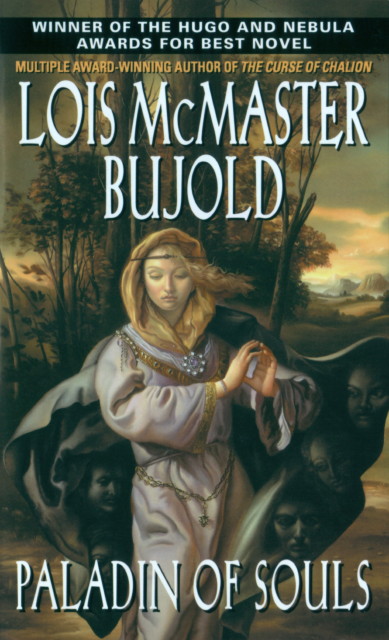
Lois McMaster Bujold: Paladin of Souls

Paladin of Souls is the sequel to The Curse of Chalion, and also the winner of the 2004 Hugo Award for next novel.

The story opens about 3 years after the close of Chalion, and the protagonist is Ista, the mother of the present royina (queen), who lived for 20 years under a cloud of depression and despair due to the curse on the royal house. It’s taken her this long to struggle out from under that cloud, and with the death of her mother Ista is now casting about for some meaning to her life, even as she’s kept a prisoner through kindness of her family and friends at her mother’s castle. Desperate for a change, Ista organizes a pilgrimage for herself and a few helpers, including a pair of soldiers sent by her daughter, Ferda and Foix, and her new lady-in-waiting, Liss, whose main occupation is a horse courier.

On her pilgrimage, Ista learns that more and more demons seem to be loose in the world, a point driven home when one of her party is himself occupied by a demon. But the group soon has larger problems, when they are attacked by a raiding party from the neighboring – and unfriendly – nation of Jokona. After the group is scattered, Ista is eventually rescued by Lord Arhys and taken to his castle Porifors, where she also mets Arhys’ young wife Cattilara. Though charmed by their hospitality – and rather taken with Arhys – Ista soon realizes that there’s something not right in Porifors. In fact, a visit from a party from Jokona some months earlier had adversely affected Arhys and left his best friend, Illvin, close to death. Moreover, all that has transpired can be traced back to Jokona, and Ista finds herself unwillingly at the center of the happenings, and even more unwillingly charged by one of the gods – gods whom she believed abandoned her to her decades-long misery – to set things right.

Being set in the same world as Chalion, I found Paladin suffers many of the same problems, among them its stock and basically unimaginative backdrop. The most interesting aspect of the backdrop are the five gods – the Father, the Son, the Mother, the Daughter, and the Bastard – who each hold sway over different aspects of the world, and with a structure that makes it more than a common polytheistic religion. But the structure doesn’t really play a major role in the story, it’s just a backdrop which shapes the character of the one god – the Bastard – who does play a significant role.

The big problem is that Paladin shares the biggest flaw of Chalion, which is that the story moves so s-l-o-w-l-y. It takes nearly a hundred pages for anything significant to happen, during which we’re mainly treated to the endless musings of Ista over her situation, until they encounter the Jokonan raiders. And then it’s over a hundred more pages before the revelation of what’s happening in Porifors, which is when the real story begins; everything before that it really just set-up, and it drags. A lot.

The balance of the story is generally stronger than Chalion, though: While Ista is not as engaging a main character as Cazaril was (Ista is another stock “strong woman in a society which marginalizes women” character), the challenge she faces is more interesting, and it has a much more dramatic and satisfying resolution. I also enjoyed the denouement of this book better than the first book, as it provides some nice insight into where the main characters will be going after the story ends.

But overall this is still a very flawed book. I’d sum it up with the old chestnut, “If you like this sort of thing, then this is the sort of thing you’ll like.” As for me, I think Bujold’s career has pretty much bottomed out with this pair of fantasy novels, and I certainly have no interest in reading any of her later fantasies. I’ll probably read further books in the Vorkosigan series (even though I’m not wild about the path that’s taken, either), but the action and adventure and humor that characterized her earlier novels has dwindled and finally vanished, and instead she’s writing dreary dramas with flat characters, and that’s just not worth my time to read.

This Week’s Haul

  • The Brave and the Bold: The Book of Destiny HC, by Mark Waid, George Pérez, Jerry Ordway, Bob Wiacek & Scott Koblish (DC)
  • Justice Society of America #18, by Geoff Johns, Alex Ross, Dale Eaglesham, Jerry Ordway, Mick Gray, Kris Justice & Nathan Massengill (DC)
  • Legion of Super-Heroes #45, by Jim Shooter, Francis Manapul & Livesay (DC)
  • Madame Xanadu #3, by Matt Wagner & Amy Reeder Hadley (DC/Vertigo)
  • Final Crisis: Superman Beyond 3D #1 of 2, by Grant Morrison, Doug Mahnke & Christian Alamy (DC)
  • newuniversal: Conqueror #1, by Simon Spurrier & Eric Nguyen (Marvel)
  • Nova #16, by Dan Abnett, Andy Lanning, Wellington Alves & Scott Hanna (Marvel)
The Brave and the Bold vol 2: The Book of Destiny Although I loved the first volume in Mark Waid and George Pérez’s The Brave and the Bold (The Lords of Luck), I was not nearly as enthusiastic about the second one. Although The Book of Destiny reads better in collected form than as individual issues, it still shows all of its warts: It’s got a hodge-podge of characters thrown together for shakier-than-usual reasons (Ultraman?), and a plot whose villain’s motivation feels insufficiently crafted, with a sudden reversal at the end which also doesn’t work for me. But the big problem is that Waid’s characterizations – usually his strong suit – fail him badly here. His depiction of Power Girl in the first chapter is about as ham-handed as I can recall seeing, and the Flash/Doom Patrol story also features one-note characterizations which often feel contrived and out-of-place.

The best story in the volume is the short Hawkman/Atom yarn, although the beginning of the Superman/Ultraman one is pretty funny. And of course Pérez’s artwork is great, as usual, and if you’re losing George Pérez in the middle of a story – as happened here – you can’t do much better than replacing him with Jerry Ordway, who gets to pencil the finale.

It’s the artwork that motivated me to pick up the hardcover of this – well, that and the fact that I already owned the first volume in hardcover – but anyone else who wants to read the back half of the Waid/Pérez run on this title would probably do better to wait for the (cheaper) paperback. Overall, it was a big disappointment compared to the terrific first half.

Final Crisis: Superman Beyond #1 Superman Beyond 3D is a 2-part story spinning out of Final Crisis #3, in which a Monitor, Zilla Vallo, plucks Superman from the side of Lois Lane’s hospital bed to take him outside reality on a quest to save her. She’s recruited several of his counterparts from parallel worlds to help: Ultraman, Captain Marvel, Overman (from a world in which the Nazis won World War II) and Quantum Superman (based on a combination of Captain Atom and Doctor Manhattan, it seems like). They end up in limbo – the place where forgotten characters go to live forever in obscurity – and learn about their nemesis, Mandrakk.

I’ve been pretty down on Final Crisis so far, and unfortunately this issue fits right in with that: It’s a bunch of gosh-wow stuff thrown together so that it makes no sense. Why bring together the five Supermen? Who thought bringing in Ultraman would be a good idea? (Although if you’re an Ultraman fan, that means you can get a double dose this week.) What exactly are they supposed to accomplish? Who is Zilla Vallo and why is this her fight? Why go to limbo? To be fair, it’s the first issue and arguably Morrison is going to explain it all in the second issue. Unfortunately, his track record suggests that a lot of it won’t be explained at all, it’s just there for the gosh-wow factor, but that’s not the reaction it gets from me.

Much of it also feels like old territory, too. The form of Limbo is certainly old news, whether it feels like it’s from Morrison’s own Animal Man of 20 years ago, or the Supremacy from Alan Moore’s Supreme, and in any event it feels a lot like the Bizarro world from All-Star Superman, and the concept seems like just a more depressing version of . Morrison references the Bleed, which is a Warren Ellis interpretation of the multiverse, and Morrison doesn’t add anything new to it here. And on top of this we have the silliness with some pages being in 3-D – a pair of 3-D glasses are included – which adds nothing to the story. (At least it wasn’t all in 3-D, or I’d have passed on it entirely.)

So the story isn’t very much. The art is sometimes very good, and sometimes rather iffy. I think I liked Doug Mahnke’s work best back when he was drawing The Mask, since his sense of shape and form gave his books a very solid feel, the exact opposite of the Image style which was prevalent in those days. He’s changed quite a bit since then, working more with shadows and layouts, and I think it hasn’t been a change for the better. Some of his pages look great – especially the two-page spread in which Zilla Vallo contacts Superman – but others look very awkward: Any page in which a character is grimacing or gasping or shouting or gritting their teeth, and their faces just look deeply unnatural (which means that Ultraman always looks unnatural).

It’s weird to think that Grant Morrison, who’s usually one of the more innovative ideas men in comics, seems to be retracing the steps of Warren Ellis, Alan Moore, and himself, but that seems to be what’s happening. But this could still be a pretty good story, except that Morrison seems to have lost sight of giving the readers a reason to care. Superman’s supposedly doing this to save Lois, but what ‘this’ is he doing? And the adventure is all too metaphysical to have any emotional resonance (not really surprising, as emotional resonance has never been Morrison’s strong suit). Is this story really going to matter? My guess is no.

newuniversal: Conqueror newuniversal: Conqueror is another one-shot providing background to Warren Ellis’ newuniversal series, this one taking place in 2689 B.C., when a White Event has given several individuals in this primitive world the powers of the New Universe heroes we’re seeing play out in the main title. In this story, one of the empowered characters has gone badly wrong, and he’s manipulating the others for his own end, to the detriment of the timeline. The beings from outside the timeline are trying to warn the others, and this issue is mostly about the Star Brand character – the Conqueror of the title – trying to figure out what’s going on.

It’s a story of small scope, and it works on those terms, although I found the ending to be too abrupt and unsatisfying. Eric Nguyen’s art has a sketchy quality to it, but it works for me in the gloomy atmosphere it brings to the story – although as with many artists these days (it seems), he needs to work on drawing background so the story doesn’t seem like it’s taking place in mid-air.

newuniversal is quietly becoming one of the more intriguing mainstream comics. I hope Ellis keeps with it and sees it through to a conclusion. (Of course, I’m still waiting for that last issue of Planetary…)

Sibling Revelry

For a rapid-fire, three-day introduction to the Bay Area, you could do what my sister Katy and I did the first half of this week:

Katy and I have had a tempestuous – is that the right word? Sure, why not – relationship. We didn’t really get along at all in our teenaged years, and we have rather different memories of what it was like growing up in our home town, though to be fair on that count our experiences were quite different for two people who went through the same school system and grew up in the same town with the same parents. So all things considered we didn’t really have a lot of motivation to become friends as adults. I think what changed is that we just grew up (eventually), and my nephew Ivan I think motivated Katy to reconnect, as she drove up with him to visit the last two times I went back to visit my parents. So although I can’t speak for her, on my end I was perfectly comfortable having her stay for a few days before attending the conference she’s at for the second half of this week.

Maybe I pack a little too much into visits from family and friends, but we had a lot of fun, and ate a lot of good food besides. We had great weather – she came out just ahead of the heat wave that’s scorching us today – and had some nice quiet evenings with Debbi and the cats. And as with my Mom, Blackjack was charmed by Katy and visited him every night to snooze with her.

To my amusement, when I introduced her to my cow-orkers on a tour through work, three of them asked whether he had any insight into where my punning nature comes from. She doesn’t really know, though; I think I’m just a prodigy.

So it was fun, and she might even come back! And, for those of you who know both of us, here’s the evidence:

Me and Katy

This Week’s Haul

A small week, but one chock-full of geeky goodness. Which seems fitting, since this is my 500th post to Fascination Place!

  • The Brave and the Bold #16, by Mark Waid & Scott Kolins (DC)
  • Final Crisis: Legion of 3 Worlds #1 of 5, by Geoff Johns, George Pérez & Scott Koblish (DC)
  • Tangent: Superman’s Reign #6 of 12, by Dan Jurgens, Jamal Ingle & Robin Riggs, and Ron Marz, Fernando Pasarin & Scott McKenna (DC)
  • Marvel Masterworks: The Amazing Spider-Man vol 101 HC, collecting Amazing Spider-Man #88-99, by Stan Lee, John Romita & Gil Kane (Marvel)
  • Guardians of the Galaxy #4, by Dan Abnett, Andy Lanning, Paul Pelletier & Rick Magyar (Marvel)
The Brave and the Bold #16 Mark Waid’s run on The Brave and the Bold comes to a quiet end with a decent team-up of Superman and Catwoman. I’m not a big fan of Scott Kolins’ artwork these days – it seems like it’s getting increasingly less polished in its finishes, which I find rather off-putting – but it’s okay. The series never quite recovered from its stumbles starting with issue #7, nor the loss of George Pérez’s artwork, so it feels like it kind of limped to a finish. The first 6-issue story was terrific, though.

But the series is continuing with some fill-ins by Marv Wolfman, and then I guess J. Michael Straczynski is going to be the next regular writer. It’ll be interesting to see how that turns out, since Straczynski is a very low-key writer (in his comics work, anyway) and B&B always feels like it should be full of bombast and improbable, wild creativity.

Final Crisis: Legion of 3 Worlds #1 If ever there was a series made for fanboys, it’s Final Crisis: Legion of 3 Worlds. Boy, where to even begin? Well to start with, it’s drawn by George Pérez, who’s probably my favorite comics artist ever, and who’s noted for packing an amazing amount of detail into each panel, but who’s hardly ever drawn the Legion of Super-Heroes (nor, often, Superman). And the art is just gorgeous, as you’d expect.

The story all by itself has so many back-references to the history of the Legion and this decade’s DC continuity that anyone unfamiliar with it probably isn’t part of the target audience: The Time Trapper plucks Superboy Prime out of the time stream in the wake of the Sinestro Corps War and sends him to the 31st century, where the world is picking up the pieces in the wake of the defeat of Earth-Man during the recent Action Comics story “Superman and the Legion of Super-Heroes”. Prime visits the Superman Museum, where he learns about the Legion and how Superman – whom he hates – inspired the team and the creation of the United Planets, and also about the Legion of Super-Villains, whom he breaks out of prison to they can help him tear down everything Superman inspired.

Meanwhile, the Legion are being interrogated by the UP’s governing body, since many of them feel the Legion is no longer needed. Their one-time backer, R.J. Brande, shows up to speak in support of them, and it seems to be working, until he’s abruptly murdered, and the fact that he’s actually a Durlan is publicly revealed. This throws the UP into chaos. Other Legionnaires are busy finding and/or rescuing their missing teammates, but several of them can’t be found. Amidst all of this, they find out about Prime’s missing, and they summon Superman from the 20th century. Brainiac 5 reasons that the best way to fight the villains is to recruit their counterparts from two parallel worlds, and while Superman thinks that will help, he also thinks that Prime can’t merely be stopped, nor should he be killed, but that they need to find some way to redeem him, to bring him back to the hero he was during the Crisis on Infinite Earths.

If that made your head spin, then this series might not be for you, but as a longtime Legion fan, I enjoyed the hell out of it.

Now, to enjoy it you do basically have to avoid worrying about continuity, as there are continuity errors all over the place, and I assume it’s because Geoff Johns just didn’t want to bother dealing with all the little details which would prevent it from being a fun story, not least because he clearly wants to tell a story about the Legion he grew up with. Just a few of the differences I spotted:

  • The “classic” Legion clearly spins off from the end of Paul Levitz’ run on the book, and Keith Giffen’s “Five Years Later” stories never took place. For instance, the Legion remembers Superman as having been a member, so the Pocket Universe stories never took place, and Mon-El is his original self, rather than his FYL “Valor” self. I think FYL started out strong but fizzled after half a year or so, so I don’t mind this being pushed out of continuity.
  • The panel depicting the Zero Hour rebooted Legion shows some characters who are dead in that continuity, such as Monstress and Leviathan.
  • The Mark Waid/Barry Kitson Legion (the one currently being depicted in the ongoing Legion series) shows Supergirl as a member, even though she departed a while ago.
  • Superboy Prime is still Superboy, even though he’d had adventures as Superman Prime during Countdown – another example of Countdown being basically willfully disregarded by later series (which isn’t such a bad thing, as it was awful).

There are a lot of interesting things that bringing the three Legions could result in. For instance, maybe one of them is the Legion of Earth 2. Or having characters meet who are substantially different among the worlds, such as Princess Projectra and Sensor. I don’t expect them to clear up which Karate Kid stayed in the 20th century at the end of “The Lightning Saga”, though. Honestly I don’t think anyone at DC editorial has any idea why they bothered with that plot thread, anyway, since it ended up going nowhere.

The biggest risk the series runs is that of not just having a single large cast of Legionnaires, but three of them, and characterization getting lost in the shuffle – always a risk with any Legion series. But the most encouraging thing is Superman’s stated goal at the end of the issue: Not to just to stop Prime, but to redeem him. I’ve been pretty unhappy with how this character has been treated, and finding a way to redeem him would be a challenge well worthy of a 5-issue series illustrated by George Pérez. Here’s hoping Geoff Johns can pull it off; he’s off to a good start.

(Oh, one more thing: There’s no apparent connection between this series and Final Crisis that I can see. Maybe they’ll work it in there somehow, but I rather hope it ends up standing on its own.)

Anyway, yes, I’m a big Legion geek. I don’t think that “my” Legion will ever truly appear again, but I do enjoy reading good Legion stories.

Guardians of the Galaxy #4 Guardians of the Galaxy is saddled with a Secret Invasion crossover in its 4th issue, much like Nova got stuck with an Annihilation: Conquest crossover in its 4th, but this one makes even less sense since the Guardians don’t operate on Earth, which is where the invasion is taking place! but Abnett & Lanning play a neat trick by locking the Guardians on their extradimensional home base of Knowhere, and revealing that there are shape-shifting Skrulls infiltrating that place, too! Plus, the Guardians find that many inhabitants of Knowhere don’t really trust or like them, and a couple of the Guardians members are acting a little oddly. From the issue’s last panel, it looks like things are really going to blow up next month, so this might be pretty good as non-crossover crossover stories go. If nothing else, DnA are taking every opportunity to keep advancing the Guardians’ own story in the middle of all this.