The Kittens Go to the Vet

We took the kittens to the vet yesterday for their annual check-up. At 14 months, they’re not really kittens anymore, but we still call them that, and probably will for a while.

We also brought Roulette for her check-up. In the past she always rode in our large carrier with her brother Blackjack, but since he passed away just about a year ago, we decided to put her in a small carrier by herself and put the kittens together in the large carrier.

Result: Roulette meowed the whole drive, and Sadie meowed from time to time and even louder than Roulette. Jackson was completely blasé about the whole thing.

In fact, Jackson was perfectly happy at the vet: He came out of his carrier, tail straight up, and checked out everything in the office, and was perfectly pleasant to everyone he met. Other than a brief yowl when his temperature was taken, he was quite comfortable in this new place. He really is the alpha cat, I guess! We also learned just how enormous a cat he is, which is to say, not as enormous as we’d thought: He weighed in at 14-1/2 pounds, well under the 16 pounds I’d guessed, and even the 15 that Debbi guessed. He’s about the side Jefferson was when Jeff wasn’t getting pudgy.

Sadie was also pretty comfortable at the vet, but Roulette was not, and had to be pulled out of her carrier for her exam. And afterwards she jumped down and went into the large carrier and curled up. So we decided to have her and Sadie ride home together, since they get along pretty well (it’s Jackson and Rou who don’t get along – specifically, Roulette does not like Jackson).

(Aside: Roulette is a little lighter than Debbi had expected, at 11 pounds. Sadie weighed in at 10 pounds, fluffiness and all.)

Putting the girls together worked great, as everyone was relatively quiet on the ride home, and Roulette was even up and looking around during the ride. When we got home we let them all out and the three sort of followed each other around looking a little dazed by the experience, without any friction between Jackson and Rou. So maybe there was a little bonding that went on during the trip.

The adventure took a lot out of them as they slept most of the rest of the day.

Oh yeah: And they’re all healthy, which was the point of the trip in the first place.

Caught Up in the Excitement

I used to think I’d been watching Doctor Who longer than almost everyone on the American. Then a friend pointed out to me that the two 1960s movies with Peter Cushing, Dr. Who and the Daleks and Daleks’ Invasion Earth: 2150 A.D. had been released in the United States at the time, so a lot of science fiction fans from that era were familiar with the character. Oh well! Still, I’ve been watching the series since the Tom Baker episodes aired in Boston in 1976 (I was 7), and I have dim recollections of seeing my Dad watch a couple of Jon Pertwee episodes circa 1974, so I’ve probably got a few years on most people who didn’t see those films in the 60s. As with Star Trek, I spent my pre-teen years watching the Tom Baker episodes over and over and over again; put next to other genre shows of that era, they were the cream of the crop.

The pattern at PBS back then was that they’d throw the shows into rotation, and then after a few years they’d get a few more seasons of the series and add them on. So I watched the hell out of the first four Baker seasons, and then they added the last three. Then in the early 1980s we got cable TV, and I discovered a New Hampshire station that was showing the Peter Davison stories, and they weren’t airing them in their original episodic half-hour format, but were showing them as full stories, which was awesome. The first one I saw was “Kinda”, which all things considered is a pretty crappy introduction to the fifth Doctor, though in hindsight it’s a good story which showcases the fifth Doctor’s attitude quite well.

By the mid-80s I had largely stopped watching television. Moreover, what I imagine was the BBC’s quixotic attitude towards the series combined with PBS’ cynical approach to premiering new Who episodes during pledge drives made it difficult to see many of the Colin Baker and Sylvester McCoy stories. I found a friend in high school who, it’s fair to say, was a bigger Doctor Who fan than I was, and he had access to bootlegged videotapes of the later stories which we loaned to me. Honestly, I wasn’t missing much; the original series went south in a big way after “The Five Doctors”, with the exception of a few of the McCoy episodes. (It is to me inexplicable that the fifth-to-sixth Doctor regeneration story, “The Caves of Androzani”, is so well regarded, as I found it to be pedestrian and tedious.)

Still, this was my first experience (other than a convention my Dad took us to to meet Tom Baker which I barely remember) with other Who fans. It was a little weird to realize that there were fans who were more willing and able to get those episodes than I was.

A friend and I watched the 1996 TV-movie when it aired. It was pretty bad, though actor Paul McGann was good int he title role. We watched it again on Friday, after watching “The Night of the Doctor”, and it is a shame McGann didn’t get more of a chance to show his stuff. (There’s a petition to create an eighth Doctor series in the wake of the minisode.)

I was never into reading any of the spin-off books or listening to any of the audio dramas. I felt like I’d been burned by all the yahoos on USENET in the early 90s earnestly arguing that all the Star Trek novels and such were canon. As far as I’m concerned, if it ain’t in the original medium (video for Trek and Who) then it’s fanfic. I guess there’s a complex series of plots in some of the novels, but it’s been largely discarded by the new series, so I don’t feel that I missed much.

I was encouraged when I’d heard that the new series was going to be a continuation of the old, and that they were going to treat the TV-movie as part of canon. And it’s been a fun run, though erratic at times, perhaps struggling to reconcile the series of unrelated adventures of the original series with the “larger storyline” demands of modern TV (though most series manage to flub their ongoing storylines). The series also led with its best, as Christopher Eccleston as the ninth Doctor has pretty much overshadowed every other actor in the series.

As Doctor Who has become a worldwide phenomenon it’s been strange for this old fan to see some of the new conventions that have grown up around it. The weirdest for me was been people referring to the Doctors by just their number (“eight”, “ten”, “eleven”). I guess it’s a natural development in these days of texting shorthands. LOL. I also find it a bit odd how strongly Doctor Who has become identified with the U.K., since the original series just felt like a science fiction show with a low budget and English accents.

So it’s been a long strange journey, and now we’re heading up to the 50th anniversary of Doctor Who next Saturday. And despite myself, I’ve been getting just as excited about it as everyone else, following the speculation and all the bits that have been released officially. I worry that I’m too excited: There’s a huge amount of potential in the premise they’ve set up, honestly they could base a whole season around it, but they’ve only got 75 minutes to work through it all. Will it be enough? Will it be ridiculously over-the-top, as the silly season-enders under Russell T. Davies were? We’ll find out.

I’m looking forward to it anyway.

(But I’m secretly hoping they’ve managed to sneak a real surprise into the story. Like a guest appearance by Tom Baker or something.)

A brief spoiler for anyone who hasn’t seen the last episode of season seven, or the developments since, after the cut:

Continue reading “Caught Up in the Excitement”

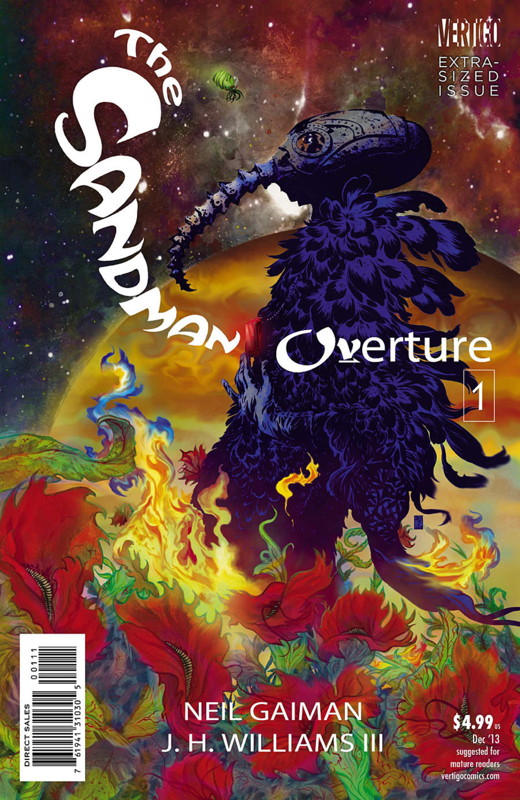
The Sandman: Overture #1

The Sandman: Overture #1 of 6, by Neil Gaiman & J.H. Williams III, DC Comics, December 2013

The Sandman: Overture #1 There’s surely no comic less in need of my recommendation than this new installment (“Back After Fifteen Years!”) of Neil Gaiman’s keynote fantasy series. But The Sandman: Overture #1 was the standout comic this week.

I was generally a big fan of the original series (I only say “generally” because I actually dropped it about six issues in, after the death-in-the-diner issue, and picked it up again with “Dream of a Thousand Cats”; also, I felt that “The Kindly Ones” was hecka padded. But it had many truly excellent stories, and worked superbly as a grand arc), so I was a bit skeptical of Overture being a prequel to the series, explaining what led to Dream being captured in the first issue of the original series. Indeed, we see many elements in this first issue which were revealed only over time in the original series (and, thus, Overture is a poor starting point for people who haven’t read the original), some of which are portents of plot threads which would be resolved in the original (a lengthy sequence with The Corinthian, for example).

But there’s also an undercurrent of mystery, as Dream senses something wrong in the universe, and then in the final scene Gaiman throws a curve, showing that Overture isn’t just going to walk through territory we’ve been through before, but that there are new things to discover – big things – back here in The Sandman‘s past. It was exactly where this story needed to go, as trying to extend a “complete unto itself” magnum opus is a tough feat. (And recall that the few Sandman stories published since the series’ conclusion have been asides, pieces filling out the universe as it were, and not ones that tackled the main character’s story head-on.)

Joining Gaiman is artist J.H. Williams III, who is certainly one of the best renderers in comics today. Where his work often falls down, for me, is in layouts and storytelling, which I often find hard to follow. (His Batwoman had this problem in spades.) While I’m a fan of innovative layouts, they should never compromise telling a coherent story. Fortunately, he adopts a much more straightforward approach here (possibly prompted by Gaiman’s script, I don’t know), and consequently we can happily enjoy the pretty pictures. Williams also supplies the lovely primary cover (an alternate cover is by original series regular cover artist Dave McKean, whose work I’ve never warmed to).

Overall it’s a winning combination, and looks to be an excellent series. So if you had some of the same reservations about it that I did, I would say that you should put them aside and check it out.

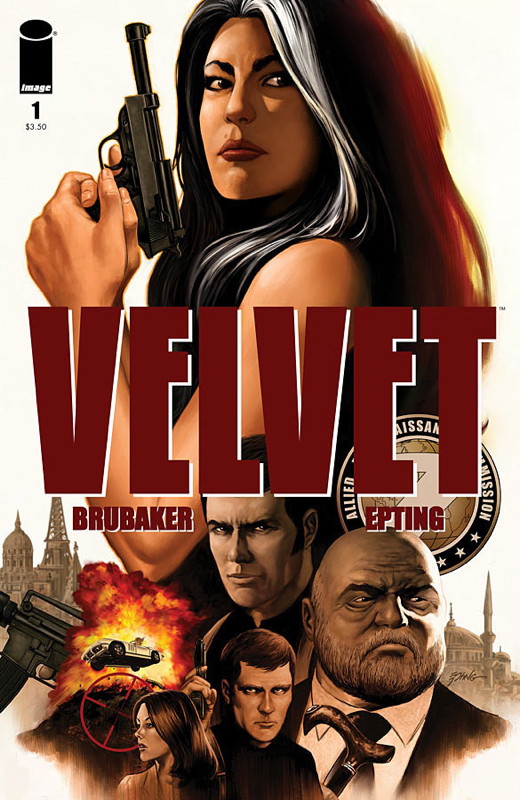
Velvet #1

Velvet #6, by Ed Brubaker & Steve Epting, Image Comics, October 2013

Velvet @1

I can’t remember the last comic book I’ve been looking forward to as much as the first issue of Velvet.

Ed Brubaker and Steve Epting worked together on the terrific Captain America: The Winter Soldier (the source material for next year’s Cap movie), where they successfully resurrected the long-untouchable dead character Bucky Barnes. Brubaker writes a lot of nourish comics, but Cap was more in the style of espionage thrillers, much like my hitherto-favorite work of his, Sleeper. Epting, meanwhile, has grown from an artist doing work that felt a little out-of-place following George Perez’ run on The Avengers to an outstanding artist who mixed in with Butch Guice and Michael Lark on Cap.

So the creative team is great, and I was completely sold on the premise of Velvet as soon as a read a preview: Velvet Templeton is the secretary to the director of ARC-7, a top-secret British intelligence agency. But it’s not giving much away to say that she’s much more than what she appears, since we learn in the first page of the issue that she’s romanced several of the agency’s top agents without any of them knowing she was playing the field. When one of their agents is killed, she ends up in the middle of the investigation, and we see that she’s really not what she appears to be.

It’s a wonderful set-up issue. It takes place in 1973, perhaps coincidentally the year that Roger Moore took over as James Bond in the film series, and a few years after The Prisoner. But I suspect Brubaker is mainly going for the period atmosphere and is working from a wider assortment of source material. (The afterword by Jess Nevins cover the history of spy fiction, almost none of which I’ve read, so I can happily enjoy the series without worrying about most hidden references that have been dropped in.) The time period is also one in which there were very few woman agents (the ones from The Avengers and…?), which could lead to some exploration of gender issues, if Brubaker decides to play it that way.

I’m more interested in how Velvet managed to end up in her position given her obvious qualifications for other lines of work, and presumably that will be at least the subject of the first arc, if not of the whole series. But this being a Brubaker series, there are surely plenty of other characters who have interesting dirty laundry to be aired.

It looks great. I can’t wait.

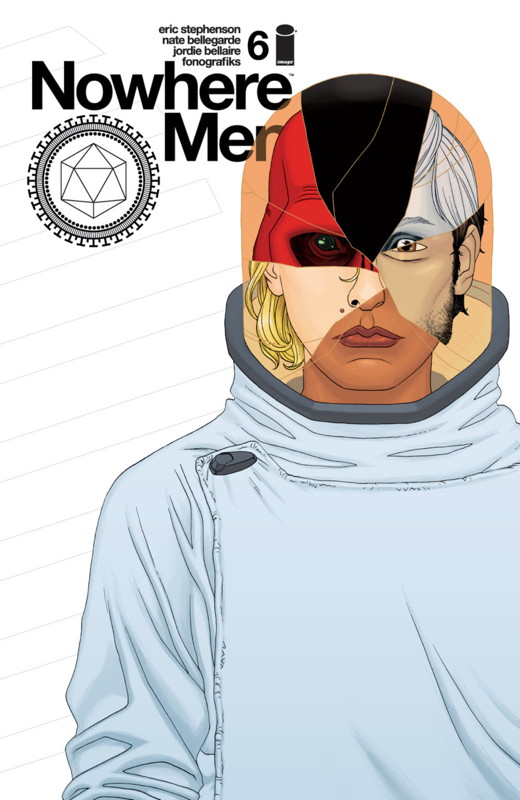
Nowhere Men #6

Nowhere Men #6, by Eric Stephenson & Nate Bellegarde, Image Comics, October 2013

Nowhere Men #6 Nowhere Men is an interesting science fiction title from Image. It seems both the writer and artist have both been working for Image for a while (I’ve probably seen Bellegarde’s work in some of the Invincible titles, but I don’t remember it clearly), but Nowhere Men is different from anything they’ve worked on before.

The core of the book is a quartet of scientists who formed a global corporation, World Corp, back in the 60s. The scenes from that era evokes imagery of the Beatles (the book’s title presumably comes from John Lennon’s similarly-named song), without there being an explicit match of the scientists to the original Fab Four. But most of the book takes place in the present day, where there’s an ongoing theme of the optimism and wonder of the founding of World Corp having rotted through: Emerson Strange, once a dashing man with long hair, is now old, bald, and seems crushed by the weight of running World Corp. Dade Ellis has spent years in a coma. Simon Grimshaw seems not to have aged, and has split from the other two with plenty of hard feelings. And Thomas Walker apparently succumbed to drug addiction and dropped out of society, not having been seen for years.

Worse, experiments on a space station which Strange was overseeing have gone badly wrong, and the crew of the station barely managed to escape, while all being mutated in various ways (some of them grotesque).

This issue features a confrontation among the station crew, Strange, Ellis and Grimshaw, in which all hell breaks loose. The World Corp founders clearly aren’t used to being challenged by people they regard as inferiors (both Strange and Grimshaw have huge egos, though Strange at least has some basic empathy), and whatever plans they’ve had in motion are clearly falling apart in the face of developing events. (There is at least one, perhaps two, loose cannons around, as well.) And what exactly happened to Thomas Walker is an ongoing question.

Nowhere Men contains several text pages in each issue, providing background on World Corp and their accomplishments over the years, often in the form of magazine articles and interviews. It’s surprisingly effective; I recommend reading the one-page piece at the start of this issue from start to finish, as it has a nifty kicker in the final paragraph.

The book sometimes feels a little distant, like the founding members of World Corp are gods (the presumed irony is that Thomas Walker is perceived as having disconnected from the world but that he’s probably closer to it than the other three), and the hapless mutates from the space station are normal(ish) people caught in a situation beyond their control. That the story is largely concerned with the ongoing machinations of the principals, as opposed to smaller escapades of individuals, reinforces that feeling. Overall it works, but it is something of a sprawling epic which keeps barreling forward, rather than a careful character-driven narrative. It feels like the series is about half-done now, but the premise is so far-reaching I could imagine them doing more with it after this story is over.

It helps a lot that Bellegarde’s art is outstanding, capable of both drawing ordinary people (with a diversity of faces and ethnicities!) and fantastic entities and effects. His clean linework and the effective colors by Jordie Bellaire make this one of the sharpest-looking books on the market.

This particular issue isn’t easily read on its own, given the backstory, but the first six issues will soon be collected, with the appropriate title “Fates Worth Than Death”. I recommend it when it comes out.

(Coincidentally, the blog Second Printing also just reported on this issue.)

This Year’s Biking-to-Work Experience

Biking to work this year can be summed by saying that I’ve had to overcome several bits of adversity to keep going. Nothing huge, but enough to be a drag on my enthusiasm.

Last year I had planned to reach 40 rides for the season for the first time. I bike in twice a week (rarely more, since I often need to drive somewhere after work), and with 7 months in the season (between Daylight Savings Time changes – I prefer not to bike home in the dark) that gives me about 30 weeks, so in theory I could get as many as 60 rides in without adding extra days (minus time spent on vacation, at WWDC, etc.), but I think I’ve topped out at 35. Debbi suggested I aim for 50. But then all the business with my Mom came up, and I ended up at around 35 again.

This year I was back east in March during the DST change (“Spring Forward, Lose Sleep”), but I didn’t bike in until May because we were working on selling her house, and I wanted to make sure I could dash home and take care of anything that came up where I needed some specific records (it turned out that nothing did).

Along the way I’ve broken two spokes on my rear wheel, and I’m coming to accept that I need to get a new bike. I have a 2002 Bianchi Eros road bike (at least, that’s the year I bought it), and I think I just weigh too much for the bike. I bought a beefier rear wheel for it a couple of years ago, but I’ve continued to pop spokes (just less often), which is pretty annoying (even though I found a store nearby which is able to fix it within 48 hours reliably). So I think I need to get a bike which is built for someone of my weight (as with buying clothes, it’s better to buy for the body you have, not the body you want to have). So this winter I will probably look into getting some sort of hybrid bike. The plus is that I could take it off-road onto some of the dirt trails in Shoreline Park, which my road bike can’t really handle.

Then in August Debbi and I were doing an abdominal workout challenge, and I started having pain in my hips, which mostly went away when I stopped doing the sit-ups. Toward the end I also started having pain in my right knee, which may or may not be related (perhaps I was compensating for the hip pain in a way that stressed my knee). It gets sore when I apply downward power when pedaling – either going up hills or when starting moving. It’s not debilitating, and it doesn’t both me much when not biking (maybe a bit when climbing stairs), but it is worrisome, and the two weeks off for our September vacation didn’t let it heal fully. It felt a bit better this past week, but I have had to be careful around it.

So it’s been a bit of a frustrating summer for biking. I’m on pace to hit 40 rides by the end of the month, which will be a nice milestone; fortunately I had a day’s worth of cushion since I got sick a few weeks ago. I don’t think my knee would take a third day of riding in one week very well.

I like riding to work, but I’ll like it even more if I can get a more reliable bike for next year. Meanwhile, as sunset creeps earlier and earlier, I’m getting ready to switch to going to the gym over the winter, instead.

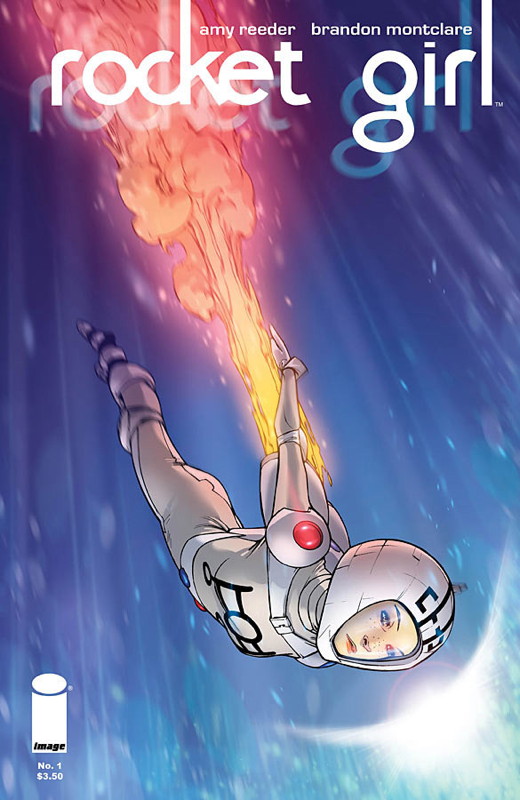
Rocket Girl #1

Rocket Girl #1, by Brandon Montclare & Amy Reeder, Image Comics, October 2013

Rocket Girl #1 I’ve been doing a poor job on my plan to review a comic book per week, but I’ll try to make up for it, starting with the fun comic book Rocket Girl.

Rocket Girl was the subject of a successful Kickstarter over the summer, and is illustrated by Amy Reeder, perhaps best known for the Vertigo series Madame Xanadu, of which I enjoyed the art but felt it was let down by the story. (You can read a few of my comments on that series here.) I’m not familiar with writer Brandon Montclare, however.

The premise of this ongoing series is that Dayoung Johansson (age 15) is a member of the New York Teen Police Department in the near future, and persuades her boss that Quintum Mechanics has managed to change the past so it becomes the dominant corporation. Dayoung – the title character – arrives just as Quintum is kicking off their first big experiment – and promptly passes out. Taken in by a few of the scientists, she has to maintain her equipment with ancient technology, and then responds to an emergency elsewhere in New York City where she captures a criminal, and then escapes the local cops.

The kicker is that Dayoung comes from the year 2013, and has travelled back to the year 1986. And you may have noticed that there’s no Quintum Mechanics, New York Teen Police Department or Rocket Girl in our 2013.

I like the premise, and the first issue is a lot of fun, driven mainly by Dayoung’s enthusiasm (and nifty costume). Reeder’s artwork is excellent – oh how I love when an artist can draw dynamic panels that have backgrounds!

The story is a little shaky; I immediately wondered how Dayoung could show up and threaten to arrest the Quintum scientists, pass out, and not have them do something nefarious to her – like turn her over to the cops – never mind that she actually ends up staying with one of them in her apartment. It looks like the series is setting up a “hero and her team of supporting scientists” scenario, which feels cliche – especially since none of the supporting characters have much personality at this point – but could work out. And to balance out the plotting issues, the dialogue is solid and often witty.

So it’s a bit of a mixed start, but I’m optimistic that the early bumps can be overcome, while still being a fun, energetic series.

Goodbye to the DC Universe

With this week’s publication of Earth 2 #16, I’m dropping the last three comic books I’ve been buying set in the DC Universe [1]. This despite the fact that it ends on a cliffhanger, but with writer James Robinson leaving, it feels like a good point to jump off.

[1] Earth 2, World’s Finest and Batgirl.

Where DC and I have parted ways is that they clearly are interested in pushing their characters, whereas for me it hasn’t been about the characters for years, it’s been about the creators. I follow the creators I’m interested in, and I want to find people with interesting voices and novel stories to tell, and stories that are going to develop their characters and go somewhere.

But it seems like DC treats their creators as fungible, and the stories in the New 52 mostly have a mediocre sameness to them. None of them have truly excited me – the closest is Gail Simone’s Batgirl, clearly the standout voice of the New 52, but the weight of crossovers and events has dampened my enthusiasm for any Batman title. So I’ve gradually dropped them, until September’s “Villains Month” event presented a good opportunity to make a clean break. (I like to say that “a good jumping-on point for new readers is a good jumping-off point for old readers.”)

(Another is “creators, not characters”, though “creators, not properties” would be more accurate.)

I don’t really know what’s going on in DC editorial, but stories like the creators of Batwoman leaving the book after not being able to have their heroine marry her girlfriend reinforces my perception of it being all about the marketable properties for them. Setting them up for movies and TV shows, I guess (that being where the big money is). And, well, I don’t care about that. The recent Batman films were good because of Christopher Nolan, not because they starred Batman.

So this is goodbye. Not necessarily forever – I’m still buying several Vertigo books and creator-owned titles that DC publishes such as Astro City. But the New 52 is clearly the culmination of plans that DC editorial has been brewing for years, and it’s just not resulting in the kinds of comics that I want to read.

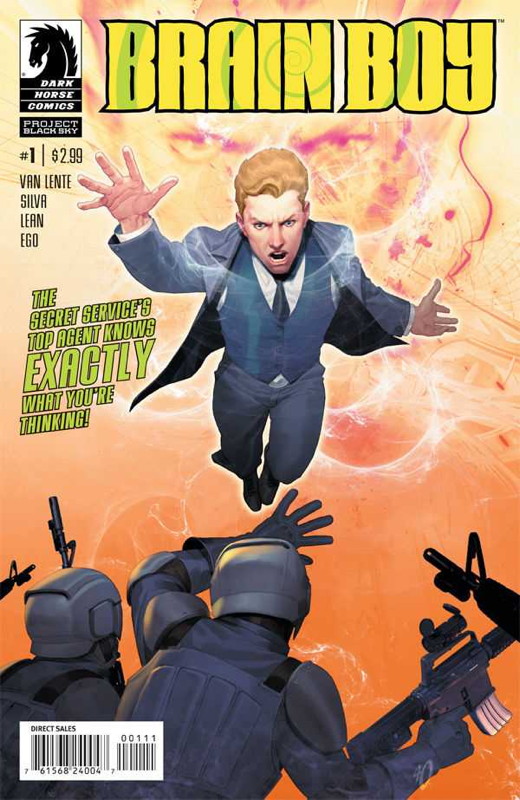
Brain Boy #1

Brain Boy #1, by Fred Van Lente, R. B. Silva & Rob Lean, Dark Horse, September 2013

Brain Boy #1 I have three different introductions to this post:

First, it’s been a while since I finished reading the first issue of a comic book and said out loud, “That was fun.” Brain Boy #1 met that exacting standard.

Second, Brain Boy was actually an early-60s comic published by Dell, which Dark Horse has reimagined. Wikipedia has a little info about the title.

And third, Brain Boy got a preview in Dark Horse Presents, Dark Horse’s fine monthly anthology series, and it impressed me. That story will be collected in a future issue, I understand, but it was on the strength of that story that I picked up this first issue. Anthology comics are good for something!

The title character is Matt Price, the world’s most powerful telepath (also a telekinetic). What do you do if you’re the world’s most powerful telepath? Raised by his parents’ employer after their deaths (hmmm), he now is “on loan” (?) to the Secret Service, where he works as part of the security detail on the most sensitive assignments. Oh, and he hates being called “Brain Boy”.

How do you write a story about a man who can know what everyone around him is thinking? Perhaps taking a cue from Alfred Bester’s classic SF novel The Demolished Man (which is also about telepaths), figuring that out seems to be part of the challenge. Price is approached by a man who claims to be able to deliver information about his parents, but he doesn’t actually have it; he “knows a guy who knows a guy who knows a guy”, and while Price could track that guy down, it would take time and resources. Or, he can do a job he’s being asked to do, even though it goes against his orders, guarding a dictator who’s visiting the United Nations. Before the first issue is out, there’s a turn, followed by a last-page twist, in this first of a three-part story.

Writer Fred Van Lente is perhaps best known for Incredible Hercules and Archer and Armstrong, both of which I would describe as “fun but light”. Brain Boy feels like it has the potential to be more substantive, especially if Price develops as a character (neither Hercules nor Archer are characters with a lot of development potential, albeit a lot of humor potential). Van Lente has a droll sense of humor, though it tends to result in a whimsical atmosphere rather than a lot of direct laughs. But he mixes in some hefty material here, as the story gets more serious throughout the issue, which is what the story will need to work.

R.B. Silva’s art has a very modern look, and the layouts and finishes are both strong (abetted by a complex coloring job by “Ego”). Some of his figures are a little hard to read (especially the ones with any facial hair), so there’s room for improvement there.

Overall it’s a very strong first issue. It takes place in the same universe as Dark Horse’s Captain Midnight revival (which is itself pretty good), but you don’t need to read that book to enjoy this one (and hopefully it will stay that way, as I’m pretty much done with crossovers at this point). While I could imagine the challenge of trying to keep coming up with clever ways to challenge Brain Boy might eventually wear thin, hopefully Van Lente can get at least a year’s worth of neat stories out of it.

Roulette’s Difficult Summer

It’s been a couple of months since Newton passed away. I’m not sure Jackson and Sadie really noticed. I mean, I’m sure they did in some way, but it didn’t slow them down. They both started lying in Newton’s spot on the couch pretty quickly (to be fair, so did Debbi and I). But he was not a big part of their life for very long.

Roulette has taken his passing harder. It doesn’t help that Jackson still chases her from time to time, and doesn’t take her hissing at him as a signal to stop. She spent several weeks mostly upstairs, and mostly under the guest bed, which seems to be her safe spot. She would come down at night and sit on the back of the family room couch and mostly try to avoid Jackson. She recognized that Sadie is not a big threat, even though Sadie would chase her too, sometimes.

But I think she’s been a bit stunned by the last of the three cats she grew up with passing away. It’s been a sad time for her.

We wondered what would happen when we went away for our vacation for 12 days. We found a great cat sitter through a friend, and knew that she would give them all plenty of attention and play time, but still Roulette would be alone with the kittens for at least 23 hours a day.

Oh, and the kittens ceased being kittens early in September, as it turned out their recorded birthday is September 4.

Our first night back we realized that Roulette was coming in to our bedroom, and leaving when she noticed Jackson in there. I suspect she expanded her territory to include our bedroom while we were gone, and that the kittens mostly stayed downstairs.

Also, since we got home she’s been spending more time downstairs, and not a lot of time under the bed. She sits on the couches, and on the dining room table in the sun during the morning. Last week when I sat in the living room reading comics she curled up with me for most of the evening, and even tolerated each of Sadie and Jackson lying with us, for a while.

This weekend she started lying on the family room couch itself, not just on the back, and she’s been cuddling up next to me and Debbi. And there’s been less chasing, and less hissing. And she plays with toys when we bring them out sometimes, too. She’s also joined me in the study to pester me while I’m paying bills. And Debbi even noticed her eating next to Jackson yesterday. Sadie has gone up to her and groomed her a little without any growling.

So I think she’s started to get used to the kittens, slowly, slowly. I think the next step will be to see her and Sadie grooming each other, or at least snoozing together. Perhaps not any time soon, but maybe it will happen.

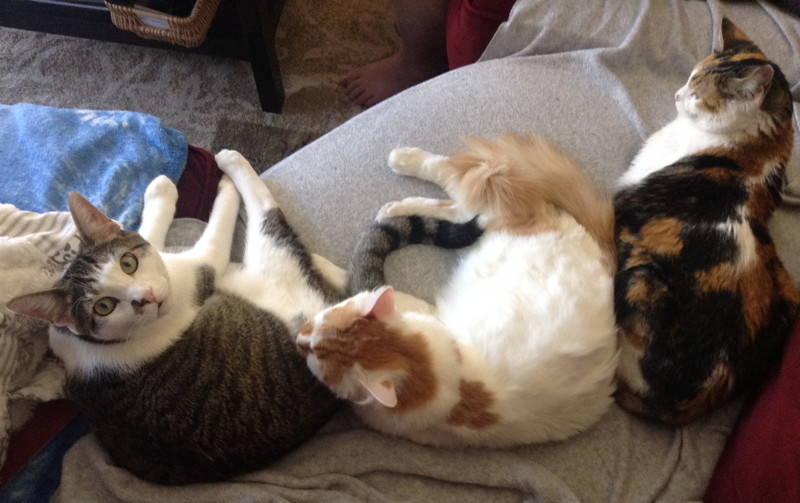
But we did get some pics of the three of them lying together on the couch, in Newton’s spot, for a little while:

Cat harmony