A Phelpsian Post

The Olympics seem to be on everyone’s mind lately, so here are a couple of the neater things I’ve found on the Web about them:

First, frame-by-frame evidence of Michael Phelps’ 0.01-second victory in the 100-meter butterfly. Looks pretty conclusive to me. (via Daring Fireball)

After winning 8 gold medals at this year’s contests, maybe Michael Phelps would like to star in some film roles. Here’s one he seems well-suited for.

Well-suited! Har! But seriously, the resemblance is uncanny.

This Week’s Haul

  • Action Comics #868, by Geoff Johns, Gary Frank & Jon Sibal (DC)
  • Booster Gold #11, by Chuck Dixon, Dan Jurgens & Norm Rapmund (DC)
  • Sparks #3 of 6, by Christopher Folino & J.M. Ringuet (Catastrophic)
  • B.P.R.D.: The Warning #2 of 5, by Mike Mignola, John Arcudi & Guy Davis (Dark Horse)
  • Hellboy: The Crooked Man #2 of 3, by Mike Mignola & Richard Corben (Dark Horse)
  • Atomic Robo: Dogs of War #1 of 5, by Brian Clevinger & Scott Wegener (Red 5)
Atomic Robo: Dogs of War #1 Atomic Robo is back with a new series, this time taking place during the Allied invasion of Sicily in 1943, in which Robo is dropped onto the island to take out a group of mechanized suits which the Nazis have been using to decimate Allied forces. I had mixed reactions to the first series: There was a lot to like in Wegener’s clean artwork and the wacky inventiveness of it, but the stories felt like a series of vignettes and thus the series as a whole felt rather lightweight. So I’m encouraged that Dogs of War will be a more substantive long-form story with a little more meaning behind it.

Fundamentally, though, Atomic Robo is cut from the “big monsters smashing each other” cloth that Hellboy comes from. I don’t know why Hellboy – at least the earlier stories – felt more substantive than Robo has so far, maybe it was because it was new and different at the time. Maybe the characterizations felt deeper, as I really still have no feel for who Robo is as a character, other than a big metal smart-ass, much less any of his supporting cast. In any event I’m hoping this new series will show some significant growth over the first one.

Busy Work

So yesterday Debbi gives me a call near the end of the day: She’d gone home early due to a slow day at her office, got home and was puttering around the house, when the power went out. No idea why, but she called PG&E and was told that it was targeted to be fixed in the next two hours.

I got home an hour later, and we went out to dinner and did a little shopping. We got home after the 2-hour window, and the power was still out. So I called PG&E again and they said the outage was due to an equipment failure, and it would be fixed in – yup – the next two hours.

Fortunately, 20 minutes later the power came on again, saving us from having to figure out where else we could go to watch Michael Phelps win his 7th gold medal of this year’s Olympics.

Unfortunately, when I opened my laptop to check baseball scores I learned (after running around the house a couple of times) that our phone service was out, both voice and DSL. So I called AT&T and learned that they didn’t have any service appointments over the weekend, and only a 12-hour appointment available on Monday. Grr. (Naturally, I didn’t actually talk to a human during all of this, and it took me nearly 8 minutes to navigate their phone menu system along the way.)

Half an hour later, I checked the phone again and lo and behold it was working again, Intarwebs and all.

So this morning I called AT&T to cancel the appointment.

You guessed it, I’ve been on hold for 30 minutes waiting to cancel an appointment.

Fortunately, shortly after I typed the previous sentence, I got through to a human and within 2 minutes she’s routed me to the right place and I cancelled my appointment. Yay!

Though along the way I learned that I could have cancelled the appointment on-line.

Sigh.

Here’s hoping the rest of the weekend goes more smoothly.

This Week’s Haul

  • Final Crisis #3 of 7, by Grant Morrison & J.G. Jones (DC)
  • Avengers/Invaders #4 of 12, by Alex Ross, Jim Krueger & Steve Sadowski (Marvel)
  • Hulk #5, by Jeph Loeb & Ed McGuinness (Marvel)
  • The Twelve #7 of 12, by J. Michael Straczynski, Chris Weston & Garry Leach (Marvel)
  • Echo #5, by Terry Moore (Abstract)
  • The Boys #21, by Garth Ennis & Darick Robertson (Dynamite)
  • Star Trek: Assignment Earth #4 of 12, by John Byrne (IDW)
Final Crisis #3 I’m not sure two reviews of Final Crisis #3 could be more different than Brian Cronin’s and what I’m about to write. Cronin loved it, while I, well, didn’t.

Almost everything Morrison does here is either boring, or has been done before. A few people seem to be impressed with how he’s handling bringing back Barry Allen (the silver age Flash), but c’mon, it’s not like Barry hasn’t been popping up from time to time for the last 20 years anyway. The guy’s a time traveller! Maybe he’s back for good, but – so? Hal Jordan (the silver age Green Lantern) died, and came back not once (as the Spectre) but twice (as Green Lantern again, complete with his own ongoing series). There’s nothing in this to get even a little excited about.

Almost everything in the series feels like it’s been done before. The running subplot involves bringing back characters from Morrison’s Seven Soldiers series (and what a mess of a narrative that was). The main threat is of Darkseid and his minions of Apokolips conquering the world – “the day that evil won” as the series’ tag line goes. But Morrison used this exact same premise – and used it very well – in his own run on JLA a decade ago!

This issue also features the conscription of superheroes to fight the threat, hearkening back to the formation of the All-Star Squadron (which is explicitly referenced), but doing so makes no sense: Far direr threats have arisen in the DC universe in the past without resorting to such measures. Why this, why now? History suggests that simply putting out the call to all hands would be sufficient – these are the DC heroes, after all.

This series is just one instance after another of things that either don’t make sense, or just aren’t fun or exciting or thought-provoking. The longer Final Crisis goes on, the more pointless it seems. If this really is the “final crisis” of the DC universe, it’s because the concept has jumped the shark – there are no more interesting crises to tell.

Avengers/Invaders #4 Alex Ross/Jim Krueger projects don’t have a good track record in my estimation, going all the way back to my bitter disappointment with Earth X, but I keep trying them out anyway. Project Superpowers over at Dynamite has been pretty awful, but to my surprise I’m rather enjoying Avengers/Invaders. The premise is that the Invaders from World War II – Captain America and Bucky, the Human Torch and Toro, and Namor the Sub-Mariner – have been accidentally brought forward to 2008 New York City, along with (and without their knowledge) a US soldier of that era. This is problematic since in the present Marvel Universe, Cap is dead, Bucky is the new Cap, Namor is King of Atlantis and has withdrawn from the surface world, and, well, I don’t know what the status of the Human Torch and Toro are, since it seems like it changes every few years. Moreover, the Invaders think this is all some Nazi plot, especially since Iron Man and S.H.I.E.L.D. capture them while trying to figure out how to return them to their own time. And frankly, after the Civil War I can’t really fault anyone for accusing Iron Man and S.H.I.E.L.D. of being Nazis. Anyway, two groups of Avengers end up fighting over the Invaders which is where this issue leaves off.

I think what’s winning me over with this series is that it’s treating time travel seriously and not as some sort of gimmick: The adult Bucky finds the Invaders Cap’s shield and shows up at the end of this issue, clearly having memories of this adventure. The current Namor also recalls what happened and deliberately sends his younger self off without help from Atlantis to fulfill his destiny. And the soldier meets his future self – who’s nearly 90 years old – and compares notes. It’s all played for drama rather than convenience, and with the hint that the Invaders’ removal has also changed history, with dire consequences on the way once the changes catch up to the current day.

Admittedly, none of this is especially original, but it’s a lot less ponderous than the usual Ross/Krueger fare, with good art by Steve Sadowski. 12 issues might end up being too long if there aren’t some new plot twists in store, but so far, so good.

The Twelve #7 Speaking of heroes transported from World War II to the present day, J. Michael Straczynski’s The Twelve starts its second half this month. Like Ross, Straczynski’s another comics writer whose stuff I find to be too slow without much ever happening. (His current run on Thor is a perfect example of this.) The Twelve isn’t exactly gripping, but the mix of plot (which is shaping up to be a murder mystery of sorts) and drama (the heroes meeting their old – now very old – friends and their descendants) is nonetheless engaging. The gorgeous artwork by Weston and Leach helps quite a bit, too.

This issue continues the theme of characters reconnecting with their past 63 years later, as Captain Wonder meets his former sidekick, Tim, now an old man. The guy’s hard a rough time of it, as his wife and sons all died before he was revived. But the ongoing story makes some progress as Master Mind Excello tells the Phantom Reporter of some premonitions he’s had regarding the group, and the Reporter both investigates a murder in the city and then confronts the Black Widow about her nighttime excursions.

There are lots of hints that funny things are going on: Dynamic Man might be involved in the aforementioned murder, the Widow is being used by some demon as an angel of vengeance, and the inert robot Electro apparently has been wandering off as well, but who’s been doing what is still unclear.

The main thing I regret about this series is that the cast feels too large for its scope, as several characters seem both fairly generic and don’t get much screen time, which makes me wonder why they’re there. With five issues left to go perhaps they’ll play a role. But although the series superficially feels a bit like Watchmen, the storytelling is pretty standard and not very dense, so there’s only a limited amount of space per issue to tell the story, so perhaps not. Still, I’m certainly enjoying it enough to want to see how it turns out.

The Boys #21 I’m still enjoying The Boys, Garth Ennis & Darick Robertson’s brutal take on amoral superheroes, but the current story, “I Tell You No Lie G.I.”, has been somewhat disappointing. Early on it seemed like the world was overrun by superheroes, who mostly (maybe entirely) got their powers from a special drug which seemed to have gotten leaked to many companies and governments able to produce these supers, and The Boys were a covert group trying to rein in the worst abuses, especially a few corporate-run American superheroes.

This story reveals a lot of the series’ backstory, and the book’s scope is narrowing to being a conspiracy story: The drug which creates heroes is mainly controlled by a single company (Vought American), which is using it to become a major player on the national and world stage. I find this disappointing because giving the heroes a major villain and target (Vought American) seems just too simplistic; having a few foes who are representative of the larger problems – but a problem which is too big to be tackled by a single covert team – would be much more interesting, I think. The series is feeling more and more like Warren Ellis’ Transmetropolitan, only with superpowers and some gratuitous sex and violence (well, okay, even more gratuitous sex and violence than in Transmet).

Or maybe I’m just tired of this sort of conspiracy story.

Hellboy II: The Golden Army

I quite liked the first Hellboy film, which came out back in 2004. Despite a plot which didn’t make a lot of sense, it was stylish and funny and basically a satisfying action-adventure film. So I was enthusiastic about the sequel, Hellboy II: The Golden Army. I’d hoped that director Guillermo del Toro had learned through doing Pan’s Labyrinth to tell a better story and that Hellboy II would be a more serious, dramatic and sensical film than its predecessor.

My hope was completely misplaced, and I was quite disappointed in the film.

The film opens with a scene in the 1950s in which Hellboy’s father, Trevor Bruttenholm (John Hurt), tells the story of the Golden Army, an indestructible, unbeatable mechanical army created by goblins and controlled by elves to fight mankind, until the king of the elves was saddened by the bloodshed and came to a truce with humanity and agreed to put the Golden Army away forever. Unfortunately his son, Prince Nuada (Luke Goss), feels this has doomed the elves to eventual extinction, and embarks on a plan to gain the three pieces of the crown which can control the army, and awaken them and conquer the world.

In the present day, Hellboy (Ron Perlman) is living with Liz Sherman (Selma Blair), but their relationship is rocky at best. During a mission to clean up after an attack by Prince Nuada, Abe Sapien (Doug Jones) learns that Liz is pregnant, and Hellboy reveals his existence to the world, to the frustration of his boss, Tom Manning (Jeffrey Tambor). This causes the government to send the ectoplasmic Johann Krauss (voiced by Seth Macfarlane) to take control of the Bureau of Paranormal Research and Defense. The team goes to seek the mythical Troll Market, where they meet and rescue Prince Nuada’s twin sister Nuala (Anna Walton), who has the third piece of the crown, and whom Abe falls in love with. But Nuada tracks them down and critically wounds Hellboy, forcing the team to decide whether to deal with him or try to defeat him, even though they haven’t had much success so far. They end up going to confront him in Ireland at the resting place of the Golden Army.

It’s difficult to know where to begin with how badly this film goes wrong. Fundamentally, Hellboy is about two things: Modern unearthing and explorations of ancient mythical beings, and big monsters hitting each other. So while the myth of the Golden Army is a fine starting point, the sequence in which the team tries to fight off a horde of ravenous tooth fairies is just disgusting and no fun at all. Seeing people eaten alive is just gross, and I wish we could declare a moratorium on it in films like this. Yuck.

The romance between Hellboy and Liz, and also between Abe and Nuala, both are handled so heavy-handedly that they’re pretty painful to watch. There’s a scene in which Hellboy and Abe get drunk talking about women, and although it has a couple of funny lines, it really feels wrongheaded. Not to mention rather insulting to Liz, who’s mostly treated as a fifth wheel, even if she is one who can blow up a building with her mind.

Hellboy isn’t a very subtle character, but he acts so stupidly here from time to time that it’s hard to be sympathetic to him, and seeing Johann teach him a lesson seems well-deserved, but also quite a departure from the comic books, in which he has both brawn and brains. Del Toro tries awfully hard to show that Hellboy is more like the monsters he fights than the people he protects and that they’ll eventually turn on him, but again he beats us over the head with it – and then just sort of drops it in the latter part of the film – that it’s completely unconvincing. Johann experiences a sudden and unexplained change in attitude late in the film as well, which really makes no sense at all.

The best part of the film is the final sequence, which starts with them meeting a goblin who agrees to take them to the army and also find someone who can heal Hellboy – which turns out to be the Angel of Death. And then we have the confrontation with Nuada and the Army itself, and the Army is indeed very cool and badass, and the final fate of Nuada is also quite well done. Even before they got to the Angel I was thinking, “Gee, I want a lot more of this and a lot less of what we’ve been watching for the first 90 minutes.”

I think Del Toro really lost sight of what makes Hellboy interesting and fun, and tried way too hard to make some points about Hellboy’s unique situation and his relationship with Liz, and it all sunk quickly under the weight of its heavy-handedness. So rather than being an improvement on the first film, Hellboy II feels like a bit of an embarrassment. And a huge disappointment.

Excalibur Poker Room Going Electronic

The first time I played Texas hold ’em was at the Excalibur casino in Las Vegas (admittedly only a couple of years ago). It was a pretty nifty room then, set aside from the casino and brightly-lit. They’ve since moved it to a dimly-lit area in the middle of the casino, which made it harder to get away from the smoke. I’d still play there from time to time, though.

So it’s with a little sadness that I read that the Excalibur poker room will be going all-electronic later this month, with dealer-less tables. Chatting with the dealers is one of the perks of playing low-limit hold ’em, and the better ones are both good dealers and fun conversationalists. Of course, not having a dealer to tip means more profit for winning players. It still seems weird, though. The dealer is also the accountant and policeman for the table, and a good one can have a calming effect on a rowdy or out-of-control table.

I’ll be curious to see how this experiment works – will the players embrace it, or will they abandon the Excalibur to go play with actual dealers? My guess is some of each, depending on how much each player is concerned about the rake and tips.

Moment of Clarity

So I’m working on a story tonight (yes, at the coffee shop; yes, I know I’m not fooling anyone) and getting pretty bummed about how it’s going. The writing feels forced and artificial, stilted sentence construction, not jocular enough. Sure, the scenario is rather downbeat, and it’s supposed to be an introspective piece, but it still just feels all wrong. The main character is talking about going to his new home in a new city and what he sees on the way there.

So all this is sucking and I keep telling myself that it’s just a shitty first draft and once I get a good hunk of it written I can go back and edit it into shape.

Then he finally gets there and meets another one of the characters and suddenly there’s, you know, dialogue and jocularity and stuff.

So yeah, all that earlier stuff? Needs to be edited right out of existence. Anything worthwhile in there can be filled in later, during an episode when something’s actually happening.

Sometimes I just need to be smacked upside the head, I guess.

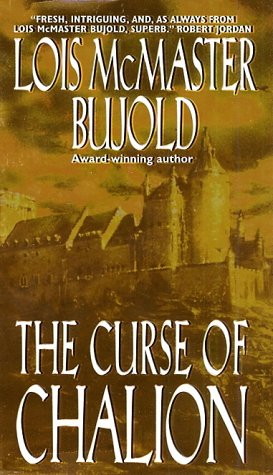
Lois McMaster Bujold: The Curse of Chalion

After the main character of her Miles Vorkosigan series got married, the series kind of stalled out and Lois McMaster Bujold turned to writing fantasy novels, of which this was the first. She’d previously written an uninspiring fantasy named The Spirit Ring, and since in general I’m not a fan of heroic fantasy I dithered for a long time before reading The Curse of Chalion, but since my book discussion group is reading its sequel Paladin of Souls this month, I finally sat down and tackled it.

Chalion is a nation in a generic European medieval fantasy setting, set between two other nations with whom it fights wars from time to time. Our hero, Cazaril, is a former soldier and a broken man; he’d once captained the defense of a castle until their negotiated surrender, and then he was left off the list of names ransomed back to Chalion and sold off as a galley-slave. Eventually freed, he returns to Chalion at the age of 35 – but in a body that feels far older – seeking some small employment with a noble family he’d served years before.

Cazaril gets a lot more than he bargained for, as the provencara of the castle is grandmother to the heir to the throne of Chalion, Teidez, and his sister Iselle. After just long enough to get his bearings, the provencara hires him as Iselle’s tutor (in an exchange which is probably the high point of the novel). This would be difficult enough except that not long after Teidez and Iselle are summoned to the throne of the kingdom. The king, Orico, is old and ill and is largely controlled by his chancellor, Martou dy Jironal, and his younger brother Dondo. The dy Jironals want to get their claws into Teidez and Iselle so they can control the next generation of the throne, and while Iselle is smart enough (with advice from Cazaril) to recognize that she’s being played, Teidez is easily seduced by the riches and flattery the brothers heap on him. Worse, for Cazaril, is that the brothers are responsible for his being sold off years ago, and he’s certain that they plan to get rid of him to cover one of the few tracks they’ve left. When the brothers try to force an alliance by marriage, several desperate souls are moved to stop them, including through the use of death magic – in which one sacrifices oneself to kill another – but things go strangely awry, to the confusion of everyone.

On top of this, it turns out that the royal family of Chalion has been cursed for several generations, that this is what’s holding down Orico, and that Teidez and Iselle will surely inherit the curse when they inherit the kingdom. So Cazaril and Iselle are put in the position of trying to end the curse – through means they can barely imagine – while trying to foil dy Jironal’s ongoing machinations. Along the way they meet some interesting allies while trying to avoid their myriad enemies.

While Bujold still meets the requirements of telling a story that goes somewhere, and flashes some of her skills with dialogue and humor at times, but overall I found this to be a bland book. The setting is relentlessly generic, with nothing to set it apart from any number of other heroic fantasy settings. The characters are also pretty generic, with a standard assortment of “strong women trying to rise above their medieval stereotypes”, “misguided young men”, “corrupt schemers trying to eliminate their rivals”, and so forth. The novel is essentially plot-driven, with character developments that seem de rigueuer given the story developments.

Unfortunately, one of the worst problems a plot-driven novel can have is to be slow, and The Curse of Chalion is oh-so-very slow. It starts with one of the least informative opening paragraphs I can recall in a novel, telling us essentially nothing about the setting, character, or scenario. From there the story drags on for over 50 pages before anything interesting happens, and then bogs down again for more than another 50 pages before the characters finally head off to the royal court. And though Bujold doesn’t generally write action stories, the dialogue here isn’t much to write home about, so the text doesn’t even keep things moving along through lively exchanges between the characters. It just drags.

The novel’s saving grace is Cazaril, the one character who has any, well, character, as a former soldier whose spirit has been broken and has to put himself back together again for the good of the kingdom and of Iselle. His position as the wise advisor to Iselle and some of the dumber supporting characters is a pretty stock position, and his rewards for deeds well done at the end are likewise routine, but his internal struggles to overcome his burdens make for the book’s most interesting moments, especially when he’s revealing his past to another character, or being amazed at the unique position in which he’s been placed.

But overall The Curse of Chalion is merely light entertainment, and it could easily have had 200 or so pages edited out of it. I was a big fan of Bujold’s earlier novels, but I think she peaked with Mirror Dance and her writing has been in decline ever since. This one’s one of her weakest, and it doesn’t give me optimism towards Paladin of Souls.

Twittering Away

A few weeks ago I gave in to peer pressure and joined Twitter. You can find me there under mrawdon. Okay, I wasn’t really being pressured, but I’d several of my cow-orkers were hanging out there making pithy remarks, so I decided to sign up.

I’ve joked that Twitter is “like blogging only without the pesky content”. I’ve also seen it called “microblogging”, which I take to mean, “There is content, but there isn’t very much of it.” Which seems about right: I see little tidbits of real content here and there, but most of Twitter consists of tiny, generic snippets of thought which are either devoid of depth, or devoid of meaning due to a lack of context.

It’s the lack of context that really makes Twitter a suboptimal experience compared to blogging: If I didn’t know the people I’m following personally, there’d be essentially nothing there for me. So it’s no surprise that the few times I’ve tried to go out and find new Twitterers to follow, I’ve come up empty because it’s all just random nattering without any context to give it meaning, or any depth to give it value in the absence of that context. (By contrast, I’ve found many fine journals and blogs over the years simply by poking around in one place or another on the Web, even if I didn’t know the author beforehand.)

If I were to use a single word to sum up Twitter, I think it would be “disposable”. It’s hard enough to build anything of lasting value in a blog format, and it looks to be nearly impossible on Twitter. I don’t expect to become educated or informed through Twitter, and I strongly doubt there’s anything of interest in “the archives”. Will I ever go back to look at my old tweets to recall what was, like I do with my journal? Probably not. I wonder whether anyone else does so with their tweets?

Clearly a lot of people are having fun on Twitter, though. A tool like Twitteriffic turns Twitter into something like a push-notification system, which means less effort on your part to keep up with what your friends are doing. (This isn’t very different from following a blog via an RSS feed, though.) But it seems like most of the fun is in following the snarky remarks and exchanges and the occasional raw outbursts that pepper the site.

So there’s some value in that; people have fun and get a few laughs. But there’s a lot of fun and plenty of laughs elsewhere in the world, and a lot of it is more rewarding when it’s not restricted to 140 characters.