Anti-Psychopath

The Scientific American podcast recently had an episode titled “Psychopathy’s Bright Side: Kevin Dutton on the Benefits of Being a Bit Psychopathic”. In it, interviewee Kevin Dutton says:

Psychopaths in everyday life, if I’m talking about what kinds of psychopathic characteristics serve people well in everyday life, well, psychopaths are assertive, psychopaths don’t procrastinate, psychopaths focus on the positives, psychopaths don’t take things personally, they don’t beat themselves up when things go wrong, and they’re very cool under pressure.”

I listened to this bit and thought, “Wow, I’m pretty much the anti-psychopath.” Not completely (I’m assertive in many circumstances and I sometimes focus on the positives), but mostly.

Psychopaths probably make good poker players.

(Dutton’s book on the subject is The Wisdom of Psychopaths: What Saints, Spies, and Serial Killers Can Teach Us About Success.)

The End of Comics Buyer’s Guide

I read this morning that the owner of Krause Publications has announced that the venerable comics periodical Comics Buyer’s Guide is ending its long run.

CBG (as it’s commonly known) was a regular part of my life for a long time. I first discovered it back in the mid-80s when voting for the annual CBG awards (which, at one time, were a big thing in comics) was announced in places other than CBG. I believe everyone who voted received a free copy of CBG #600 – I did, at any rate, and I’m pretty sure I didn’t pay for it. This was an extra-sized issue, the cover sporting a Mike Grell illustration for the upcoming Batman/Jon Sable mini-series (which as far as I know never actually happened). CBG was published in tabloid newspaper format, which was a novel thing for a teenager like me. It contained a huge letter column and was chock-full of comics news not readily available to most teenaged fans in those pre-Internet days.

I subscribed immediately. My first regular issue was #607 (which of course triggered my collector-mania to want to find #601-606, but I never actually tried). As I recall, the front page of that featured an article on the upcoming DC series Hex, which did see print. That first issue of Hex was cover-dated September 1985, which means CBG #600 must have come out sometime in 1984.

CBG was a weekly publication, and was anchored by three things: News, that voluminous letter column, and a large ad section in the back. The letter column saw the publication of several controversial letters over the years, most memorably (for me) that by “Name Withheld” arguing that comics writers were not really needed anymore since comics artists could do the writing side of the job perfectly well. Much hilarity ensued. I believe the identity of “Name Withheld” (one of the rare times a letter-writer’s identity was not published at his request by CBG) was eventually sleuthed to be a fairly notable comics artist, though I was never certain of it myself.

I subscribed to CBG for a little over 15 years – a bit past issue #1600, I think, so over 1000 issues – and I read it promptly and regularly for almost that whole span. I had a few (astonishingly poorly written) letters published in it over the years (my comics letterhacking career is not one I look back on fondly, for the most part), but despite that I enjoyed the hell out of the paper.

One enduring contribution CBG made to my life was the discovery of amateur press associations, and I spent a good chunk of the 1990s participating in a variety of APAs. I made several enduring friends directly or indirectly through membership in APA Centauri (which I discovered directly through CBG because the central mailer of the time ran classified ads to drum up membership in 1987) and Capacity.

CBG was edited by a couple of long-time comics fans, Don and Maggie Thompson, when I first subscribed. They were level-headed and even-handed (in my opinion, anyway), and kept the paper from going off the rails through various instances of tumult in its pages. Don passed away in 1994, which was a Big Deal for readers at the time, even for someone like me who was never really involved in comics fandom. Maggie continued to edit the paper solo afterwards.

I think CBG was ultimately done in by the Internet, as news and conversations drifted off to bulletin boards. It lost me when it converted to a monthly magazine format in 2004, as it was the weekly dose of news and letters which kept me interested in it; a monthly – but larger – publication didn’t interest me, as I liked reading each issue in a single sit-down, and the letter column became much less lively. My subscription happened to run out (a coincidence because I was renewing for multiple years at a time at that point) about a year later, and I decided that 1000 issues was an adequate run.

Some CBG writers have been observed the magazine’s end online:

  • John Jackson Miller outlines the history of CBG in a meaty obituary.
  • Maggie Thompson looks back briefly, and then looks ahead at what’s next for her.
  • Heidi MacDonald of The Beat reminisces.
  • Tony Isabella calls writing for CBG “the longest and one of the most rewarding continuing relationships of my career.”

Peter David regularly runs his old CBG columns on his web site, although it may be a while before we see another one, or a reminiscence of his own, as he recently had a stroke.

Though it’s been nearly 8 years since I stopped subscribing to CBG, its cancellation after over 40 years of publication (hey, it’s almost as old as I am!) still feels like the end of an era.

How The Big Bang Theory Works

There’s an ongoing kerfuffle in geekdom (certainly not restricted to this recently-popular post) over the TV sitcom The Big Bang Theory. (If you’re not familiar with the series, you can either read up about it, or just ignore this post.) The usual objection to the series is that we (the viewers) are supposed to identify with the character of Penny, and to laugh at the four geeky friends, Leonard, Sheldon, Howard and Raj. I know at least one person personally who feels this way.

I think this is at best a superficial understanding of the series, and perhaps an outright misunderstanding of it.

Now, I’m a fan of the series. It’s rare that I’m a fan of any sitcom, since I generally dislike situational comedy. The last sitcom I enjoyed before this was Sports Night, whose humor was based more on wordplay than on situations. BBT also has a lot of wordplay-based humor, but most of its humor is based in its characters rather than in situations. (I think the archetypal situation comedy is Three’s Company, which I loathe.)

One thing to keep in mind is that, as with any series, there are good episodes and bad episodes. One interesting thing about BBT is that even the bad episodes serve to highlight what it is that makes the show work when it does work.

I agree wholeheartedly with Akirlu that Leonard is the central character of the show. The reason for this is that Leonard both fills the role of “everygeek”, and of the geek who can relate in a fairly normal way with non-geeks. The reason all of this is true is that Leonard is highly self-aware and has a strong empathy for others. This is also what causes him to be the character who makes the funniest scenes even funnier.

Penny is in many ways the least important character in the show. She essentially serves as a foil for the four friends by being generically “normal”. But her character actually develops fairly little during the show, and we don’t know a lot about her (we don’t even know her last name!). Really, it’s a testament to actress Kaley Cuoco’s comedic acting skills that the character works. (Like Johnny Galecki, who plays Leonard, she has an impressive array of funny faces.)

The core of the show, though, are the four geeky friends, who works well together because they’re not wildly different, but rather vary from each other in well-defined ways. Here’s how their characters work:

  1. Leonard, As I stated earlier, is geeky, but he’s also very self-aware. He’s also keenly aware of the foibles of his friends. He is for the most part well-adjusted to living in society (heck, he’s at least as well-adjusted as I am!), is familiar with social conventions, and is comfortable talking to a wide variety of people. His shyness around women is not particularly unusual; lots of men are uncomfortable talking to women they are strongly attracted to (as he is to Penny from the outset).

    What makes Leonard work is that he is a basically normal guy, but with strong geek interests. This is what makes some episodes poignant, such as the one where he decides to give away all of his geeky possessions after being criticized by Penny for being too attached to them: It’s two sides of his character at war with each other. But if he wasn’t well attuned to society at large then his reactions to Sheldon’s absurd behaviors – often the funniest moments in the show – wouldn’t ring true.

    Leonard is the guy we’re supposed to identify with. Heck, Galecki is listed first in the credits, so that even seems to have been the creators’ intent from the outset!

    The episodes of BBT that work the least tend to involve ones where Leonard’s self-awareness goes AWOL and he just goes along with someone’s cockamamie plan (or follows his own bad instincts) without realizing that what he’s doing is a bad idea. Sometimes Leonard falls prey to his own foibles and just can’t help himself from doing the wrong thing even when he knows it’s the wrong thing, but that’s just him being human. It’s a big source of the show’s dramatic (and comedic) tension – will Leonard figure it out in time to stop himself, or will he come to a bad end?

  2. Sheldon is essentially Leonard’s opposite: He has no self-awareness and no empathy for others. He has very little shame, and only a rudimentary grasp of social norms. His brilliance has allowed him to craft a bubble in which he lives most of the time, and he ignorantly bulldozes his way through anything which isn’t part of his normal world.

    Actor Jim Parsons has deservedly gotten a lot of credit for the show’s success due to his performance, and Sheldon is the character who drives many of the plots of the show. But it’s often Leonard’s reactions to Sheldon’s foibles that make the show funny: Either his expressions of amazement at Sheldon’s behavior, his attempts to keep other people from inadvertently pushing Sheldon’s buttons, his occasional triumphs over Sheldon’s own efforts, or his attempts to accomplish something by performing an end-run around Sheldon’s structures.

  3. Howard is a sort of alternate Leonard: He’s also aware of his own foibles, but he either chooses to ignore that they make him a jerk, or he feels that he just has no hope of ever overcoming them and gives in to them. (I think it’s the latter, since his mending of his ways through his courtship with Bernadette is one of the series’ major chunks of character development.) He puts on an air of self-confidence that he doesn’t really feel. It’s easy to see that Leonard could fall into the same behavior if he didn’t have a basic understanding of and respect for other people.

    (Howard has a minor axis of humor based around his being a “bad Jew” and his relationship with his mother. These are not central to his character, but often make for some good one-liners.)

  4. Raj is Leonard taken to a different extreme: He’s very insecure in anything not related to his work or his geeky interests, he can’t talk to women, and he doesn’t feel comfortable in non-geeky social situations. Raj is in many ways the weakest character of the four, the one who might most justify a “laughing at them rather than with them” criticism of the show. On the other hand, Raj’s brightest moments come when he stands up to Sheldon (or anyone else) on subjects he does feel comfortable with (Star Trek his work, etc.).

    Raj’s weakness as a character is evident in that the writers have not really developed him over the years. Sheldon and Howard have both gotten girlfriends, Leonard continues to court Penny, Sheldon has developed a better understanding of social norms, Howard has been forced to grow up, etc. Raj is largely the same (except for being able to talk to women some of the time). There’s been an implication that Raj is gay, but until the writers actually tackle the subject head-on, I don’t really believe it (we’ve seen Raj sleep with several women along the way, seemingly perfectly comfortably, too; maybe he’s bisexual).

So the show’s characters are rather complex. Even Sheldon, who often is the butt of laughter in the series, work in this way because he doesn’t really care (or even understand) that people are laughing at him, and frankly he’s so full of himself that it’s hard to tell whether he’d care. Early in the series we laugh at Howard for being a jerk (whose jerkitude gets him into some unfortunate situations), but over time we see that he is a much deeper character than that and he achieves some degree of redemption.

But it’s really Leonard who holds it all together. Indeed, Leonard often serves as the voice of reason for Penny, who has her own foibles, obsessions and blind spots. (I really wish the writers would just send Penny back to school to do something with her life, since it doesn’t seem likely she’s going to become an actress. If they’re planning to end the series with her finally getting that big acting job, then I think they’re doing a big disservice to the character.)

I wonder whether the fact that Sheldon has been the breakout character in the series caused a few of the writers to think, “geeks being ignorant of social conventions is what makes the show funny!” and bled some of Sheldon’s character traits into the other characters on occasion. Fortunately it doesn’t happen very often.

I could go on (Amy Farrah Fowler and Bernadette are interesting additions to the cast, and I think comic ship owner Stuart is a good character who has been extraordinarily poorly handled), but I think that’s enough for one entry.

One last thing: I can’t help but wonder, when people who think that The Big Bang Theory is somehow disrespectful to geeks or geek culture, if that doesn’t say more about the people who feel that way than it does about the show.

Here’s to a Better 2013

Frankly my feeling about 2012 is that it shouldn’t let the door hit it on the way out.

The year started quietly enough, but in March Newton spent several days in the hospital. I honestly didn’t think he was going to make it when we brought him in, but he pulled through and is still with us today. It made for a really rough month, though.

Sadly, Blackjack wasn’t so lucky, as he passed away last month 20 months after being diagnosed with lymphoma. We don’t have any regrets about making the decision, but it made for an un-merry holiday season.

The second half of the year was dominated by my Mom’s affairs, which has been very stressful for me – and rather expensive, with three trips back east. In July I flew back to help take care of her while she was rehabbing from knee replacement surgery. This trip seemed like a big disruption at the time, but in hindsight – in contrast to what followed – I remember it as practically a vacation (albeit one where I was working remotely every workday): I had dinners with friends and with my Dad, and went down to visit Debbi’s family at their beach house three times. And Mom’s cat Maggie and I bonded in the evenings.

But this was just the beginning, as soon after I returned we decided that Mom would be moving into an assisted living home. This led to a second trip in August to take over managing her financial affairs. And another trip in October where my sister and I worked on going through her physical stuff. My uncle (who’s done this for family members himself) did give me some good advice, though, that many of the things I had to do are straightforward so long as you attend to them and don’t let them languish, and frankly he’s been right. As much as I’ve disliked having to do many of these things, I haven’t really run into any real problems in getting them done.

Anyway.

The whole year wasn’t bad. Debbi’s parents visited us in February, and my Dad came to visit in April. I got to see a lot of Dad this year with my trips back east; as I said at the end of the August trip, it was good to see him and Mom (and Debbi’s family), but the rest of the trip sucked.

And in November we expanded our furry family with the addition of Jackson and Sadie, who have been a handful but have also been a nice distraction from some of the other things going on.

So I dearly hope that 2013 will be a better year, with less stress and less sadness. I still have some worries about things I have to take care of, and I think I’m just going to be worried about Newton’s health from here on out (he will, after all turn 19 in April).

My hope for this year is that the tasks I have to accomplish for my family go smoothly, and that Debbi and I can take a few vacations. That and healthy kitties is all I really ask from this new year.

Webcomics I Read (2012 edition)

Just in time to beat the end of the calendar year, it’s time for my annual round-up of webcomics I’ve started reading in the past year. As usual, I cover both strips I liked and strips I that didn’t work for me, and quite a few in between. If you’re just interested in the good stuff, I’d most recommend Derelict, False Positive, Guilded Age, Widdershins, and Carpe Chaos.

You can find my past entries here: 2009, 2010, 2011.

Let’s get to it:

  1. The Adventures of the 19XX, by Paul Roman Martinez: I discovered this strip through its Kickstarter, and backed it because I find buying the physical collections is a great way to catch up on a long-running Webcomic (more convenient than clicking through a couple hundred web pages). The second volume is wrapping up on the web now. The premise is that of a group of adventurers in the early 1930s who are crossing the world looking for mystical artifacts which could change the future, perhaps by preventing the second World War that’s coming. They’re opposed in this by a secret cabal who want these artifacts for their own purposes (usually to rule the world). The story features a lot of period settings and technology, so it has an Indiana Jones feel to it.

    That said, I’m lukewarm towards the strip. The storytelling is pretty flat, and the dialog often feels stiff. The characters – and there are a lot of them – are pretty simple and their motivations are not very strong. Since the strip has a strong pulp feel all of this is in keeping with that, but there are a lot of pulpy stories around today which have more modern sensibilities underlying that pulp feel, and this one doesn’t measure up. The art is pretty good, but again often feels stiff, carefully laid out but not very fluid.

    Overall if adventures in this time period are your thing, then you’ll probably enjoy this. But if not, then it probably won’t be.

  2. Balazo, by Bachan: Bachan is the artist for Power Nap, and he’s quite good. Balazo is the English-language site of this Mexican illustrator’s work, and I’d characterize it as “lightweight, but entertaining”. It involves anthropomorphic characters, and focuses on the adventures of an outside-the-boundaries cop. In that way it somewhat resembles the print comics Grandville or Blacksad, but it’s not as hard-hitting or meaningful as either.
  3. Boston Metaphysical Society, by Madeleine Holly-Rosing & Emily Hu: I came across this at APE and decided to check it out. It looks like it’s being published as a webcomic with the intent of ultimately publishing it as a comic book mini-series. It’s a steampunk adventure about a group working to contain psychic forces which have been unleashed on the world, in the structure of a young woman trying to persuade an experienced male agent to let her accompany him. Various historical figures show up, too.

    In the large, it resembles The 19XX, down to similar flaws in both writing and art. It’s okay, but feels very rough. (The site also feels like it was assembled around the turn of the millennium and is awkward to follow from the RSS feed.)

  4. Carpe Chaos, by Eric Carter, Jason Bane, Anthony Cournoyer, Daniel Allen and others: I picked up a collection of this science fiction webcomic at APE last year, but it took me a while to catch up on the full site. This is a “soft” SF story, in that it’s more space opera then crunchy science; it focuses on the interactions of several alien races (which all look extremely alien), exploring themes of tolerance, understanding, difference, prejudice, and the like, highlighted by the different outlooks of each of the species. It’s very well done, and the individual stories are generally excellent. The creators clearly have a large universe they’re working in, but it’s often not at all apparent to the reader at which point on the timeline a story occurs, which makes some of the stories a little confusing. Other than that my biggest complaint is that it updates infrequently, but it’s well worth reading. All-digital art by multiple artists is quite good, too.
  5. Cat vs. Human, by Yasmine Surovec: Gag-a-day comics about the author and her feline obsession. Funny if you love cats, probably not if you don’t.
  6. Cyanide and Happiness, by various: Another gag-a-day strip by multiple people, all working in a common almost-stick figure style. Highly cynical and irreverent, often being deliberate obscene, occasionally with punchlines that seem like non-sequiturs. I guess this is one of the more popular webcomics, but I think it’s merely okay. If you can’t tolerate gratuitous obscenity and nastiness in a strip, then avoid.
  7. Derelict, by Ben Fleuter: After going a while without finding a new webcomic I really adored, Derelict was a revelation: Fantastic artwork, fine world-building, and a gripping story. The heroine is a young woman in a future after the world has been flooded, operating her own salvage ship and trying to stay alive in a changed world where no one can be counted on to be friendly (and which is also populated with some strange things). The details in the art are stunning at times, and the atmosphere of loneliness punctuated by occasional hope is powerful. The biggest downsides are that the heroine’s face sometimes looks awkward (although she’s very expressive), and the erratic update schedule. Despite these, I still recommend it highly.
  8. False Positive, by Mike Walton: An anthology comic written and mostly drawn by Walton, each story lasts a few weeks and is frequently in the horror vein. If you enjoy The Twilight Zone then you’ll probably enjoy this, although the illustrations are sometimes quite graphic. Walton’s art is outstanding, and his coloring – which uses a distinct limited palette for each story – compliments the art very well. “Season two” just started, but read through season one – you won’t be disappointed.
  9. Guilded Age, by T. Campbell, Phil Kahn, Erica Henderson & John Waltrip: I had tried to read this once before and got bogged down, I don’t know why. When I tried again this year, I was hooked. From the start it’s an entertaining medieval fantasy strip (I guess it’s based around World of Warcraft), though it takes a few chapters to get going as initially it’s a series of vignettes mixing adventure and comedy, focusing on a band of five heroes. The strip features a number of anachronisms, especially in turns of phrase and the attitudes of the characters, which seem to be there to add some color and relatability for the reader.

    The strip really comes together in chapter 8, which reveals a number of previously-unrevealed things about the world, and providing a larger structure for the story which makes you really feel for our heroes. There are strong indications of what’s really going on, but it’s taking a while to get there (not that the journey isn’t enjoyable on its own).

    Read this one from the beginning; there are several hundred pages to catch up on, but it’s worth it. Just be a little forgiving of the first few chapters, until the story finds its feet.

  10. The Hero Business, by Bill Walko: A superhero strip in which the heroes have a publicity company, it’s been around for a while but I just started reading it recently. It’s written like a soap opera, drawing comparisons in my mind to Love and Capes. L&C is to my mind the better of the two, having a stronger character focus and, well, generally better gags. Walko’s art is quite stylized, with the characters all looking like teenagers to my eye. Overall it’s a cheerful strip – kind of an homage to 60s and 70s superhero comics – which hasn’t won me over yet.
  11. Incidental Comics, by Grant Snider: This came to my attention via his oft-reblogged comic “Pig Latin”, his site is a series of understated, philosophical jokes which should appeal to fans of xkcd or certain New Yorker cartoonists. A recent favorite of mine is “Story Structures”. His art is somewhat minimalist, but still eye-pleasing.
  12. Rich Morris: An artist who did an epic Doctor Who comic titled “The Ten Doctors”, and who does various other strips on this site. These are strips he does for fun in his spare time, so the art is often sketchy, but he’s obviously quite skilled (I think he’s a commercial artist by profession), and TTD is very good. He hasn’t updated much since I started following him, but check out his archives.
  13. Nerf Now!!, by Josué Pereira: I have to say this is one of those strips that I just don’t get, at all. I think it’s a somewhat meta strip based around video games? It seems to involve a curvaceous woman and her friend who is a tentacle (?), in a series of gags without a running storyline. It’s drawn in a simple manga-esque style, but I just don’t get it.
  14. The Oatmeal, by Matthew Inman: Another irreverent gag strip, whose creator got a lot of attention recently for thumbing his nose at a lawyer who pressured him. That incident aside, the comic is generally funny, though probably not everyone’s cup of tea. Inman’s exuberance comes through in every panel, including in his ode to Nikola Tesla, giving it a rather different attitude than the usual wry humor of many gag-a-day strips, and one that feels more genuine than, say, Cyanide and Happiness, which often seems nasty just to be nasty. The Oatmeal is surely not for everyone, but I like it.
  15. The People That Melt in the Rain, by Carolyn Watson Dubisch and Mike Dubisch: A creepy comic about a mother and her daughter who move to a new town and promptly get rained on by frogs, and then learn that actual rain burns the people who live there. The comic follows the daughter, Laura, learning about the curse that hangs over the town, and the various effects it has on its inhabitants and visitors. The strip went on an extended hiatus, and when it came back the art seemed sketchier and murkier than before, and the story feels like it’s meandering around rather than making progress. It’s okay – you might find it easier to follow than I have.
  16. Saturday Morning Breakfast Cereal, by Zach Weiner: SMBC is a popular gag-a-day strip with no recurring characters and strips that run from a single panel to ten or twelve. Subject matter is typically irreverent and sometimes over-the-top, with a regular theme of taking ideas to their logical and ridiculous extreme. Despite this, the strip doesn’t really grab me: It’s not as clever as xkcd, not as profane as Cyanide and Happiness, and the art is simple bordering on sketchy. I know lots of people who are fans, but it doesn’t do a lot for me.
  17. Shortpacked!, by David Wallis: I’ve actually already stopped reading this one. It’s a slice-of-life strip centered around employees of a toy store, with hijinks that regularly ensue, but it just didn’t grab me: I found it hard to tell the characters apart and the gags didn’t really work for me. The art is okay, on the simple side. Overall I think Comic Critics covers similar territory more effectively (though to be fair I find a comic shop a lot more interesting than a toy store). On the flip side, All New Issues also takes place around a comic book store, and I like it only a little more than Shortpacked!
  18. Wesslingsaung, by Eric Cochrane: This has to be the most exotic comic I’ve found this year, as most of the characters are nothuman. The title character is, well, I think he’s an adventurer who travels his world – occasionally traveling through time – with a centipede-like partner named Gossip. Wesslingsaung is looking for humans, and eventually finds one, and then his adventures really begin.

    It’s a strangely compelling strip, although its dreamlike quality and loose plot has made it hard for me to follow, and the characters’ motivations are still murky to me. It feels like it could be a much better strip with some additional clarity. On the other hand, the inventiveness is appealing, and though Cochrane’s art is fairly simple, it’s equal to the story in inventiveness. So I’m sticking with it to see where it’s going.

  19. Widdershins, by Kate Ashwin: Taking place on the cusp of the Victorian age (the first story starts in 1833), Widdershins is a town in an England where magic is real. There have been two complete – but separate – stories so far. The first features artefact hunter Harry Barber and down-on-his-luck young wizard Sidney Malik forced to work together to recover a valuable treasure. The second involves a pair of wanderers who get caught up in an evil plot involving mystical spirits. The third story started recently and returns to Barber and Malik for their next adventure That’s putting it all very simply, but both adventures involve colorful characters and incredible plots, and it’s quite a fun ride. Ashwin’s art is on the cartoony side, but detailed enough, and it fits the fairly lighthearted tone of the strip. Refreshingly, it’s not really steampunk because all the fantastic elements are magic, not science.

    It also had a Kickstarter recently.

  20. The Wormworld Saga, by Daniel Lieske: This is not your typical webcomic. For one thing, each chapter is published in its entirety when Lieske finishes it, with several months between each (there are four chapters currently up, the last having been published in August). For another, each chapter is a single vertical “page” with panels arranged within it, and you scroll down continuously to read it. This gives it a look like no other webcomic I’ve seen, and the fact that Lieske’s full-color art is gorgeous helps too.

    As for the story, it’s about a boy in our world in 1977 who discovers a portal in his grandparents’ house to another world, a fantasy world in which he is apparently destined to be a major participant. It has themes of childhood imagination and wonder, but also alienation and being thrown into adult concerns while still a child. But while lavishly envisioned and illustrated, the story is (so far) not much more than that; I enjoyed reading it more for the art than because I really wanted to know what happens next. I’m also somewhat suspicious of any story with the world “saga” in the title, as it always strikes me as being a little pretentious (or at least non-descriptive). But if youthful fantasy if what you like, then you’ll probably love this.

Alastair Reynolds: Blue Remembered Earth

Blue Remembered Earth is near-future SF, taking place in the 2160s. Following two centuries of climate change (global temperature shifts, depletion of traditional energy supplies, rising sea levels), Africa is on the cusp of displacing China as the dominant world power. The powerful Akinya family dominates Africa and has interests throughout the solar system, to which humanity is still confined.

Geoffrey Akinya and his sister Sunday are inheritors of the Akinya legacy, but both are marginalized by their family due to a shared lack of interest in its business affairs: Geoffrey researches elephants, while Sunday is an artist on the moon. But when their grandmother Eunice dies, their business-oriented cousins enlist Geoffrey to go to the moon to check out a safety deposit box she left behind. What he finds sends him and his sister on a treasure hunt throughout the solar system, following her path as an early explorer of Mars and beyond, despite great resistance from their cousins.

The novel has two major characteristics: It’s a world-building endeavor, and it’s a science fictional mystery involving a trail that Eunice left for her family to follow.

In general, I’m not a big fan of near-future SF, because the ideas are not big enough to satisfy me, and I’m just not terribly interested in extrapolating our current situation out only a century or two (i.e., a period where things are largely similar to our world today with some fairly straightforward changes). I appreciate what, for example, Charles Stross is doing in Halting State and Rule 34, but it’s more the story than the setting which pulls me along. I particularly dislike settings like that of Paolo Bacigalupi’s The Windup Girl, with dreary settings, little hope, and unlikeable characters.

Blue Remembered Earth falls into a slightly different category: The setting isn’t dystopic, and the story is a mystery wrapped in the shrouds of history (a bit like Jack McDevitt‘s Alex Benedict novels in that way). Rather than the characters playing out a set of movements implied by the setting, they’re involved in their own story against a slightly exotic locale. And the mystery implies that there’s something a little more advanced out there as well, assuming it pays off properly. (I’ll talk about the mystery in more detail behind a spoiler cut below.)

This is one of Reynolds’ best efforts at world-building, and he does a good job of laying things out without it becoming tedious (although I did find Geoffrey’s research with elephants to be hard going). Some of the big hooks involve an omniscient surveillance system called the Mechanism which has essentially eliminated violent crime, aquatic transhumans, and most humans having virtual reality implants. There’s also a tension in manned space exploration being potentially supplanted by unmanned, as artificial intelligence gets to the point that it can take on the risks so humans don’t have to. (And if that sounds like a disappointing development, well, that’s one of the themes of the book.)

Geoffrey and Sunday’s quest operates as a travelogue of the solar system, as Geoffrey goes to the moon where he visited Sunday in the “Descrutinized Zone”, which is free of the Mechanism. There’s also a trip to Mars, which is just barely on the civilized side of being a frontier and has a few amazing wonders of its own. They’re accompanied in this by a telepresence simulation of Eunice herself, who embodies the character of the woman but naturally lacks many of her memories. But as Eunice was both family to the pair, and a significant figure in the exploration of the solar system, she plays a significant role.

Reynolds’ characterizations are not his strong suit, and BRE is not out of step with the rest of his work in this regard: Geoffrey, Sunday and Eunice are reasonably drawn, the other characters are largely two-dimensional. And there’s not a lot of character development – Geoffrey struggles a bit with not wanting to make waves with his family beyond what’s necessary for his research, but doesn’t want to just roll over and do whatever the cousins want, either. This tension does come to a head, but the resolution is somewhat dictated by outside forces, so there’s not a moment of epiphany or a significant character shift for him.

Blue Remembered Earth is sometimes noted as the first volume of a series titled “Poseideon’s Children”, but there’s almost no indication of that in the edition I have (save an offhanded comment in the author’s afterward), and the book in fact stands on its own perfectly well, not so much the first of a series as a novel which could have sequels.

Overall it’s a pretty good book, an enjoyable ride, probably sitting somewhere in the middle of Reynolds’ oeuvre in my opinion.

As promised, a little more spoilery commentary on the mystery side of the story after the cut:

Continue reading “Alastair Reynolds: Blue Remembered Earth”
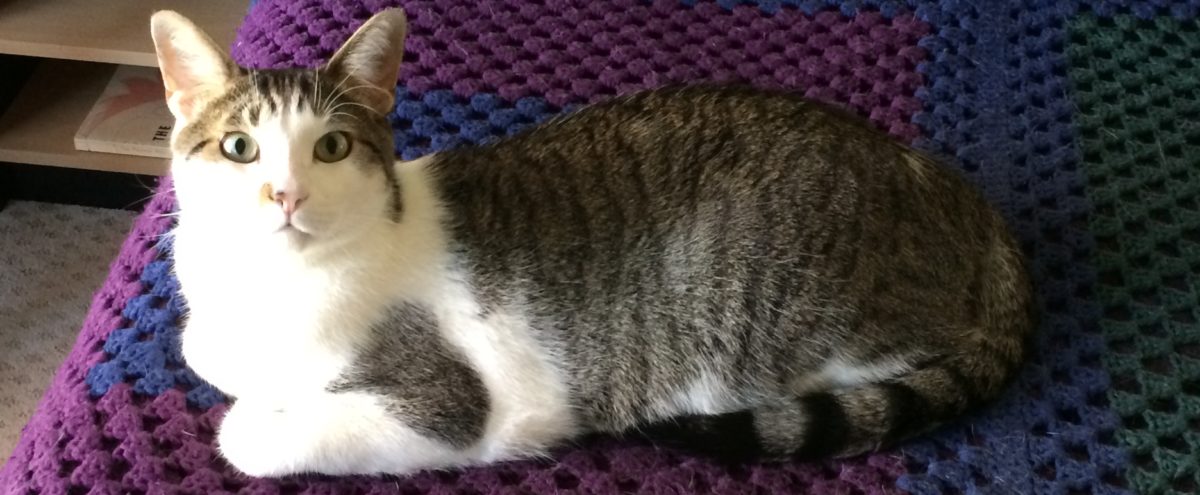
Kitten Distraction

The kittens have been a nice distraction from Blackjack’s passing. They’re getting big so quickly! A about two weeks ago we started letting them out of their room to start exploring. First we let them have half the upstairs hallway and a bathroom, then the whole upstairs (guarded by a baby gate and a human sitting at it at the top of the stairs). They loved chasing each other back and forth through the hall and bedrooms, and they explored the bathrooms, and the beds, and various other things.

A melancholy moment was when Sadie went to the laundry basket where she’d encountered Blackjack before, and we’re pretty sure she remembered him and was looking for him, as he was the first kitty she’d really met. I like to think Sadie and Blackjack would have become friends, had things gone differently.

Anyway.

Last weekend we opened up the whole house to them (except for the study and the laundry room). They careened down the stairs and suffered a major traction loss when they got to the hardwood floors downstairs, but since then they’ve loved it! Jackson likes hanging out under the Christmas tree (and we have to stop him from chewing on it), and they both like to scale the cat tree.

I think it took the better part of the two days last weekend for them to finally calm down enough to sit and snooze with us. At times we’d see Sadie walking around looking absolutely exhausted, but she was still so excited that she didn’t want to sleep because she might miss something! But eventually they napped: Sadie sleeps loafed up on a couch cushion, while Jackson sleeps on his side with his legs sticking out. And then they wake up and do it all over again.

Lick Time
(click for larger image)

We still put them in their room overnight or when we’re leaving the house (and sometimes just to give the big cats a break from them), but they’re totally looking forward to being out all the time. And we’re being really careful when we go outside when they’re out to make sure they don’t try to dart outside.

The big cats are doing okay with them. There’s been some hissing. Jackson seems to back off when hissed at, he doesn’t want to get smacked down. Sadie, though, runs after Roulette and paws at her even when hissed at; I think those two are going to have to throw down at some point. If Roulette would just smack her a couple of times that might resolve things, but so far she hasn’t. Sadie has even tackled Newton on the couch a couple of times!

Roulette ran upstairs the first few times we let them out, but now she stays downstairs and is usually either under the futon, or on the back of the couch, watching them. Newton followed them around a little, but now isn’t very interested unless they disturb his sleep. Jackson likes to go sleep with him sometimes, and he gives Newton a bath when he does (Newton has mostly stopped grooming himself in his old age). One time I heard Newton meow, and I went over to find him ready to jump off the couch, while Sadie was upside-down, on her head, back to the couch cushion looking at him. “Extreme kitten flirting” I called it.

Snoozing with Newton Snoozing with Michael and Newton

Debbi’s started giving all four cats wet cat food together as a treat, and they’re all pretty accommodating. Jackson is a bit of a bully trying to get the others cats’ food, and Roulette is torn between wet food (her favoritest thing) and staying away from the kittens – the food wins. To her credit, she’s also played with Debbi and the kittens when Debbi brings out a toy, so she’s starting to get used to them.

Who's That? Sitting with Debbi

The kittens’ personalities are slowly emerging. Jackson is full of energy, is easily distracted, but is also the snuggler when he finally winds down. He’s also got the extra-loud purr. Sadie paces herself a little better, isn’t quite as aggressive, but also interacts with the humans less. I think she’s still trying to figure out how to get people to love her. I hope she becomes more snuggly because she has extra-soft fur which is great to pet.

The kittens have been a lot of work, but they’re also a lot of fun. They keep themselves entertained a lot, and then crash and hang out with us for a while. The big cats are still not too happy about it all, but I think they’re slowly coming around.

Hi there!

Iain M. Banks: Matter

I read Matter last year around the same time I read Surface Detail, but they’re two very different books. While I quite enjoyed Surface Detail, I found Matter to be fairly tedious, and the ending to be a big letdown. This review contains mild spoilers.

The story revolves around members of the royal family of the Sarl, a medieval-level humanoid race who live on one of the levels of the artificial shell world of Sursamen. Ferbin, the heir to the throne, is forced to flee his nation when his father is betrayed and overthrown by his second-in-command, tyl Loesp. His younger brother, Oramen, is installed as regent, but tyl Loesp plans to kill him and become king himself when the time is right. Thirdly, their sister Djan Seriy Anaplian was gifted to the Culture years earlier where she’s become an agent of Special Circumstances, a group tasked with especially difficult and important missions.

While Anaplian travels back to Sursamen – a little tricky since it lies outside Culture space – Ferbin works to get out into space to contact her, while Oramen works to stay alive even as he is effectively exiled to oversee excavation of the Nameless City on the adjacent level the Sarl have recently conquered. He also learns that the Sarl’s advanced patrons, the Oct, are up to something in the Nameless City. That something turns out to be of extreme importance – and danger – to all of Sursamen, which Anaplian and Ferbin find they have to stop once they get to the planet.

When I started reading the book, my first reaction was, “Uh-oh, another medieval-setting Culture novel,” having not been especially enamored of Inversions. It’s better than that novel in many ways, as Ferbin and Oramen both being forced to grow up and deal with the new realities of their lives is expertly handled. And Anaplian’s adventurs outside Sursamen are also entertaining.

Unfortunately, the larger threat from the Nameless City really undercuts all of the nice character development, truncating the growing tensions in much the same way that Janet Leigh’s stop in the hotel truncates the story in Psycho. It then becomes a very different story, which itself has an unsatisfying ending, as nearly everyone comes to grief. While it’s a page-turning ride, the conclusion feels devoid of meaning and borders on a throw-the-book-across-the-room experience.

The enduring character of the story is Ferbin’s aide, Holse, who is a lower class man who is devotedly loyal to his master, largely at sea in the advanced environments he and Ferbin travel to, but who has enough presence of mind and sense of self not to be overwhelmed by them. But he’s not enough to save the book.

Banks’ Culture series is pretty uneven, with some great books and some weak ones. Matter is towards the lower end of the spectrum, which is too bad because it starts promisingly.

Jack McDevitt: Firebird

I’ve given McDevitt a hard time over his Alex Benedict novels since the terrific A Talent For War, but I’m happy to report that the latest in the series, Firebird, is the best since that inaugural effort, with a genuine sense of wonder, a nifty plot twist and a satisfying conclusion.

The story opens with antiquities dealer Benedict’s aide, Chase Kolpath, being approached to sell some items from the estate of Christopher Robin, a physicist of some note who disappeared several decades earlier. (Yes, unfortunately the disappeared man has the same name as the boy in Winnie-the-Pooh, but oh well.) Chase doesn’t know who he is, but Alex fills her in: Robin was notes as being a proponent of there being alternate realities, and supposedly having been trying to find a way to them. One evening he returned from a trip with his pilot, who dropped him off in front of his house, and he disappeared. The pilot then volunteered to help with rescue efforts in a major earthquake and was killed in the process. While Robin is assumed to have died, no one knows for sure. Maybe he found a a way to other realities and simply stepped into one.

Alex doesn’t really believe this, but hits the talk show circuit to build up Robin’s mystique to make the most money for his client. But then, as always happens, he gets bitten by the bug to find out what really happened to Robin. THe investigation turns up a few facts: That Robin had become interested in reports of mysterious ships that occasionally appear near worlds, stations or other ships and then disappear without ever being identified. That he had a friend he went on missions with who was killed on one of them. That he was interested in a world named Villanueva, where human life had died out centuries ago but the trappings of it had been left intact. And that he had bought several old spaceships and taken them out in the 15 years or so before his death, returning without any of them. It all adds up to something that doesn’t equal parallel realities, but does equal something just about as cool, which even raises the specter of one of the earliest background elements of the series.

McDevitt often stretches to put Alex and Chase in danger, sometimes a little too far as neither of them is a fighter, and the risks they take sometimes seem ridiculous. But he does a better job of balancing this than in recent novels. He also does a good job of taking one of the side plots and turning it into a serious moral dilemma and distraction from the main plot.

Best of all, once we learn what’s really going on, he lets Alex and Chase get to the meat of the problem, and there are several wrenching scenes where we learn what happens to several characters. Fortunately there’s also a satisfying afterward which ties up one of the loose ends. So McDevitt really gets just about everything right in the novel.

Overall the story doesn’t have quite the impact of Talent, and the nature of the series takes just a little wind out of the sails of the potential of the story (in a true standalone novel, there’s the potential for a lot more exploration of the plot twist which can’t really happen here without revealing more about Alex and Chase than can really happen here). But it’s still a really fun novel, and quite a page-turner too. If you’ve bailed on the series prior to this, I suggest getting back on board at least for this installment.

Remembering Blackjack 2003-2012

Debbi says that when she went to get Blackjack and Roulette she knew Blackjack was the cat for her. I think she got Roulette partly because Roulette seemed to like me, but Blackjack was the cat for her. She wanted a black cat, and he played hard and seemed to like people. He came with his name, while Debbi came up with “Roulette” to match him.

Blackjack was a little sick as a kitten, but got over it. Then he became all kinds of trouble! He was bold and liked to check everything out. And after he played hard, he crashed hard and slept hard. He just kept going until he was done, and then he climbed somewhere he felt safe and zonked out.


(click the thumbnails for larger images)

Blackjack also chose Debbi as his human. He would often nuzzle at her neck while kneading her and purring, something we called “giving her wuv”. He only did this for me once, when he was a kitten and she was visiting her family back east and had left them with me. But otherwise this was something he saved for her.

I think he had designs on becoming top cat when he came to my place, but Jefferson knocked him off of that idea promptly. Then he and Newton started fighting to see who would be second cat. We called them the “silent wrestlers”, as they would struggle on the floor without meowing or yelping. I’m not sure who won that struggle, since when Jefferson passed away we think Roulette moved from being bottom cat to being top cat, without anyone putting up a fight.


Blackjack was a very demonstrative kitty: He would often fall asleep on the floor, and then eventually end up lying on his back, exposing his tummy for everyone to see. We think he meant he was happy and comfortable with us. He was also very strong, being 14 pounds of pretty solid muscle, with powerful hind legs that could let him leap sideways quite some distance from a starting position. He had the most pathetic meow, sounding like someone was torturing him, when he was perfectly fine. Since he was all black, he could meow without us seeing his mouth open, which was pretty weird at times.

Like I said, he was a trouble-maker: He was a shoelace chewer. He liked to eat vegetables: Corn, frozen peas, and he’s gnaw on banana peels. Once he went deaf he got even pushier at the dinner table, trying to grab our food, and of course saying “no!” to him would have no effect! He would sometimes pull out one of his nails grooming himself, with just the quick sticking out from his paw. The nail always grew back, but that was kind of strange.

He and his sister wrestled and chased each other a lot. When they started chasing each other upstairs at the townhouse Debbi would say, “The elephants have been released!” Blackjack would often play harder than Roulette really wanted, and she’d meow in protest until we separated them. But he didn’t bite or otherwise cross the line.


Blackjack was – along with Newton – our social cat. He’d hang out when we had visitors, and as recently as last month he was up on the dining room table checking out what we were up to when I had friends over to play Magic. When our friends Lisa and Michel brought their daughter Isabella over, he was the one who eventually went over to check her out. She sat down and he sniffed her from toe to head, with her looking a bit startled by it all. Then he decided that was good enough for him and he left.


He would find strange places to sleep: Under the shelves in the closet at the townhouse. Under the desk. In the laundry basket. Places where it was hard to spot him because he was all black! He liked sleeping under the Christmas tree, too. He also discovered the heating vents under the cabinets in the new house, and enjoyed sitting in front of them last winter; he’d usually be in front of one every morning when I came down. He liked looking out the window, and was more curious than agitated when we got outdoor feline visitors (whereas Roulette would go nuts over the intruder).

And of course he would play: Jump after toys, run up and down the stairs. My Mom gave us a two-foot-long tube with fleece on the inside, and I could get him to run back and forth through it for quite a while. And then he’d get tired and he’d sack out inside it. Like the other cats, he enjoyed being carried outside, but he was especially aggressive about trying to eat grass if we put him down, so we usually didn’t.

I wanted to end with what I think is the quintessential Blackjack picture. He was still young when Debbi took this picture with her phone, but it captures his innocence and curiosity. He still had his whole life ahead of him and he was ready to enjoy every minute:

Goodbye, fella.