This Week’s Haul

  • Fables #100, by Bill Willingham, Mark Buckingham, Steve Leialoha, Andrew Pepoy, Chrissie Zullo & others (DC/Vertigo)
  • First Wave #5 of 6, by Brian Azzarello, Rags Morales & Rick Bryant (DC)
  • Knight and Squire #3 of 6, by Paul Cornell & Jimmy Broxton (DC)
  • Echo #26, by Terry Moore (Abstract)
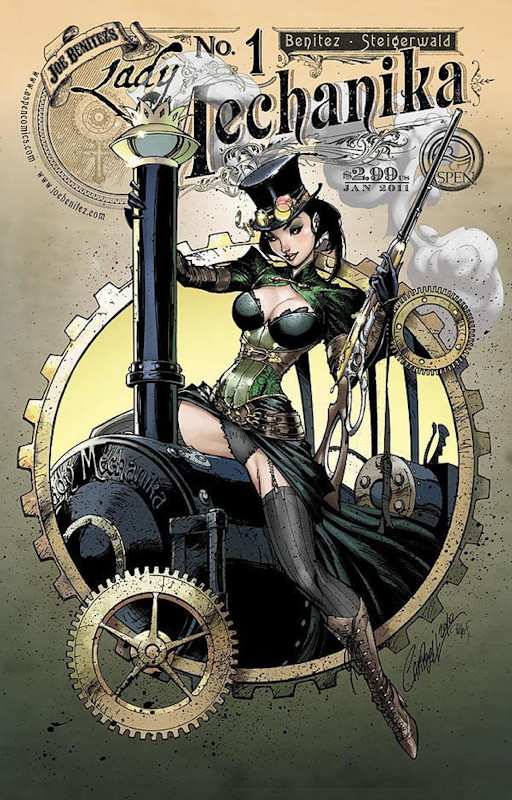
  • Lady Mechanika #1, by Joe Benitez (Aspen)
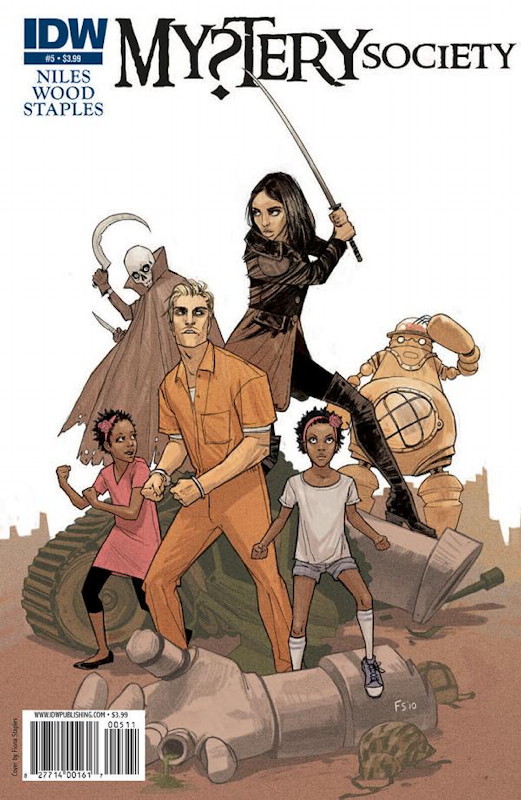
  • The Mystery Society #5 of 5, by Steve Niles & Fiona Staples (IDW)
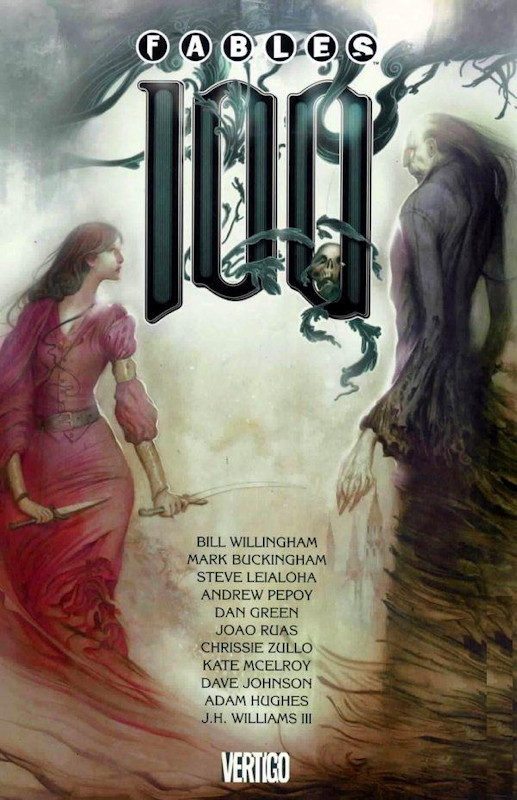
Fables reaches the big one-zero-zero this month – quite a milestone for a comic that features no superheroes at all. I’ve been on board since the beginning, and while it’s had its ups and downs, it’s been quite a fun ride.

Since the war against The Adversary wrapped up in #75, the book has taken an even darker turn (and considering the book’s first story arc was entitled “Legends in Exile”, that’s saying something): A powerful entity named Mister Dark (whom some compare to Neil Gaiman’s character Morpheus, but I think the similarity is superficial at best) destroyed Fabletown, forcing the surviving fables to flee to The Farm in upstate New York. Mister Dark has been building his own edifice atop the remains of Fabletown, but finally someone has dared to challenge him: Frau Totenkinder, having been reborn as a young woman and calling herself Bellflower, engages him in a duel to the death of one of them in this issue.

The Mister Dark storyline has had some gripping moments, but overall the series has felt somewhat adrift, much like the Fables themselves. The most recent story arc highlighted the backstory of Rose Red, and her getting her act together to be a leader on the Farm again. But since Bellflower is the one who actually brings the fight to Mister Dark, that arc now feels a little superfluous. Fables has always tended to take a circuitous route to the end of its stories, but whether they end up being fun has depended more on the characters involved than anything else; Bigby Wolf, Snow White and Boy Blue carried the first 75 issues, but the recent focus on Rose Red and the witches has been a lot less successful, as none of them have really been sympathetic characters. More to the point, they’re all fairly inwardly-turned characters, so their interactions with the other Fables tend to be not very entertaining.

The conclusion of this issue is disappointing since it’s more of a transition than an end to the Mister Dark story, and I was really ready for his story to be over. The big fight in the issue is quite well done, but I’d been hoping for a different outcome.

The issue contains lots of extras – short stories, even paper doll cut-outs – which feels like an anniversary issue or giant-sized “annual” of years past. Certainly a nice package. I’d just been hoping for more out of the main story.

I don’t think I’ve ever bought anything rom Aspen Comics before – they seem to largely specialize in ladies-in-skimpy-costumes fare with run-of-the-mill stories. But Joe Benitez’ new steampunk series Lady Mechanika interested me. (That cover on the left, by the way, is by J. Scott Campbell, and is awful. The main cover, which you can see here is much better. But the Campbell cover is the only one my retailer still had in stock when I was there.) Certainly steampunk doesn’t have a shortage of improbably-skin-baring Victorian ladieswear, and Lady Mechanika‘s interiors seem right in keeping with the genre as I’ve seen it otherwise.

The story is okay: Lady Mechanika is an almost-legendary vigilante in the English city of Mechanika, a woman who’s left-machine, but whose role in the city’s life seems vague (is she a protector or avenger like Batman, or just someone investigating other unusual creatures like herself?). In this issue she’s looking into a report of another woman who’s turned up in the city with mechanical limbs, who promptly died after her arrival. The story and art are long on atmosphere, but short on plot advancement or characterization. It’s not bad, by any means, but it’s lightweight. I’m not familiar with Joe Benitez’ work, but he’s a pretty good artist, definitely a cut above the typical Image-style artist.

The book has some promise, but it’s also at great risk of being an ordinary steampunk adventure. Time will tell which direction it heads.

Steve Niles’ The Mystery Society wraps up this month. As a new entry in the monster-hunter adventure genre (alongside Hellboy and The Perhapanauts), it holds up quite well, with a strong dose of The Thin Man-inspired marital intrigue between Nick and Anastasia Mystery, with several peculiar characters joining them in their quest to investigate strange occurrences and liberate mysterious objects from around the world. It’s not going to set the world on fire, but it’s fun and funny.

The best part, I think, has been watching artist Fiona Staples develop, expanding her range of expressions and poses. Her biggest drawback as an artist is that her backgrounds tend to be sketchy-to-nonexistent, which makes the book feel like it’s taking place in a multicolored mist at times. Hopefully she’ll flesh out that part of her skill set on her next project.

I don’t know that The Mystery Society has a huge amount of long-term potential, but I’d read another series about these characters. Whether I’d go beyond that depends on whether Niles has some solid character surprises up his sleeve.

This Week’s Haul

Despite having Thanksgiving week off, I never did an entry for that week, so here’s the catch-up:

Last Week:

  • Action Comics #895, by Paul Cornell & Pete Woods (DC)
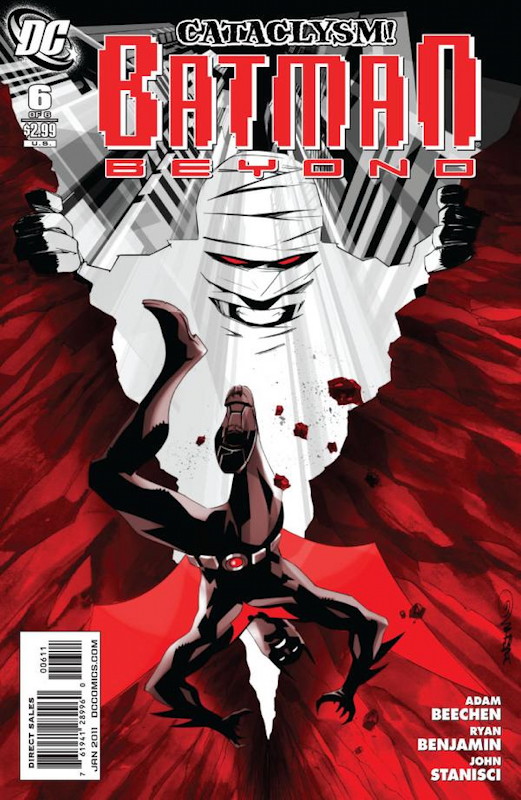
  • Batman Beyond #6 of 6, by Adam Beechen, Ryan Benjamin & John Stanisci (DC)
  • Justice Society of America #45, by Marc Guggenheim & Scott Kolins (DC)
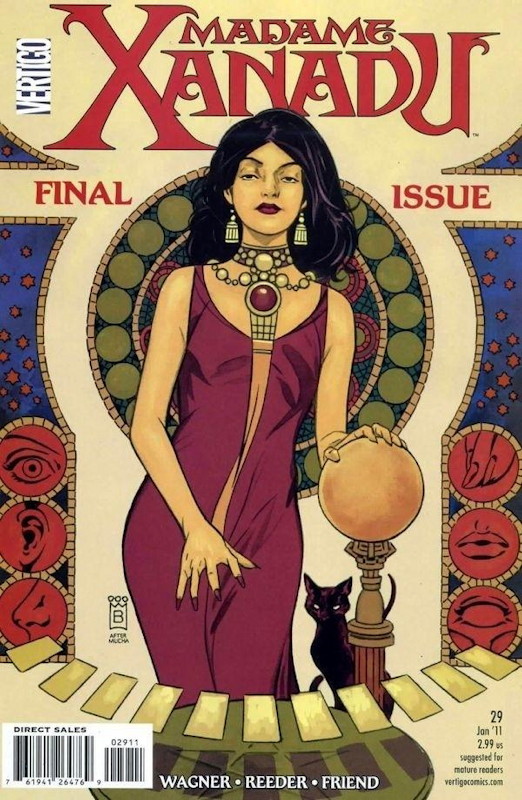
  • Madame Xanadu #29, by Matt Wagner, Amy Reeder & Richard Friend (DC/Vertigo)
  • Captain America #612, by Ed Brubaker & Butch Guice (Marvel)
  • Fantastic Four #585, by Jonathan Hickman & Steve Epting (Marvel)
  • Chip: Second Crack #2 of 3, by Richard Moore (Antarctic)
  • Incorruptible #12, by Mark Waid & Marcio Takara (Boom)

This Week:

  • Action Comics Annual #12, by Paul Cornell, Marco Rudy & Ed Benes (DC)
  • American Vampire #9, by Scott Snyder, Rafael Albuquerque & Mateus Santolouco (DC/Vertigo)
  • Fables: Witches TPB, by Bill Willingham, Mark Buckingham, Steve Leialoha, David Lapham, Andrew Pepoy, Jim Fern & Craig Hamilton (DC/Vertigo)
  • Secret Six #28, by Gail Simone & Jim Calafiore (DC)
  • Irredeemable #20, by Mark Waid & Peter Krause (Boom)
  • RASL #9, by Jeff Smith (Cartoon Books)
  • The Boys #49, by Garth Ennis & Russ Braun (Dynamite)
The Batman Beyond mini-series has been fairly clever and entertaining, sitting sort of in-between the kids books that DC publishes based on its animated properties, and the more serious mainstream fare. This one attempts to bridge the two continuities – comic book Batman and animated Batman Beyond – and does a pretty good job. I’m not really a fan of Ryan Benjamin’s artwork, which also tries to bridge the styles between the two continuities and I thought just looks kind of weird, the characters not having much emotional range beyond a grimace or a scowl. But it’s okay.

The series has apparently been successful enough to warrant a new ongoing series, but while this was a cute little series I didn’t enjoy it enough to want to jump on-board for a longer-term commitment. One of the problems with Batman Beyond was that it never managed to establish itself as a series with a purpose; the best episodes tended to be ones revolving around Bruce Wayne’s past, and while Terry McGinnis – the Batman of the future – is an enjoyable character, he’s not strong enough to carry the series himself. I just don’t see that an ongoing series will provide a satisfying payoff, especially given that the mini-series was fairly light and by-the-numbers.

In the “light entertainment” department, this is a pretty good series and the ongoing series may be just as good. But for me, I think I get the idea and that’s enough.

Madame Xanadu comes to a close with this issue, with Amy Reeder (formerly Amy Reeder Hadley) coming back for the denouement.

The series has been erratic, starting with Madame Xanadu’s origins in the days of King Arthur (who is revealed as being Nimue, who in DC continuity is the woman responsible – tragically, in this instance – for imprisoning Merlin prior to the fall of Camelot, and also Morgan Le Fey’s sister), and progressing up through the 1960s. So it’s basically been a big retrospective, since the character is well-established (albeit as a mysterious individual without any personality) in present-day continuity.

The series has been an extended story of Xanadu’s maturity, starting as a credulous girl who encounters the Phantom Stranger, meeting him again through the centuries to her frequent regret (it’s also implied that the Stranger is living his life backwards through time, and interesting nugget which isn’t really explored), and also manipulated by her sister, but who gradually gains maturity, wisdom and knowledge to become a powerful sorceress. She’s certainly a more interesting character here than she’s ever been before.

Yet the series never really gelled for me, as it frequently wandered away from its main story arc, and seemed to lack focus. I think Wagner was enjoying playing around in the corners of the DC Universe, in much the way Neil Gaiman did in Sandman, but I don’t think he was nearly as effective in doing so; he doesn’t have the same touch for the fabulous that Gaiman does. I often find Wagner’s writing to be rather distant, more interesting for the complex and subtle mechanics of his plots and less for his characters, who tend to be rather flat (I love both Grendel and Mage, but neither is really memorable for its characters). Madame Xanadu is one of his stronger characters, but he seems to struggle with how to develop her in a satisfying manner, especially since the stories have been so low-key in nature. Seen in hindsight it’s clearer how he was building the character, but the emotional impact was often muted. The most effective issue on that score was a 1950s housewife who finds her body being creepily transformed, but I didn’t think the follow-up (after our heroine dealt with the problem) provided a satisfying resolution for the character; Wagner follows up on her here, but her story, although it has a happy outcome, is seen from a distance and doesn’t feel very rewarding for the reader.

Amy Reeder’s artwork has been the real strength of the series, channeling a bit of Charles Vess in her designs and layouts, and delivering most of the emotional impact the series did have. I sometimes wished she had an inker who would soften her lines, someone like Joe Rubenstein or even Tom Palmer, but certainly she’s quite a find and I hope she gets more work in the future.

Overall, though, Madame Xanadu has been a bit disappointing; I suspect DC hoped it would build a following more in line with Sandman or Starman, but it was never really that kind of book. Really it was just the sort of book that would slip under the radar in today’s market, and it didn’t have any developments or twists that made me want to tell people that they must read this book. 28 issues is a good run for a low-profile book like this, but it feels like Wagner should somehow have gone for the splashier storyline so it could be more high profile. In that way, the series feels like a missed opportunity.

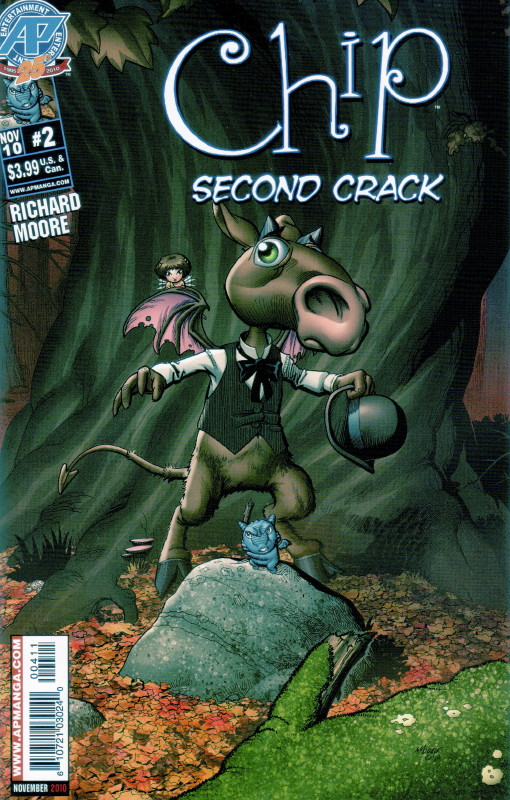
Richard Moore’s plan seems to be to corner the “cute, sexy, and a little scary” comic book market. He did a great job on this in his regular comic Boneyard, which he wrapped up a while back since I guess it wasn’t making much money. Now he’s been doing a number of little side projects for Antarctic Press, one of which is Chip. This comic features a 4-inch gargoyle who is determined to show he can be just as scary as his brethren, with the help of his pixie friend Ash. He’s not very successful, though. Second Crack is his second series, in which Chip and Ash are trying to capture the Jersey Devil.

The thing is, Moore’s gone way too far into the “cute” realm for my tastes, and Chip is a pretty slight book in both plot and characters. His writing style works better when he can develop things over a period of time as in Boneyard, or his more serious wild west fantasy Far West. Moore has a pretty wry sense of humor, but the jokes here seem cheap.

Heck, I somehow missed the first issue of this series, and I don’t feel like I missed very much. Hopefully he’ll have the time to do something more ambitious sometime soon.

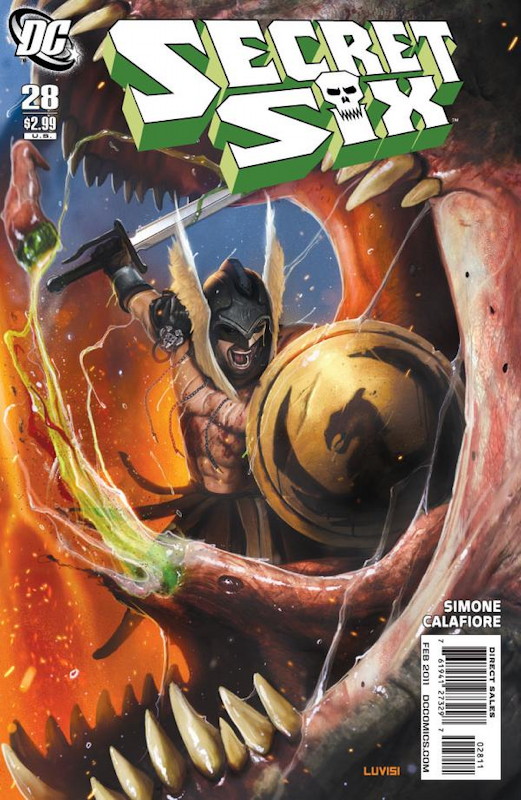
I think I’m running out of gas on Gail Simone’s Secret Six. Part of it is that Jim Calafiore has replaced Nicola Scott as the regular artist, and he seems like the go-to guy for second-tier series who need a reliable artist: But while he’s reliable, his figures are too stiff and generic for my tastes. I had the same problem when he was drawing Marvel’s Exiles series.

But part of it is that the series has been floundering around, losing its focus, that being a group of mercenaries with extreme personalities who have trouble getting along. The team broke up and splintered into two factions, both of whom ended up in the underground primeval world of Skartaris, fighting each other and the locals, a story which wraps up in this issue. I wasn’t quite clear what they were supposed to be doing there – I think one group was being manipulated by a rogue element inside the US government, while the other was sent by Amanda Waller, but no one seemed to be keeping their eyes on the prize, whatever it was. It seemed like an excuse to have the protagonists beat up on one another.

The series has been at its best when it puts its characters – who have questionable morals – in situations which challenge both their well-being and what sense of right and wrong they have. But such stories usually require a pretty strong focus, especially with a large-and-growing cast of characters as exists here, particularly when the characters are a group of anti-heroes at best, and the reader won’t always relate to them. Throwing in an exotic land and a confusing mission as this story featured throws off the balance of the story and makes it difficult to figure out what the story is trying to accomplish.

Series about villains are difficult to keep going, especially characters who aren’t ones who naturally tend to work together, and Secret Six is probably the most successful such comic in history (Suicide Squad, remember, was anchored by several clear-cut heroes; Secret Six is more like trying to write a series about The Joker or Lex Luthor). But it feels like it’s spiraling out of control.

More Adventures with Newton

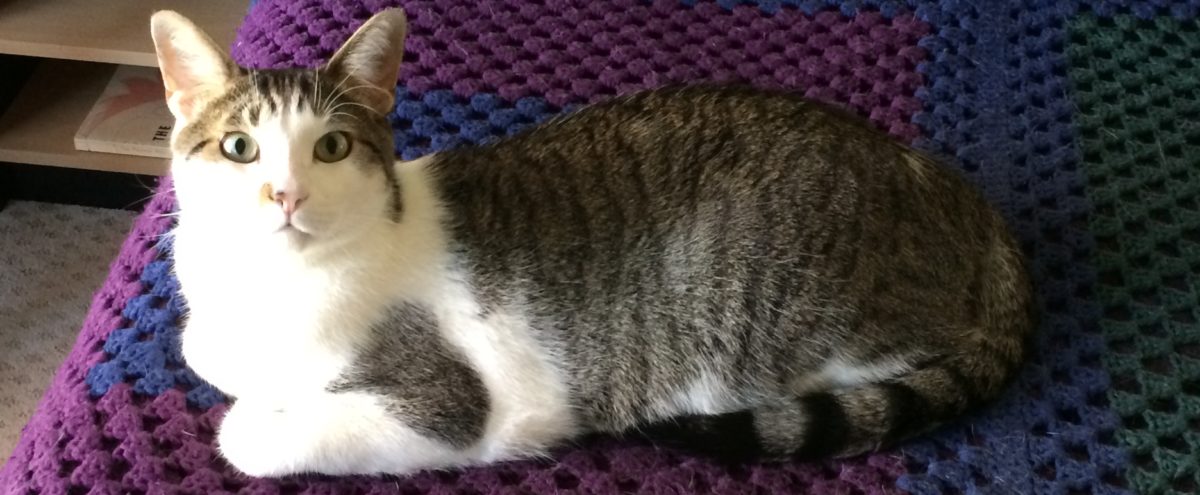
So Wednesday I had the feeling that something was not right with Newton. Now, all three cats have been in mega-sleep-overtime during my week off, probably a little confused that I’ve been around, and bored that I wasn’t playing with them. Plus it’s been hecka cold, which may have made them want to curl up and snooze.

But Thursday it had become clear that Newton wasn’t eating or drinking very much, and Friday morning he didn’t take his daily pill (for hyperthyroidism), which he always takes because he loves pill pockets. He did eat some soft food we bought, though, and he’d drink some water out of the sink. I worried that his mouth hadn’t healed well from his oral surgery, or had gotten infected, since the vet didn’t give me antibiotics for him.

So Friday afternoon we took him in to the vet. She checked him out and said his mouth has actually been healing very well. But I also said that he’d been having some diarrhea, and going on our bathroom carpets too, and she said that his thyroid meds – which we recently upped in dosage because his thyroid level had gone up – can cause diarrhea as a side effect. And of course diarrhea leads to dehydration, and he has been dehydrated.

So he’s been off the thyroid meds for the weekend, and he’ll go back to his older level tomorrow, and then go up a little – but not as far – in a week, and see how he does. But I foresee having to balance controlling his thyroid vs. disturbing his bowels. He’s also on a round of medication to help his diarrhea.

He seems to be getting better, although he’s not yet eating a lot, and he’s still kind of lethargic. So I’m still worrying about him a lot. Debbi tells me that worrying about him doesn’t help anyone, but it’s hard not to worry. I am encouraged that he still drinks out of the sink, and he is eating some things. But he’s not back to normal.

All-in-all, not really what I’d wanted to be spending my mental energy on over Thanksgiving weekend.

We did have some fun, though: Visited a couple of friends who are moving away next month, visited a couple of other friends and their infant and had brunch. Went for a walk in a part of our neighborhood we hadn’t walked through before.

Hard to believe it’s back to work tomorrow.

A Little Time Off

I’ve got the week off from work, so I’ve been hanging around the house working on various projects. My big accomplishment was to catalogue 4 months’ worth of comics and file them. (I sold a bunch of ones I decided not to keep back to my store for store credit. Handy trick, that!) The next project was to go through a whole bunch of old electronic gear and prep it to get rid of: Wiping hard drives on old laptops, figuring out which old cables and accessories to keep, and so on. It’s amazing how this crap builds up over the years.

I spent this morning reconfiguring our wireless network. I recently bought a new DSL modem (the old one died spontaneously two weeks ago), and also got our DSL upgraded, so I wanted to reposition the wireless base station to get better signal downstairs. An hour of fiddling with modem and base station configuration, and running ethernet cable across the room, everything’s working again, and indeed we do seem to be getting faster connections downstairs.

My next computer trick will be to sign up for Magic Online so I can waste time playing Magic a different way. I’ve repurposed my previous-generation MacBook Pro for this by installing Windows 7 on it, and I’ll probably sign up this weekend. It’s been a decade since I used Windows regularly, and it’s really weird: It feels like I’m flashing back to the 1990s, as other than brighter colors it seems like it hasn’t really changed since Windows 95. I imagine it will take a little experience to remember how it all works. (Not to mention that I hear the interface to Magic Online is pretty crappy. I can’t believe they haven’t written a Mac client for it; seems like Wizards of the Coast is living in the 90s when it comes to technology, too.)

I also got some good news this morning: Last Friday I took Newton to the vet for oral surgery. In addition to a tooth cleaning, he’d grown a mass on the inside of one cheek, which he had removed. I was quite worried about him, not just about the mass but because he’s had alarming drops in blood pressure when he’d been anesthetized in the past, and he’s now 16-1/2 years old, so I wasn’t sure how well he’d handle another round of surgery. Turns out he came through it fine, and today the vet called to say that the biopsy of the mass showed it to be benign. A big relief all around! He’s been extra-snuggly since he came home from the vet, too.

We’re having quite a cold snap this week: Cities in the area recorded record low temperatures last night, and it may be even colder tonight. Nothing my Boston-incubated blood can’t handle, of course. But quite a shock considering it was cracking 80 a little over a week ago.

We’re having a quiet Thanksgiving tomorrow, though we’re still cooking the full Turkey Day dinner. Most of it works fine as leftovers, after all. We can probably put them outside to keep them frozen overnight!

Matthew Hughes: Template

There are many refreshing things about Matthew Hughes’ novels: The old-style galactic empire feel of the setting, and quirky sense of humor he puts into his writing, and even the brevity of his novels, which pack a lot of ideas and plot into stories typically under 300 pages. Template weighs in at under 200 pages, yet it’s not only one of his best, but it’s an excellent introduction to his Archonate universe.

Conn Labro is a professional duelist on the world of Thrais, and also an indentured servant on a world where everything is for sale. But when his owner and patron is killed, Conn is bought by an off-world consortium – or nearly so, as a man he’s gamed with weekly for his entire life has also been murdered, and willed Conn enough money to pay off his debt. More significantly, he’s given Conn a bearer chip which seems to be what the assassins are after. Accompanied by a woman from Old Earth, Jenore Mordene, Conn leaves Thrais to learn what his friend really left him, but he also finds the galaxy to be a much more diverse place than he’d ever expected.

Template wanders all over the place, and yet it’s a pretty terrific book. Initially I’d summarize Conn Labro as being “a Libertarian Mr. Spock”: His upbringing on Thrais makes him believe that all aspects of human endeavor of transactional, things being bought, sold and exchanged, and that anything else is irrational. Yet every other world is considerably different from Thrais, not least the archipelago on Old Earth where Jenore grew up, which is based around art and lacks monetary currency. Hughes comes up with a nifty way to consider different cultures in the Archonate via a brother and sister who have come up with the idea that every human society is based on one of the seven deadly sins. It’s a fun mental exercise.

Conn’s story is his personal odyssey to learn where he comes from (and why that matters), and where he belongs. So he has to grow emotionally to understand how to relate to other people, and a lot of the suspense comes from him making some poor choices along the way. For much of the book he has Jenore to help guide him and inform him, but eventually he has to control his own destiny. Fortunately he’s not without skills of his own (professional duelist, remember?).

While the book drags a bit in the middle when Conn and Jenore are on Old Earth and the plot doesn’t move forward very much (what does it mean when a book under 200 pages “drags a bit in the middle”?), and one could argue that the cultures Hughes portrays are too simplistic to be plausible, it’s still a really fun story. And besides, Hughes at his best – and this is him at his best – portrays both the people and the cultures of the Archonate as a little absurd, having a bit of the feel of a fable even in an otherwise serious story. (It’s not so different from, say, the races in John Scalzi’s Old Man’s War series, actually.)

Overall Template is one of Hughes’ best books, and should appeal to anyone who likes space opera, adventure, or just good old galactic empire science fiction.

Matthew Hughes: The Commons

If you haven’t read Hughes’ earlier novel Black Brillion, I suggest reading it before reading The Commons, as this novel’s second half replays the events of the earlier novel, but from the point of view of Guth Bandar, a supporting character in Brillion, but the protagonist here. The Commons is a “fix-up” novel, reworked from a series of short stories featuring Bandar, plus the Brillion material. So it doesn’t entirely hang together as a novel, but it’s pretty entertaining anyway. (For what it’s worth, I read The Commons first, not realizing the connection between the two.)

Guth Bandar is a “noönaut”, a man who can enter into humanity’s collective unconscious and explore representations of our racial memories. This domain is known as The Commons, and while it’s a rich source of information, it’s also a dangerous place, as explorers can get trapped in a story or legend, or get wrapped up in the doings of archetypal figures which represent undiluted facets of human experience. The book opens with Bandar as a student at the Institute for Historical Inquiry, and its first half consists of short stories in which he attempts to become a full scholar, encountering repeated setbacks in his competition with another student, Didrick Gabbris, for favor with the capricious and insular faculty. These stories show how the Commons works, and the exotic techniques the educated traveler uses to try to insulate himself from the influences of the scenes he visits. Bandar’s adventures include:

  • A visit to a planet where the native life forms are exploited into adopting human archetypes to perform in plays for the human colonists.
  • Being waylaid in a contest with Gabbris and having to take the long way around to reach the finish line. (This is the most absurd story, as Bandar alters parts of his body in comical fashion in each episode, but has the best payoff when he gets stuck in a representation of the eternal war between Heaven and Hell.) You can read this story on Hughes’ web site.
  • Getting caught up in the collapse of an Event in the Commons – which he inadvertently causes himself – and which reveals something hitherto unknown about the Commons.
  • Getting stranded – for reasons I won’t reveal here – as the Helper to a Hero in an ancient scenario of a slaves’ revolt, which leads to a pivotal development in Bandar’s life.

As I said, the second half of the book revisits the events from Black Brillion, in which Bandar meets the policemen Baro Harkless and Luff Imbry, and learns that Harkless has an unusual and disturbing talent for entering the Commons himself. Bandar helps tutor Harkless for a while, and then gets caught up in the case the pair are investigating on the wasteland on Old Earth known as the Swept. Here he becomes the Helper to Baro Harkless’ Hero, a key component but ultimately largely a watcher in the younger man’s story.

Taken as a whole, some key elements of the novel are not very satisfying: Bandar’s life is disrupted by powers beyond his ken in order to accomplish a goal of great importance to all of humanity, but I don’t think Hughes really sells the manipulation of Bandar very well, and the ultimate goal that he and Baro Harkless manage to achieve just doesn’t feel like the sort of thing that the powers that be would have known about years ahead of time, much less manipulated Bandar to be the right man in the right place at the right time. And as a character arc the payoff for his troubles hardly seems adequate: While he finally achieves something like his life’s goals, he’s lost a big chunk of his lifetime because of his career getting derailed, and he ended up being a supporting character in someone else’s story. I really just felt sorry for the guy. Also, it felt like most of Bandar’s maturation occurs off-stage between the first and second halves, when he’s growing from a young man to an experienced one through the natural day-to-day progression of life; he definitely feels more mature in the second half, but we don’t see it happen, which makes it feel like a big part of his character arc is missing.

I think Hughes’ sense of whimsy – particularly the ludicrousness of the situations Bandar ends up in – isn’t as effective here as in other books. Indeed, a problem with both Bandar and Harkless in their respective novels is that they’re both too serious, too humorless, to feel like characters that fit into these situations. While Henghis Hapthorn is himself a pretty serious character, he has both the style and the verbal wit to be an effective actor in ridiculous or belittling situations, in ways that Bandar isn’t.

The book is at its best in portraying the narrative potential of the Commons, especially in the first half, which runs through a number of inventive situations, with clever puzzles for Bandar to figure out within the confines of this strange environment. The story involving the war between heaven and hell is my favorite precisely because Bandar takes advantage of the peculiar nature of a scenario within the Commons, and the fact that it’s not a real event, to be able to get out of his predicament.

So overall I was disappointed with The Commons; I don’t think it measures up to Hughes’ other novels. I hope he revisits the environment again sometime, but with a story that holds together better.

This Week’s Haul

In the wake of news that J. Michael Straczynski has bailed out of writing Superman and Wonder Woman due to the success of the Superman: Earth One graphic novel, I’ve decided to drop those books too. I mean, if he can’t commit to finishing the stories he started, why should I commit to finishing reading them? Honestly, though, his Superman was awful, just nonsensical and boring. Wonder Woman was better, but nothing I’m going to miss.

And yes, I skipped Superman: Earth One, too, because, you know, another retelling of Superman’s early days? No thanks.

Oh, and both Batman: The Return and the first issue of Batman Inc. shipped this week, but as I said last week I’ve pretty much gotten the idea where Grant Morrison’s Batman work at DC is concerned (quirky, yet dull and characterization-free), so I decided the end of The Return of Bruce Wayne was the end of it for me, and I passed on both those issues.

  • DC Universe: Legacies #7 of 10, by Len Wein, Scott Kolins, Dan Jurgens, Jerry Ordway & Brian Bolland (DC)
  • The Flash #6, by Geoff Johns & Francis Manapul (DC)
  • Green Lantern #59, by Geoff Johns, Doug Mahnke & Christian Alamy (DC)
  • Green Lantern Corps #54, by Tony Bedard, Tyler Kirkham & Batt (DC)
  • Legion of Super-Heroes #7, by Paul Levitz, Yildiray Cinar, Wayne Faucher & Francis Portela (DC)
  • Power Girl #18, by Judd Winick & Sami Basri (DC)
  • Zatanna #7, by Adam Beechen, Chad Hardin & Wayne Faucher (DC)
  • Mouse Guard: Legends of the Guard #4 of 4, by David Petersen, Craig Rousseau, Karl Kerschl & Mark Smylie (Archaia)
  • Hellboy: Double Feature of Evil, by Mike Mignola & Richard Corben (Dark Horse)
  • Grandville: Mon Amour HC, by Bryan Talbot (Dark Horse)
  • Morning Glories #4, by Nick Spencer & Joe Eisma (Image)
  • Ghost Projekt #5 of 5, by Joe Harris & Steve Rolston (Oni)
  • The Sixth Gun #6, by Cullen Bunn & Brian Hurtt (Oni)
Speaking of series I’m dropping, this is it for me and The Flash. Geoff Johns’ writing has been okay, but the title, “The Dastardly Death of the Rogues”, had very little to do with the actual story (only one “Rogue” died, and he wasn’t even the real deal), and the plot felt rather recycled (time travel, changing history, etc.). And as I’ve said before, I haven’t been at all convinced by Johns’ handling of Barry Allen returning to his old life and job after what must have been 5 or 10 years of time in Central City, with little questioning from his colleagues and friends as to where he’s been. The adventure has been a decent romp, but it didn’t really hang together.

But the thing that’s really driving me away is Francis Manapul’s artwork, which is sketchy, simplistic, makes many of the characters look like teenagers, is short on backgrounds, and features some really bland layouts. His art has been getting rave reviews from some corners, which frankly astonishes me, but diff’rent strokes, I guess. It just hasn’t worked for me at all, and his name on a book will be a big caution sign for me in the future.

Maybe down the road I’ll regret dropping this series so soon, as I did Johns’ previous resurrected hero’s series, Green Lantern. But at least that series had top-notch artwork, even if it got off to a slow start. There’s really nothing that appeals to me about this Flash series.

And speaking of Green Lantern that series is still dealing with Hal Jordan trying to hold together an alliance of the seven colored ring corps as they try to track down the seven avatars of the corps. Since some of the corps are outright villains, this is a tough group to manage, and this issue focuses largely on Flash trying to talk some sense into GL that perhaps he should be turning to his earthbound friends – no slouches themselves in the power department – rather than the murderous Red Lanterns or the avaricious Larfleeze, the Orange Lantern.

The problem with this story is that Flash is absolutely right, and the set-up smells strongly of Johns being just too in love with the idea of a rainbow lantern corps that he’s making GL behave out of character in order to keep the idea going. While an alliance between the Green (will) and Blue (hope) corps, and maybe even the Star Sapphires (love) makes some sense, working with Larfleeze or the Red Lanterns is borderline-insane. And frankly the fact that bad things happen at the end of this issue are the natural consequences of GL not listening to reason. It makes the story difficult to believe in.

I think the premise is supposed to be that the Blackest Night changed the status quo among all the ring corps, but it doesn’t really hold up: Absent a clear-and-present danger (and the avatars don’t really present one), it’s hard to believe that these corps would work together and ignore their natural impulses. And at some point the series is going to have to deal with the presence of several thousand rings of each color flying around the galaxy, because otherwise it’s going to lead to everything being destroyed. Johns has raised the power level too high without really considering where that’s going to lead, and having it lead somewhere else makes the story less and less plausible.

Let’s move on to some good stuff: Grandville: Mon Amour is (you guessed it) the sequel to Bryan Talbot’s anthropomorphic alternate-history scientific-romance thriller (whew!) that I read earlier this year. The setting is Britain and France in the present day, but a world where France conquered Europe under Napoleon, and Britain has only recently won its independence. Detective-Inspector LeBrock is one of Scotland Yard’s best investigators, and was recently involved in an escapade which resulted in the death of the French Emperor, as well as the death of a woman he loved. But he’s pulled out of his misery by the escape of “Mad Dog” Mastock, a former revolutionary who later became a deadly serial killer, whom LeBrock apprehended several years ago. Mastock escapes from prison on the day of his execution, and LeBrock is forced to resign from the Yard in order to pursue him. As before, LeBrock and his partner Detective Ratzi follow Mastock back to Grandville (which I believe is Paris) to find out what he’s up to and to bring him down. As in the first book, the case will change the course of nations.

Oh yeah, and all the characters are human-sized animals: LeBrock is a badger, Ratzi’s a rat, and there are dogs, cats, rams, pigs, and various other creatures. Plus a few humans, who are a lower-class oddity in this world. Other than very muted undertones of racial differences, Talbot doesn’t really do much with the different species in the book, but it does make the work visually different. But I found it perfectly easy to ignore the anthropomorphic renderings and just enjoy the story for what it is.

And it is a very good story, as Talbot – as he always does – has meticulously worked out the setting and characters of his story, and sumptuously renders every panel. It’s really a beautiful work (as was the first volume). The story is a page-turner, too, with a smashing climax (although there’s an extra layer of discoveries to be made at the end which I felt was a little too much, but it’s not a big deal). While I haven’t read everything Talbot has done, I’ve read a lot of it, and his writing and art have gotten consistently better with time. I hope he’s planning to continue doing Grandville volumes, because the first two have been great. If any of the elements I’ve described in the story appeal to you, I suggest you check it out.

(You can see a preview of the volume here. Note especially that the interior art is much lusher than the relatively flat cover to the left.)

Two Oni comics stories wrap up this week. Ghost Projekt has been an excellent 5-issue miniseries about Will Haley, an American weapons inspector working in Russia, who teams up with with Anya Romanova, a Russian agent, to learn the secret of the Cold War Project Dosvidanya, whose former members have been turning up dead. It was a nifty combination of the post-Cold War Russian setting and a fantasy/horror plot. The payoff is pretty good, although there’s a development at the end involving Anya which I didn’t understand – I think I’ve forgotten a plot detail somewhere. I also appreciated that the story has a climax, and then several pages of denouement trying up loose ends – too many stories these days forget how important that part is.

Steve Rolston‘s art is simple but extremely effective; his style feels like it comes from doing comic strips, but he does a great job drawing the darker stuff, too. It gives the story a cheerful veneer without compromising the seriousness of the story – it’s an approach you wouldn’t see much from one of the major publishers.

I hope there will be a sequel series, because this was a lot of fun.

The other series that’s been a lot of fun is The Sixth Gun, which could easily have been a 6-issue miniseries, but apparently it’s continuing beyond this issue. Hooray! I’ve gushed about the series before, which involves supernatural guns in the Wild West, an insane Confederate General trying to bring about the apocalypse, and the handful of men (and the woman who inherits the General’s gun) trying to stop them. This issue has the big showdown with the General and his men, and it’s a good one, with some pretty awesome moments during the big battle. I don’t think it’s a surprise (since the series continues on) that the good guys prevail, although certainly there’s room for the General to return.

I’m curious to see where Bunn & Hurtt take the series next, after this climax. I could see them jumping the story forward in time, or they might continue the current narrative – if the latter, I hope they start to focus a little more on the characters since they should have more time to let them grow a bit.

Things I Learned at Frisbee Last Night

Last night was the first night of this season’s SBUL. While I pretty much failed at my goal of losing a substantial amount of weight for it, I have been pretty active since last season. However, I learned that:

  1. Bicycling doesn’t really improve your endurance for sprinting while playing ultimate, and
  2. Jogging doesn’t really improve your endurance for sprinting either.

Yes, it was another first-frisbee-night huffing and puffing after running back and forth down the field.

On the bright side, my forehand throw hasn’t deteriorated as much as it usually does between seasons. Also I completely shut down a couple of faster, taller players while I was on defense (although that’s what leads to the huffing and puffing).

I was surprisingly not very too stiff and sore this morning – except for my right heel, which hurt a lot when I put weight on it getting out of bed. It gets better as I use it during the day, but I think I need to get some cushioned insoles for my (new) cleats to try to mitigate this problem.

Man, this game sure was a lot easier when I was in my 20s.

Neil Gaiman: The Graveyard Book

I temper my expectations for a Neil Gaiman novel: I view him as being a style-over-substance writer, whose emphasis is on crafting a setting and evoking a mood – usually with a heavy overlay of clever and witty use of language – rather than being strong in plotting, characterization, or giving his stories meaning. Indeed, Gaiman is someone to avoid if you mainly want character development, as his main characters tend to be either everyman sorts (Neverwhere, Stardust, Anansi Boys) or empty shells (American Gods, and the hero in this book). I actually do enjoy most of his books, because of his strengths, but because I tend to prefer books which are based around his weaknesses, I never expect or hope that one of his books will become a favorite.

So it was with The Graveyard Book, an homage to Rudyard Kipling’s The Jungle Book. I’ve never read The Jungle Book (shock, horror from the audience), nor even seen the Disney film (even more shock and horror), but a friend of mine summed up both books like so: “In The Jungle Book, a boy is adopted by animals and learns the things that animals know. In The Graveyard Book, a boy is adopted by dead people and learns the things that dead people know.” A fine summary, as the book opens with man with a knife named Jack kills a family in a nameless town in England, save for the youngest child, a toddler who happens to toddle away to a graveyard during the massacre, where he’s saved by the spirits in the graveyard, adopted by a couple there, and given the name Nobody Owens. “Bod” grows up in the graveyard, rarely leaving it because his guardian, Silas (who is hinted as being a vampire), says that Jack and the cabal behind him are still looking for Bod, and only in the graveyard is he safe. So his parents and friends in the graveyard teach him the knowledge and skills of dead people, even though he’s still alive. But they also prepare him for his eventual rejoining of the living world.

The book is told in episodic form, as Bod learns about the skills that dead people have (fading from view, walking in dreams, instilling fear), and also learning about some of the less-visited nooks and crannies of the graveyard. He does, of course, venture out of his home, which eventually leads to a showdown between Bod and the cabal. But for the most part you’ll either accept the premise and enjoy the individual stories – which are only loosely linked, although several points are recapitulated in the climax – or not.

For myself, I did enjoy the stories Bod follows a fairly traditional “hero’s-coming-of-age” journey, questioning his elders and the rules he lives by, then coming to learn when he should follow them and when he should break them. I particularly like “Nobody Owens’ School Days”, when he ventures out to attend a regular school and has a variety of adventures, partly because his motivation to do the right thing by other kids gets him in trouble with the bullies, and events spiral out of control from there.

His confrontation with the cabal signals the coming of his adulthood, leading to a bittersweet ending, but I was disappointing in the climax since we never really learn why the cabal are so set on killing Bod – the reasons are hinted at, but so vaguely that they’re hardly sufficient to explain the events which set the story in motion. Gaiman sometimes gets too caught up in being mysterious and leaving holes for the reader to fill in, and that’s the problem here, as more specificity was sorely needed.

As a book aimed at the “young adult” market (which I always instinctively think means 18-22 year olds, but which really means 10-14 year olds, I think), for an older audience The Graveyard Book is an easy read and could be summed up as “enjoyable but light”, sliding in as better than Stardust and about on par with Coraline. (This is a good point – as he illustrated both books – to make my obligatory statement that I cannot stand Dave McKean’s artwork. His work is better here than in Coraline, but it still fails to be either illustrative and evocative, and frankly I just find it ugly. Your mileage may vary.) As someone once said, if you like this sort of thing, then this is the sort of thing you’ll like. While it’s full of wonderful imagery, I don’t think it’s a story that will stay with me for very long.

This Week’s Haul

This week marks I think the third collection of Matt Wagner’s Mage: The Hero Discovered I’ve bought. It’s not quite as nice as the 2005 collection, except that that edition contained a printing error (missing text in one of the chapters), which was certainly annoying. So I decided to pick up this one. Now… which one do I keep?

Meanwhile, I’m finally all caught up on both Green Lantern Corps and Captain America with the collections out this week.

  • American Vampire #8, by Scott Snyder & Rafael Albuquerque (DC/Vertigo)
  • Batman: The Return of Bruce Wayne #6 of 6, by Grant Morrison, Lee Garbett, Pere Pérez, Alejandro Sicat & Walden Wong (DC)
  • Green Lantern Corps: Emerald Eclipse TPB, by Peter J. Tomasi, Patrick Gleason, Rebecca Buchman, Christian Alamy, Prentis Rollins & Tom Nguyen (DC)
  • Green Lantern: Emerald Warriors #4, by Peter J. Tomasi, Fernando Pasarin & Cam Smith (DC)
  • Knight and Squire #2 of 6, by Paul Cornell & Jimmy Broxton (DC)
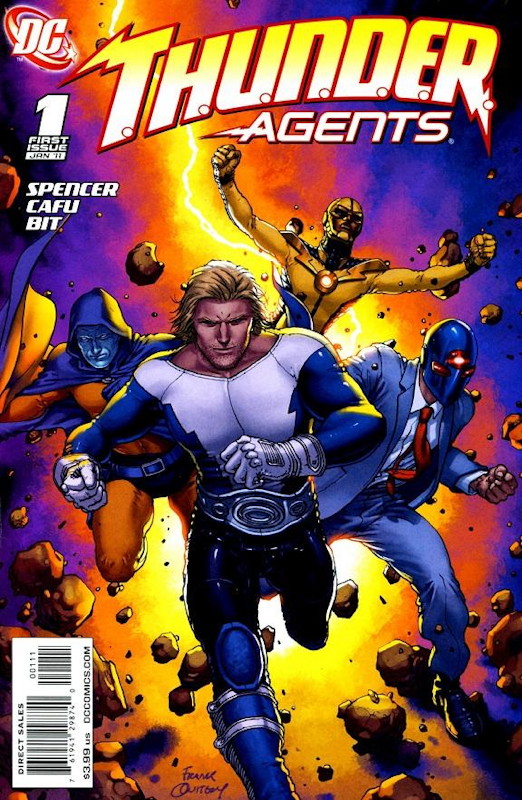
  • T.H.U.N.D.E.R. Agents #1, by Nick Spencer, Cafu & Bit (DC)
  • The Unwritten #19, by Mike Carey & Peter Gross (DC/Vertigo)
  • Victorian Undead: Sherlock Holmes vs. Dracula #1 of 6, by Ian Edginton, Davide Fabbri & Tom Mandrake (DC/Wildstorm)
  • Captain America: Two Americas TPB, by Ed Brubaker, Luke Ross, Butch Guice & Rick Magyar (Marvel)
  • Captain America: Forever Allies #4 of 4, by Roger Stern, Nick Dragotta, Marco Santucci, Patrick Piazzalunga, Brad Simpson, Chris Sotomayor & Andrew Crossley (Marvel)
  • Chew #15, by John Layman & Rob Guillory (Image)
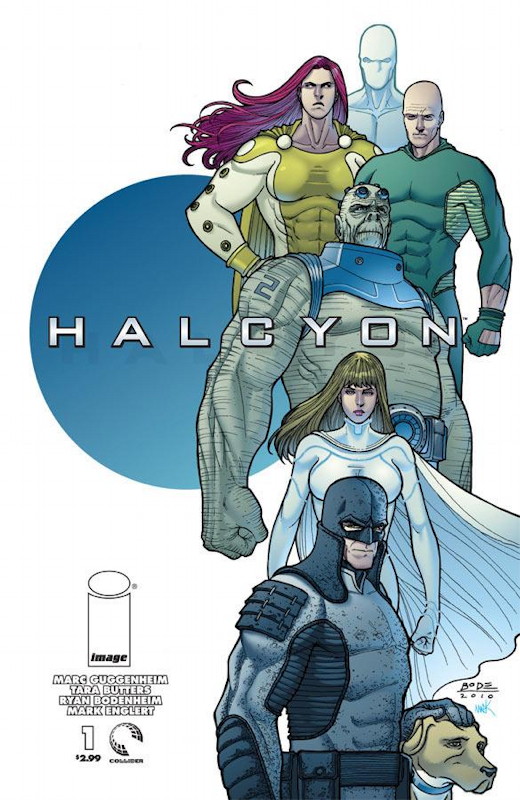
  • Halcyon #1, by Marc Guggenheim, Tara Butters & Ryan Bodenheim (Image)
  • Mage: The Hero Discovered HC, by Matt Wagner (Image)
  • Atomic Robo and the Deadly Art of Science #1 of 5, by Brian Clevinger & Scott Wegener (Red 5)
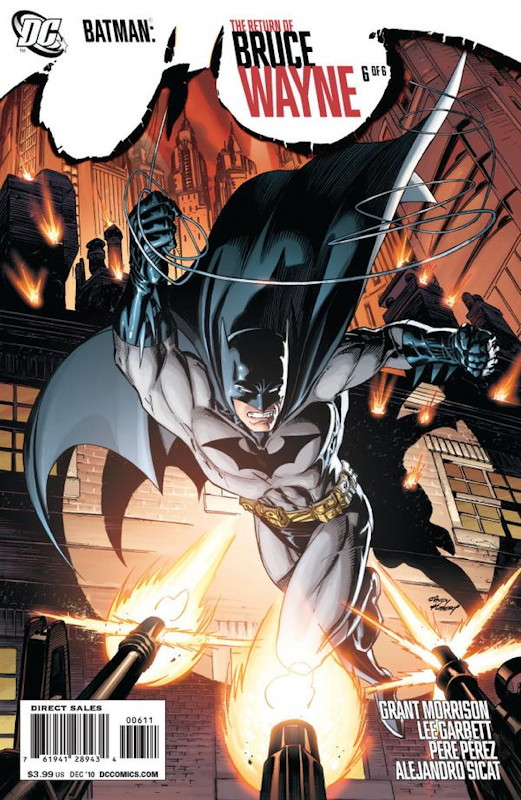
Batman: The Return of Bruce Wayne wraps up a week after Batman actually returned in Batman and Robin. As with most of Grant Morrison’s Batman stuff, it’s so-so. It’s not helped by the uninspired Image-style artwork of Lee Garrett.

This whole story has been hamstrung by the overly-convoluted plot, in which Darkseid sent Batman into the distant past, slowly working his way to the present, and pursued by a “hyper-adapter infestation”. First, why would Darkseid pursue such a plan, and why would he use Batman, who he’s got to think is one of the people most likely to defeat his plan? Why not just unleash the creature immediately, and by surprise? Well, one reason is the second problem, which is that the creature doesn’t seem so tough, since Superman, Wonder Woman and Green Lantern wrap the thing up, stuff it into a time sphere, and send it off to oblivion. Weak stuff, especially since it’s not clear the thing could have gone toe-to-toe with any of that trio anyway.

Morrison was once a writer who – despite his flaws – produced some ground-breaking stuff for DC. While I wasn’t a fan of every bit of it, Animal Man, Doom Patrol, The Invisibles and JLA were all key comics for fans of their day who wanted more than routine superhero fare. But JLA seemed to have made more of a mark on Morrison’s writing style than the other way around, as Morrison’s work over the last few years has been only a little more than routine superhero fare – slightly unorthodox in its style, but when he went farther than that it produced the basically-unreadable Final Crisis.

So all of this raises the question: What is Grant Morrison really accomplishing at DC comics, for the readers? Honestly Geoff Johns’ Green Lantern work has felt more inspired and coherent than Morrison’s Batman and related titles. Maybe Morrison is a huge Batman fan and is having the time of his life writing the character, but I don’t think it really shows in the final product, which has been uneven at best.

At this point I think I’ve long since gotten the idea of what Morrison is doing here, and it’s not doing much for me, so as I said last week I think this is it for me with Morrison’s mainstream DC titles. Maybe I’ll check in again when he seems to be doing something different again.

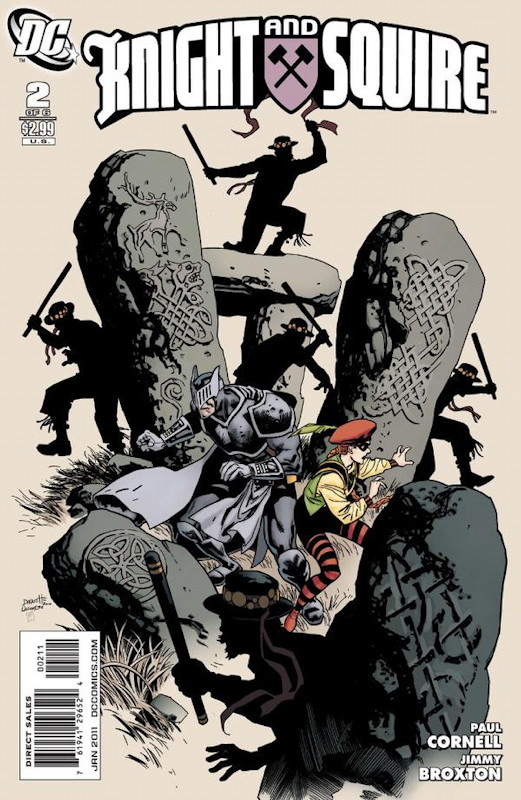
The second issue of Knight and Squire is so much better than the first that I wonder why Paul Cornell decided to lead with the first issue at all. This one is a much better introduction to the characters: We already know they’re a Batman and Robin type of duo, but we see them operating in their hometown and how they relate to the locals (it’s cute and clever, really), and then they face off against a group of evil Morris dancers (no, really). It’s not a profound story, but it’s fun and funny and the right amount of ridiculous. I hope the rest of the series is more like this issue.
I’ve always been unaccountably fascinated by the T.H.U.N.D.E.R. Agents, a team of superhero-secret agents from a small publisher in the 1960s. The original series was not much to read compared to the typical Marvel Comic of the era, but they did have first-class artists (Wally Wood, Gil Kane, Steve Ditko, etc.). What hooked me was the short-lived series from Deluxe Comics in the mid-80s, which not only had true top-notch art talent (George Pérez, Dave Cockrum, Jerry Ordway, and unfortunately Keith Giffen at his artistic nadir), but also outstanding writing, highlighted by the characterization of Lightning, whose speed suit causes him to age rapidly, and after just a few years of use he’s now an old man. Unfortunately that series came to a premature end because Deluxe though the Agents were in the public domain, when in fact they were not. The owner (the late John Carbonaro) licensed the character to a couple other companies, but none of them really took off. Now, after the success of DC’s Archives collections of the series, DC is publishing a new series, which apparently has no continuity relationship to the earlier series.

This series is taking the Lightning angle and running with it: Using any of the Agents gear causes its wearer to rapidly burn out, much like the premise of Marvel’s 1980s series Strikeforce: Morituri. (I wonder if writer Nick Spencer realizes the resemblance?) The first issue is pretty good, and suggests that it’s going to be more of an espionage play-and-counterplay story with overtones of superheroics than the other way around, which could be interesting. The art by the single-named artists Cafu and Bit is quite good, strongly resembling that of Paul Gulacy, albeit with less use of shadow.

I doubt it will ever replace the 80s series in my heart, but it’s got promise.

It’s pretty hard to write a “end of the age of superheroes” story, especially one deploying the usual Justice League/Avengers paradigm as the team of protagonists. Bill Willingham’s Pantheon (which I liked) took a “if the heroes win” approach, while Rick Remender’s The End League (which I didn’t) took an “if the villains win” approach. Now Image is publishing Halcyon, in which Marc Guggenheim and Tara Butters seem to be taking an “all the villains stop being villains” angle (with the possibility that it’s actually a devious villainous plot). The series are immediately nervous that they’ll be rendered redundant (because, after all, what fun is it to be a superhero without supervillains to beat on?), but maybe I’m reading too much into it: This first issue is really just the set-up, with some foreshadowing, and it’s pretty well done. Certainly good enough for me to stick around for a while to see where it’s going.

The art by Ryan Bodenheim is pretty erratic. His style seems inspired by that of early Doug Mahnke, maybe with a little Frank Quitely. His layouts are pretty good, but not very dynamic. The darker characters are rendered better than the purer hero types. And his anatomy, especially of the women, seems a little off to me. On the other hand, he seems to have talent and everyone has to start somewhere (he’s drawn a few other things over the last decade, but this is my first exposure to him), so maybe he’ll develop.