Did I Mention The Lovely Weather This Past Weekend?

Well it was amazing: Highs in the 80s in the valley, so Sunday morning we drove over to Half Moon Bay for breakfast and to walk around along the coast. We were delayed getting there due to an accident on Route 92 (a sedan smashed up with a minivan – both cars looked totaled, but I didn’t see any injured people), but we got there about half an hour later than expected.

After breakfast at the Main Street Grill we went to Poplar Beach and walked along the bluffs to the south of the parking lot. Here are a couple of pics from our walk:

Debbi by a wind-blown cypress tree in Half Moon Bay
(click for larger image)

Half Moon Bay beaches & coastline

It was cooler and breezy by the ocean, but still just about a perfect day. I think 4 out of every 5 people we saw were out walking their dogs. Can’t blame them, as this might be our last nice summer day for the year – summer days in November! Now I remember why I live here!

In the evening we cooked chicken-fried steak with homemade fries and frozen green beans for dinner. Mmmm…

What a Day!

It’s the middle of November and it’s pushing 80 degrees outside here in the Bay Area. Sunny, a little hazy, just about perfect. I’m wearing shorts and sandals today. Couldn’t ask for much better.

This is something of a change from Wednesday night when we were out playing frisbee and in the space of 20 minutes, the field we were on went from this:

The fog rolling in

…to this:

The fog has arrived

Not to mention what the other fields looked like:

The other fields in the fog

Thank goodness those Bad Old Days are behind us.

Until, you know, next week or something.

This Week’s Haul

  • Booster Gold #14, by Rick Remender, Pat Olliffe & Jerry Ordway (DC)
  • Fables #78, by Bill Willingham, Mark Buckingham & Steve Leialoha (DC/Vertigo)
  • Justice Society of America: Kingdom Come Special: Superman #1, by Alex Ross (DC)
  • Fire & Brimstone #3 of 5, by Richard Moore (Antarctic)
  • B.P.R.D.: The Warning #5 of 5, by Mike Mignola, John Arcudi & Guy Davis (Dark Horse)
Fables #78 Wow, after a couple issues of adjustment, Fables is hitting the ground running in its post-Adversary storyline. A couple of treasure-hunters in the homelands free what looks like a Really Bad Man aims to cause big trouble for our heroes. Geppetto is still holier-than-thou, and he maybe has some justification. And something really bad happens to a good guy, while something really good happens to a bad girl (and that ain’t good for the good guys). Things could get out of hand quickly for our heroes, and I think that’s the point: They’re heading into uncharted waters against opponents they don’t know much about, one of whom they don’t even know exists.

Willingham’s usual modus operandi as a writer involves characters making careful plans and then navigating the difficulties in executing them. It looks like he’s preparing for a sequence of sheer carnage and mayhem, and I’m very interested in seeing how it plays out. And, frankly, a little nervous, because I foresee things going very, very badly for some of our heroes – and that this makes me nervous is a sign of good writing.

Justice Society of America: Kingdom Come Special: Superman #1 Alex Ross flies solo on this Justice Society tie-in, focusing on the Superman from Kingdom Come. The issue is mainly an exploration of Superman’s feelings and regrets in the wake of the death of his wife and friends on his own world, and it’s quite well-done. Arguably it doesn’t really provide a lot more information than we received in Kingdom Come, but it does provide some depth and nuance, and humanizes the Man of Steel from the parallel world some. The most touching moments are when he tells this world’s Lois Lane what happened on his world, and how it changed him.

The important detail regarding the ongoing JSA story is the revelation that Superman was sent to this Earth when the bomb was dropped on the warring superheroes. This occurs near the end of Kingdom Come, but it’s still before the end. That suggests that Superman’s presence here is part of his redemption at the end of that story, and it also explains his anger in JSA since he hasn’t gone through the crucial experiences in the final pages of that story.

Well, either that, or Ross and Geoff Johns are just messin’ with us. (That would suck.)

The book has an afterword in which Ross describes his process of illustrating the book, which is not painted like his usual work. It’s fairly interesting, although somehow seeing how extensively he uses photographic models takes some of the magic out of his otherwise wonderful artwork.

I’ve given Ross a rough time in my reviews of many of his recent projects, but this one is solid. I wish all his work was this good. Heck, I wish JSA was this good, as character bits like this have been almost entirely absent from that series (a problem I’ve had with it ever since the previous volume was launched back in 1999).

B.P.R.D.: The Warning #5 The latest B.P.R.D. mini-series comes to an end, and although some of the pieces have moved around (there’s a new villain – who might be a hero, but his methods are questionable; Liz Sherman has disappeared; monsters are allying with each other and have decimated Munich), I’m still wondering where it’s all going. It’s been years and it doesn’t feel like we’re getting anywhere.

I know, I’m sung this song before, and anyone who’s been reading me long enough is probably wondering why I keep reading the series. I wonder that myself; every time I decide to give up I figure if I just read one more mini-series, then the answers and resolutions will start coming. Sometimes I read one more series and it’s just good enough to make me curious what happens next. But ultimately I keep being disappointed: I honestly can’t tell whether the plot has really progressed over the last couple of years.

Maybe it is time for me to quit.

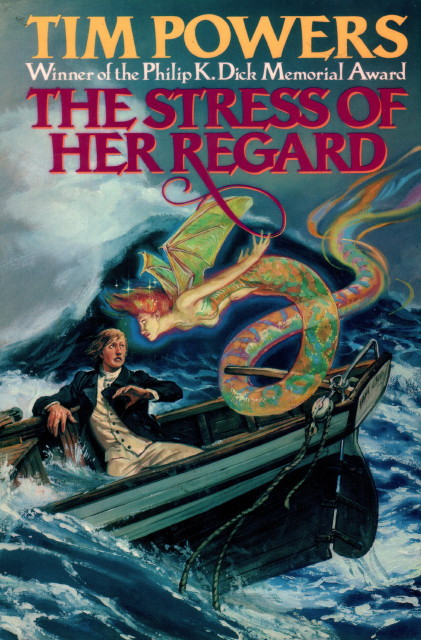
Tim Powers: The Stress of Her Regard

One stormy night in 1816, shortly before his wedding, physician Michael Crawford places his wedding ring on a statue, and so becomes ties to one of the nephelim, a race of inhuman vampires who predate humanity on Earth. The morning after his wedding, he wakes to find his bride Julia horrifically torn to bits in their locked room, and he’s forced to flee the life he knew to escape the hangman’s noose. With the aid of poet John Keats, he heads across the English Channel to France where he encounters Percy Shelley, Mary Shelley and Lord Byron, and becomes deeply embroiled in a fight to fight off the creature which haunts him. He’s pursued by Julia’s twin sister Josephine, who gains a nephelim lover of her own.

Taking place between 1816 and 1822, The Stress of Her Regard is a shadow history centered around the lives of the three romantic poets, all of whom died young and whose families also suffered from early deaths. Powers uses the nephelim to explain both their artistic prowess as well as the grim elements of their lives: The nephelim attach themselves like haunting spirits to humans and (perhaps as a side-effect) imbue them with certain skills and even with long life, but the nephelim are also jealous creatures who try to kill all who are loved by their human beloved.

There are many recurring elements of a Tim Powers novel: The main character is physically mutilated and forced to abandon the life they knew; there’s a leap in time between the first and second halves of the book; and the plot culminates in a mystical ritual which goes wrong somehow (yet often succeeds nonetheless). The main character is usually an everyman – albeit one with some skills of his own – who ends up as the lynchpin character amidst towering (or at least more knowledgeable) figures. All of these elements are present here, and while you could argue that this makes Powers’ books a little repetitive, his intricate plotting and clever twists and turns make each story unique. Clearly he just enjoys writing about certain dramatic situations.

A common theme of Powers’ novels is being torn between the temptations offered by the opposing forces, and one’s own well-being or loved ones. This conflict is as clear here as it’s ever been, with Crawford deeply succumbing to the nephelim’s influence in the first half, and then severely tempted to invite them back – despite the ruin it would deliver on his life and friends – in the second. He sees what the nephelim do to other people, even when – as they do for Byron – they provide a vital piece of meaning in their lives. Crawford goes through hell to get rid of his succubus, but constantly feels the temptation to invite it back, and thus can’t pass judgment on others who succumb. For the love of his friends, he drags himself through further hell in order to help them. Although Powers’ narrative is sometimes verbose enough to take the reader out of the moment, it’s still powerful stuff through the sheer aggregation of tension and emotion.

Stress wraps up with a satisfying climax and touching denouement, bringing the lives of the famous supporting characters to their historical closes. It should please any Powers fan, and is a strong fantasy/suspense tale for anyone else.

This Week’s Haul

  • Justice Society of America #20, by Geoff Johns, Alex Ross, Dale Eaglesham, Nathan Massengill, Jerry Ordway & Bob Wiacek (DC)
  • The New Teen Titans Archives vol 4 HC, by Marv Wolfman, George Pérez & Romeo Tanghal (DC)
  • Terra #1 of 4, by Justin Gray, Jimmy Palmiotti & Amada Conner (DC)
  • Top Ten Season Two #2 of 5, by Zander Cannon & Gene Ha (DC/America’s Best)
  • Gigantic #1 of 5, by Rick Remender & Eric Nguyen (Dark Horse)
The New Teen Titans Archives vol. 4 When compiling a list of the most significant books during the bronze age of comics (roughly 1970-1990), Marv Wolfman & George Pérez’s New Teen Titans would certainly make the top ten, a little bit behind Chris Claremont & John Byrne’s Uncanny X-Men. The two books (and rumor is that Titans was intended to be DC’s answer to Marvel’s X-Men) brought stronger characterization and soap opera elements to mainstream superhero comics, essentially taking what Stan Lee, Jack Kirby and Steve Ditko had done at Marvel in the 60s to a higher level of sophistication. As such, both series are worth reading for their historical import, but also because they both hold up pretty well today.

This week DC released the fourth volume of the Titans Archives, covering issues #21-27, which is roughly the midpoint of the Wolfman/Pérez run (Pérez left the series after #47, although he returned occasionally thereafter, but the book wasn’t the same without him). What really makes the series work is that it’s about a group of former teenage sidekicks who are growing up; rather than being 11 or 12, they’re now 19 or 20 and are coming into their own. This was truly a once-in-a-lifetime opportunity: The original Robin was only going to become a man once, Kid Flash was only going to figure out how to come out of the shadow of his mentor once. Into this mix they dropped three brand-new characters from significantly different backgrounds and forged a team out of them.

This particular volume is something of a mixed bag: The first story involves the cult leader Brother Blood, who I never felt really worked as a villain due to being just too heavy-handed. The third story was notable for dealing with teenage runaways and the underworld they can often fall into. It does a pretty good job of both surveying many different characters’ fates with a central story holding it together, but again it feels a little too heavy-handed. But it was cutting-edge at the time, the sorts of issues (drugs, prostitution, minors getting involved with the mob) which had previously been verboten in comics. It’s the middle story which really shines, the longest story since the 6-issue one which launched the series: The alien Starfire’s evil sister comes to Earth and kidnaps her, and the Titans chase after her and get involved in the ongoing civil war in her home solar system. It’s satisfying as a science fiction adventure, but it also cements Robin and Starfire’s growing romantic relationship, while providing insight into her background. It’s still a fun read even today, at least as long as you ignore the political situation of the Vega system, which mostly makes little sense.

This was the point where George Pérez was making his transition from a Jack Kirby imitator to become George Pérez, with his outstanding sense of anatomy, unusually wide range of character faces, and detailed costumes and backgrounds. The changes occur almost before your eyes, and he’s now only about a year away from becoming the artist we know today, but he’s not quite there yet, and Romeo Tanghal’s inks – although they’d benefit nearly any other artist working at the time – are starting to feel not quite subtle enough to bring out the best in the pencils.

All-in-all, it’s a fine package, but the best was yet to come. Hopefully DC will keep going with these collections so we can get the whole run in hardcover.

Terra #1 Speaking of the Teen Titans, the volume above featured the first appearance of Terra, a Wolfman creation who was the pivotal character in the climactic story arc of his run with Pérez. Since then, as ComicVine’s entry on her says, she’s “probably one of the most retconned characters in the [DC Universe]”. She’s back this month, in a mini-series with yet another take on the character: This Terra is a cipher with the ability to telekinetically move the dirt and rock who protects the inhabitants below the Earth’s surface from intrusions from above – and vice-versa. In this first issue she gets in a little too deep and is rescued by Power Girl, who brings her to Doctor Mid-Nite who makes a surprising discovery about her identity. It’s a promising start, so we’ll see how it plays out.

It’s rare to see a female artist make it in mainstream superhero comics, so I’m always secretly rooting for them to hit it big, since I think it couldn’t help but be good for the industry. Unfortunately, it seems like there are only a few who make even a small impact in any decade: In the 80s there was Mary Wilshire and June Brigman, and in the 90s there was Jill Thompson.

In this decade we have Amanda Conner, who might be best known for drawing the sardonic graphic novel The Pro, and the Power Girl story in JSA Classified a few years ago. Terra may well end up being better than either of those. Conner’s strength is in facial expressions; she regularly composes pages with a series of panels from the same perspective which vary mainly in body language and expression, and they’re often the most memorable scenes in the issue. There are two such pages at the end of this issue. With the slightly cartoony edge to her style, reading this issue feels a little like reading a webcomic, yet it has a friendliness which sets it apart from the doom-and-gloom hyper-realism of many comics at DC these days.

The rest of this one ought to be fun.

Barack Obama and the Supreme Court

One thing I’m surprised didn’t get more attention during the Presidential campaign – honestly, I can’t recall it being mentioned more than in passing – is the impact the next President will have on the US Supreme Court. Consider the ages of the Justices now that Barack Obama has been elected:

  • John Paul Stevens, age 88
  • Ruth Bader Ginsberg, age 75
  • Antonin Scalia, age 72
  • Anthony Kennedy, age 72
  • Stephen Breyer, age 70
  • David Souter, age 69
  • Clarence Thomas, age 60
  • Samuel Alito, age 58
  • John Roberts (Chief Justice), age 53

Unfortunately 3 of the 4 more right-wing members of the court are age 60 or under. But I wonder if John Paul Stevens has been waiting for this election to retire, while the other 5 Justices are certainly at the age that they might consider retiring in the next four years the way Sandra Day O’Connor did. And if Obama wins reelection in 2012, well, it’s conceivable that he could end up with 4 or 5 or maybe even 6 appointments.

(Okay, honestly I expect Scalia will remain on the Court until he croaks, but we can hope, can’t we?)

Given the disastrous results of the Reagan and Bush appointments to the Court, it would be wonderful if Obama had the opportunity to transform it back into something more reasonable.

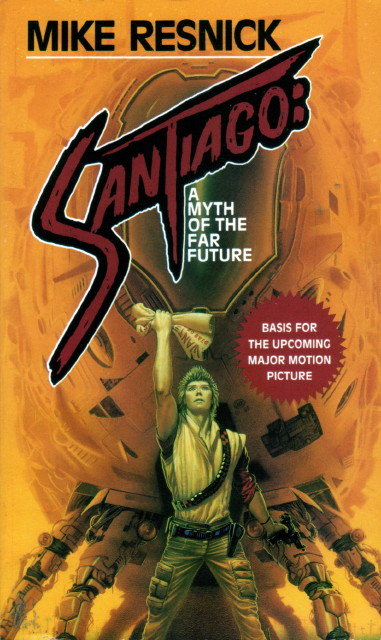
Mike Resnick: Santiago

Santiago is my first exposure to Mike Resnick’s writing. I think it first attracted my attention when I read about its sequel, The Return of Santiago, and the notion of a major figure in the political scene whose existence wasn’t actually verified intrigued me. I think I’d expected it to be similar to Jack McDevitt’s novel A Talent For War, which is one of my favorites.

Santiago is told like a folk tale, with each chapter headed by a four-line stanza from a poem written by a far-future scribe recording the figures on the inner frontier of the human Democracy. The inner frontier is just that, full of rogues and scoundrels and bounty hunters. Sebastian Nightingale Cain is one such bounty hunter, who picks up the trail of the notorious criminal Santiago and starts to follow it, with reporter Virtue MacKenzie tagging along hoping to get the story on the mythical figure. Cain wants to head off the Angel, another bounty hunter, who’s also after Santiago. Along the way they meet many colorful figures as they unravel the mystery.

Santiago is low in science-fictional “ideas content”, with only the standard array of faster-than-light starships, laser guns, and other boilerplate science fictional trappings. The story rests entirely on the characters and on the mystery of Santiago, and neither of them really grabbed me. The characters are pretty simplistic, although Cain’s bluster – which he’s earned the right to – is often amusing. I figured out who Santiago would be about half-way through, and was disappointed that that was the extent of the mystery. It’s not so much a bad story as just not a very deep story, and the folk tale storytelling approach isn’t really my cup of tea.

I like McDevitt’s approach to this sort of mystery more (although it has its flaws, too), and the melange of characters is similar to – though not as strong as – the set in the comic book GrimJack (which was originally published around the same time as this volume). Santiago has a certain folksy charm, but it was a little too simplistic for my tastes.

Election Day

I voted this morning. My polling place is 3 blocks from my house, so I always take a nice walk down there in order to vote and enjoy the weather. That one can take a “nice walk” there in early November is a clear sign that I live in the Bay Area and not in Wisconsin any longer. Anyway, there were 5 people in line when I got there, and I ran into both one of my neighbors and one of the guys I play Magic with. I guess we have a fairly quiet district. Or maybe everyone votes after work.

My political leanings are somewhere to the left of the mainstream Democratic party, but I’m not especially enamored with any of our small parties, so I typically vote party-line Democratic. I think Obama will make a pretty good President; the bar isn’t set real high for him to be our best President since LBJ. (I’m not hugely enamored of LBJ, either, but he was a President who did some great things and some awful things, which is still a step up from everyone since, who have generally been mediocre-to-awful.)

Although I voted party-Democratic in the national and state elections, I wasn’t real enthusiastic about doing so. I’ve been disappointed in the Pelosi/Byrd Congress, who haven’t really stood up to the Bushies. I’m not real fond of the California state legislature, either, although to be fair I think California’s state government is basically screwed: Federal mandates and an extremely-difficult-to-manage budget make it practically ungovernable except during boom times. The problems are partly structural (a 2/3 majority vote of the populace is required to raise taxes, and a 2/3 vote of the legislature is required to pass a budget), and partly because I think California is just too big and too diverse to govern at the state level. I think California would be better off if it were split into two states, probably along north/south lines. But that’ll never happen.

We had some interesting state propositions this time around:

  • I voted against the “anti-freedom” propositions, 4 (parental notification of minors seeking abortions) and 8 (outlaw gay marriage). These measures are both just plain evil, rolling back freedoms and rights for many citizens. I think anyone who supports Prop 8 should also have their right to marry revoked – it seems only fair. I suspect 8 will fail, but I’m concerned that 4 will pass.
  • Prop 1 is a bond measure for high-speed rail between San Francisco and Los Angeles. I voted against. I generally oppose bond measures as less efficient than passing new taxes, but I will occasionally vote for a county bond measure with a critical goal in mind. I also don’t think high-speed rail between the two cities will be more than a novelty. Plus, I’m very concerned with what it would do to the rail corridor on the SF peninsula, where I live, which hasn’t been worked out. I don’t know how this one will turn out, though.
  • Prop 5 reduces sentencing for certain nonviolent crimes, while Props 6 and 9 strengthen law enforcement and impose tougher penalties. I think we lock up far too many people (over 1% of the US population is presently incarcerated) with far too little attention paid to rehabilitation, so I voted for 5 and against 6 and 9. (I suspect 5 will fail, 9 will pass, and 6 could go either way.)

County measure B is a tax increase measure to bring BART to San Jose. I’m really on the fence on this one, as I think BART is a good system which is well-run, but which is also very expensive due to poor design at its inception. I like it a lot better than “heavy rail” alternatives than CalTrain, though. But it’s expensive to extend. I ended up voting yes, although I suspect the measure is going to fail.

Anyway, I’ll be watching the results tonight. Five Thirty Eight is currently projecting a 98.9% chance of an Obama victory. One of their more interesting posts recently has been What a McCain Victory Looks Like.

I’m not as excited as some Democrats about an Obama Presidency, mainly because I think the Bushies have left the country in such horrific shape that the next President is going to have some huge hurdles to overcome just to hold things together. If the Bushies hadn’t screwed things up so soundly then I think it would be a much more exciting time. As it is, I’m just hoping things can turn around soon enough that the Democrats don’t lose control of Congress in 2010.

Still, getting the Repugnicans out of the Oval Office is a great first step forward.

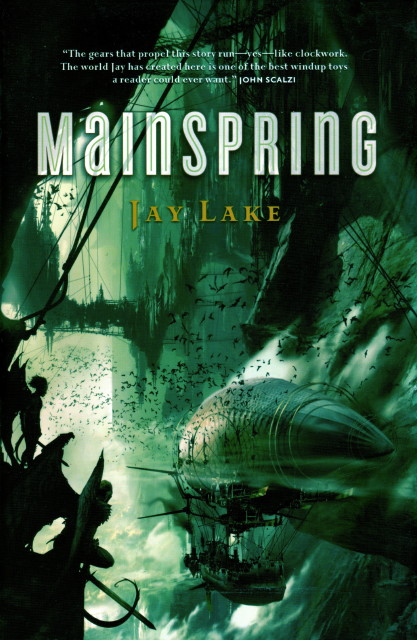
Jay Lake: Mainspring

Jay Lake is one of the current generation of SF writers who I heard about through word-of-mouth on the Internet,. Mainspring is his first novel, and also my first exposure to his writing.

It’s a “fantastic alternate world” story, in that it takes place on an Earth where the British Empire is ascendant and America is merely one of its provinces, but where magic is real, and the world is bisected by a giant wall around the equator. Our hero, Hethor Jacques, is a young apprentice clockmaker in New Haven, Connecticut who receives a visitation from the angel Gabriel. Gabriel tells him that the mainspring of the world is winding down, and that he has to find the fabled Key Perilous and wind it up again, a feat the likes of which hasn’t been seen since the days of Christ.

At first unsure that it’s not just a dream, Hethor is convinced by the small silver feather that Gabriel leaves behind, and a visit to his master’s son, and then to a librarian at Yale, convinces him that his vision was real. Unfortunately, it also causes him to run afoul of his father’s dishonest and greedy sons, who force their father to turn him out onto the street. This sets Hethor on a path to Boston to petition the Queen’s representative for help. This, too, goes badly, but is a blessing in disguise as he ends up conscripted to one of Her Majesty’s airships (zeppelins), where he meets Simeon Malgus, who also has some knowledge of the strange doings of the world. The ship travels to the equator to extend the empire’s reach into the wild areas near the wall around the world.

The adventure goes badly for the ship, and Hethor is separated from them and carried to the top of the wall, where the gears on which the Earth travels around the sun are located. He and Malgus travel over the gears into the southern hemisphere where they become separated. But Hethor is taken in by some small aborigines who call themselves the Correct People. He forms a close bond with one of the People, Arellya, and the People accompany Hethor – whom they see as a messenger from God – on his mission as he forges ever southward in search of the Key Perilous and the Mainspring. He is opposed in this by William of Ghent, a sorcerer who served the regent in Boston, who believes that if the mainspring is allowed to wind down then it will signal a new age for mankind in freedom from the whims of heaven.

I generally prefer SF over fantasy, and this story leans more to the fantasy side than I’d expected. But my basic problem is that the story is a straightforward quest/travelogue: Hethor has a mission and he sets out to fulfill it even though he really doesn’t have much idea how to go about it, and this provides the impetus to send him across this quirky world that Lake has created and show us many things about it. Mixed in with this is Hethor’s coming-of-age tale. But despite putting these elements together in a single tale, I don’t think it manages to transcend any of them.

A travelogue is successful only to the extent that the world fascinates. The archetypal fantasy travelogue, of course, is The Lord of the Rings. There’s certainly some interesting stuff in this world, but throughout the story I kept wondering: Why is Earth on a gear? How did civilization evolve so closely with our own despite being separated from the southern hemisphere? What other effects did the bisecting of the Earth have? These questions are outside the scope of the story, but they’re the ones I was most interested in, which meant the travelogue had some big missing pieces for me.

Hethor’s narrative is okay, but doesn’t really distinguish itself in the annals of quest or coming-of-age stories. At first Hethor pursues his quest through some reasonable avenues, seeking out knowledgeable people to help and direct him, but as it progresses once he enters the southern hemisphere his attraction to the south pole doesn’t seem rational, even in the context of the story’s supernatural elements (why the south pole rather than the north?). His progress into manhood is decidedly quirky, especially once he meets Arellya and the Correct People. Lake certainly deserves props for the odd turns the story takes at this point, but overall it wasn’t a remarkable story.

Finally, I felt let down by the conclusion, as Hethor ends up leading a strange life after the conclusion of his quest, leaving everything he’d known behind. In a way it does make sense given where he ended up travelling to, but it wasn’t a very satisfying conclusion to the story.

Stories like this always make me feel like I’m missing some piece of the big picture, suspecting that there’s an allegory that I can’t see. There’s a lot of Christian imagery in Mainspring, and I have negligible understanding of Christianity other than the broad ways in which it’s influenced the culture I live in, so if Lake is trying to make points about Christianity through the story, they went entirely over my head. But if the book is what it appears to be to me, well, Lake shows considerable craftsmanship in his world-building, but the story just wasn’t very interesting to me.