This Week’s Haul

  • Batman and Robin #8, by Grant Morrison & Cameron Stewart (DC)
  • Booster Gold #29, by Dan Jurgens & Norm Rapmund (DC)
  • Secret Six #18, by Gail Simone, John Ostrander & Jim Calafiore (DC)
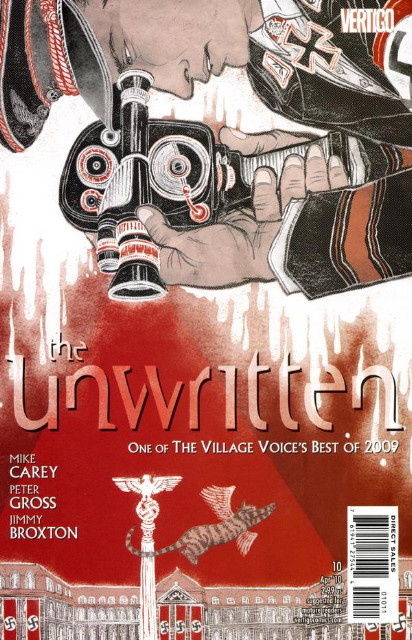
  • The Unwritten #10, by Mike Carey, Peter Gross & Jimmy Broxton (DC/Vertigo)
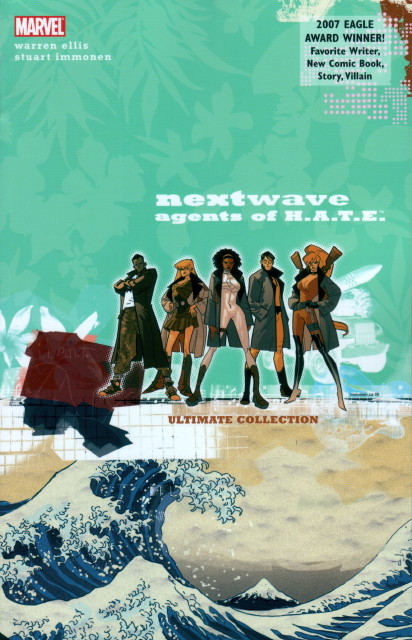
  • Nextwave: Agents of H.A.T.E. ultimate collection TPB, by Warren Ellis, Stuart Immonen & Wade Von Grawbadger (Marvel)
  • B.P.R.D.: King of Fear #2 of 5, by Mike Mignola, John Arcudi & Guy Davis (Dark Horse)
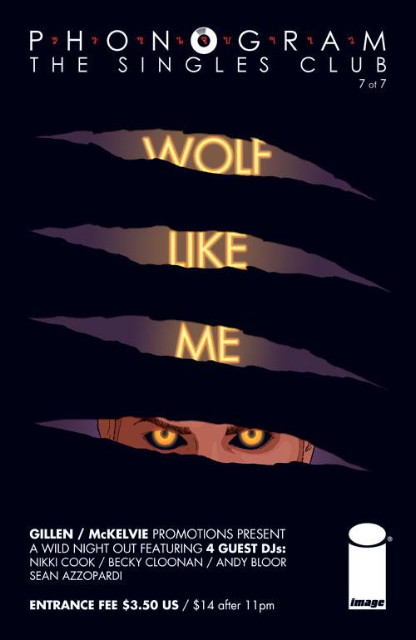
  • Phonogram: The Singles Club #7 of 7, by Kieron Gillen & Jamie McKelvie (Image)
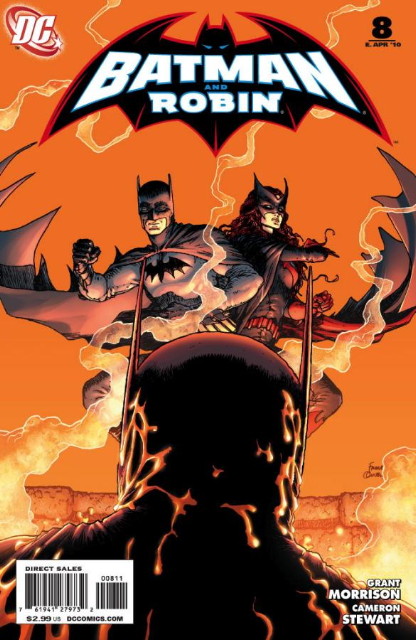
Grant Morrison does clear a few things up in the new Batman and Robin: Who the body left behind when Darkseid killed Batman in Final Crisis belongs to, and why Superman verified that it was Bruce Wayne’s (the explanation is fairly stupid, though), and how Batwoman ended up in England (though she’s basically superfluous to the story).

Either DC or Grant Morrison (maybe both) have really painted themselves into a corner here: Bruce Wayne is “dead”, but we know he’s not really dead. But Dick Grayson and Damian Wayne Al Ghul are now Batman and Robin – but we’re getting this story where Dick’s being a weenie and trying to resurrect Wayne using a Lazarus Pit. Which means the story can’t focus on Dick and Damian – plus Damian just had his spine replaced (!) so he’s been off the stage for a few issues anyway. The most promising part of Batman and Robin from the start was the relationship between Dick (a kinder, gentler Batman) and Damian (a nastier, crazier Robin), but that’s all fallen by the wayside in favor of plumbing the depths – yet again – of Batman’s convoluted mythos. And that’s just not as much fun as playing new games with new players. And Morrison’s writing style seems supremely unsuited to writing this series, inasmuch as characterization is his weak point.

At this point I’m basically assuming that Wayne will be back soon, and that this series will end with #12 or so. It’s shaping up to be completely forgettable, which is too bad, since there was some potential here.

From the beginning, The Unwritten felt like it was going to take a while to get going, and now it feels like it’s getting there: Our hero, Tom Taylor, has been confused for his fictional alter-ego written by his father in a series of Harry Potter-esque novels, and he’s been hunted by an assassin, whose victims’ murders Tom has been framed and imprisoned for. Now Tom has escaped prison with a reporter and a mysterious woman who sees to know more than she’s telling, and in this issue they end up in what seems like a giant hologram of late-1930s Germany. The only person they can talk to is Nazi propagandist Joseph Goebbels, who is making the film Jud Süß, and who provides a little insight (if obliquely) into the nature of fiction in the world writer Mike Carey is creating.

I’m willing to go along with the sometimes-frustrating pace of the story because I can identify with Tom’s own frustrating that many things don’t make any sense. He’s a sympathetic character who has gotten caught up – apparently through no fault of his own – in something much larger than he is. Of course, there’s the implication that he actually is the fictional character and that the story is building towards revealing that to him and showing what it means. My expectation is that these early chapters are largely sowing the ground for where the story is ultimately going, and that they’re not being oblique and obscure just for the sake of being so. The success of The Unwritten is going to depend heavily on there being clear explanations and resolutions of the major story elements at some point.

But so far I’m happy to go along for the ride. While I wish the pace would pick up a little bit, The Unwritten is still an intriguing read.

Nextwave: Agents of H.A.T.E is all about superheroes blowing things up. It’s Warren Ellis writing about five heroes who barely achieve the level of has-been (Photon and Machine Man are the headliners), making smart remarks and blowing up everything that a terrorist organization that’s taken over their sponsor group can throw at the, with Stuart Immonen drawing in a cartoony style which completely submerges the lush realism he usually brings to the page.

It is, overall, a really, really bad idea, executed with a modicum of what I assume is supposed to be humor, and even less cleverness, never mind anything even resembling an understanding of the characters. ( I always wondered why Machine Man suddenly appeared in Ms. Marvel behaving completely unlike his past appearances, and apparently this piece of drek is the reason.) The one actual good idea is plundering Marvel’s 1960s humor comic, Not Brand Ecch, for a team to fight the Nextwave.

Apparently this series was something of a fan favorite when it first came out, and it’s completely beyond me why: It’s not funny, it’s not smart, it’s not exciting, it’s just a train wreck from beginning to end. In short, it is Brand Ecch. And that ain’t good.

Eight months ago, Phonogram was getting a fair amount of positive Internet press, so I picked up the collection of the first series, Rue Britannia. Although it had its rough edges – Jamie McKelvie’s art wasn’t very polished, and Kieron Gillen’s story’s structure was a fairly uninventive “hero’s journey” one – it won me over. The premise was that phonomancer David Kohl’s identity and power were bound up in an early-90s incarnation of the goddess Britannia, based around the music of Britpop, and that someone was trying to rewrite her role in history, which would completely change Kohl’s nature, so he sets out to save her, even though her obsolescence meant that no one was really willing to help him. No one really cared, except him. It worked as a story of identity and sense of self in the face of a changing world.

Gillen and McKelvie followed this up with the series – now in color – The Singles Club, which comes to a close this week. Greg Burgas loved this series, as he wrote about here and here, but the series has not done well commercially, and it sounds like there won’t be a third series. Unfortunately, I’m not very surprised, because The Singles Club had none of the strengths of Rue Britannia, and I found it very difficult to relate to.

The core problem is that The Singles Club is a collection of 7 vaguely-linked short stories, and none of them have the power of Rue Britannia. I guess they were emulating the Sandman model of a big story followed by some short stories, but that’s a terrible model for a struggling independent series, and none of the short stories here are anywhere near as good as Neil Gaiman’s typical short story in Sandman. Gillen tries awfully hard to evoke a sense of wonder through love of music, but the characters are mostly ciphers and there’s no deeper thematic underpinnings to the stories to give them force. The premise of the world of Phonograph is subtle and thus a difficult clay to work with anyway: Phonomancers are able to work magic through the focus of music, but the magic is very understated, which means the sense of the fantastic is subdued and rarely a selling point to the series. Rue Britannia did get to the payoff of big-effect magic in the climax, which is what it really needed. The Singles Club never reaches that level in any of its stories. There’s just not much oomph in these little character dramas – the characters were pretty thin anyway – and they needed some oomph to get readers to spread the word. While Rue Britannia is something I’d recommend to a certain set of readers, The Singles Club isn’t.

This is a real shame, because McKelvie’s artwork is leaps and bounds better than in the first series, and the colors are fantastic, making his art all the more vivid. Indeed, the best moments in The Singles Club are the visuals and panel-to-panel storytelling; this last issue has one of the most memorable scenes in which the main character taunts and is chased by gang of apparent street thugs.

Burgas has a response to one of the criticisms the series has received:

Some people here have said they don’t like Phonogram, and some have even said they don’t like it because of the music Gillen references. But the music is ultimately beside the point completely, because, as Kohl points out, any music will do. Gillen might be an elitist ass, Kohl might be an elitist ass, Seth Bingo might be an elitist ass, but who really cares about their taste in music? All that matters is how you make it magical.

But I think Burgas is not understanding the criticism, which is that Britpop is such an integral part of the setting of this series that the series has to bend over backwards to make it relevant to the readers. The story titles in The Singles Club come from a variety of songs, none of which I’m familiar with, and so they have no meaning for me. The music isn’t magical for me, and Rue Britannia went to great lengths to emphasize that music is very personal, very specific, from person to person (a sentiment I completely agree with), so using Britpop as a stand-in for “any music the reader finds magical” is a complete failure of approach, because it’s not that “music” is used to make magic, but that very specific music is used to make a very specific sort of magic. The magic of Pete Townshend‘s “Stardust in Action”, Yes‘ “Wonderous Stories” and Dream Theater‘s “Six Degrees of Inner Turbulence” are all very different from one another – and probably different for someone else than for me. So I can completely sympathize with readers who found it difficult to relate to the series because of the musical references (and the “liner notes” at the end aren’t really adequate): I thought Rue Britannia did a good job of making the story work even though the musical references were outside my understanding, but The Singles Club didn’t succeed in doing so at all.

On the one hand it’s sad that Phonogram didn’t make it because Gillen and McKelvie were clearly trying to hard, and they’re both so talented. But on the other hand, The Singles Club was really not a good vehicle to try to build an audience for the series, so I’m not surprised at the outcome. If they try again in a few years, I hope they’ll return to something in the Rue Britannia mold.

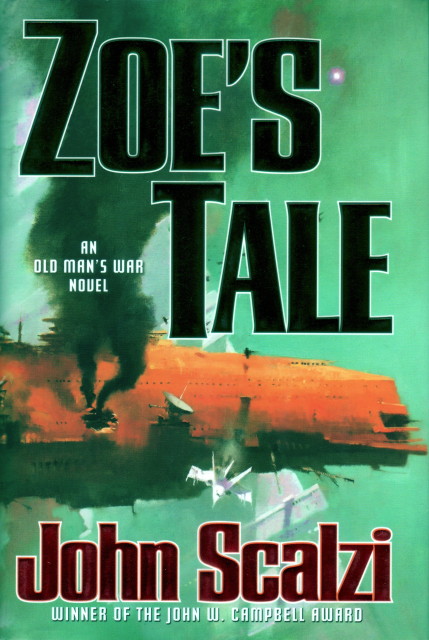
John Scalzi: Zoë’s Tale

Zoë’s Tale can be read on its own, but it fits better as a companion novel to Scalzi’s previous book, The Last Colony. It follows the events of that novel through the eyes of Zoë, the teenaged adoptive daughter of John Perry and Jane Sagan, the protagonists of the first three of Scalzi’s Old Man’s War novels. Scalzi writes in the afterward that he was moved to write this novel partly to illuminate the character of Zoë, who plays a pivotal role in the story despite not being the protagonist, and to fill in some perceived gaps in the story, particularly Zoë’s role in the climax, which happens off-stage. I was skeptical of a companion book like this, in part because I think The Last Colony is fine as it is, but Zoë’s Tale is actually perfectly entertaining on its own.

You can read the synopsis of the overall plot in my review of The Last Colony, and it serves largely as backdrop here: The nitty-gritty details of colonizing a hostile world, the living in fear of being discovered by hostile aliens, and the duplicity of the human government are downplayed: They’re all elements on the minds of Zoë and other colonists, but they’re not things they have to grapple with every minute, because they’re not the colony’s leaders. Instead the book is about Zoë and her perceptions as all this is going on, and particularly her journey to discover her role in the universe. And it’s a big role, because a friendly alien race, the Obin, revere her as the daughter of the human scientist who gave them consciousness, and two of them, Hickory and Dickory, are her bodyguards and watchers. She was eight when all this started, but as she’s grown up she’s stopped seeing it as some cool thing that makes her special and started wondering why she should be so special, and found that being followed around by two overprotective aliens is in fact a little bit annoying, especially since – other than keeping her safe (which until this adventure has not been a big issue) – it doesn’t really benefit her or anyone she knows very much. Well, other than that this situation is a condition of the peace treaty between humanity and the Obin. But that’s not a very personal sort of benefit.

Zoë is a very likable character, although she becomes a little annoying since she sees a little too transparently to be a vehicle for Scalzi to express his own considerable facility for sarcasm. I’m as big a fan (and fount) of sarcasm as anyone, but her interactions with John and with her best friend Gretchen seemed a little too cute and too perfect, and this made the first third of a book hard going at times, especially since the other events in this period were basically a recapitulation of The Last Colony. Zoë and her friends become much more interesting once the colony is abandoned on the planet Roanoke and the tensions become ratcheted up: Then it becomes more of a tale of people (some smart, some rather stupid) dealing with exceptional situations, where Zoë is sometimes the voice of reason and sometimes one of the rebellious kids.

So the enjoyment of the story mainly comes from seeing Zoë grow from this sarcastic kid into a responsible young woman, a growth forced by her love of her family and friends and recognition that she has resources that no one else has. She demonstrates that she’s responsible and smart when she helps save two of her friends from the local alien race on Roanoke through cleverness and bravery. And she demonstrates a deeper level of responsibility when we follow her into space to meet with several races who are involved in the drama that John and (through him) the rest of humanity is playing out. In some ways that meeting is the most compelling development in the book, as she befriends the leader of the group who plan to wipe out their colony (getting involved in their own political battles), and also resolves her position with the Obin as a means of getting a boon from the much more powerful race of the Consu. On the other hand, the direct meeting with the Consu feels a little too much like a pivotal scene in Old Man’s War, only without the denouement of the actual combat, and the three lines that punctuate that climax feel too abrupt. I see that Scalzi felt that the key moment had already been written and everything else was not essential, but it still felt awkward and pulled me out of the story.

Zoë’s Tale moves the tone of the Old Man’s War stories away from more “serious” military/political SF and toward purely humanistic SF (in the Kim Stanley Robinson mode). On the one hand it’s a welcome evolution (one I appreciate a lot more than the farcical style of the unrelated The Android’s Dream), but on the other hand I think Scalzi is at his best when he’s writing a story about plans-within-plans, or the people trying to figure out and foil those plans, which means this novel has less of Scalzi’s best stuff in it. As I said, it’s a companion volume, and ultimately not as good as The Last Colony (which, to be fair, is quite good), and it does little to advance our understanding of the OMW universe, which is a bit disappointing. It’s an enjoyable read, and while Scalzi had developed a lot as a writer since Old Man’s War, but I don’t think it measures up to the first three.

Rebuilding Downtowns

Interesting article at the San Jose Mercury News today on the rebuilding of Sunnyvale Town Center having stalled out, and how the only piece that’s thriving – and having a hard time of it even then because of all the surrounding construction – is the one block of Murphy Street. A few choice quotes:

In the 1970s, Sunnyvale razed its downtown and built a shopping mall, complete with a Macy’s. It kept one block of Murphy Avenue intact, and that street—crowded with cafes and boutiques—thrived, becoming one of the valley’s coolest hangouts while people bypassed the sun-starved mall.

and:

Now the mayor and council have to deal with one of the largest redevelopment fiascoes after the half-completed project fell into foreclosure proceedings and contractors walked off the job last year.

Today, Murphy Avenue sits next to a mishmash of vacant lots, nearly completed buildings and the steel skeletons of others. Orange tape stops shoppers from pulling into never-finished parking lots.

I think my own city of Mountain View really dodged a bullet regarding its own downtown. It probably helped that in the 1970s and early 1980s Mountain View had not one, not two, but three malls: The huge strip mall San Antonio Center (which still exists today and even thrives despite seeming hopeless outdated in its layout), the Mayfield Mall (now a defunct office building and itself the subject of ongoing redevelopment efforts), and the Old Mill (now the site of two townhome complexes), so turning Mountain View’s downtown Castro Street – which at the time I hear was a wasteland – into another large mall would have been redundant. Castro Street’s renaissance apparently came from redevelopment funds in the wake of the Loma Prieta earthquake in 1989, when it was turned from a 4-lane thoroughfare to a 2-lane pedestrian shopping district.

Mountain View has been one of the smarter cities I know of about land use (no doubt some would disagree, but looking at some other cities the bar has been set pretty low), and development of downtown has been gradual and considered. Castro Street has three forms of public transit (bus, light rail, and CalTrain) that stop at one end of the street, and there is a huge amount of lot and garage parking behind the storefronts, avoiding that strip mall look. Castro Street has become a lot more interesting just in the 10 years I’ve lived here, as the vast numbers of Asian restaurants which supposedly kept the area afloat in the 80s have thinned out and been replaced by a more diverse selection. It’s very nice.

But then there’s Sunnyvale.

Sunnyvale’s main shopping district other than downtown is El Camino Real, and without a large mall as a shopping anchor it’s perhaps no surprise that the city decided to redevelop downtown into a mall in the 70s. But large malls have large problems as the years wear on: They’re not modular, like downtowns are, so renovating and updating them is difficult (and expensive, if the whole mall has to be updated at once). And if the mall falls so far behind the times that no one wants to renovate it, then your only option is to bulldoze it (wasteful) and redevelop it (expensive), possibly as another large mall project (really expensive). This could be the ultimate fate of other nearby large malls, such as Westfield Valley Fair (a traditional indoor mall) and Santana Row (an outdoor pedestrian mall with housing on the upper floors), although Westfield has worked hard to keep Valley Fair up-to-date, and Santana Row is less than 10 years old. Also-nearby Cupertino Square (formerly Vallco) is also a traditional indoor mall, and it’s been struggling to stay afloat as long as I’ve been here. The current owners are making a good go of it, but I wouldn’t lay money that it will still be open in another decade.

So Sunnyvale’s decision to redevelop downtown as a second mall is expensive, risky, and probably dooms the city to having to go through the whole thing again in another generation. Now, they do seem to be trying to apply the Santana Row model (or something closer to it) this time, but it’s yet to be seen whether that model will be more durable over the long haul.

Meanwhile, Murphy Street is already an unqualified success (its biggest problem is not enough parking – and it’s only one block long!), and redeveloping the mall space as a traditional pedestrian street-oriented shopping center might be less expensive (or at least the expense could be amortized over time as the streets are built out gradually), less risky, and more enduring, while perhaps being more successful in the long run. Sunnyvale does have a problem in that it has few places to locate large anchor stores like Macy’s, but it’s not too hard to envision a creative solution that places a large department store venue in the midst of smaller stores.

Given the straits that Sunnyvale seems to be in now, I wonder whether they might be better off razing large chunks of the work that’s already been done, and heading in a completely different direction. Of course, I don’t know what financial problems that might raise for the city, given the money that’s already been borrowed for the current project, but at some point they may have to just see that as a sunk cost and that the current project just isn’t worth pursuing.

I would be amazed if they pursued that route, and no doubt they’ll at least wait until the economy improves to see if the current project becomes viable again (although the Merc article says they might consider going partway on that). But ultimately I think it’s a shame that they went the mall route at all, since traditional downtowns are now in vogue, and have shown themselves to be enduring over long spans of time through changing demographics – a feat that few malls have managed to achieve.

This Week’s Haul

A light week, for a change:

  • Justice Society of America Annual #2, by Keith Giffen, Matthew Sturges, Tom Derenick & Rodney Ramos (DC)
  • Criminal #4, by Ed Brubaker & Sean Phillips (Marvel/Icon)
  • Nova #34, by Dan Abnett, Andy Lanning, Mahmud A. Asrar & Scott Hanna (Marvel)
  • The Boys #39, by Garth Ennis, John McCrea & Keith Burns (Dynamite)
The early contender for “worst comic book of 2010” is Justice Society of America Annual #2. This thing was terrible.

The cover is awful. The characters’ faces look grotesque. The prominent feature of the cover is Power Girl’s breasts (really?? That never happens!). And although it’s presumably depicting the other characters’ disgust for Magog (a disgust which, frankly, I share), the composition is such that it’s not portrayed very clearly (at first I thought it was a standard “team vs. team” cover).

The interior art is a little better, but nothing special. The story, though, is truly terrible. The way the JSA has split into two teams was handled ham-handedly, and this story features the spin-off team, the All-Stars, showing up at a prison (a large, rather palatial prison, it seems) to deal with a riot purportedly started by Magog. None of the team (his own team!) really trusts Magog – especially Power Girl – even though these are supposedly the characters who left the core JSA with him to form their own team, seemingly because they sympathized with his outlook. Then the villains in the prison show up and it turns into an all-out fight, between the heroes and the villains, and between Magog and his supposed teammates. Then the other JSA team shows up and everything gets thrown even more into chaos. Meanwhile, some apparently-villainous group I’ve never heard of is using the prison as a lab facility, which is why Magog went there in the first place.

None of this makes even the first lick of sense. Magog seems about as bright as a couple bags of hammers, but his communication skills are near zero. How’d he find out about the prison being a cover? Why did he go in alone? Why was his own team so willing to believe the worst about him? And the fight isn’t even well choreographed.

The point of the story seems to be to get Magog off the All-Stars team, to which I say: Good riddance to bad rubbish. But almost all of the characters behave badly, the plot is nonsensical, the art isn’t much to look at, and it feels like a routine 2-issue story for some reason shoved into an annual. Was it really necessary? Haven’t there been plenty of opportunities to show Magog the door in the last six months?

The regular JSA book has been rather dour since Bill Willingham started writing it – it’s been well over a decade since someone’s done a JSA series which captures the spirit of the team – and this annual piles a muddled story on top of that feeling. It may be time to bail on this series.

Jack McDevitt: The Devil’s Eye

Why is it that Jack McDevitt’s second novel, A Talent For War, is one of my favorite books, but the others I’ve read by him have been merely… okay? Talent starred antiquities dealer Alex Benedict, a resident of human space in the far future, unraveling a mystery of the great war between humans and the only other sentient species we’d discovered. The other Benedict novels – there are three more – follow a similar pattern, of Benedict and his aide/pilot Chase Kolpath traveling around the galaxy to unearth clues to a historical mystery, yet none of them worked nearly as well for me as Talent did.

The Devil’s Eye is the latest Benedict novel, and it covers similar ground: On the way back from a visit to Earth, Alex receives a message from popular horror novelist Vicki Greene asking for help, with the cryptic line that “They’re all dead”. But when they get back home, they find that Greene has had her personality wiped after transferring a large sum of money to Alex’s account. Feeling honor-bound to figure out what drove her to this extreme, Alex and Chase follow up on her recent activities, travelling to the isolated world of Salud Afar, a planet rich in ghost and horror stories, in addition to having come out from under the yoke of a brutal dictatorship just a few decades earlier. And they do discover what happened to Ms. Greene, about halfway through the book, at which point it becomes a very different story, one of moral conflicts and government cover-ups and appeals for help in the face of impending tragedy.

A Talent For War was a game-changing novel for Alex’s universe, and it’s difficult to do that in every story (and to his credit, McDevitt hasn’t tried), but it also makes it a tough act to follow. More importantly, Talent was both a portrait of a flawed hero – a hero of the past war, whose nature Alex had to figure out – and a story in which Alex had to make some tough choices for himself, even though there were some clues that maybe the mystery were better left unsolved. Talent is more of a character drama than the other McDevitt novels I’ve read, in addition to being an exciting adventure, and having some compelling vignettes sprinkled through it. It works because it’s the complete package, and McDevitt pulled it off with unusual subtlety.

The Devil’s Eye feels like it’s trying to recapture the power of Talent (the intervening two Benedict novels have been essentially straight-up mysteries), and mixing things up a bit by using the mystery to get into the larger story, in which Alex and Chase have to decide whether to reveal what they’ve learned, and then whether they can do more to help. (It’s difficult to describe the second half of the story without ruining the surprises of first half.) But unfortunately the second half is not nearly as interesting as the first half, and it felt very heavy-handed. There are some good moments in it, in particular Chase ends up being the hero of the day in the way that Alex usually is, but the machinations of the characters in the second half often felt routine to me, and the outcome seemed fairly clear from the outset. The first half, with its mysteries and atmosphere and moments of adventure, is much more intriguing and exciting.

McDevitt’s strength in the latter Benedict novels is that atmosphere, which is grounded in the settings of the places the characters visit, and their histories. That’s the case here, too, as the mysterious locales of Salud Afar are a little bit corny, and a little bit spooky, which I think is the intention. It’s the SF equivalent of a haunted house, or a local legend where no one’s quite sure whether it has any basis in truth or not. For example, the isolated village where a cyborg is reputedly buried and who rises from the grave to claim new victims, or the mysterious light in the Haunted Forest. The book’s strength is all the more impressive since Benedict’s universe is pretty low-tech for a far future novel (at least, a modern one), being of about the same tech level as Asimov’s Foundation books (McDevitt’s writing reminds me of Asimov’s from time to time, actually). The sense of wonder is in the world building, not the tech.

One of the weaknesses of the Benedict novels after Talent is that they’re narrated by Chase, whose voice never really rings true to me, and who I think is a much less interesting character than Alex. And Alex isn’t even a Sherlock Holmes type who’s best revealed through an everyman narrative; he’s rich and smart, but not truly exceptional, and being inside his head in Talent was much more interesting than seeing him from Chase’s point of view.

(Unsurprisingly, I said many of the same things in my review of the previous Benedict novel, Seeker.)

The book overall rates for me as “pretty good”, but at this point I don’t think McDevitt’s going to recapture the excellence of Talent. The Devil’s Eye has its moments, and the series is entertaining enough that I’ll keep reading them – mainly for the setting and the mystery (I think space opera mystery is an underexplored genre, and I wish more writers were working this territory). But his writing seems more geared for the mainstream than for the high tech SF fan, which isn’t bad, but I often think it could be more than it is.

Vivid Dreams

I’ve had three nights in a row of strong, vivid dreams. They’ve been pretty nonsensical, but powerful, considering that I rarely remember my dreams. I rarely write about them when I do remember them (because reading about other peoples’ dreams is pretty boring, I think), but after three nights in a row, I wanted to note this down:

  • Friday night the dream involved cleaning a large house, though one I didn’t recognize. Somehow that mutated into the house being on top of a tall tree (or something like that), and swinging on vines to clean up dead pieces in the tree. And somehow that ended with me landing on a street corner (which I also didn’t recognize) to watch a performance put on by a group of actors. The actors were three former actors to play Doctor Who, Jon Pertwee (who is deceased), Tom Baker, and Colin Baker, plus someone I didn’t recognize who apparently had played Mister Fantastic back in the 70s or 80s (as he appeared much older now). What exactly they were doing I’m not sure, but I had a lengthy conversation with Jon Pertwee in the dream (which I don’t recall).

    Dreams involving heights are a recurring theme for me, probably because I have mild acrophobia, so that’s not unusual. The presence of Mister Fantastic was probably because we watched Fantastic Four: Rise of the Silver Surfer on Friday night (not recommended). The rest of it is a mystery.

  • Saturday night I had a dream involving zombies. You’d think this was because I just took the first volume of The Walking Dead out of the library, but in fact I haven’t read it yet, so I don’t know where this dream came from. It mostly involved me watching several young teenagers walking back and forth between two points in a small town, including going through a shotgun house in which an old man lived. Obviously at some point they were going to find that the old man became a zombie. When the inevitable happened, one of the kids – or maybe me, since my point of view had merged with them by then – let out with a “Nooooo….!”

    This was so powerful a moment that I actually let out with a loud moan in real life, waking up Debbi and scaring all the cats off the bed. I wasn’t particularly frightened by the dream when I woke up – it didn’t feel like a true nightmare – but I was embarrassed that the dream crept out into real life like that.

  • Last night the dream involved going to the ocean and finding that it had risen quite a few feet, swamping the shore. I met an old girlfriend of mine there, and she was apparently swimming around collecting large sea shells. I think this was the tail of a longer dream, which mostly involved getting to the ocean, but I don’t remember anything but the end of it.

I guess my mind must have a bunch of stuff it’s trying to work through, but it’s certainly not any clearer from all of this nocturnal activity. I’d be just as happy to not remember any of these dreams, because they don’t feel helpful at all.

Matthew Hughes: The Spiral Labyrinth

At the end of Matthew Hughes’ Majestrum, Henghis Hapthorn, Old Earth’s foremost discriminator, found that his intuitive other half, his own fully-formed personality inside his head, had taken a new name, Osk Rievor. This new story begins with Rievor researching the history of magic from the previous age in anticipation of the next age when magic will again reign supreme. But Hapthorn has clients to work for in order to get paid, and to Rievor’s frustration Hapthorn and his integrator – a digital assistant turned into a wizard’s familiar – head off in search of a missing person, getting captured themselves before managing to free the object of their quest, and coming away with a small spaceship under their ownership in the bargain.

From there, Hapthorn acquiesces to Riever’s desire to visit some points of mystical power in the world, a task which seems tedious at first, but turns dangerous when their pair – plus integrator – are again captured, this time by a mysterious being controlling a red-and-black spiral labyrinth down which they walk. When Hapthorn emerges at the other end, Rievor is no longer in his head, and he’s no longer in his own world, having been thrown into a medieval period hundreds of years in the future, in the coming age of magic. Armed with only his superhuman reasoning ability, in a world where reason is at best scoffed at, Hapthorn must find and rescue his other half and find a way to return to his own time – not to mention figure out who captured them in the first place, and how to stop him from doing it again!

Labyrinth is similar structurally to Majestrum in that it starts with a short mystery to show off Hapthorn’s skills, and then launches into the main story. But this one is more of a fish-out-of-water story, and features more interplay among the characters, especially as Rievor and the integrator both become better realized.

Hughes has plenty of fun playing with Clarke’s third law, as Hapthorn uses his skills to perform feats of reasoning that seem like magic – and of course can be duplicated by magic in the future era. This leads to the philosophical conundrum in which he’s unable to convince people that he’s not a magician, even though they can tell he’s not using magic – there’s clearly something odd about him. The way Hughes sets up these ideas and pulls them together is quite clever, and is a big part of the enjoyment of the book.

Another part, of course, is the light touch which Hughes applies to his writing style. Hughes spreads his humor around among all the characters, and Hapthorn more than anyone else is the target of the jibes of other characters. It results in a fine line that Hughes has to walk, since constantly making fun of the main character in a largely serious story can undermine the whole narrative, but the fact that Hapthorn is both very competent and also a bit full of himself means that seeing him cut down to size from time to time seems justified.

The book has a more satisfying climax than Majestrum did, as Hapthorn cuts a more heroic figure than he did at the end of the first book, and the confrontation with the antagonist feels not quite so metaphysical. Hughes also proves willing to make some radical changes to the status quo of Hapthorn’s world, as two major characters undergo significant transformations at the end of the book. Not many authors seem willing to do this in serial fiction, which makes it exciting since now we can anticipate what Hughes will do with the new configuration even though we know we won’t be getting exactly more of the same.

As a result, The Spiral Labyrinth isn’t so much better or worse than Majestrum as simply different, and equally entertaining on its own terms. But you can’t ask for much for than an exotic milieu, engaging characters, and amusing writing, which is what this series delivers. There’s at least one more volume in the series, and I’m looking forward to it.

This Week’s Haul

  • Astro City: The Dark Age Book Four #1, by Kurt Busiek, Brent Anderson & Alex Ross (DC/Wildstorm)
  • Batman and Robin #7, by Grant Morrison & Cameron Stewart (DC)
  • Green Lantern #50, by Geoff Johns, Doug Mahnke, Christian Alamy, Rebecca Buchman, Tom Nguyen & Mark Irwin (DC)
  • Justice Society of America #35, by Bill Willingham, Travis Moore & Dan Green (DC)
  • Madame Xanadu #19, by Matt Wagner, Joëlle Jones & David Hahn (DC/Vertigo)
  • Victorian Undead #3 of 6, by Ian Edginton & Davide Fabbri (DC/Wildstorm)
  • Fantastic Four #575, by Jonathan Hickman & Dale Eaglesham (Marvel)
  • Guardians of the Galaxy #22, by Dan Abnett, Andy Lanning, Brad Walker & Andrew Hennessy (Marvel)
  • Echo #19, by Terry Moore (Abstract)
  • Irredeemable #10, by Mark Waid & Peter Krause (Boom)
  • The Unknown: The Devil Made Flesh #4 of 4, by Mark Waid & Minck Oosterveer (Boom)
  • Chew #8, by John Layman & Rob Guillory (Image)
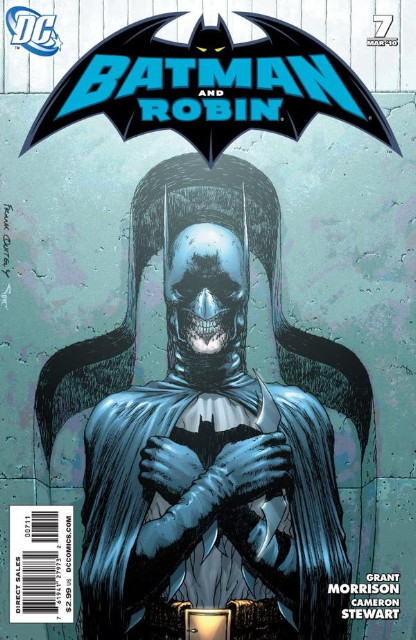
Batman and Robin #7 is the perfect example of the “average” Grant Morrison book:

  1. The story starts with the current Batman (Dick Grayson) carrying the body of the previous Batman (Bruce Wayne – or as far as everyone in the DC Universe knows it’s his body) out of its crypt. This page is a piece of the setup, but it then transitions to a seemingly-completely-unconnected scene in London, a gimmick Morrison often employs make his plots more cagey.
  2. Obscure guest stars, in this case Knight and Squire, the equivalent of Batman and Robin of England. (Morrison created the current versions of these characters, but their antecedents are from the Silver Age, and John Byrne also used them in his series Generations III.) Knight visually resembles another Morrison creation, Prometheus.
  3. The first two episodes of the story are essentially a blind for Batman’s real goal, which is the revive his predecessor with the help of a Lazarus Pit. This unfortunately tends to make many of Morrison’s stories hard to follow, especially as in this case, where it seems like Batman was well aware of where the pit was (the body preceded him there, after all), and Batwoman turns up for some reason, but the chain of events doesn’t really make much sense.
  4. The characterizations don’t quite ring true: Dick’s speech near the end about his drive to bring Bruce back belies both the rocky relationship between the two men as adults. Dick’s defeated tone of voice – even though he really had nothing to do with Bruce’s death – also feels out of character.

The story overall is intriguing despite its flaws, and Cameron Stewart draws the hell out of it, easily the best artwork the series has yet seen. The issue did have an unfortunate in word balloon placement flaw in one panel, and you might find a glossary of British terminology in the issue helpful, but neither is a detriment to the book.

What’s less encouraging is how the faux body of Batman is being handled, since we know from the end of Final Crisis that Bruce Wayne is still alive, apparently on a parallel world, but Dick says here that Superman confirmed that the body has Bruce’s DNA. Superman is by definition a reliable source in situations like this, so it has to be Bruce. Which severely limits how Morrison can explain that it’s not really Bruce: A clone would be so cliché that it would render the whole thing pointless. Bruce could have traded places with his double from the other Earth (which would be a bit draconian). But any solution which ends up with Superman being wrong or having been tricked means the whole thing fails. (This was a flaw in Mark Waid’s otherwise excellent The Return of Barry Allen, where Green Lantern’s ring verifies that Barry is really Barry, and that undercuts the whole story; this is a problem with having godlike characters running around your universe.) I’m curious to see whether Morrison can make it work.

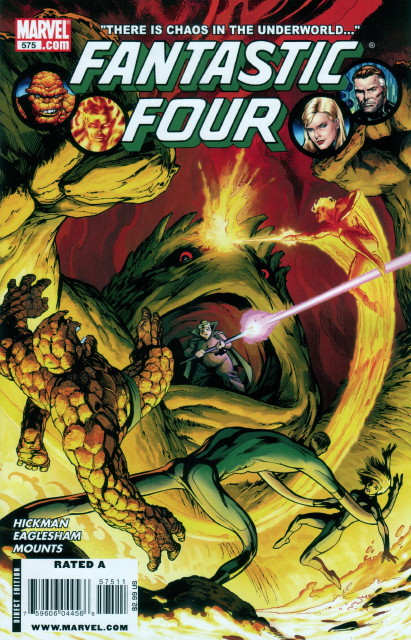
Fantastic Four hits a mini-milestone this month, issue #575, but I thought the issue was a disappointment. It involves the FF going deep into the Earth to help the Mole Man with a problem he’s having, and they’re not able to help very much, but a highly-advanced underground city is raised to the surface within US territory, presumably to set up future storylines. There are some great visuals by Dale Eaglesham, but at the end my reaction was, “Wait, that’s it?” Something about this issue was just ill-conceived: Not a lot much action and not much of a climax, nor was it very thought-provoking. If it doesn’t end up setting up something big down the road, then I’ll wonder why they bothered with this issue at all.
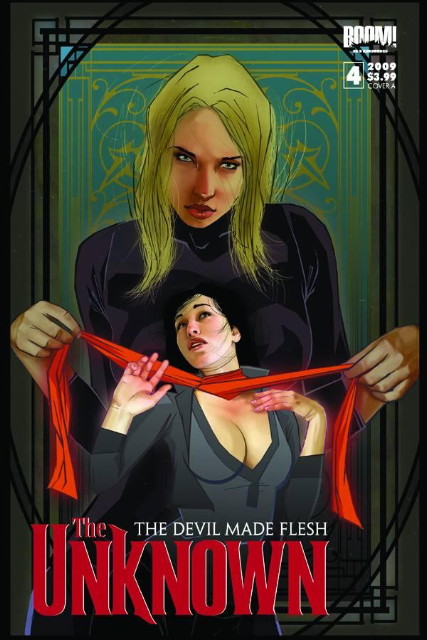
The second series of The Unknown ends this week, and it’s been quite a bit better than the first series, which ended rather ambiguously and without a lot of satisfaction for the characters or the readers. It turns out that there were several things happening in the first series which were just not clear at the time, and writer Mark Waid reveals a lot of what was going on here: What Catherine Allingham was really after, and a the surprising nature of her former partner, Doyle.

At first, The Unknown seemed like it was going to be a Sherlock Holmes-like series (something Waid has done before in a more traditional manner with Ruse) with supernatural overtones, but in fact it’s turning out to be a fantasy/suspense/horror series which happens to have a detective as its protagonist, in particular, a detective interested in learning the truth about the afterlife because she’s under a death sentence herself.

Yet so much of the series’ status quo has been overturned in this second series that I wonder if Waid is going to send it off somewhere else again in the next series. I could easily see him wrapping up the whole story in one more series if that’s what he has in mind, or peeling back more layers from the onion. I could be happy with it either way, though I think making it a longer, more complex series will make it more likely that it will be a great story rather than an interesting diversion. Especially if he expands on the characters more, as they’re fairly one-dimensional so far.

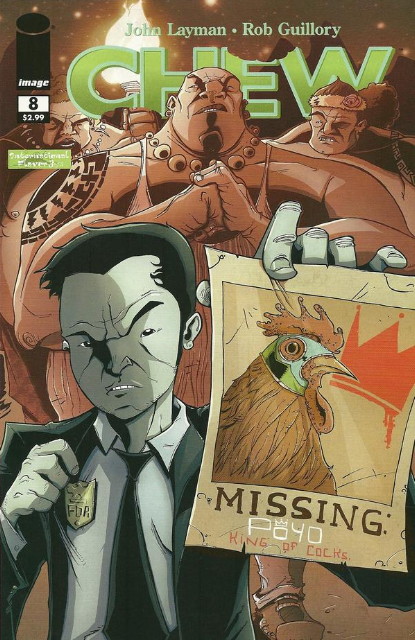
The biggest surprise in independent comics last year was the series Chew by John Layman and Rob Guillory. I missed the boat on it, and picked up the first collection and the next two issues to catch up, so now I’m up-to-date.

The premise is that in the near future avian flu has caused the US and several other nations to outlaw poultry from the market, and the F.D.A. is charged with investigating poultry and food-related crimes. Tony Chu was a cop who has the ability – more of a curse, really – to be able to read the history of anything he tastes. Very useful, but also rather disgusting when what you need to get information about is a rancid corpse. Tony is recruited to work for the FDA, his boss hates him, and his partner has an agenda at odds with Tony’s sense of right and wrong.

The stories are mildly disgusting (and often quite violent), but rather witty. The art is cartoony and expressive, not entirely my kind of thing, but it fits the story well. Overall it’s a very offbeat package, a little bit fantasy, a little bit crime drama. Some people love Chew to bits, while I think it’s entertaining enough but I don’t want to read it while I’m eating dinner. But if quirk is something you appreciate in a comic book, then it might well be for you.

Not Much Luck

We’re back from our latest vacation to Las Vegas. It was a fun trip, as always – except for the losing part, that is.

We flew in on Saturday as usual, and this time got a room in the west wing of the MGM Grand, where we tend to stay these days. The west wing is quiet and we had a room right next to its elevator, which was convenient since we usually have a hike from our room to get to it. The west wing’s elevator also drops you out near the poker room, which was convenient for me. And the room itself has more gadgets in it than the normal rooms (a television in the bathroom mirror, a touch-to-activate lamp, and so forth), so we spent a while playing once we arrived.

Then we puttered around for the afternoon before going to see Lance Burton at the Monte Carlo. Burton is a classic magician – he opens his act by running down a short genealogy of magicians dating back to the 1800s, with himself as the current heir to the throne. His illusions rely heavily on making things disappear and reappear, the most spectacular form of illusion, I guess. He even has a couple of tricks which made me think of The Prestige to the point that I wondered whether he has a twin brother.

One of the most surprising things about Burton’s show is the gap between his promotional material and the show itself. The posters and images I’ve seen of him are split between him as a debonair high society man from the early 20th century, and a more modern “tall dark stranger” in black clothing (especially the 2009 image all over the Monte Carlo). In the show, though, he seems quite different from what I’d expected from the images, though not at all displeasing: The biggest surprise is that he still has a fairly strong hint of a Kentucky accent, not the “standard American” midwest accent most performers have (nor even a southern country accent). Another difference is that he’s all smiles all the time, not at all mysterious in his demeanor (plus he currently has his hair cut short, very different from in the photos). His act itself is actually rather jokey, and the dramatic flair (such as the masked stranger who appears from time to time) seems too goofy to take seriously. There’s also a lot more skin in the show (in the form of seven scantily-clad women) than I’d expected from a show which seems targeted at families. Overall quite different then I’d been expecting.

But the show is basically a lot of fun: I have some vague understandings of how sleight-of-hand works (I’m far from being an expert, but I’m not entirely clueless), but some of his illusions are truly impressive. We were able to get second-row seats so we got a good view of everything, and I don’t have a first idea how many of his tricks work. And that’s not a bad thing. So if you enjoy magic shows, you ought to enjoy seeing Burton.

Sunday morning we had brunch at the Café Bellagio, and then went to check out the new property on the strip: City Center, a 5-hotel project which reportedly cost in the vicinity of $11 billion (with a ‘B’) dollars to build. We walked through some pieces of it, but mostly went and gambled at the Aria, the only hotel of the five which has a casino, including a poker room. The thing is certainly a step forward in elegance and extravagance in Vegas hotels, but – it’s still a Vegas hotel, and making a bigger, posher one is just no longer impressive in and of itself.

Sunday was also the day of the NFL championship games. While we were at the Aria, the Jets/Colts game was on, and it was amusing to hear the cheers from the bar nearby while playing poker: Jets fans were much louder (and therefore probably more numerous) than Colts fans, and their TVs were showing the game a few seconds earlier than ours were, so we could tell when a big play happened based on how loud the cheers were. Since I always root against New York sports teams, I was happy to see the Jets lose. Despite being a Patriots fan, I don’t have any problems rooting for the Colts; the teams have been big rivals in this decade, but it’s hard to root against Peyton Manning, who I think is clearly the best quarterback of his generation.

Later in the afternoon we gambled at the Flamingo, during which time the Saints/Vikings game was on. At one point I took a bathroom break and passed a bar with 5 people sitting at it, all wearing Vikings jerseys. Vikings fans seemed to greatly outnumber Saints fans, and there were plenty of Packers fans wearing their Favre jerseys, too. I was rooting a little more for the Saints, since I went to college in New Orleans, but seeing Favre get to another Super Bowl would have been fine, too. But it wasn’t to be for Favre, as the Vikings turned the ball over 5 times – including Favre’s last-minute interception throw in the 4th quarter – and the Saints won it in overtime. The teams did hit the over on the total score of 53.5, though, and the Super Bowl had an over/under of 56.5 when we left Vegas, so it may be an exciting game.

We finished the evening with our annual meal at Bally’s Steakhouse, which was delicious as always. The after-dinner coffee with kahlua and grand marnier was excellent, too!

Our weekend at the gambling tables was not quite as much fun, though. We’ve almost entirely moved away from slot machines and video poker, to games which have less of a house edge, or in my case, no house edge, at the poker tables. Debbi mostly plays Pai Gow Poker, where the house still has an edge, but you can play for a long time and often break even. Our first day we played some Pai Gow together and Debbi won what I lost, and I lost a little more at those tables over the weekend. But at the poker tables themselves, I had a really rough weekend.

The first game I played was 2/4 limit at the MGM, which was a tight-passive game where I basically bleeded off chips over two hours. The next game, 3/6 limit at the Aria on Sunday, was a loose-aggressive game where I did not get very many good cards and lost over a full buy-in. Finally at the Flamingo on Sunday, the 2/4 limit game was good to me and I was able to recoup some of my losses. But Monday I finally tried the 1/2 no-limit game at the Flamingo, and got stacked twice, mostly I think through bad luck, but it overwhelmed my good luck. I finished the weekend with a break-even session of 2/4 back at the MGM.

A few memorable hands:

  • In limit at the Flamingo, I got a “big blind special”, flopping a flush with J5h and getting paid off. I later flopped the nut flush with AKh and got paid there, too.
  • The first hand in which I got stacked in NL: I had about $110 in the small blind. After a few limpers, I raised to $10 with pocket Queens. The big blind reraised to $20. The limpers folded, and I raised to $50. The big blind called. So there’s about $105 in the pot, and I have about $60 left. The flop is AA6, and I go all-in. The big blind calls and shows Kings. The final board is AA6-6-A, so even if a queen had come, the 3 aces would have counterfeited my full house. The big blind was a guy from Russia who didn’t speak English (his English seemed limited to “I don’t speak English”), but he crushed the table, going on a tremendous run and winning about $500 in a little over an hour. In a later hand, I managed to get out from under his turned nut flush (which he showed) when I folded my pocket Tens on a Jack-high board.
  • The other hand had me on the button with about $75 in my stack. After 4 limpers, I raised to $12 with pocket Aces. The small blind called, and the big blind and limpers folded (pot $34). The flop is KQ9r, and the small blind bets $10. I go all-in for my last $63, and she calls. She shows K9 for two pair. I hit my 5-outer on the turn, a Queen, and she rivers her 4-outer, a King, and I lose. Yes, she was sitting in the same seat as the guy who stacked me the first time.

It’s not clear that I could have gotten away from either of the big hands, although on reflection I should have played the first hand more carefully, since AK and AQ were within his range (even though I hadn’t been at the table long enough to get a read on anyone) and obviously crush me on an AA7 board. Then again, with him having Kings, AK, AQ and AA were within my range so I arguably had some fold equity. I dunno.

All told this was I think my worst showing at the tables in Vegas I’ve ever had, which was pretty demoralizing since I thought I’d been getting better over the last couple of years. But other than one encouraging session, it was almost entirely disappointing. Just bad luck, or so I have some serious work to do to improve my game to take on even the low-stakes tables? I’m not sure.

We flew out Tuesday afternoon. It was still a fun trip, but the losing part did color it unfavorably to some degree. I’m sure we’ll go back next year (if anything, because Debbi wants to go see Garth Brooks), but it might take most of that time to work back my enthusiasm for the trip. At least for the gambling part.

This Week’s Haul

Hey, would you look at this, it’s an entry finally posted in a timely manner!

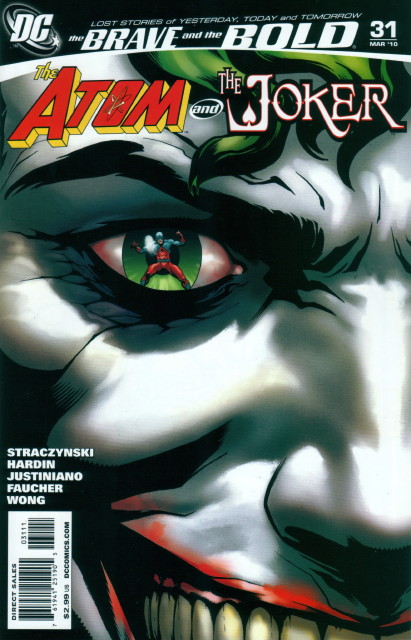
  • The Brave and the Bold #31, by J. Michael Straczynski, Chad Hardin, Justiniano, Wayne Faucher & Walden Wong (DC)
  • Fables #92, by Bill Willingham & David Lapham (DC/Vertigo)
  • Green Lantern Corps #44, by Peter J. Tomasi, Patrick Gleason, Rebecca Buchman, Tom Nguyen & Keith Champagne (DC)
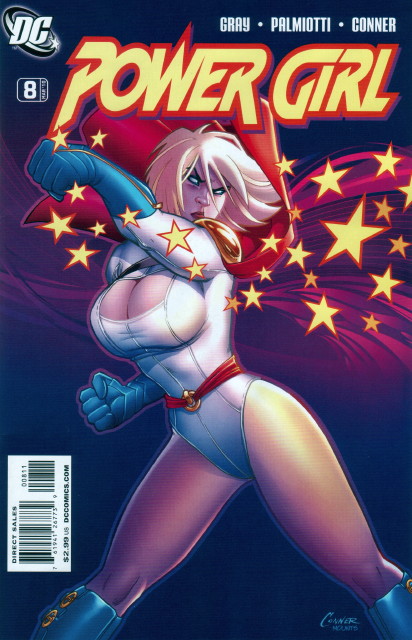
  • Power Girl #8, by Justin Gray, Jimmy Palmiotti & Amanda Conner (DC)
  • Starman #81, by James Robinson, Fernando Dagnino & Bill Sienkiewicz (DC)
  • The Incredible Hercules #140, by Greg Pak, Fred Van Lante & Rodney Buchemi (Marvel)
  • Nova #33, by Dan Abnett, Andy Lanning & Andrea DiVito (Marvel)
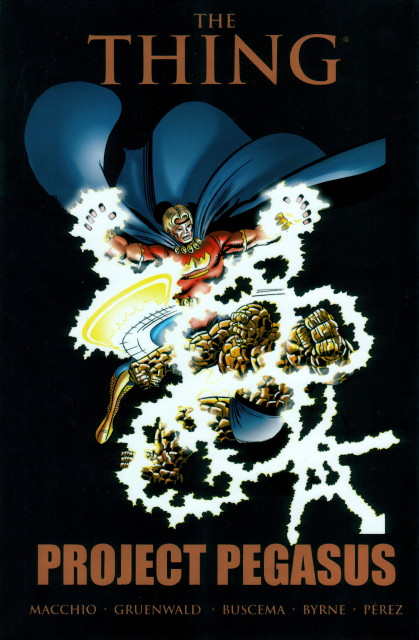
  • The Thing: Project Pegasus deluxe HC, by Ralph Macchio, Mark Gruenwald, Sal Buscema, John Byrne, George Pérez, Sam Grainger, Alfredo Alcala, Joe Sinnott & Gene Day (Marvel)
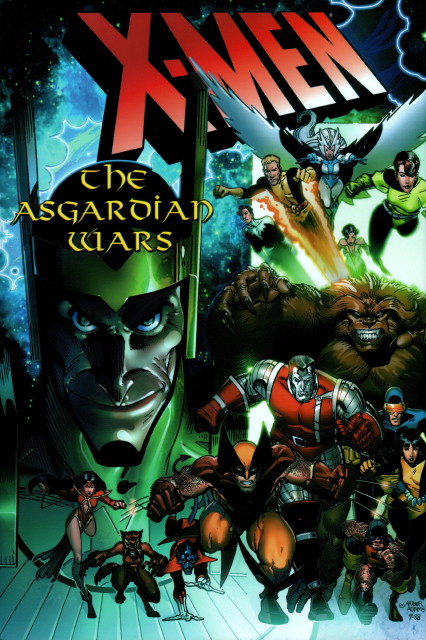
  • X-Men: The Asgardian Wars HC, by Chris Claremont, Paul Smith, Arthur Adams, Bob Wiacek, Terry Austin, Al Gordon & Mike Mignola (Marvel)
  • Incorruptible #2, by Mark Waid, Jean Diaz & Belardino Brabo (Boom)
  • RASL #6, by Jeff Smith (Cartoon)
The Brave and the Bold #31 I picked up a couple of DC books this week which are largely humorous, but they couldn’t be much more different if they’d tried. The Brave and the Bold features the uncomfortable pairing of the Atom and the Joker, where the Joker is suffering from a brain illness, and only the Atom can save him, by shrinking down far enough to deliver a capsule to a point in his brain that might cure him – or kill him. The story opens with Atom being unable to get to Arkham at first because he can only travel through land telephone lines, not cell phones, and then features several pages of Atom refusing to help save the Joker until he’s told that the cure might not even work, so Atom could do his best and still fail. The phone idea is cute, as long as you don’t think about it too hard (throwing an arbitrary limit on an ability that doesn’t make much sense in the first place is always silly; wouldn’t Atom also have trouble with fiber optic cables in the phone system?), but wrestling with his conscience doesn’t work at all. The Atom if an old-style hero who’s largely stuck to those roots, and while he might lament the need to save the life of an enemy, his over-the-top heart-wringing here feels completely out of character.

The rest of the story is okay, and played more seriously: While in the Joker’s brain, Atom gets flashes of Joker’s childhood memories – the making of a psychopath, as it were. It’s not terribly insightful, and has flashes of gallows humor, which still isn’t terribly funny. There’s isn’t much covered here that hasn’t been covered in many Joker stories previously, and the story wasn’t as satisfying overall as, say, John Byrne’s tale in his Generations series where one Batman has to save the Joker from being haunted to death by the ghost of an earlier Batman.

But mostly it’s that the humorous bits go so horribly wrong that makes this story rather painful to read. Quite a letdown after last month’s decent Green Lantern/Doctor Fate yarn. The format of The Brave and the Bold seems to be exposing many of Straczynski’s flaws as a writer, and it’s not pretty.

Power Girl #8 On the other hand, while the set-up of this 2-part Power Girl story disappointed me, the payoff in this issue is considerably funnier. Okay, the cliffhanger from last month gets handled in 4 pages (despite “hours of fighting” having elapsed between issues), but after that, rather than PG being (theoretically) at the mercy of Vartox, she manages to tame him down to civilized levels, and laughs out loud at some of the ridiculousness of his plans. There are several giggle-worthy moments in the issue, and everything works out for the best for both characters.

I still think Power Girl would be better served with some more serious stories – since very little about the series has been serious so far – but at least they got the lightheartedness of this issue right. And certainly more right than Straczynski did in The Brave and the Bold.

Starman #81 The most-heralded Blackest Night series revival has to be this one issue of James Robinson’s Starman. Naturally Robinson – who writes the issue – sticks to his guns by having Jack Knight stay retired despite his brother being raised by the black lantern rings to wreak havoc on Opal City; instead we catch up with some of his supporting cast to see where they’ve ended up since Jack left and his father died. Naturally the Shade figures as the prominent hero. It’s a clever way to do another Starman issue without really doing another Starman issue. Even the art evokes some of the low-key feel of the original series, although I’ve never been a big fan of Bill Sienkiewicz’s endless squiggles as an inker.

It works as an add-on to the original series, rather than just a cynical Blackest Night tie-in. (Don McPherson notes that readers of the series are likely to enjoy the issue more than people surfing by due to the tie-in, which is exactly right.)

I’ve heard a rumor (which may be baseless) that Robinson is interested in doing a Shade series. I’d totally sign up for that.

The Thing: Project Pegasus If you want to see how they did good superhero comics when I was a teenager (in the 1980s), Marvel has two fine hardcover collections out this week. First (and best), is the Thing in Project Pegasus, from his old Marvel Two-in-One series. If you can believe it, there was once a series (it ran for 100 issues!) which mostly featured this member of the Fantastic Four teaming up with a different hero every month, often with good stories and better artwork. Project Pegasus was the apex of the series, a 6-issue story featuring some third- and fourth-string supporting characters, but what made it work was the setting: Ol’ blue-eyes signs on for a tour as a security guard at Project Pegasus, a high-security prison and research institute for super-powered criminals, as well as heroes and innocents who need some sort of high-tech treatment. During his stint, an outside organization infiltrates the project for their own nefarious aims, leading to a major disaster (when their main agent goes rogue) which Ben and company have to fight.

Admittedly, the motivations of the infiltrating organization are a little vague, but it’s still cracking good superhero adventure stuff. Great art by Byrne, Pérez and company, too. The series has also been collected in paperback in the past, but the hardcover has a 2-part story which introduced Pegasus 2 years earlier. Check it out.

X-Men: The Asgardian Wars Then there’s X-Men: The Asgardian Wars, which was arguably Chris Claremont’s last hurrah as a great comics writer. The Uncanny X-Men and New Mutants titles (the main X-books in the late 80s) had been spluttering along in gradual artistic decline (in my opinion) when Claremont put together this pair of 2-part stories featuring Marvel’s mutants facing off against the Norse god Loki. First Loki tries to gain favors from even more powerful gods by forcing a boon on humanity, and the X-Men and the Canadian team Alpha Flight have to deal with the consequences. Then, perturbed by the X-Men’s interference, Loki abducts Storm (who was powerless at the time) and accidentally knocks a collection of New Mutants across the realm of Asgard, where they find themselves rather out of their league. The X-Men join in the fun to foil Loki, who’s really just entertaining himself while waiting for the right moment to make a play for the throne of Asgard.

The first story is one of Claremont’s better moral dilemmas for his characters, putting the heroes on opposite sides of a complex issue, and it’s lushly illustrated by the great Paul Smith. The second story more of a straightforward adventure story, and it’s drawn by Arthur Adams just as he was getting good, although it still has a little too much of the “boobs, boobs and more boobs” style he sometimes lapses into, and the finishes are not as clean nor the work as detailed as his later stuff.

But honestly I think this was the last great X-Men story. Yeah yeah, Grant Morrison, Josh Whedon, Warren Ellis, blah blah blah. None of them turned out X-Men stories as good as this. And this was just the last gasp of the “All-New, All-Different X-Men”; it used to be even better.