This Week’s Haul

Hey, look! It’s another late entry! You’d think I was running out of gas on writing these every week or something!

Last Week:

  • Astro City Special: Silver Agent #2 of 2, by Kurt Busiek, Brent Anderson & Alex Ross (DC/Wildstorm)
  • Secret Six #25, by Gail Simone & Jim Calafiore (DC)
  • Tom Strong and the Robots of Soom #4 of 6, by Peter Hogan, Chris Sprouse & Karl Story (DC/America’s Best Comics)
  • Captain America: Forever Allies #2 of 4, by Roger Stern, Nick Dragotta, Marco Santucci & Patrick Piazzaguta (Marvel)
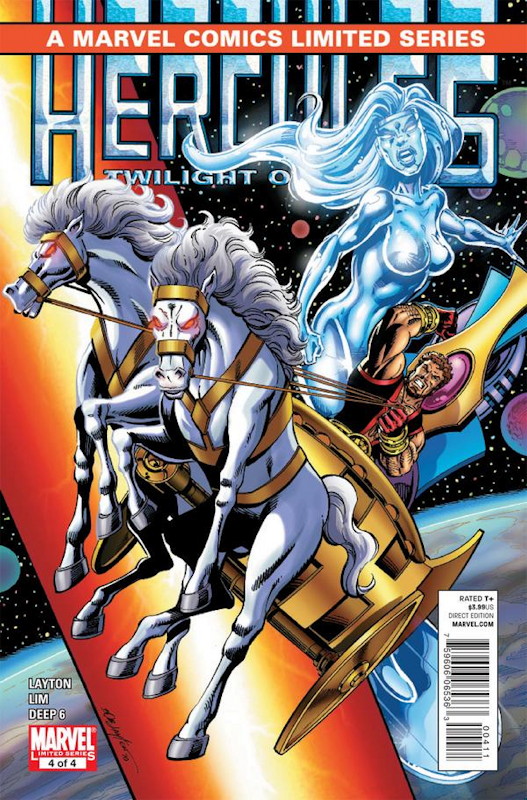
  • Hercules: Twilight of a God #4 of 4, by Bob Layton & Ron Lim (Marvel)
  • Scarlet #2, by Brian Michael Bendis & Alex Maleev (Marvel/Icon)
  • Mouse Guard: Legends of the Guard #3 of 4, by David Petersen, Katie Cook, Guy Davis, Nate Pride & Jason Shawn Alexander (Archaia)
  • Incorruptible #9, by Mark Waid & Horacio Domingues (Boom)
  • Hellboy: The Storm #3 of 3, by Mike Mignola & Duncan Fegredo (Dark Horse)
  • The Boys #46, by Garth Ennis & Russ Braun (Dynamite)

This Week:

  • American Vampire #6, by Scott Snyder & Rafael Albuquerque (DC/Vertigo)
  • Batman and Robin #14, by Grant Morrison & Frazer Irving (DC)
  • Green Lantern #57, by Geoff Johns, Doug Mahnke & Christian Alamy (DC)
  • Wolverine: Old Man Logan TPB, by Mark Millar & Steve McNiven (Marvel)
  • Irredeemable #17, by Mark Waid & Peter Krause (Boom)
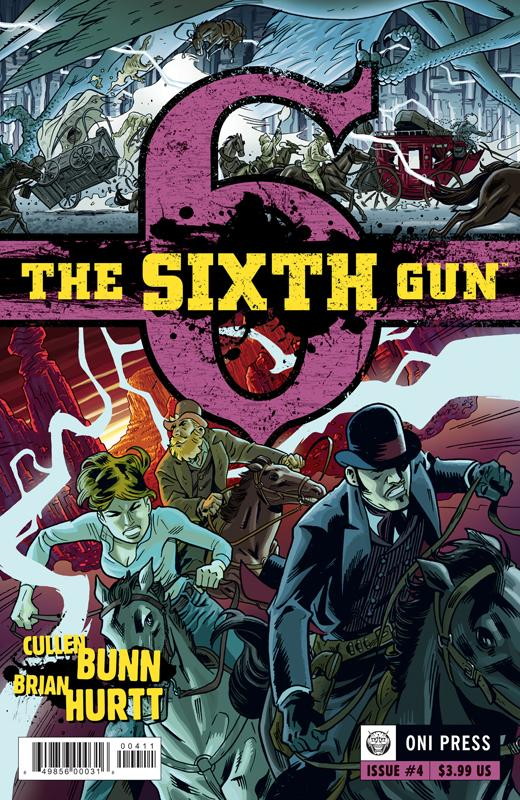
  • The Sixth Gun #4, by Cullen Bunn & Brian Hurtt (Oni)
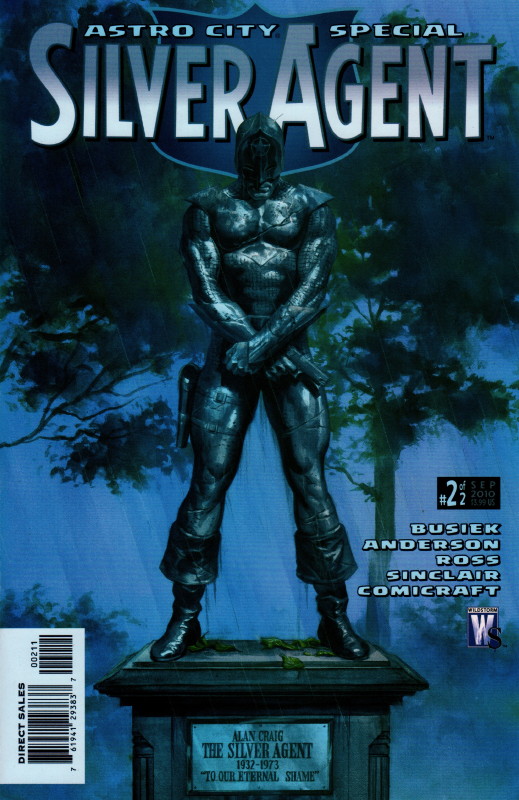
The second half of Astro City‘s Silver Agent story came out last week, and it wraps up (or winds down?) the story of the Agent, one of the tragic figures in the city’s history, and one of the most-anticipated mysteries from the early days of the series. But I was a little disappointed, not for the reasons Greg Burgas was in that I think he doesn’t see that the Agent’s point of view is just as interesting as the man-in-the-street’s (or, at least, he doesn’t think it’s as interesting), but that it feels like it wasn’t quite worthy of all the attention and build-up.

To be fair, the fact that Astro City has been on an erratic publishing schedule for a decade, and that The Dark Age initially seemed to promise to be the Agent’s story but ended up being something else, perhaps build up anticipation for the Agent’s story way beyond what it deserved. And yet.

Having in the first half seen the Agent (a Captain America character) being saved by a Legion of Super-Heroes type group from the future, now we see him walking back through time to meet his eventually end in the electric chair, and excerpts of his experiences along the way, with a focus on his last two visits, with his nephew. And he does meet his end, but in a weirdly ambiguous way, which seems like it can only be satisfying if it’s the seed for further revelations about Astro City in the future, since it suggests things about the source of the Agent’s powers which aren’t really meaningful in isolation.

I think what I feel is missing from this story is that the world at large felt a great deal of guilt over the Agent’s wrongful execution (which is why they erected the statue, after all), but given that this is a time travel story, I was very disappointed that there’s no interaction between him and the world in the future in which both he and they (obviously representatives of those who convicted and executed him) deal with the issue. He comes to terms with his fate, but the rest of the world doesn’t, and while maybe that’s a lost cause, the fact that this is a time travel story and there’s not even an attempt to try makes it feel like the whole story has been dramatically undermined.

At his core, the Agent is a symbol to Astro City: First, a symbol of the greatness of the silver age, and later, a symbol of the shame of what the city went through in the dark age. While this story focuses on the agent as a man and not a symbol (other than as a symbol out of distant memory in the far future, which is not the same thing), a satisfying treatment of the character I think needed to address both sides, and that’s missing here.

The story is itself fine, and we get a lot of tantalizing glimpses of the future of the world, but I think it went off-track in some basic way, and ended up being less than it should have been.

I’m not quite sure what I think of the finale of Hercules: Twilight of a God. Though it’s refreshing in a way that the title is absolutely truthful: This is the chronicle of the last days of Hercules, in Bob Layton’s future-outer-space milieu. Having suffered brain damage, and with his comrades from his earlier adventures in their own old age, Herc is called on for one final task, to prevent Galactus – who is collapsing into a black hole – from destroying the galactic region where Herc has made his home and spawned a family. He completes his quest, and we see the aftermath and denouement of his adventure. While it’s a glorious end, it also feels rather anticlimactic; Hercules in his dotage is not nearly as entertaining as Hercules in his prime, and the sense of foreboding and gloom surrounding this story is just not as much fun as the earlier tales (especially the second mini-series, chronicling the fall of the Olympians, which was itself a bit gloomy yet was a much better story).

So there’s stuff to like here, but… it’s not the same. And it’s also clearly the end of this series of Hercules adventures, which is in itself saddening.

Ron Lim’s art is okay, but it feels stiff, and not as dynamic as Layton’s own art on the original stories. Sometimes Lim can be quite a good artist, but it feels like he phoned this one in.

I’ll put this series on the shelf next to the nice hardcover copy of Herc’s earlier adventures, but it’s not really the same.

Hey look, I bought something written by Mark Millar this week!

I kvetch about Millar a lot. I think he’s one of the worst writers working in comics these days, and I feel no shame in kvetching because he’s also one of the most popular and successful writers in comics these days. It makes no sense to me, but, well, it’s not the only thing. My basic problem with Millar is that I think his stories are mean-spirited and un-fun, and he frequently just misses the mark in depicting existing characters. I loathed his gratuitously nasty run on The Authority, I hated his depiction of guys who happened to be wearing Avengers costumes in The Ultimates, and I hated pretty much everything about Civil War.

But I was still moved to pick up Wolverine: Old Man Logan, and frankly the main reason is that I’m just a sucker for alternate-future stories. Some of them are good, some of them are bad, but I read most of them (at least featuring characters I’m familiar with) because I just like the genre.

The premise of this one is so simple you can almost see Millar thinking it up: One day all the super-villains team up to take down all the super-heroes, and the ringleaders divide up the United States among themselves. Naturally, a few heroes survive, and 50 years later, Wolverine is living outside Sacramento, an old man who refuses to fight anymore, having been broken in the villain attack. But when the Hulk gang demands their rent, he hooks up with Hawkeye to drive across the country to deliver a package in Washington.

So the story is mostly a travelogue in which we see what happened to the heroes and the country, and learn what happened to Logan.

Considering my biggest problem with Millar is usually that he can’t get characterizations right, he nails Wolverine here, as a broken yet still strong-minded man. The story wouldn’t work at all if he hadn’t made Wolverine work. On the other hand, the story is thin, little more than a reworking of films like Unforgiven, with the Marvel Universe future-travelogue stuff thrown in.

Indeed, almost everywhere you look in Old Man Logan you can see bits that feel lifted from other stories: The Hulk as a tyrant whose creed is that he survives when the weak die (from Peter David’s excellent Hulk: Future Imperfect), Hawkeye being blind (from another David yarn, The Last Avengers Story), the Red Skull’s trophy room (also from Future Imperfect), and one of the signature spreads of art in the story, that of a gargantuan skeleton of Goliath lying outside a city, feels like it came right out of Warren Ellis’ Planetary. A lot of what would otherwise be “the neat stuff” has been done before.

Besides that, the story is decent enough. My biggest gripe in terms of characters is the notion that the Hulk would mate with his cousin, the She-Hulk, and produce a clan of hillbilly enforcers. This so runs against the grain of Bruce Banner and Jennifer Walters’ characters that although the final visuals are cute (Steve McNiven draws some ugly-looking redneck Hulklings) it seems gratuitous and implausible. And while the story’s climax is cathartic, it doesn’t really work if you think about it, either.

McNiven is a terrific artist – he was certainly the best part of Civil War – and there’s really nothing to complain about in any aspect of his work. While his style has echoes of John Cassaday and Gary Frank, I’d say he’s better than either of them, with more intricate designs than Cassaday, a better sense of anatomy than Frank, and more dynamic layouts and figures than either of them. Unfortunately he seems to be a bit too slow of an artist to maintain a monthly schedule, because he has all the tools to be one of the greatest comics artists of his generation.

So all-in-all Old Man Logan may be the best Millar story I’ve read, but it’s still merely okay. At least it’s not downright repugnant like other stuff I’ve read by him, so maybe this is the first of several steps forward.

Is The Sixth Gun the best comic being published today? That’s high praise, and frankly it’s hard to make a firm decision, but wow, it’s awfully good. This Old West supernatural horror adventure (that’s a mouthful!) involves a Confederate general who – we learn in this issue – somehow got hold of six enchanted handguns for himself and his five henchmen. One of his posse, Sinclair, decided this was too much for him and bolted, managing to escape the General’s revenge. At some later point the General was defeated and imprisoned, having somehow become immensely powerful in the meantime. Now he’s back and he’s looking for his gun, now in the possession of Becky, the daughter of the reverend who apparently took down the General.

The comic’s full of foreboding, supernatural conflict, and mystical beings hanging out in the Old West, and features a pair of strong female characters in Becky (coming to grips with the position she’s been put in) and the General’s wife, who matches her husband in ambition and spirit. The backstory is being revealed slowly – but not so slowly as to be frustrating – and it’s not yet clear exactly what stakes are being played for (just how powerful will the General be once he recovers from his imprisonment and if he gets his gun back?). But just four issues in The Sixth Gun has covered more ground than many comics today cover in a dozen (I’m looking at you RASL). And Brian Hurtt’s artwork is terrific, cartoony in the sense that Charles Addams’ work was cartoony, but still dramatic and menacing. His style might not translate into mainstream superhero comics (where he’d surely earn a lot more money), but it’s perfect here.

The only downside is that I don’t know if this is a mini-series or an ongoing series. The story doesn’t feel like it’s poised to end in a couple of issues, but you never know. Nevertheless, this series is a lot of fun: Go buy it.

Fenestration

This morning, @joeyhagedorn tweeted that his word of the day is “defenestration”:

I was moved to respond to him on Facebook:

Used in a sentence: “A lot of wildlife habitat loss in the world is occurring due to defenestration.”

His response:

For that grammatically correct sentence, I wish to defenestrate you, mrawdon!

I later stopped by his office and observed that everyone talks about defenestration, but refenestration never gets any love.

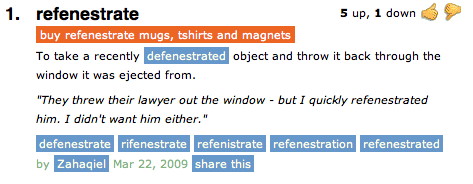
It turns out the Urban Dictionary has a definition for “refenestrate”:

Sad to say, this exchange may have been the high point of my day. Sure made me laugh, though!

San Jose Municipal Rose Garden

Last week I bought myself a new digital camera – a Nikon Coolpix S8000. My old camera is still decent, but I was sucked in by the growing megapixel rates, and more importantly by the suddely-growing optical zoom capabilities of subcompact cameras. This thing has a 10x optical zoom, about 3 times greater than my old Canon! I’m by no means a power photographer, but greater optical zoom is one of the few things I’ve wanted in my cameras, and now I’ve got it.

Then, since we were heading down that way yesterday anyway (to buy cinnamon bread at Greenlee’s Bakery and drop in at Recycle Bookstore), I surprised Debbi by taking her to the San Jose Municipal Rose Garden. This rose garden was in danger of being taken off national registries a few years ago due to neglect (presumably due to shrinking budgets), but a huge volunteer effort not on revived the gardens, but won them an award recently, as well as a lot of local recognition.

So it’s no surprise that it’s quite pretty. There appeared to be two weddings going on at the edge of the garden when we arrived. We wandered through it for about an hour, Debbi being attracted to orange and peach roses, and me by any roses that weren’t white. I also like old municipal land like this since they often have signs of early 20th century architecture or decor, which I find attractive: The wrought-iron fences, the stone benches and buildings, and so forth.

And this gave me a chance to try out my new camera, so here are a bunch of pictures:

Continue reading “San Jose Municipal Rose Garden”

This Week’s Haul

Haven’t felt like posting lately, so here’s three weeks of comics to catch up on.

Best bets from the last few weeks: Steve Rogers: Super-Soldier #2, The Sixth Gun #3 and Ghost Projekt #4. Oni is publishing some good stuff, huh?

Three Weeks Ago:

  • Green Lantern: Emerald Warriors #1, by Peter J. Tomasi, Fernando Pasaron & Cam Smith (DC)
  • Superman #702, by J. Michael Straczynski, Eddy Barrows & J.P. Mayer (DC)
  • The Unwritten #16, by Mike Carey & Peter Gross (DC/Vertigo)
  • Zatanna #4, by Paul Dini, Chad Hardin & Wayne Faucher (DC)
  • Steve Rogers: Super-Soldier #2 of 5, by Ed Brubaker & Dale Eaglesham (Marvel)
  • A Skeleton Story #1, by Alessandro Rak & Andrea Scoppetta (GG Studio)
  • The Sixsmiths #1, by J. Marc Schmidt & Jason Franks (SLG)

Two Weeks Ago:

  • Batman Beyond #3 of 6, by Adam Beechen, Ryan Benjamin & John Stanisci (DC)
  • Brightest Day #8, by Geoff Johns, Peter J. Tomasi, Patrick Gleason, Ivan Reis, Ardian Syaf, Vicente Cifuentes, Rebecca Buchman & Mark Irwin (DC)
  • DC Universe: Legacies #4 of 10, by Len Wein, Jose-Luis Garcia Lopez, Dave Gibbons, Scott Kolins & Joe Kubert (DC)
  • Ex Machina #50, by Brian K. Vaughan & Tony Harris (DC/Wildstorm)
  • Fables #97, by Bill Willingham, Mark Buckingham, Steve Leialoha & Dan Green (DC/Vertigo)
  • Green Lantern Corps #51, by Tony Bedard, Ardian Syaf & Vicente Cifuentes (DC)
  • Justice Society of America #42, by James Robinson, Mark Bagley & Norm Rapmund (DC)
  • Power Girl #15, by Judd Winick & Sami Basri (DC)
  • Chew #13, by John Layman & Rob Guillory (Image)
  • The Sixth Gun #3, by Cullen Bunn & Brian Hurtt (Oni)

Last Week:

  • Justice League of America #48, by James Robinson, Mark Bagley & Rob Hunter (DC)
  • Legion of Super-Heroes #4, by Paul Levitz, Yildiray Cinar, Francis Portela & Wayne Faucher (DC)
  • Madame Xanadu #26, by Matt Wagner & Chrissie Zullo (DC/Vertigo)
  • Time Masters: Vanishing Point #2 of 6, by Dan Jurgens & Norm Rapmund (DC)
  • Wonder Woman #602, by J. Michael Straczynski, Don Kramer & Eduardo Pansica (DC)
  • Astonishing X-Men #35, by Warren Ellis, Phil Jimenez & Andy Lanning (Marvel)
  • Captain America #609, by Ed Brubaker, Jackson Guice & Rick Magyar (Marvel)
  • Fantastic Four #582, by Jonathan Hickman, Nail Edwards & Scott Hanna (Marvel)
  • Echo #24, by Terry Moore (Abstract Studio)
  • Dynamo 5: Sins of the Father #3 of 5, by Jay Faerber & Júlio Brilha (Image)
  • Invincible #74, by Robert Kirkman, Ryan Ottley & Cliff Rathburn (Image)
  • Ghost Projekt #4 of 5, by Joe Harris & Steve Rolston & Dean Trippe (Oni)
Brian Vaughn & Tony Harris’ Ex Machina came to an end this month. It’s been one of those rarities, a long-running series published less than monthly (bimonthly, in this case), I believe because Harris isn’t quite able to keep up with a regular monthly schedule. (James Robinson wrote many of the “Times Past” episodes of Starman to give Harris time to catch up or get ahead, I understand.)

The premise of the series is that Mitchell Hundred is the only man in the world with superpowers: A strange encounter in New York harbor gave him the ability to communicate with and command machines. He embarked on a brief and controversial career as a superhero, the “Great Machine”, until he saved one of the World Trade Towers from being destroyed on September 11. Retiring from adventuring, he is elected Mayor of New York City, where he has a controversial term as a populist leader who holds strong positions, always annoying the left or the right. Meanwhile, his two friends from his heroing days have different opinions about his new position (one becomes his bodyguard, the other thinks it’s a waste of his talents), and Mitch gradually learns about the origins of his powers.

The series often felt at times like a mouthpiece for Vaughan’s political views. Actually I have no idea if they’re actually Vaughan’s own views or not, but they were by far the least interesting part of the series, repetitively presenting Mitch as the voice of reason while various people were freaking out around him about his positions. It got pretty dull pretty quickly.

I always saw the political milieu as a mundane backdrop to the more interesting story, that being: Why did Mitch get his powers, and what did it mean? But Vaughan clearly didn’t see the series in the same way, as he spent most of the series dealing with the very mundane details of Mitch’s life and friendships, none of which are really deep enough or complex enough to be very compelling, and only one of which (with his bodyguard Bradbury) has a really rewarding payoff. So the more fantastic elements get shoved aside for most of the series, but completely take over the stage when they do come up. For example, the man who’s able to command animals. And then the explanations and drama over the last four issues. We do eventually learn the source of Mitch’s powers, but ultimately it’s kind of disappointing.

I think my fundamental disappointment in Ex Machina is that it feels like it was a lot of text and noise, but not very much happened. Despite Mitch (and a handful of others) with fantastic powers, they don’t really change the world (or even New York City) very much. Indeed, Mitch’s tenure as Mayor doesn’t really change him very much, besides putting some of his friends and family in harm’s way. It doesn’t feel like he really grew or changed as a character or person.

Vaughan’s other major work in comics is Y The Last Man, which is, by far, the superior series of the two. The characters are more engaging and more fully-realized, and despite characters with strong positions it rarely felt like the writer was preaching to us. The fantastic elements are omnipresent (since the premise is that every man on the planet save one has died), but serve to drive and inform the story, while still allowing plenty of space for drama and character development. Things happen, people go places, and change the world (and their lives) through their actions. And while there are some rough edges around the ending, it was on the whole moving and satisfying. Really, the polar opposite of Ex Machina in nearly every way.

To be sure, Ex Machina had one major asset, that being Tony Harris’ always-outstanding artwork, which has grown and evolved, retaining his touch for realistic figures with a stylized veneer, while slowly shedding the awkward facial expressions and compositions. Harris is one of the better artists in comics today, and I look forward to seeing what he does next.

But overall I have to say it’s been a disappointing series. It feels like it’s been playing out the string for the last couple of years, and I can’t really recommend to anyone to go back and read through it, because I don’t think you’ll find it rewarding. Pick up Y The Last Man instead, because it’s going to stay on my bookshelf, while this one’s probably going up on eBay.

(As usual, Greg Burgas and I felt quite differently about this series.)

Long Time No Draft

Since I recently introduced my cow-orker Sean to our Monday night Magic group, I decided to take him up on his suggestion to go with him for a Magic 2011 draft yesterday afternoon. Sean goes to Legends of Comics & Games, a store in Vallco Mall which somehow has survived and even thrived as that mall has come near to death and then slowly come back to life. (Oddly, the store seems to lack both a web site and a Facebook page.)

I’ve done drafts at a couple other places in the area, and this one seems like the friendliest and lowest-pressure among them, so I’ll probably go back just for that reason. It would be nice to draft once a month or so, if Debbi is willing to sacrifice part of a weekend every so often for me to go off and do so. 🙂

This week’s draft was Magic 2011, and it’s my first draft on about two years, since Shadowmoor. Despite visions of first-picking a Grave Titan, in fact my first pack was not very exciting, and I decided to take Corrupt and see if I could force mono-black. In fact, the black poured in from the right, and I did indeed end up mono-black, only taking other colors when there was no black left in a pack. My one big decision came in deciding whether to take a second Corrupt, or a Nantuko Shade. Others agreed it was a tough choice, and felt the Shade (which is what I took) was defensible because if I actually dropped it on turn 2 it would be hard for any decks to deal with. In fact as things played out Corrupt would have helped more, but that was purely situational.

My deck seemed so-so, in particular it felt light on creatures. But I did have a Demon of Death’s Gate, which I looked forward to playing. I also had a pair of Duress.

I won’t detail the games greatly; I lost my first match 1-2 against a blue/white deck; in the deciding game I double-mulliganed, got him on the ropes anyway, then stalled out and finally lost. The second match I won 2-1 in three lightning-fast games against a red/blue deck. My big lesson from the first two games was learning how effective Quag Sickness is in mono-black.

The third match was the most interesting, against a green/white deck which was nearly all creatures. So after the first game I sideboarded out Duress in favor of a pair of Deathmarks (woo-hoo!). We split the first two games, and played the decider. I got out three creatures, but he was starting to build up defense, so I played my Demon of Death’s Gate, which put him on a 2-turn clock. He winced, said he wasn’t sure how he’d get out of this, drew for his next turn – and Pacified my demon. Ugh. Then we each started building up creatures (I sacrificed my Demon to a Viscera Seer, hoping I could bring it back with Rise from the Grave), and were in a stalemate. I was at 5 life, he was at 11, and I started just drawing land. Oddly he decided not to attack – I think he could have won if he started applying pressure – and I observed that the dam was going to burst soon. As I was drawing, he remarked that I could draw the right removal and break the deadlock. I looked at my card and said, “Or I can Corrupt you for 12.” He put his head in his hand and we shook hands.

I was slightly amused that I was quite a bit older than most of the players – I played against two high schoolers and a 20-year-old. Though there were a couple of people older than me, there. It was also an object lesson in, well, financial means, since most of the younger folks were interested in trading cards (imagine that, trading trading cards!) whereas I tend to just buy most of the cards I want (except for the most expensive ones). Still, as with any game, once you sit down to play you’re on equal footing.

So I had a lot of fun, and won a free pack of M11 for my efforts. By the next time I draft, Scars of Mirrodin might be out, and that ought to be a completely different experience.

Scott Pilgrim vs. The World

It had me at “An epic tale of epic epicness.”

Scott Pilgrim vs. The World, the film adaptation of the graphic novel series by Brian Lee O’Malley (first volume here), lived up to my hopes, being a good adaptation of the key parts of the series, while also being a hilarious and at-times touching film in its own right.

It’s not exactly an examination of slacker culture, or hipster culture, or any other culture, so much as the story of slacker Scott Pilgrim (Michael Cera), bassist in a small-time band, who is recovering from a bad relationship by dating high school student Knives Chau (Ellen Wong), but who meets the girl of his dreams, Ramona Flowers (Mary Elizabeth Winstead). As if that wasn’t enough, in order to date Ramona, Scott has to fight and defeat her seven evil exes.

Considering it condenses 6 graphic novels into a just-under-2-hour movie, Scott Pilgrim does a good job of staying faithful to the source material, especially the first (and best) volume, which takes up the first half-hour of the film. But whereas in the first book Scott seems almost heroic, albeit basically clueless, and then descends into being hapless and pathetic, the film is consistent as portraying him as a loser, a likable but hardly admirable protagonist.

None of that really matters, though, because what makes Scott Pilgrim worth seeing is that it’s frickin’ hilarious, and full of exciting and over-the-top fight scenes based on martial arts video games. Whereas in the comics the fights never quite seem fully-realized, in the film they have the extra impact that came in the fight scenes in Watchmen, while being at the polar opposite end of the ridiculousness spectrum from that film. It works much better here, since it’s all thrilling rather than troubling.

And the film is loaded with quotable lines, which have kept me giggling for two days since I saw the film.

The cast is superb, too. Okay, no one’s going to win an Oscar here, but Michael Cera is excellent as the earnest-yet-pathetic hero, Jason Schwartzman is appropriately creepy and smarmy as the ultimate evil ex in the film’s climax, seeming like an evil version of Austin Powers. Then there’s Brandon Routh (yes, from Superman Returns), made up almost unrecognizably as another evil ex. Chris Evans, the Human Torch from Fantastic Four, also does a turn as an ex. Ellen Wong steals a few scenes as Knives, especially when she’s dealing with being dumped by Scott. But special mention has to go to Kieran Culkin as Scott’s gay roommate Wallace Wells, who practically steals every scene he appears in. If nothing else, I hope this film gets him some choice roles, because he’s earned them with his turn here. May Elizabeth Winstead is perhaps a little disappointing as Ramona, but her character seemed rather underwritten and passive, so she wasn’t given as much to work with (unfortunate since Ramona is a pretty string character at the beginning).

Really, between the script and the delivery, there’s just a lot of fun to be had in Scott Pilgrim. It doesn’t seem to have been doing well at the box office, so go see it soon if you’re interested, because it benefits from being seen on the big screen. Not that it really matters whether we get a sequel, because it’s complete unto itself. Check it out.

Long-Delayed Project

Yesterday I finally got around to putting together an Ikea bookcase – that I bought over Memorial Day weekend.

One thing I’ve been bad about doing with my bookcases is anchoring them to the wall, but this bookcase is 8 feet tall (including the extra shelf I bought), will hold a third of my comic book collection, and will hover (ominously?) above our bed, so I really needed to anchor it, this being earthquake country and all. The thing is, having never anchored a bookcase, I wasn’t sure how much work it would be. So I’ve been intimidated by the project for all this time, while the bookcase stood unassembled, in its box, in the garage. (Why didn’t I put it together over the long weekend on which I bought it? Because I spent a big chunk of that weekend at work.)

It turns out none of it was a big deal, but it did take about 2-1/2 hours to finish the project. All together the project involved:

  1. Carrying the bookcase upstairs – too big a job for one person, and actually it took Debbi and me a good 5 minutes to maneuver it up the stairs.
  2. Assembling the bookcase. Really, this was the easiest part. I’ve assembled so many prefab bookcases in the last 20 years that I can almost do it in my sleep.
  3. Unloading comic books from the first of the four six-foot bookcases they currently live in, and piling them on the bed. Then, realizing that I really need to unload the second bookcase, too.
  4. Locating the wall studs and marking the spots to drill holes for the anchor straps.
  5. Moving the old bookcases out of the way and putting the new bookcase in place.
  6. Vacuuming where the old bookcases where, since it was pretty dusty back there.
  7. Affixing the anchor straps to the wall. (Requires ladder.) Then attaching the straps (which are the velcro type) to the underside of the top shelf of the bookcase. Why the underside? Because the top of the top shelf is going to be a usable shelf itself, with comics on it, once the extension is attached, and I don’t want comics sitting on the straps.
  8. Assembling the extension and attaching it to the bookcase.
  9. Filling the bookcase with comics.
  10. Since one eight-foot bookcase is not as capacious as two six-foot bookcases, carrying a small (three-foot) bookcase into the bedroom from the front room and fill it with the remaining comics.
  11. Putting one of the two six-foot bookcases in the front room in place of the small bookcases.
  12. Disassembling the other bookcases and dump it in the trash. (I inherited this bookcase when I bought the house. It’s not an Ikea bookcase, and is not as cleverly designed as Ikea bookcases. Ikea cases don’t have screws going all the way through the outer wood, whereas this one did, and had little wood-patterned stickies to cover up the screws.)
  13. Cleaning up. In this project I used a bunch of stuff in my toolbox, a ladder, a ruler and a tape measure, a pencil, a studfinder, and the vacuum cleaner. Waste included the box the bookcase and extension came in, the box the earthquake straps came in, and various bits I didn’t need (Ikea often adds a few extra hardware parts, though which parts you get always seems random). Plus two glasses of water. Not to mention that I showered and changed clothes.

So, that’s one bookcase, and it looks great! Now I need to buy two more such bookcases, put them together to replace the remaining six-foot bookcases, and then throw away two (or maybe all three) of the old bookcases (we’re undecided whether we’ll put the three-foot bookcase back in the front room or leave a six-foot bookcase there). So that will be a project for the coming weeks. But now that I’ve done it once, hopefully the other two will be easier.

The ultimate result of all this, I hope, will be a little more extra room for comics (ultimately, the three new bookcases should replace 21 shelves of comics with 21 slightly-wider shelves), but more importantly converting lateral wall space into vertical wall space so that we can replace our aging queen-sized bed with a new king-sized bed.

Plus, of course, the new bookcases really do look a lot better than my 17-year-old ones that I bought from a furniture store in Madison, in different colors because they kept running out of the colors I wanted. Ikea really does things right.

By the way, comments about the number of comics books I own will be ignored. 🙂

Common Grounds

First, a little background: Several weeks ago I was moved to a different team in my department. As with past such moves (and I’m unusual in this regard), I’m once again working on the same stuff, only on a new team and for a new manager. Additionally, the other half of our department, which moved off to another building a year and a half ago, has been reunited with us in our building (which is a different building from where we were when they left, but the point is that they’re back with us). So there are a whole bunch of different people in my work life, most of whom I knew before, but most of whom either weren’t really around or I didn’t interact with a lot.

And then there are some folks I didn’t really know before.

A couple weekends ago Debbi and I got together with one of these folks, Jacob, who’s a relatively new hire (earlier this year) on my new team, and his wife Lisa. We had breakfast together and then went to their house and played board games for the afternoon, which was fun. I told them about Subrata’s Wednesday night board gaming, which recently started up again, and this past Wednesday we met up to introduce them to the gaming crowd. It was a large night, so we split into two groups (I ended up getting crushed in my game, despite being the one who chose it). They played in the other group, had fun, and signed up for Subrata’s mailing list for gaming.

Then earlier this past week I went to lunch with the usual group at work, and another guy, Sean, tagged along. He’s in the group that moved to our building recently, and I know him a little because he’s interned with us in past years (he’s a full employee now). Well, it turns out that not only does he read comic books, but he also plays Magic. “How is it we don’t know each other better?” I asked him. “Probably because I’ve been in the other building for the last year and a half.” Well that makes sense. Anyway, I told him about our Monday night Magic game and it sounds like he might come on Monday. On the other hand, I might join him some Saturday for a Magic draft at the store he patronizes.

You’d think that working in a company full of geeks that I’d be surrounded by people I have lots of things in common with, but it mostly doesn’t seem to work out that way. My strongest interests are pretty specialized (and/or I make casual friends easily but find it difficult to make close friends, but that’s a different post), so this has been an unusual set of encounters.

This Week’s Haul

  • Brightest Day #7, by Geoff Johns, Peter J. Tomasi, Ivan Reis, Patrick Gleason, Ardian Syaf, Scott Clark, Joe Prado, Vicente Cifuentes, David Beaty & Mark Irwin (DC)
  • Secret Six #24, by Gail Simone & Jim Califore (DC)
  • Tom Strong and the Robots of Doom #3 of 6, by Peter Hogan, Chris Sprouse & Karl Story (DC/Wildstorm)
  • Captain America #608, by Ed Brubaker, Butch Guice, Rick Magyar & Mark Pennington (Marvel)
  • Captain America: Forever Allies #1 of 4, by Roger Stern, Nick Oragotta, Marco Santucci & Patrick Piazzalunga (Marvel)
  • Casanova #2, by Matt Fraction & Gabriel Bá (Marvel/Icon)
  • Hercules: Twilight of a God #3 of 4, by Bob Layton & Ron Lim (Marvel)
  • S.H.I.E.L.D. #3, by Jonathan Hickman & Dustin Weaver (Marvel)
  • Irredeemable #16, by Mark Waid & Peter Krause (Boom)
  • Hellboy: The Storm #2 of 3, by Mike Mignola & Duncan Fegredo (Dark Horse)
  • The Boys #45, by Garth Ennis & Russ Braun (Dynamite)
Roger Stern was a workhorse author at Marvel Comics back in the 1980s, and he wrote a lot of excellent stuff (I especially remember his West Coast Avengers mini-series with fondness – it was recently collected in hardcover), but by the end of the 1990s he’d largely disappeared. He teamed up with John Byrne on the nifty mini-series Marvel: The Lost Generation a decade ago (worth seeking out), and now he’s back writing a new Captain America mini-series, Forever Allies, which I picked up partly because I’m enjoying Ed Brubaker’s Cap series so much and this spins out of it, but mainly because Stern’s one of those comics writers whose stuff I’ll always check out because he’s a good solid writer.

The premise here involves Cap – who is currently Bucky Barnes, having skipped over most of the last 65 years thanks to suspended animation – attending the funeral of one of his friends in the Young Allies team during World War II, and reminiscing about their days together. But at the funeral he spots a woman who resembles a mind-controlling antagonist from that era, Lady Lotus, herself having aged not a day. Investigating, he learns that she’s listed as being in prison – only she’s actually escaped. And so the hunt is on – as is Lotus’ master plan, hinted at on the final page.

As I said, Stern’s a fine storyteller, and he handles the shifts between the 1940s and 2010 quite well, aided by some nice classic-style artwork by Nick Dragotta (in a style that feels like Jack Kirby crossed with Darwyn Cooke) and modern-style art by Marco Santucci (sort-of resembling the main Cap series art by Butch Guice and others, but not quite up to their level). I’m not familiar with either of these guys, but they’re both quite good in this context.

It looks like this one should be fun, and I hope it opens the doors to more Stern stories in the future.

In the category of “comics I don’t really get”, there’s Casanova, which is clearly trying to be particularly bizarre and offbeat and which might gel with time, but there’s also Jonathan Hickman’s S.H.I.E.L.D., which I was skeptical of from the first issue. The nominal main story involves a man named Leonid in the 1950s being inducted into the order of S.H.I.E.L.D., the secret organization which protects mankind from extraterrestrial (in all senses of the word) threats. This story is moving at a glacial pace, as it’s been consistently preempted by flashbacks to the organization’s history, which includes Isaac Newton, Leonardo da Vinci, Galileo, and various other historic figures (one of whom is still alive in the 20th century and has taken Leonid under his wing).

Honestly these flashbacks seem like just sequence after sequence of historical wankery, touting the merits of science and discovery, showing some of the group’s accomolishments (like the defeat of Galactus in the 16th century), and not-quite-clever integrations of Marvel figures into the story (the use of the Deviants here is rather gratuitous). It’s all rather dreary, never focuses on any of its scenes long enough to truly evoke a sense of wonder, and doesn’t seem to be going anywhere. So I don’t really get what the appeal is.

A good contrast is the series Annihilation from a few years back; while also rather downbeat, it explored its themes and situations at length and is one of the most sense-of-wonder evoking stories that Marvel’s published in recent years. It was also strongly character-driven, something that S.H.I.E.L.D. decidedly is not.

The bright spot in this series is Dustin Weaver’s artwork, reminiscent of that of Barry Windsor-Smith, but the finishes a bit more polished (Smith’s inks always looked uncomfortably rough to me). He gets both the period looks and the effects down, although his characters’ faces are sometimes hard to recognize when the people are different ages.

Overall, though, S.H.I.E.L.D. seems at best disappointing and at worst unnecessary. Maybe it will all come together in the next couple of months, but I’m not sure I have patience to wait longer than that.

Peter Krause is back on Irredeemable, and boy has he been missed! The interim artists have been okay, but Krause really set the look for the series and it’s not the same without him. It feels like Mark Waid took the opportunity to kick the story into a new gear with this issue, too, with revelations about several characters and a surprising proposal on the final page.

Carrying the “Superman-gone-bad” premise for an ongoing series is tough to do, and the story feels like it’s gotten sidetracked over the last few months, but hopefully this is a sign that the next arc will be more satisfying.

(I wonder if Waid has an ending in mind, and how long he expects it will take to get there?)

Date Day

Yesterday Debbi and I took a day off from work and had what Debbi called a “date day” – we drove out to a couple of spots in the Bay Area and had fun together. When Dad visited me last spring he and I went to Big Basin Redwoods State Park, and I thought that would make a nice outing with Deb.

We started by driving down to the Original Pancake House in Cupertino, which has the advantage over the one we usually go to (in Los Altos) of having more seating, comfier seating, and a lot more parking. Though the parking didn’t come into play since the place was pretty quiet on, well, a Thursday morning.

Big Basin was much busier than when I went there with Dad (that’s the difference between April and August, I guess, even on a weekday). I think I’ve decided Big Basin is not quite as nice as Muir Woods (at last as far as the main scenic trail goes), but it’s still a fun little walk. Someday we might head back for one of the longer hikes.

After the park we drove down to Santa Cruz – eventually, since it turned out that Highway 9 was closed for the last few miles before Santa Cruz. The signage along the way didn’t (IMO) make it clear that it was actually completely closed – the mere presence of “detour” signs aren’t really persuasive since such signs are often put up long before and taken down long after the detour is relevant. At least the route was scenic before we had to turn around.

We did a little shopping in downtown Santa Cruz (always fun to drop in on Logos, not to mention the Pacific Cookie Company), and then headed down to the Beach Boardwalk where we walked along the beach, and out the wharf. It turned out that a landing along the wharf is currently hosting a group of sea lions, and you can get extremely close to them. I was standing about 4 feet above the lions when I took this shot:

After returning home we collapsed for a bit before heading downtown to have dinner and walk around Thursday Night Live. We don’t take many random days off, and as Debbi said it was nice to spend a day going around doing some fun things and not having any chores or errands to run. We’ll have to do it again sometime. But where to go?