This Week’s Haul

  • The Flash: Rebirth #1 of 5, by Geoff Johns & Ethan Van Sciver (DC)
  • Justice Society of America #25, by Geoff Johns, Jerry Ordway & Bob Wiacek (DC)
  • Avengers/Invaders #9 of 12, by Alex Ross, Jim Krueger, Steve Sadowski & Patrick Berkenkotter (Marvel)
  • War of Kings #2 of 6, by Dan Abnett, Andy Lanning, Paul Pelletier & Rick Magyar (Marvel)
  • Irredeemable #1, by Mark Waid & Peter Krause (Boom!)
  • The Boys #29, by Garth Ennis & Darick Robertson (Dynamite)
  • Star Trek: Crew #2 of 6, by John Byrne (IDW)
The Flash: Rebirth #1 I remarked a while back that Green Lantern was looking like Geoff Johns’ best work in comics, going back to his bringing Hal Jordan back from the dead (or the undead) in a clever and satisfying way. Now he’s trying to do the same by picking up the thread of Barry Allen – the Silver Age Flash – coming back from the dead in Final Crisis. This is a much tougher challenge, partly because Flash’s death was a heroic send-off for a character who at the time had seen his series cancelled for cause, while Green Lantern was brought down largely by editorial fiat. But also because Johns doesn’t get to construct the reason for Flash coming back, like he did for Green Lantern, and that makes The Flash: Rebirth a tough sell.

The story is okay: People other than Flash are emerging from the Speed Force, even as Flash takes in the changes in the world while he’s been gone, and watching others celebrate his return. There are some nice touches (Flash approves of how everyone’s multitasking all the time, as if they’re finally catching up to how he lives his whole life), but they’re overshadowed by what a dour sourpuss Barry is through the whole issue, focused on needing to get things done (“I can’t be late.” “Late for what?” “For whatever the rest of the world needs me for.”), without explanation for what that might be.

There’s a suggestion that Barry feels guilty over his mother’s death, that he somehow wasn’t fast enough to be there for her (especially since his father was accused of the crime), which indicates that Johns is going to be retroactively filling in details of Barry’s pre-Flash life. But the tone of the character feels completely at odds with who he was before his death, and given the commonality of heroes coming back from the dead in the DC universe, his mere return doesn’t suffice as an explanation.

As for the GL relaunch, the artist is Ethan Van Sciver. Van Sciver is a very detail- and rendering-oriented artist, but not the most dynamic of layout guys. Overall I like his art, but I find him a somewhat odd choice for a character as dynamic as the Flash. He evokes a feeling of speed and dynamism through “after-image” effects, copious lightning bolts, and dramatic poses. It’s not bad art by any means, but I don’t think he’s nearly as good a match for Flash as he was for GL.

There’s some interesting stuff here – mostly what’s going on with the Speed Force – but mostly the issue feels like a misfire, not really capturing what it was that made the character interesting. Certainly Barry Allen was rarely a deep character and there’s going to be some updating to give him more nuance for a modern audience, but I don’t think Johns really captured the core of the character here and that makes me wonder why he’s bothering.

Of course, I wondered why DC bothered to bring him back in the first place. But as part of the whole Final Crisis mess, at this point I assume there wasn’t really any sort of planning or intent involved.

Irredeemable #1 Ironically, the other comic I’m reviewing this week is written by the guy who’s probably most associated with the post-Barry Allen Flash franchise: Mark Waid.

So first, a digression: Grant Morrison pens the afterward to Ireedeemable #1, in which he professes surprise that Waid’s reputation is one that seems inextricably linked to nostalgia for the Silver Age and an encyclopedic knowledge of comics history. I profess such surprise myself, since that’s never been my image of Waid as a writer. (A better match for such a profile would be Geoff Johns, actually.) While Waid clearly knows his stuff where comics history and trivia is concerned (he’s noted for being unstumpable in trivia panels at comics conventions), Waid’s actual writing career has been marked by a strong focus on the current characters, and making them into first-rate heroes and villains in their own rights. This is especially evident in the keynote story of his career, “The Return of Barry Allen”, which was all about Wally West living in the shadow of his late mentor, but emerging from that shadow to become his own man.

A better summary of Waid’s career might be that he considers at length what the nature of superheroics means to the heroes themselves, and how they are defined or changed by the experience. In this way he’s not so different from Kurt Busiek – which puts him in outstanding company, I’d say.

Irredeemable seems like a natural step after his series Empire: In Empire, a villain managed to defeat all the heroes and now rules the world. In Irredeemable, the Plutonian – a Superman stand-in – suddenly turns villainous and starts killing off his former allies. Besides being dark stories, what really ties these two series together is that they’re both character dramas, with suspense both in the front-and-center storyline, and in the revelation of how things got to this point. Irredeemable suggests that it’s the little derisive comments and gradual feeling of not being appreciated that pushed the Plutonian over the line, but I expect there’s more to it than that. And what makes it really creepy is that his one-time friends and allies don’t really know anything about him (“Is he even from Earth?” “We don’t know.”).

So at worst I expect this will be a rousing chase in which the remaining heroes try to stay alive, even as they find out who the Plutonian really is and why he went bad. To some extent the artistic success of the series will depend on that revelation being sufficiently novel, although it could certainly succeed by having a strong enough character grounding rather than clever mystery reveals. I’m a little optimistic about it than is Don MacPherson, but his review is worth a read, too.

Artist Peter Krause has that solid, muscle-bound style a la Dan Jurgens, but he manages to pull off the dark scenes as well as the bright ones. He’s a solid artist, although he skimps on the backgrounds a little too much for my tastes.

Bottom line: Irredeemable feels of-a-piece with Waid’s previous work, it’s just on the darker side rather than the lighter side, and it’s an enjoyable thriller and I’m looking forward to see what happens next.

And honestly, if anyone really sees Waid as little more than the preserver of the shiny heroes of the Silver Age, then, honestly, they haven’t been reading his works very deeply.

Where The Time Goes

I haven’t had much time to update recently. A lot of this is because it’s been insanely busy at work recently, and like (I imagine) many people I scribble down things for journal entries during slow times at work. But if there aren’t any slow times, well, you get the picture.

But I’m plenty busy out of work, too. For instance:

  • I had frisbee last night. And next Thursday. And then our final tournament on Easter Sunday. And that’ll be it for the season.
  • I’m still playing Magic Monday nights.
  • It turns out there’s a regular Tuesday night poker game near my house. I went by this week, but only one other person showed up, so it was cancelled. But not before I walked over.
  • I’ve been going over my taxes from my CPA. Every year I find something that confuses me, so this always takes longer than I think it should. I have yet to find an actual error in her work, though!
  • Our homeowners association is looking at treating our buildings for termites. I’m mostly staying out of it, but I still read the updates. This is going to be a real pain in the ass if we tent our building, mainly in that we’ll have to figure out what to do with the cats for several days. Ideally we can stay in a pet-friendly hotel, but we’ll see.
  • My friend Karen is visiting this weekend, for her birthday, so we’ll likely be all around the Bay Area over two days. This also means we’ve been cleaning a lot this week, especially to cut down on the cat dander.
  • Next weekend is our fantasy baseball draft, so I’ve been preparing for that, which is a time sink. (Keeper lists are due tomorrow.)
  • I’ve been doing some weeding and tree-trimming in the back yard, in advance of all the spring greenery coming in.
  • I still need to order tickets to the Red Sox/A’s games, which are the week after Easter.

It’s hard to wedge journal entries into all of that. But after the Sox games, life should go back to normal, I think. (Well, until we tent for termites.)

I think my pinched nerve is slowly getting better. Yesterday was the first day in quite a while when I didn’t notice any pain in my arm (until I played frisbee, which aggravated it). I take that as a good sign. But it’s still not all better, as I do get the bicep soreness regularly, and the hand tingling occasionally. So I suspect it will be a while yet. The doctor didn’t say how long I should wait if it doesn’t go completely away before I contact him again. But hopefully it won’t be an issue, and it will in fact heal over the next few weeks.

I’m still grateful that it’s merely annoying and not impairing; it could have been so much worse.

My physical exam was pretty routine. I still need to lose weight, so I’m trying to cut back my eating a bit (which is all it takes, really, given time). I need to make an appointment to see a dermatologist, since I have a few odd marks on my skin. My doctor said none of them look alarming to him, but he thought it’s worth my getting checked out by an expert just to be safe.

So that’s what’s going on. I may update only sporadically for a couple of weeks, but I’ll be back!

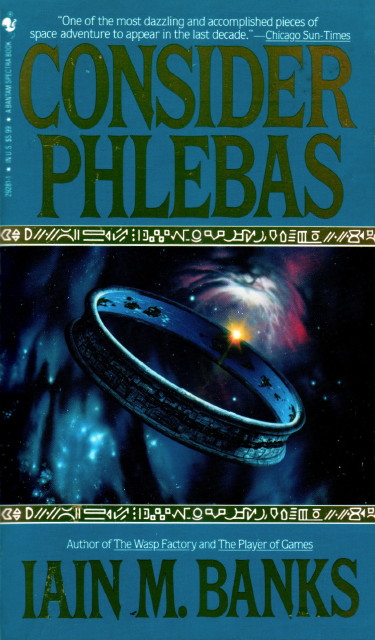
Iain M. Banks: Consider Phlebas

I read several of Banks’ Culture novels earlier in the decade, but I hadn’t read Consider Phlebas, which was the first of them published. We read it for our book discussion group this month, rectifying that oversight.

Consider Phlebas is a grand space opera which introduces us to the universe of the Culture, itself a sweeping civilization maintained by ultraintelligent computers (Minds) which live in harmony with the humanoids and humanoid-level robots (drones) which make up most of the Culture’s trillions of citizens. But we’re introduced to the Culture through the eyes of one of its enemies, Bora Horza Gobuchul. Horza is a Changer, a humanoid who can shift shapes (given time) to imitate other humanoids. He’s also an agent for the Idirans, an alien race of religious fanatics who are at war with the Culture. Horza opposes the Culture because of their reliance on – and perhaps in his eyes servitude to – machines.

Horza is extracted from his current mission at the start of the novel (where he’d been bested by a Culture agent, Perosteck Balveda) and charged with going to Schar’s World to retrieve a Mind which has been marooned there following combat with the Idirans. Unfortunately, Schar’s World is a dead world which has been closed by an even more powerful race, the Dra’Azon, whom the Culture and Idirans are both wary of. The Idirans sent a force there to retrieve the Mind, but it was apparently shot down. Horza had once served there in a neutral base his race maintains, so perhaps the Dra’Azon will let him in.

Even worse for our hero, the Idiran ship where Horza is briefed is attacked before he can set out, and he ends up being marooned and then rescued by the Clear Air Turbulence, with a crew of freebooters led by Captain Kraiklyn, a leader who proves both poorly informed and incompetent. Horza wins his way onto the crew (through combat), and gets involved with a shipmate, Yalson. Kraiklyn’s crew embark on several adventures – with a mounting body count – including an extended stay on Vavach Orbital, a larger-than-Earth-diameter ring which the Culture plans to destroy before the Idirans can take it over. Horza ends up on both the giving and the receiving end of many atrocious acts, but remains fixed on his goal of getting to Schar’s World, where the last third of the book takes place.

The element that all the reviews of Consider Phlebas mention is that it introduces the Culture through the eyes of one of its adversaries. Horza has thrown in his lot with the Idirans because he sees them as being “on the side of life”, whereas he detests the Culture’s melding of man and machine into a larger gestalt, one he perceives as dominated by the machines to the detriment of the humanoids. I wish the book had explored this notion further, since it’s probably the most interesting idea in the novel. But Horza isn’t a very philosophical man, and on this subject he perhaps is motivated not to be, since if the Idirans are the best that “the side of life” can put up against the Culture, one is forced to wonder if Horza isn’t just deluding himself: The Idirans are warlike, dogmatic, and obsessive in their drive to absorb other races into their empire. Horza is getting tired of the war altogether, but one wonders if he hasn’t realized that he’s not on the right side but just can’t admit that to himself.

Unfortunately the book mostly doesn’t concern itself with interesting questions like that either, being mostly a space-operatic show of wonder as Horza takes his tour through what is effectively the leading front of the war: The enormity of Vavach Orbital and what exists inside it, the brutality of the game of Damage that he witnesses while there, the various wonders and dangers that exist on worlds in the vicinity, and the nitty-gritty of the soldiers, including Balveda’s resourcefulness and the brutal single-mindedness (one might say blooddy-mindedness) of the Idirans sent to recover the Mind. Many of these are interesting ideas, but none of them are enough to hang a book on. Indeed, the book feels like it went instantly obsolete in the “sense of wonder” region when Vernor Vinge’s A Fire Upon The Deep came out, and like it’s at best a great-great-grandparent of Alastair Reynolds‘ works. That’s not a good thing for a book barely 20 years old.

But the book doesn’t have a lot going for it besides appeals to the sense of wonder. Horza is an unlikeable protagonist, one who does horrible things and suffers some horrible experiences, and for what? The book’s conclusion is unsatisfactory, with little but misery and death having been inflicted on the characters, and no reward for that suffering. Horza doesn’t even come across as a tragic figure, nor does he really learn anything or impart much of a legacy. It appears this was intentional, as Banks said in an interview (quoted in the Wikipedia article) that it’s very difficult for an individual to change the course of civilizations. That’s all well and good (and even so, this story was terrible at making that point), but an individual can certainly have a profound impact on a smaller scale, especially a few other individuals, but other than bringing death to them (death which it seems likely would have come anyway), Horza doesn’t even do that much.

Banks’ writing is decent enough, although it often feels mechanical, mainly intended to move the characters from one place to another through plot devices (and in a galaxy where everyone’s got high-tech implants of one sort or another, there are always plenty of plot devices to go around). Some of the scenes are fine (such as Horza piloting the CAT out of a Culture GSV), while others are inventive in their way (the colony of cannibals living on an island on the orbital) but I thought they added nothing to the story. It could have been a shorter novel without losing anything.

Consider Phlebas is full of ideas, but the writing, characters, and especially the plotting just aren’t very rewarding. Although the Culture is interesting as a post-singularity civilization, with the unusual twist (which always seems reasonable one to me) of humans and AIs living together, this novel is a poor representative of the premise, because ultimately there just isn’t enough story to make it an enjoyable read.

Related Articles:

Suits Me

Today’s Life Lesson is: When buying a new suit, it pays to go at 10 am on a Saturday morning in a down economy.

Seriously: We pretty much had the whole store to ourselves! A couple of random people wandered in after we were there for half an hour, but otherwise the whole staff was helping us out.

Men’s Wearhouse is having a sale on, well, nearly everything, so I bought up two suits (“buy one get one free”) which I’ll pick up once they’re adjusted. They also laid out six different shirt-and-tie combinations for us to look at with the suits, and I bought four of them (blue, red, lavender, and white shirts, to go with the black and gray suits). Certainly they’re more interesting than the usual white-shirt-laid-back-tie combinations I usually wear.

I would say it makes me feel all grown up, but honestly I think I only ever wear suits for weddings and occasional formal events. Which these days means once, maybe twice a year. I won’t wear them to work because, first, I don’t need to, and second, people would just ask me who I’m interviewing with.

Still, I needed the suits, because my old one – which must be 15 years old now – is on it last legs and needed to be replaced, since we have a wedding to go to in May. So, mission accomplished!

This Week’s Haul

A pretty solid week of enjoyable comics, most of them in the middle of lengthy ongoing stories. And then one big standout…

  • Madame Xanadu #9, by Matt Wagner & Amy Reeder Hadley (DC)
  • Top 10 Special #1, by Zander Cannon, Kevin Cannon & Daxiong (DC/ABC)
  • Guardians of the Galaxy #12, by Dan Abnett, Andy Lanning & Wes Craig (Marvel)
  • Hawkeye HC, by Mark Gruenwald, Brett Breeding & others (Marvel)
  • The Incredible Hercules #127, by Greg Pak, Fred Van Lente, Dietrich Smith & Cory Hamscher (Marvel)
  • The Immortal Iron Fist #24, by Duane Swierczynski & Kano (Marvel)
  • Nova #23, by Dan Abnett, Andy Lanning & Andrea DiVito (Marvel)
  • The Umbrella Academy #5 of 6, by Gerard Way & Gabriel Bá (Dark Horse)
Hawkeye Premiere HC Mark Gruenwald is one of the unsung heroes of 80s comics, writing a number of Marvel comics, keeping largely-moribund series like Captain America going, and even the heavier series Squadron Supreme. But he always seemed to have his eye on the prize of making fun comics in the Stan Lee tradition, just updated for more modern sensibilities.

One of his earlier works was the Hawkeye mini-series, now collected in a lovely hardcover. Although mainly a writer, Gruenwald somehow convinced his editor to let him pencil this series, too. Although not the most polished, his layouts have an energy and charm that’s rare to see today, and veteran inker Brett Breeding keeps it all looking professional.

What really makes the series work, though, is summed up by a few words from Gruenwald’s introduction to the volume:

My philosophy of the Limited Series is that it should not only depict the single most important adventure of a hero’s life, but it should also leave the character permanently transformed by the experience. That’s what I tried to do here.

At the time the series was published, Hawkeye had left the Avengers – the team which had basically given the character meaning for the last 15 years – and become a security chief of a major corporation. This series turns Hawk’s life upside down, but he also meets the woman of his dreams – just that he never realized that she was who he was looking for. Mockingbird is a formed S.H.I.E.L.D. agent turned super-heroine, who both shares Hawkeye’s adventurous streak, but also reins in his reckless side, just what he needs after years of pining after exotic women like the Black Widow and the Scarlet Witch. Getting from one end to the other is what the story is all about, complete with a villainous plan to use Hawkeye to devastate the superhero community. The story has a certain self-aware cheesiness factor which actually works really well, as Gruenwald uses it to key the story’s humorous moments.

It’s one of my favorite series of the 80s.

Gruenwald unfortunately died in 1996 at the young age of 43, but it’s great to see Marvel bringing his great series back into print with this new collection. It also features Hawkeye and Mockingbird’s first adventures, and a couple of other important stories in the characters’ histories. So if you’re a Hawkeye fan, be sure to pick it up. And if you’re not, well, maybe you should be.

Battlestar Galactica: The End

It seems like we just started watching Battlestar Galactica a few months ago – in fact, it was not quite a year ago – but here we are at the end.

The spoiler-free version is this: The series finale was quite good. It pulled together more of the ongoing plot threads than I’d expected, and featured many of the character, action, and philosophical elements which made the series enjoyable. It was annoying that not everything was revealed – or, at least, not to my satisfaction – but on the whole it was a solid conclusion to an ambitious series and a fond farewell to the characters.

The spoiler-filled review is after the cut.

Continue reading “Battlestar Galactica: The End”

This Week’s Haul

Some really good stuff this week:

Powers vol 12: The 25 Coolest Dead Superheroes of All Time The latest volume of Powers has one downside: The title. “The 25 Coolest Dead Superheroes of All Time” may be a cute little joke – which is how it’s used in the story – but it’s a terrible title for this volume.

The reason it’s a terrible title is that this is one of the best volumes in the Powers series, which is the culmination of 30 issues of storytelling.

There’s a virus on the streets giving people powers, but leaving many of them ending up dead, too. Detective Deena Pilgrim was infected a while ago – a bad thing since having powers is illegal unless you register them – and ha run away from the force to try to stop the people responsible for and profiting off the virus. Her former partner, Christian Walker, used to be a superhero before he lost his powers, but he recently gained now powers, but only for fighting cosmic threats to Earth. And having powers is illegal, right? He’s also trying to find who’s responsible for the disease.

Pilgrim is in her own private purgatory and has been pushed about as far down as she can go, while Walker’s new partner is charged by internal affairs with finding out things about the both of them. It’s an ugly situation, and it all comes down to a big roll-of-the-dice which puts everyone at risk. And as a story it works out wonderfully. How it works out for the characters… you’ll want to read for yourself.

This volume is some of Bendis’ best writing ever, with some particularly poignant statements to make about what it means to have powers. Other than the title, if the book has a downside, it’s the sad fact that the series comes out so rarely while Bendis is writing mainstream books for Marvel. Not that I begrudge him the success he’s had in that vein (even if those titles aren’t my cup of tea), but Powers will be the book people remember 30 years from now, and much like Kurt Busiek’s series Astro City, it’s too bad we don’t get more of it.

Still, we should be grateful for what we do get.

Star Trek: Crew #1 John Byrne’s last Star Trek-related series, Assignment: Earth, was rather a bust, as it was five standalone stories which didn’t really give us any insight into the characters or ultimately go anywhere. Nonetheless I decided to give his new series, Crew a try, and from the first issue it’s 100% better.

Apparently it’s going to focus on Number One, the first office of Captain Christopher Pike in the original Trek pilot, “The Cage”, and who was portrayed by Majel Barrett. This first issue takes place on the shakedown cruise of the USS Enterprise before it was commissioned; Number One – who was never named in the pilot and isn’t named here – is a cadet assigned to help with the cruise, and who engineers the saving of the ship from an enemy plot. The plot isn’t especially sophisticated, but Byrne nails the look of Starfleet and makes the characters and situation compelling enough to make it one of the better one-issue stories I’ve read recently.

If the rest of the series is this good, it ought to be a lot of fun indeed.

Invincible #60 A whirlwind year of Invincible wraps up with “The Invincible War”, a double-sized issue in which reality-hopping villain Angstrom Levy sends 20 evil counterparts of Invincible from parallel Earths to our hero’s own world to conquer it and humiliate him. It doesn’t work, of course, but 20 Invincibles manage to beat down the whole roster of heroes from the Image universe before they’re stopped.

This issue is like the series in microcosm: Inventive writing and artwork, hard-hitting situations and visuals (yes, there’s blood and gore), and life-altering events happening to series regulars – not to mention the rest of the world. – and despite being a single-issue story, it both picks up threads from earlier issues and sets up elements for future issues. Invincible is like a television drama which alters the status quo regularly. While its sensibilities are too modern to truly compare it to monthly comics of decades past, that’s what I often think of when I read it: Kirkman and Ottley are having fun pulling out all the stops and moving pieces around every month, and while it’s not ‘good clean fun’, it is a great ride. I’m not sure why it took me so long to discover this comic, but I sure am glad I have.

This issue has a double-foldout-wraparound cover – when was the last time you saw one of those? – by series artist Ryan Ottley, and you can see it in its entirety here.

The Power to Believe

Great article by Joe Posnanski about Cardinals slugger Albert Pujols. (via Rob Neyer)

One thing fantasy baseball does for me is gives me a little more connection to players I’d otherwise be somewhat indifferent towards – well, to the extent that one can be indifferent towards the best player in baseball. Back in 2001 during our league draft I decided to take a flyer on a guy named Pujols, who had spent most of 2000 in A-ball, and was filling in at third base while Bobby Bonilla was on the DL.

Someone in the room said, “They’ll send him down as soon as Bonilla comes back.”

A couple of weeks later, Bonilla came back. Rather than sending down Pujols, the Cardinals released John Mabry. Pujols has since gone on to beat the living daylights out of National League pitching.

I drafted Pujols in the 16th round that year (this is a keeper league, so that’s like taking him in the 21st round in non-keeper leagues). Overall he was the 248th player taken in the draft – 362nd if you include the keepers.

And I’ve had him on my team ever since.

Anyway.

If anything, I think Pujols is underrated. He’s been hurt in one way or another for most of his career – he has a bad elbow which may eventually need reconstructive surgery, and for which he had surgery this offseason to correct a nerve problem and hopefully alleviate the pain he feels in it. That’s the main reason he plays first base, to avoid aggravating his elbow by having to throw more often. He came up as a third baseman and played all four corners (first, third, left field, and right field) his first two seasons. Last year he played one game at second base. Okay, events like that are flukes. But still. How great would it have been if he’d been able to spend his career at third base or in the outfield and been fully healthy?

The only thing he can’t do is pitch. As far as we know.

Since I don’t believe in god (in my Facebook profile my “Religion” field reads “unbeliever/heathen”), it’s strange for me to read about his clearly deep religious beliefs. It’s an aspect of him I can’t realte to or even really understand. “He played baseball, and he went to church, and that seemed about all that interested him.” On the other hand, if it works for him and his life, then that works for me.

I hope – for his own peace of mind – he’s telling the truth that he doesn’t care whether people believe that he’s not using steroids. The steroid witch-hunt has been such a disaster for baseball – to my mind much worse than any actual use of steroids has been. I hope the reigning Best Player in Baseball can escape the witch-hunt. Because I just want to see him play.

Our Monday Night Magic Metagame

I’ve mentioned that I play Magic with some friends on Monday nights. I want to write about Magic more than I do, but in order to do so I ought to give a primer on our competitive environment, since that’s very important for understanding the kinds of decks we play. So here I go!

(Anyone who doesn’t care a whit about Magic can just move on. I expect most of the traffic I get on my Magic articles will be from people surfing in from Google anyway.)

At a high level, our metagame environment looks like this:

  • Constructed decks.
  • Vintage format: Any card ever published (other than the Un-sets) is technically legal.
  • Multiplayer games, especially 2-headed giant and 5-way star
  • No card penalty for mulligans, but we rarely mulligan for reasons other than <2 lands or extreme color screw.
  • Proxy cards are allowed.
  • Some people play the same set of decks every week, some bring new decks regularly.
  • Most people play a different deck each game.
  • Quite a few decks are based around cards from the powerful Urza block (I’ll probably see at least one deck with Rancor each week).

Basically, we play games for fun, and try to keep everybody involved. If you get an initial draw that would just be no fun to play, then you can get a new draw. We rarely play the top tournament-competitive decks, for two reasons: First, they don’t always do as well in a multiplayer environment as they do in duels, and second because if you have a deck that can win almost every time, what fun is it to keep playing it?

Most of our decks are creature-based because it’s hard to get off a combo which can kill multiple other players. And that means that creature removal is very popular. So we see a lot of Lightning Bolts and Wraths of God and similar spells, as well as creature defenses such as Caltrops, Ensnaring Bridge, and AEther Flash. And that means that enchantment and artifact destruction spells like Naturalize are necessary, too. We do have a few entirely creatureless decks lurking around.

One thing I like about multiplayer is that games often go on for a long time, so you frequently make your 7th or 8th land drop even without mana acceleration, and thus you can play some more expensive spells than you can in duel. I think the large amount of removal accounts for this: There’s usually at least one person interested in killing your creatures, so it’s difficult to kill anyone in just a few turns. I think the fact that the game can progress over many turns (sometimes many, many turns) leads to some very interesting games, and makes some decks viable that wouldn’t be in a duel, or more strictly competitive, environment. (I like limited play for much the same reason.)

My own decks have the additional constraint that I almost never play proxy cards, especially of powerful and rare cards like Damnation. This means that I run 1-of or 2-of many cards in my decks, since that’s all I have, so I don’t build decks around those cards. But it also means my decks tend to have several modular parts that interact in different ways, depending on what draw I happen to get.

Also, since I’m still buying new cards and most of the group isn’t, that means that I’m usually introducing completely new cards into the metagame which they haven’t seen before. I think the card I’ve introduced that’s made the biggest splash has been Austere Command, since it can wipe the board of creatures as well as cripple decks which rely on enchantments or artifacts.

By convention, we tend not to play some of the unusually powerful cards in Magic’s history, such as the Power Nine cards, or Sol Ring. This is partly because only one of the group owns many of these cards, but he doesn’t find playing unbalanced decks very fun. Plus he’s the host, so he sets the house rules. 🙂

All-in-all it’s a pretty challenging environment, but it also allows a lot of flexibility in deck construction. And it’s a fun bunch of people.

I’ll run an article on one of my better-tested decks from time to time, with the thinking behind the deck and how it’s worked out in practice.

This Week’s Haul

Not only did I somehow miss Iron Fist #22, but I still haven’t found the first two issues of Legend of the Blue Marvel. Still, a pretty big week:

  • Booster Gold #18, by Dan Jurgens & Norm Rapmund (DC)
  • Ex Machina Special #4, by Brian K. Vaughan & John Paul Leon (DC/Wildstorm)
  • Fables #82, by Bill Willingham & David Hahn (DC/Vertigo)
  • Sandman Mystery Theatre: The Mist and The Phantom of the Fair vol 7 TPB, by Matt Wagner, Steven T. Sagle & Guy Davis (DC/Vertigo)
  • Top 10 Season Two #4, by Zander Cannon & Gene Ha (DC/Wildstorm)
  • Adam: Legend of the Blue Marvel #5 of 5, by Kevin Grevioux, Mat Broome, Roberto Castro, Sean Parsons, Álvaro López & Lorenzo Ruggiero (Marvel)
  • Guardians of the Galaxy #11, by Dan Abnett, Andy Lanning & Wes Craig (Marvel)
  • The Immortal Iron Fist #23, by Duane Swierczynski, Travel Foreman, Tonci Zonjic, Timothy Green II, Tom Palmer & Mark Pennington (Marvel)
  • B.P.R.D.: The Black Goddess #3 of 5, by Mike Mignola, John Arcudi & Guy Davis (Dark Horse)
  • The Life and Times of Savior 28 #1 of 6, by J.M. DeMatteis & Mike Cavallaro (IDW)
Sandman Mystery Theatre vol 7: The Mist and The Phantom of the Fair The latest collection of Sandman Mystery Theatre features a lot of fun little bits for fans of Golden Age DC characters. “The Mist” involves a threat by the villain of the same name, but before he became the crime lord we’re familiar with; it also guest-stars Ted Knight, before he became Starman, when he was one of several scientists competing in a contest for government funding. Then “The Phantom of the Fair” has an appearance by the Crimson Avenger, and mention of Hourman and the Flash. Sandman at one point remarks with a little awe that he’s no longer the only masked man trying to bring justice to the pre-World War II American cities. It’s an effective touch reminding us that the world of 1939 is changing in more than one way in the DC Universe.

(“The Mist” is also referred to in the story “Sand and Stars” in James Robinson’s Starman series. It’s my favorite story of that series, and was recently reprinted, so it was neat to see where one element of that story came from, here.)

The stories are effective thrillers, as usual, drawing more from the inspiration of the pulps for their adventure and the British mystery novels for their character. They’re more adventure yarns than mysteries, though, which is occasionally disappointing, as if they’re not quite reaching their full potential. Still, it’s good stuff. Just be braced for some brutal scenes, especially in “The Phantom of The Fair”, in which a disturbed killer mutilates his victims – all homosexual men – before dumping them on the World’s Fair ground.

The stories also spend a considerable amount of time chronicling Wes’ relationship with Dian Belmont. Here Dian is fully aware of Wes’ extracurricular activities, and supports them and even helps him, but she’s still a little jealous that the Sandman has such a hold on him.

I’ve been thoroughly enjoying these collections of this series from the 1990s as they’ve been published this decade, having only read the first few issues when they came out. Fans of noir thrillers should enjoy them, too.

The Life and Times of Savior 28 #1 The Life and Times of Savior 28 is the latest superhero comic by J.M. DeMatteis, who’s been working the genre for over 30 years, with a fair amount of acclaim. Myself, I tend to find his stories overly wordy and expositive, with complicated set-ups and characters whose behavior and emotions never seem to quite ring true to me. I think my favorite thing of his is his abortive series Abadazad, but even it I thought had the same general flaws as the rest of his work.

In this series, Savior 28 is a hero who emerged just prior to World War II (don’t they all?) as part of some government experiments. The 28th subject, only one other survived – Savior 13, who became a twisted, evil, Bizarro-like figure. Both men lived through the 20th century until Savior 13 was finally killed. Some years later, having turned over a new leaf following the destruction of the World Trade Towers, Savior 28 is himself assassinated. The story of his life is narrated by his former sidekick, who like his mentor is long-lived, and the first issue ends with a surprising twist.

The story covers familiar ground, so I presume this issue is mainly set-up. The notion of an iconic superhero from the dawn of superheroes living to the present day and facing his end is hardly new (to pick one extremely obscure series which I enjoyed, there’s Magna-Man: The Last Super-Hero). That Savior 28 is more flawed than most such Superman analogues makes it a little stranger, but not (so far) very different. The issue follows the patterns of DeMatteis’ writing I described above: A complex set-up with a lot of exposition, but not a lot that resonates emotionally. I’m curious about where it’s going, but the first issue didn’t exactly work up my enthusiasm.

Mike Cavallaro’s art is okay. The anatomy often seems a little off. It’s very evocative of Jack Kirby, although like most art evoking Kirby it gets the trappings right but the soul of Kirby isn’t there. It’s not quite my sort of thing.

Greg Burgas (at Comics Should Be Good) is more of a DeMatteis fan than I am, and he likes the book a little better than I do. Marc-Oliver Frisch (at Comiks Debris) has an opinion similar to mine, although he enjoys DeMatteis’ work generally more than I do.