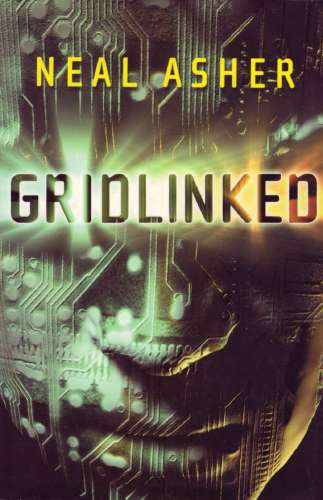
Neal Asher: Gridlinked

Review of the novel Gridlinked by Neal Asher.

Neal Asher has been on my radar screen as one of the biggers names in high-tech SF in this decade. He’s published nearly a dozen novels, which means I have a lot of catching up to do. (I’m reading his blog, too.) Before diving into Gridlinked I’d read a couple of his stories in the SF magazines and liked what I’d read.

Gridlinked opens with Ian Cormac, one of Earth Central Security’s top agents, pursuing a group of anarchists on the planet Cheyne III. Although he disrupts their operations, they had him ‘made’ from the beginning, since he is constantly linked into the computer grid, which has gradually dampened his emotional reactions to things over thirty years. He also fails to capture of kill the group’s ringleader, Arian Pelter, although he does kill Pelter’s sister, Angelina.

Cormac is them abruptly pulled off the mission and shipped to the planet Samarkand. Humanspace, you see, is connected by a set of matter transmitters, called runcibles, which are controlled by the governing collection of artificial intelligences which run Earth Central. Something managed to disrupt the runcible on Samarkand, destroying it and effectively dooming all life on the cold, partially-terraformed world. Moreover, his superiors decide that it’s time for Cormac to be unlinked from the grid since his detachment from humanity is making him a less effective agent. Naturally this cuts Cormac off from being able to instantly access information and communicate with the local AI, as well as forcing him to rely on his human memories. Nonetheless, he complies.

Arriving at Samarkand Cormac finds several enigmas, including some creatures which remind him of a powerful alien being he’d encountered years before, as well as a well-defended artifact buried in the ice. Unknown to Cormac, while he investigates the event, Arian Pelter, his hired mercenaries, and a cyborg psychopath called Mr. Crane have been arming themselves and following Cormac to Samarkand so that Pelter can avenge his sister.

Gridlinked can best be categorized as “high-tech suspense”, concentrated more on building the suspense and executing the action scenes which resolve the plot and less on a high ideas content. After all, the core concepts here are pretty routine: An AI government, cyborgs, linking into cyberspace, interplanetary teleportation, and a variety of supporting technologies such as antigravity and energy weapons. That’s not bad, but I had expected a more ideas-driven story a la Alastair Reynolds or Karl Schroeder.

The book’s serious demeanor and sense of mystery is what makes it enjoyable. It’s not a mystery the reader can really solve, but watching Cormac poke around on Samarkand and deal with an old adversary is fun. Honestly, I’m not entirely sure what motivated the Samarkand disaster in the first place; I think the bigger ideas ended up getting swamped by the adventure and shooting and running around. The book comes to a rather abrupt, and somewhat unsatisfying, end in this regard.

The characterizations tend to be thin. Cormac himself is very much a cipher, perhaps deliberately given what being gridlinked for three decades has done to him, with little background or relationship to the other characters. Pelter and his aide Stanton are more well-drawn: Pelter pretty much goes around the bed during the story, while Stanton is a calculating but flawed mercenary who ends up in an untenable situation. None of the other characters are especially memorable (I don’t really count the mute Mr. Crane as a character, though his presence is certainly memorable).

And then I wonder why the book is titled “Gridlinked“, since Cormac of course becomes unlinked during the story, and the grid (or lack thereof) plays relatively little into the story. It feels like a marketing title, not a title truly representative of the story.

So I was rather disappointed by Gridlinked. It reads like the first novel that it is, with pieces that work and pieces that don’t, and pieces that feel out-of-place. Asher has written quite a few novels since this, and this one holds enough promise that I’m certainly going to read more of them, in the hopes that he develops both as a writer and as an idea-smith. But this one isn’t essential reading.

This Week’s Haul

  • Action Comics #862, by Geoff Johns, Gary Frank & Jon Sibal (DC)
  • Countdown to Final Crisis #9 of 52 (backwards), by Paul Dini, Justin Gray, Jimmy Palmiotti, Keith Giffen, Tom Derenick & Wayne Faucher (DC)
  • Fables #70, by Bill Willingham & Niko Henrichton (DC/Vertigo)
  • Justice Society of America #13, by Geoff Johns, Alex Ross, Fernando Pasarin & Richard Friend (DC)
  • Legion of Super-Heroes #39, by Jim Shooter, Francis Manapul & Livesay (DC)
  • Thor #6, by J. Michael Straczynski, Oliver Coipel & Mark Morales (Marvel)
  • The Clockword Girl #3 of 4, by Sean O’Reilly, Kevin Hanna & Grant Bond (Arcana)
  • The Many Adventures of Miranda Mercury #295 (#1) of 6, by Brandon Thomas, Lee Ferguson & Marc Deering (Archaia)
  • Mouse Guard: Winter 1152 #3 of 6, by David Petersen (Archaia)
  • Primordia #3 of 3, by John R. Fultz & Roel Wielinga (Archaia)
  • The Secret History #5 of 7, by Jean-Pierre Pécau & Leo Pilipovic (Archaia)
  • RASL #1, by Jeff Smith (Cartoon)
  • Project Superpowers #1 of 6, by Alex Ross, Jim Krueger & Carlos Paul (Dynamite)
Legion of Super-Heroes #39 Three issues into Jim Shooter’s return to the Legion of Super-Heroes, results are mixed. His characterizations have been brutally heavy-handed at times, and it’s still not at all clear to me where his long-form story arc, “Evil Adventus”, is going: So far we’ve gotten an invasion of Neptune’s moon Triton by unknown aliens, and Lightning Lad having trouble holding onto the reins of Legion leadership.

Issue #39 is somewhat better: It focuses largely on Princess Projectra, the illusion-caster whose world was destroyed during Mark Waid’s run on the book, and who is now a princess without subjects. Shooter effectively subverts Projectra’s own heavy-handed characterization to help her character grow a little, and it’s easily the best sequence he’s yet written in his return. There’s also an enjoyable sequence with several Legionnaires cleaning up some escaped alien pets, although it doesn’t seem to move the story forward.

Francis Manapul is a decent Image-style penciller (if that’s not an oxymoron), although I find his layouts o be awkward, keeping the story from really flowing. He and Shooter combine for the issue’s low point, in which two of the female Legionnaires have a midnight conversation while in skimpy undergarments, and one of them then seduces a male Legionnaire in short order. The whole scene felt uncomfortable and pointless.

So all things considered I’m not as enthusiastic about Shooter’s run as I was at first, though I’m giving him a lot of latitude for being rusty as a comic book writer. Signs point to “getting better”, but I’d be a lot happier if he’d completely abandon the occasional attempts to present an “adult” comic book.

The Many Adventures of Miranda Mercury #295 The Many Adventures of Miranda Mercury‘s central conceit is that it’s #295 in a long-running series (the first 294 have never been published), and is the first issue of the six-issue sequence which will lead to the end of the series. It’s a little silly, but it’s no less silly than lots of what’s in Robert Kirkman’s Invincible and that’s a very good series. If comics can’t be silly once in a while, what’s the point?

This issue is mostly a run-of-the-mill adventure in which Miranda and her aide, Jack Warning, capture a high-tech Rubik’s cube which actually contains an alien genie, and they want to do the impossible and open it, so the opener can get his heart’s desire. At the end of the story we find out why this is the beginning of the end for Miranda.

It’s an extremely well-crafted story, and it’s been getting good reviews around the Web: Brandon Thomas’ script flows nicely, with excellent pacing and dialogue. Lee Ferguson’s pencils are just as good, if not better, with colorful designs, a terrific sense of motion, and a (presumably deliberate) throwback style to the days of adventure comic strips. This is a fun comic book, and I hope the last 5 issues are as good.

Archaia Studios Press seems today to be much where Dark Horse was twenty years ago: A small company which somehow is managing to attract some top-class talent with fun story ideas, and which is getting a lot of notice as a result. ASP does unfortunately have a problem with shipping items in a timely manner, which will probably limit the company’s success until they iron out these issues. But I can’t complain about the quality of their content so far.

RASL #1 Jeff Smith’s Bone was one of the best comics of the 90s, and after doing a 4-issue SHAZAM! mini-series for DC, Smith is back with a new ongoing series, RASL. RASL is about a thief who can apparently walk between dimensions – though he doesn’t have full control over the power, which he calls going into “The Drift” – and who sprays the letters “RASL” on the walls of his targets. In this issue, something goes wrong and he ends up in the wrong world being pursued by a man with a gun, with the suggestion that he knows who sent the man. He runs away and ends up in a desert landscape. So it’s a bare introduction to the premise, and not much clue of where it’s going to go from here.

RASL could hardly be more different from Bone: The latter was comical and romantic, while this one is hard-hitting and noir-ish. That’s certainly not bad, but it was surprising to me. The fantastical elements of the premise remind me a little of Quicken Forbidden (and whatever happened to that series, I wonder?), but no doubt Smith will put his own stamp on the series soon enough.

So I still have little idea what to expect from RASL, but I’ll certainly be back for more.

Happy Leap Day!

Wow, I really have not written very much this month! My head just hasn’t been in a journalling space, I guess. I have at least 3 half-written entries which I should really finish and post sometime soon. I just always seem to have other stuff to work on.

This past week a lot of my time has gone into doing stuff around the house. For instance, when I cleaned out the front closet over the Christmas break, I left four boxes of stuff sitting in the front room waiting to be gone through and mostly gotten rid of. Last Sunday I spent several hours upgrading the desktop computer to Mac OS X Leopard, and while it was chugging away at that I shredded boxes of old checks, pulled out and shredded pages from old APAs (mostly ones with my old addresses on them) and then chucked many of the APAs.

(Perhaps some of my old APAhacking friends are scandalized that I would be doing such a thing, but alas my sentimental attachment to boxes full of paper has waned in recent years, especially for the APAs that I was only sorta-kinda involved in, mainly in the mid-to-late 90s. I don’t expect to ever read these things again, and I don’t want to keep lugging them around, so out they go. Ditto some fanzines from the mid-90s, since I was never really part of fanzine culture.)

I’ve also been cleaning up and cataloguing my Magic card collection (which I think makes Debbi roll her eyes whenever I buy new cards or work on them). I went through and chucked a whole bunch of computer-related packing material (such as the boxes our wireless mice came in), books and CDs of software, as well as various other odds and ends. So things are generally looking a lot cleaner up there.

But between stuff like that, and gaming, and poker, and reading, and comic books, that just takes up a whole lot of my time.

And now I have this year’s Baseball Prospectus to read, and fantasy baseball season to prepare for, and a variety of housework to take care of, and movies at the Stanford Theatre to go see, so my March looks at least as busy as my February.

At least it’s been bright and sunny and warm out lately. Always nice to be able to move to short sleeves and start being active outdoors at the beginning of March!

I’ll try not to neglect the journal quite so much next month, though.

This Week’s Haul

  • The Brave and the Bold #10, by Mark Waid, George Pérez & Scott Koblish (DC)
  • Countdown to Final Crisis #10 of 52 (backwards), by Paul Dini, Justin Gray, Jimmy Palmiotti, Keith Giffen & Scott Kolins (DC)
  • The Death of the New Gods #6 of 8, by Jim Starlin & Art Thibert (DC)
  • Ex Machina #34, by Brian K. Vaughan, Tony Harris & Jim Clark (DC/Wildstorm)
  • Hulk #2, by Jeph Loeb, Ed McGuinness & Dexter Vines (Marvel)
  • Marvel Masterworks: Uncanny X-Men vol 90 HC, collecting The Uncanny X-Men #142-150, by Chris Claremont, John Byrne, Terry Austin, Brent Anderson, Dave Cockrum, Josef Rubenstein & Bob Wiacek (Marvel)
  • The Umbrella Academy #6 of 6, by Gerard Way & Gabriel Bá (Dark Horse)
  • Locke & Key #1, by Joe Hill & Gabriel Rodriguez (IDW)
  • Invincible #48, by Robert Kirkman & Ryan Ottley (Image)
  • Perhapanauts Annual #1, by Todd DeZago & Craig Rousseau (Image)
The Umbrella Academy #6 I was pretty enthusiastic about The Umbrella Academy after reading the first issue: The premise is that a group of 7 children were born with super-powers, and raised by their rather unpleasant mentor, Sir Reginald Hargreeves, in a weird version of the early 20th century. The first issue treated us to the children as ten-year-olds saving Paris from Zombie-Robot Gustav Eiffel and his tower, and showed us how disfunctional Hargreeves’ “family” was, largely due to his shortcomings as an adoptive father. 20 years later, the family had drifted apart, and its most prominent member, Spaceboy, lived on the moon. But the group was reunited by Hargreeves’ funeral, along with the return of one of their members – Five – who had disappeared years before.

Although essentially a horror-oriented variation of the original X-Men, this was a fine start to the series, but it went downhill from there. The interplay among the characters was easily the series’ high point, but the its plot was a muddle: One of the Academy, Vanya, who has no super-powers but is a violinist, is recruited by the Orchestra Verdammten to help bring about the end of the world, which she’s (sort of) happy to do since she’s an outcast from her family and feels marginalized by the world. Along the way the Academy faces a loud-but-pointless battle against some robots called the Terminauts in issue #3, and a lot of waiting around in issues #4 and 5, until the big confrontation with Vanya and her Orchestra in #6.

I understand The Umbrella Academy is intended to be a lengthy series of mini-series along the lines of Mike Mignola’s B.P.R.D. (probably no coincidence, as both books are published by Dark Horse). However this first mini-series – subtitled “The Apocalypse Suite” – was a big letdown in its conclusion. There’s basically no emotional payoff, as the issues the heroes have with their stepfather are largely unexplored and certainly not resolved, and their relationships with each other remain undeveloped. The motivations of the Orchestra are – to put it mildly – thin, which undercuts the story’s reason for being; indeed, the whole apocalypse suite angle seems awkwardly tacked on to the larger story of Five’s return, the group’s reuniting, and Hargreeves’ motivations and death. In short, everything that was interesting about the set-up is roughly shoved aside to serve this fairly clunky end-of-the-world threat.

This series is getting some rave reviews on the web. For instance, Greg Burgas at Comics Must Be Good: “This is one of the best mini-series you’re going to read in a long time”. Chris Sims in his Invincible Super-Blog: “I’ve gotta say, now that it’s all said and done, this has easily been one of the best comics of the year.” And Bryan Joel at IGN: “Umbrella Academy has been nothing short of brilliant for nearly its entire run.”

All of which of course makes me think: Whuh? I mean, hah?

These reactions made more sense to me once I read Valerie D’Orazio’s review in Occasional Superheroine, in which she compares The Umbrella Academy to Grant Morrison’s run on Doom Patrol of a couple of decades ago: “Way’s been very up front in interviews about his love of Grant Morrison, and while the influence of comic’s own pop magician is felt throughout, it’s just that – influence. Umbrella Academy avoids the lazy trap of trying to lift Morrison’s shtick wholesale that has claimed so many would-be talents, instead showing a real understanding of the blend of great character moments and cool, understated responses to absurdity that made books like Doom Patrol work so well in the first place.” The comparison between the books is quite apt, and perhaps indicates why I was disappointed in the series: I thought that Morrison’s Doom Patrol started off with 6 pretty good issues, and then descended into an utter mess of frenetic idea-driven yarns with characterization close to nil (even calling the characters “cardboard” is being charitable) and plot not a whole lot better. Other than those first few issues, it was pretty forgettable stuff, because there just wasn’t much story there. Morrison’s earlier Animal Man was better, and his later JLA was much better, in both cases because the ideas turned into solid stories, rather than just remaining simple products of the ideas factory that is Morrison’s mind.

The Umbrella Academy is similar to Doom Patrol in this way: A torrent of ideas illustrated by a highly capable artist (Gabriel Bá’s art is terrific; occasionally a little cartoony for my tastes, but he nonetheless can handle anything Way can throw at him, as well as a wide variety of character designs and expressions), but with a story that doesn’t make much sense, and which seems to be actively obstructed by the various nifty things being presented.

Of the reviews I’ve read, I think I agreed most with Joe McCulloch’s review in the Savage Critics: “While the book is neat enough that I’m happy to read it, I don’t pick up on anything all that striking. It’s nice, and pretty eloquent, but I don’t think it’s especially interesting.”

The next series is going to have to actually build on the premise the first two issues of this series laid out, or else The Umbrella Academy is going to end up going the route of B.P.R.D. of always teasing, but never delivering on its promise, with the story crawling forward at a snail’s pace. And that won’t keep me around for long, since I’m already just about done with B.P.R.D..

Locke & Key #1 Locke & Key has been getting a fair bit of hype in the press, perhaps because writer Joe Hill is a successful novelist (and also the son of Stephen King). I hadn’t heard of it before this first issue came out, but I thumbed through it in the store and decided to give it a try, mainly because of the artwork of Gabriel Rodriguez, whose clean linework I appreciated, and whose figures seemed pretty expressive.

It’s a horror series, with this first issue showing (in flashback) the murderous tragedy that befell the Locke family in which the father was kiled, which led them to move to a gothic mansion in the peninsular town of Lovecraft, Massachusetts. These last two overused trappings aside, the premise sounds pretty interesting: The three children of the Locke family find that going through doors in the house can can also transform them in different ways, and that the series’ antagonist wants to use the house for his (or its) own ends (Hill describes the premise in more depth here). But the premise is barely even scratched here – this first issue is all set-up for what sends the characters to the house.

So it’s a bit of a thin issue – unless you enjoy a straight-up short horror story for its own sake – but I’m hopeful that it will deliver on its promise. It seems worth a try.

Lunar Eclipse and Migraine Headache

We were fortunate out here in the Bay Area that this week’s series of showers halted long enough for the sky to clear up so we could view the total lunar eclipse last night. I saw it around 6:15 on my drive home, when the moon looked like it had a big bite taken out of it. Then around 7:40 I went outside and saw the moon was almost completely gone, with just a faint glow in the upper right to show it was there at all.

Very cool.

Unfortunately I wasn’t able to see any more of it because around that time my headache which had been lurking around since mid-afternoon turned into a full-blown migraine. Debbi took me upstairs and had me lie down on the bed, and I ended up falling asleep for some of the next two hours. When she came to bed around 10 I decided to turn in, too, and I got a full night’s sleep on top of the evening nap. Very frustrating since it meant I accomplished almost nothing that I’d hoped to do last night. I almost never get migraines, either. Much less than once a year.

At least the headache was completely gone this morning. That’s something.

Newton slept with me all evening while I was trying to shake off the headache. Debbi says the other three cats were mostly lying in the hallway outside the bedroom, and she had to step over them to come check on me. Very nice of them, guarding the door against intruders while I was sick!

Obviously the eclipse let out some evil spirits who got lodged in my head. Damn you, evil spirits!

Fun With Mirrors

This morning I was shaving and Jefferson had jumped up on the counter next to the sink. Blackjack was prowling around in the bedroom behind me, doing what I don’t know.

Jefferson, though, was going nuts when he saw Blackjack in the mirror! He looked intently and bobbed his head back and forth while swishing his tail! I think he was checking out what Blackjack was up to, and was trying to get a better look, but every time he moved his head to look the cat in the mirror moved too and got in his way.

It was hilarious. It’s been years since either of the big cats have shown any interest in all in mirrors.

This Week’s Haul

Comic books I bought the week of 13 February 2008.

  • Booster Gold #0, by Geoff Johns, Jeff Katz, Dan Jurgens & Norm Rapmund (DC)
  • Countdown to Final Crisis #11 of 52 (backwards), by Paul Dini, Justin Gray, Jimmy Palmiotti, Keith Giffen, Mike Norton & Mark McKenna (DC)
  • Salvation Run #4 of 7, by Matthew Sturges, Sean Chen & Walden Wong (DC)
  • Suicide Squad: Raise the Flag #6 of 8, by John Ostrander, Javier Pina & Robin Riggs (DC)
  • Astro City Special: Beautie, by Kurt Busiek, Brent Anderson & Alex Ross (DC/Wildstorm)
  • Nova Annual #1, by Dan Abnett, Andy Lanning, Mahmud A. Asrar, Klebs, Wellington Alves, Juan Vlasco & Nelson Pereira (Marvel)
  • B.P.R.D.: 1946 #2 of 5, by Mike Mignola, Joshua Dysart & Paul Azaceta (Dark Horse)
  • Atomic Robo #5 of 6, by Brian Clevinger, Scott Wegener, & Christian Ward (Red 5)
Astro City Special: Beautie I’ve felt for a long time that Kurt Busiek’s Astro City is the best comic book of the last 15 years, and it’s not even particularly close. Despite its erratic publishing schedule (for which there are good reasons, I understand), this chronicle of the heroes and ordinary citizens of the fictional city full of superbeings is always great human drama. Right now we’re in the middle of the 12-issue series The Dark Age, which is being told in 3 short series, each with an unrelated special between them. Beautie is the second such special, and it’s a great one.

Beautie is a member of the Honor Guard, the foremost group of superheroes in the Astro City world. What she is is a life-sized Barbie doll with super powers – really. She’s actually a robot, who mimics human form but has some frustrating limitations, and not just her problems relating to humans. She also has no memory of where she came from or why she exists, or why there are no others like her, or for that matter why she resembles a Barbie doll (which in the Astro City world is called a Beautie doll). This is the story of her quest to find out who she is, and what happens when she does.

After a fashion, this is the story of a character like Star Trek‘s Data compressed into a single issue, and rendered more realistically: Beautie not only has Data’s emotional hang-ups, she also has physical problems which prevent her from blending in. And not only is she frustrated by her limitations, she’s also not quite sure how to truly react to being frustrated. It’s a satisfying tale both emotionally and in its depth, with a little twist before the story’s climax revolving around the fact that Beautie is an android.

This would be a good issue to introduce new readers to Astro City, as I think it embodies many of the best elements of the series. And it’s another fine entry into the ongoing series, which should make longtime readers happy. I know it did me.

Nova Annual #1 So once upon a time I used to sort each week’s comics alphabetically and read them in that order, which I know provoked a snarky comment from my Dad on occasion. These days I still sort them, but in the order I most want to read them. You can’t take all of the OCD out of the boy, it seems. Anyway, in any other week I would have put Astro City on top of this week’s stack, but this week I ended up reading Nova Annual first, since it’s one of my favorite comics and I thought it would be the conclusion of the current Phalanx story.

I was mistaken, it’s not the conclusion, but it was still a good read.

Rather than wrapping up the story, it instead featured Nova remembering his origin, when he was first recruited into the Nova corps, and also thinking forward to later in life when the restored Nova corps will fight the final battle against the Phalanx, who have completely taken over the Earth. It’s likely that the latter story was simply in Nova’s imagination, but it was still pretty chilling.

In a way this issue is a throwback to Marvel annuals of old, revisiting the hero’s origin, while throwing in some extra stuff on the side. It also explains one of the underlying principles of the Nova corps – they’re not the best and brightest, they’re average citizens empowered to do extraordinary things. It’s a good issue, and makes me wish anew that Nova hadn’t been largely excluded from the Phalanx storyline in Armageddon Conquest. But hopefully he’ll get his own satisfying conclusion when the current storyline ends.

Today in Obituaries

Read this morning that actor Roy Scheider died, aged 75. I always liked Scheider, as he always brought warmth, humanity and humor to his roles.

And now I read that comic book writer Steve Gerber passed away, aged 60. Gerber is probably best-known for having created Howard the Duck, and has lately been writing the Doctor Fate series in Countdown to Mystery. It’s not clear to me whether he’d actually finished writing the 8-issue series when he passed away.

Sometimes when it rains, it pours.

This Week’s Haul

Comic books I bought the week of 6 February 2008.

  • Countdown to Final Crisis #12 of 52 (backwards), by Paul Dini, Justin Gray, Jimmy Palmiotti, Keith Giffen, Jesus Saiz & Tom Derenick (DC)
  • Fables #69, by Bill Willingham, Mark Buckingham & Steve Leialoha (DC/Vertigo)
  • Justice Society of America #12, by Geoff Johns, Alex Ross, Dale Eaglesham & Ruy José (DC)
  • Metal Men #6 of 8, by Duncan Rouleau (DC)
  • Annihilation Conquest #4 of 6, by Dan Abnett, Andy Lanning, Tom Raney & Scott Hanna (Marvel)
  • Clandestine #1 of 5, by Alan Davis & Mark Farmer (Marvel)
  • The Twelve #2 of 12, by J. Michael Straczynski, Chris Weston & Garry Leach (Marvel)
  • The Boys #15, by Garth Ennis & Darick Robertson (Dynamite)
  • Dynamo 5: Post-Nuclear Family vol 1 TPB, by Jay Faerber & Mahmud A. Asrar (Image)
Fables #69 This month’s Fables concludes the latest lengthy story in the series, “The Good Prince”. In it, Flycatcher, the erstwhile janitor of Fabletown in New York (and for that matter the frog prince), dons some magical armor and, guided by Sir Launcelot, helps guide a group of Fables out of the lands of the dead, and sets up the kingdom of Haven and invites refugees from the Empire to find shelter with him. At the end of last issue, the Emperor sent a huge army of his forces to destroy Haven, and the prince goes out to meet them, expecting to defeat them to save his kingdom, but die in the process.

“The Good Prince” isn’t the best story in the series, but I genuinely enjoyed watching Flycatcher’s turnaround from guilt-ridden janitor to earnest leader (who reminds me a little of the Lama from Doctor Strange #66, but that’s neither here nor there). Writer Bill Willingham continues to artfully shift the status quo of the series, and the balance of power between Fabletown and the Empire. I’m not sure I’d go so far as to say that Fables is the best comic being published todayl, but it’s in my top ten.

By the way, the book’s secret – well, really unheralded – weapon is penciller Mark Buckingham, who’s quietly become one of the most inventive and versatile artists working on a major comic: He can handle a wide range of emotions and faces, as well as all the fantastic elements Willingham can throw at him, while having fundamentally good storytelling skills and some smooth, skillful linework. Good stuff.

Clandestine vol 2 #1 Alan Davis’ Clandestine first came out in the mid-90s. At first it was about a family of colorful characters – not quite superheroes – and the mystery regarding who they were and how they came to be. It wasn’t a huge mystery: The Destine family (the “clan Destine”, geddit?) are all children of Adam Destine, an immortal, indestructible man born centuries ago, and whose children are similarly long-lived and each have their own amazing powers. The series was a lot of fun, but didn’t last long, only 12 issues plus a crossover with the X-Men. (The whole thing will soon be reprinted in hardcover, and has previously been issued in paperback.)

Ten years later, Davis’ family is back in a new 5-issue limited series. This first issue is a pretty good summary of the family, their background and powers, and their various problems and conflicts. In particular, some of them have a strong sense of family ties, while others do not, but they all feel bound together in various ways. Adam is not much of a patriarch, being so long-lived that he feels and acts a little inhuman, and the family often views him with suspicion since he once killed one of his children, even though the child was apparently a huge threat.

Like the first series, this one looks like it’s going to involve the family going up against another secret organization which has their sights set on them. So I do worry that it’s going to be a bit repetitious. But Davis’ art is always terrific – dynamic and colorful – so I expect it will be entertaining in any event. I do recommend checking out the first series and then trying this one if you like it.

Dynamo 5 TPB vol 1: Post-Nuclear Family I’d been reading good things about Dynamo 5, Jay Faerber’s latest project. But I hadn’t been moved to buy the monthly comic because I’d been reading his other comic, Noble Causes, since the beginning, and a few mini-series and the first 12 or so issues of the monthly in, I’d realized that it was a comic about a bunch of thoroughly unlikeable characters, with haphazard and often-nonsensical story developments, and artwork of extremely varying quality. So I’d bailed on it. But Dynamo 5 had been getting such good reviews, that I decided to give the first paperback collection a try this week.

It’s way better than Noble Causes.

The premise is that a major superhero, Captain Dynamo, had died a few years ago, and his widow, Maddie Warner, learned that he’d been sleeping around a lot over the last few decades. Worried about the welfare of the city he’d protected, she tracked down five children his liaisons had produced and activated their latent powers. It turns out that each of them had one of the Captain’s powers: Strength, flight, vision powers, telepathy, and shapeshifting.

This collection contains the first 7 issues. The first issue gives us the set-up, and ends with Maddie revealing a secret to the readers (although not to her proteges). The remaining issues are a loosely-related set of stories in which the heroes adjust to one another and to their new roles. But Faerber does a great job of setting up conflicts and tensions among the characters, most of whom are in their late teens or early 20s, and from very different backgrounds. Artist Mahmud Asrar is a good find, handling the superhero scenes quite well, and doing well enough at the civilian/talking heads scenes (although he’s not quite as comfortable with those, it seems). The collection ends with a big two-part story, and a surprise on the last page.

Faerber seems much more adept at pacing Dynamo 5 than Noble Causes, and I’m not sure why that is. Noble Causes did have a big challenge built into it, since so many of the characters were such scumbags, and maybe getting the reader to identify with them was just more than he was able to accomplish. (Well, getting this reader to identify with them; NC‘s regular series is still running so obviously some people enjoy it.) The characters here are likable even though they’re flawed, and the high concept feels easier to plug in to. The book has a bit of the feel of Robert Kirkman’s Invincible to it, although it’s not so iconoclastic.

So I’m definitely interested in coming back for the second volume. I’m not sure I’ll latch onto the monthly series, though.