This Week’s Haul

Hey, it’s my 150th comic book haul entry!

  • Booster Gold #24, by Dan Jurgens & Norm Rapmund (DC)
  • Green Lantern Corps #40, by Peter J. Tomasi, Patrick Gleason, Rebecca Buchman, Tom Nguyen & Prentis Rollins (DC)
  • Secret Six #13, by Gail Simone, Nicola Scott & Doug Hazlewood (DC)
  • The Unwritten #5, by Mike Carey & Peter Gross (DC/Vertigo)
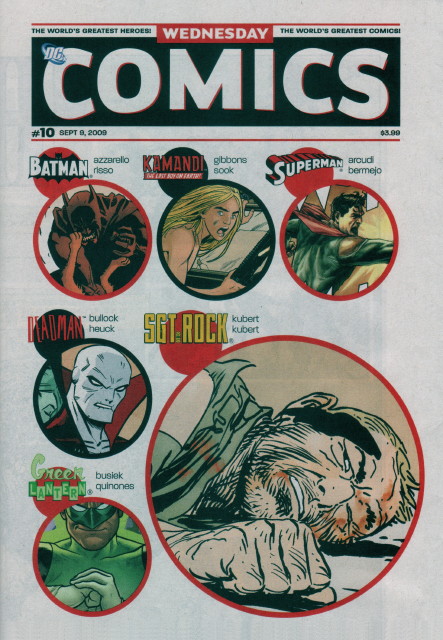
  • Wednesday Comics #10 of 12, by many hands (DC)
  • The Incredible Hercules #134, by Greg Pak, Fred Van Lente, Reilly Brown & Nelson DeCastro (Marvel)
  • The Marvels Project #2 of 8, by Ed Brubaker & Steve Epting (Marvel)
  • B.P.R.D.: 1947 #3 of 5, by Mike Mignola, Joshua Dysart & Gabriel Bá (Dark Horse)
  • Hellboy: The Wild Hunt #6 of 8, by Mike Mignola & Duncan Fegredo (Dark Horse)
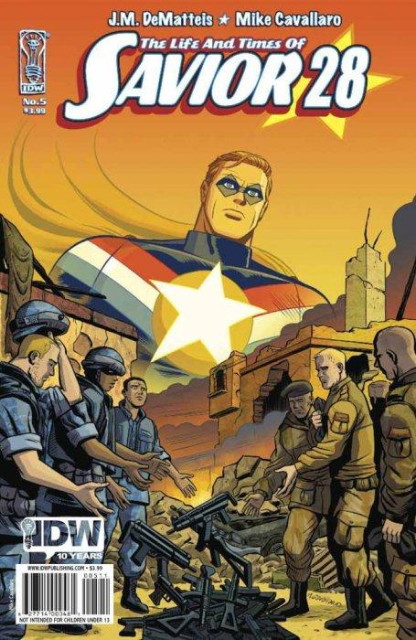
  • The Life and Times of Savior 28 #5 of 5, by J.M. DeMatteis & Mike Cavallaro (IDW)
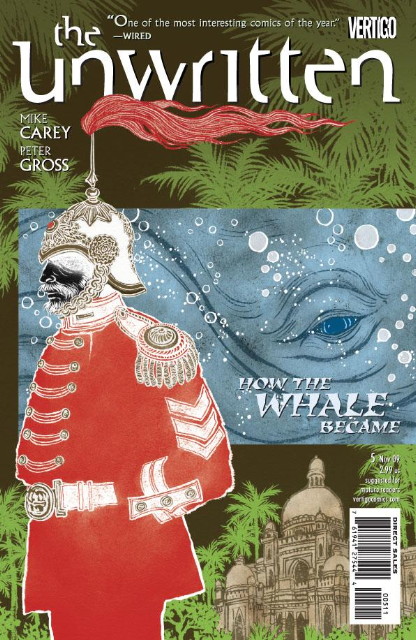
The Unwritten #5 An interesting twist to The Unwritten this month: Rather than starting a new story (the first one having ended on something of a double cliffhanger) with Tom Taylor, instead we’re presented the shadow history of Rudyard Kipling, who seems to have sold a bit of his soul for his successful fiction and poetry, but eventually turned against the people he bargained with, and they brought him low for it.

If this sounds like a dark twist on the bargain Shakespeare made with Morpheus in Neil Gaiman’s Sandman, well, other folks have noticed this too, only in this case the bargain seems to be with a secret cabal – who may or may not be human – who are using fiction and writers thereof for their own purposes. So there’s more to this secret history than Kipling’s story, he’s just how we’re getting our first direct exposure to it. Tom Taylor’s father clearly knew something of them as well, so I expect we – and Tom – will be learning more about them in the months to come.

Peter Gross does some excellent work with his period art for this issue, less cartoony than his usual style, which is a good thing.

Wednesday Comics #10 My old bud Jason Sacks (whom I know from my APAhacking days) wrote a thoughtful piece about the different creators in Wednesday Comics, with particular attention to Paul Pope on Strange Adventures. There’s a lot he says that I don’t agree with (the statement “We can’t expect an auteur approach from Busiek” I think shows a fundamental misunderstanding of Busiek’s career; and as I’ve said before I find Ben Caldwell’s Wonder Woman strip to be truly terrible, making the least out of the series’ format), but it’s still an article well worth reading.

(By the by, the “Unhand me, you pink furless thing!” panel Jason lauds in Pope’s page this week looks like a direct homage to the famous Charlton Heston line in Planet of the Apes. And inasmuch as Pope has taken Adam Strange back to his roots as a twist on the John Carter of Mars premise, I think Pope’s showing his influences rather clearly rather than being a straightforward auteur as Jason sees him.)

Deadman reaches its climax this week, but it’s something of a routine thing (“That’s it?”). On the other hand, Green Lantern and Metamorpho are both aiming for their climaxes next week, and they do so in different ways, with a darkest-before-the-dawn moment in Metamorpho, while GL defines the dawn through sheer bravado. And Karl Kerschl draws a gorgeous Flash page this week (which Jason reprints in his aforelinked article), though the story has fragmented a bit and I hope he can pull it together into a big finish.

And as for Pope’s Strange Adventures, well, it also reaches its climax this week, and it’s a rather clever one. I almost lament that Pope wasn’t given a larger canvas (in number of pages, not page size) to play out the ideas he’s presented here, as it’s perhaps the most interesting take on Adam Strange in decades. With two pages left to go for the denouement, I’m curious as to what other gems Pope can present in this milieu.

The Life and Times of Savior 28 #5 I nearly stopped buying The Life and Times of Savior 28 after last issue, but #4 was just interesting enough to make me buy another issue. I guess that’s a good thing, as it turns out it was a 5-issue mini-series, which I didn’t realize; I’d thought it was going to be a longer-form, ongoing series, and that this was still essentially the prologue.

I’ve never been a big fan of J.M. DeMatteis’ writing, as it tends toward the portentious while being simultaneously quite shallow. Savior 28 meets both of these criteria, being a retrospective of a Superman-like figure who strode unevenly through the 20th century before being killed by his former protege, just when he was trying his best to unify the world peacefully. Savior 28 was a sometime-drunk, once had a nervous breakdown, never quite left the ideals he fought for in World War II behind, and thus seemed utterly obsolete and ineffective – despite his great powers – in the 21st century. All of this is presented without any subtlety at all, right down to his uplifting speech to the United Nations being cynically dismissed by the world at large. Realistic? Perhaps, but it’s as unmoving a portrayal of superheroes brought low by real-world concerns as any I can recall, made all the less effective by the larger-than-life, Kirbyesque art of Mike Cavallaro, which seems appropriate to this story only in that it’s as unsubtle as the writing.

While I can see what DeMatteis was going for here, I think it ended up as a simple hodge-podge of ideas, with heavy-handed presentation right down to the series’ grace note on its last two pages. This territory has been worked much better in series like Astro City (with the Silver Agent storyline), Kingdom Come, or even the largely-forgotten Doctor Tomorrow from Acclaim Comics. If this had been merely the set-up for a longer form story, then there could have been some promise here, but as it turned out Savior 28 was a pretty simple, and not very fun or insightful, series.

Greg Burgas liked it, though, as did Rich Johnston.

Labor Day Weekend

If I’m doing a big project build (and I am), then it must be time to natter about my personal life again. (Hmm, there may be a clue in there as to why I don’t so this more often.)

After the big suck of my bike breaking down on Thursday, and then getting fixed during an otherwise very busy work day on Friday, I was so ready for a long weekend. We consciously didn’t make plans to get stuck in traffic due to the San Francisco Bay Bridge closure, or by going to the coast where probably everyone else was going during the lovely weather.

Instead our friend Karen stopped by for a night on Sunday on her way elsewhere, so I spent a big chunk of Saturday cleaning the front room for her arrival. I’d been piling old comics on the side table in there, and it took quite a while to get them organized. Now I need to see about bringing most of them to my comic book store to see if they’ll buy them from me, and to see about putting some of the others up on eBay.

Once Karen arrived Sunday afternoon, we went out to dinner at Cascal with a friend of hers and his wife. Monday we took her to Stacks for brunch, and showed her the Wii. And then she was off. A short visit, but fun. She managed to avoid all the bridge traffic and made good time on her drive, she says.

After she left on Monday we went for a bike ride, buying ice cream in the park and shaking down my bike after its repairs (and not coincidentally making up for the distance I didn’t bike on Thursday afternoon after it broke). Then I spent a chunk of time upgrading our last computer to SnowLeopard, and I think I’m all done with that chore in the house, thankfully. (Actually it all went perfectly smoothly. It just took a little while to do it all, especially since I decided to do a clean install of the desktop for various mostly-trivial reasons.)

And so today I biked in to work again. If you follow me on Twitter or Facebook, then you know that it was my 20th ride in to work this year, which makes a solid work-month of biking in (if that month started on Saturday and didn’t have 31 days!). My round-trip is about 18 miles, so that’s over 350 miles biked this summer. Hopefully I can get a few more rides in this month, but I plan to shut it down once it gets too dark at night to bike home.

Though I hope to transition to going to the gym twice a week instead. We’ll see how that goes!

(By the way, here’s my favorite Labor Day cartoon this year.)

The Spider and the Mouse

My own feelings about Disney buying Marvel Comics is that it’s generating a lot of hoopla, but without much reason to believe it’s going to be a big change in comics publishing.

My indifference is based on the fact that I don’t really care about anything Marvel-related other than their comic book publishing arm, and publishing is clearly not why Disney bought them. Most of the value in comic books these days is in the merchandising of the intellectual property, that is, turning the characters into movies, toys, collectibles, and theme park fodder. And while those can be fun, my days of hoping for the perfect X-Men movie adaptation have faded into distant memory. I didn’t bother seeing the second or third Spider-Man films, or the second Fantastic Four film, and I’m still kicking myself for wasting two hours watching the third X-Men film. I might buy a particularly novel toy of collectible once every few years (I gave my dad a Doctor Fate action figure a few years ago). And at theme parks I’m more interested in the rides than in the characters.

I care about the comic books. Which is, I realize, a niche industry and not where the money is. But it’s what I care about.

So what does Disney’s purchase mean for the comic book arm? Well, we don’t really know, and won’t until the deal is concluded and we know where in the Disney empire Marvel lands. And even then we don’t know until we find out whether Disney leaves it more or less alone, or takes a hands-on approach to publishing.

It’s not like Marvel hasn’t been corporate-owned before. And heck, DC has been corporate-owned for decades (they’re owned by Time-Warner). So I don’t think that means anything one way or the other. The difference is that it’s unlikely that Marvel will ever be owned by anyone other than Disney – unless Disney so mismanages the properties that it spins Marvel out again – and that Disney is its own unique corporation. But mere corporate ownership doesn’t really mean anything.

One could argue that there’s reason for optimism that Disney could pump money into Marvel publishing and encourage them to develop new properties, character and stories. On the other hand, I understand Disney has a reputation of being rather parsimonious, so it doesn’t seem like that’s a good bet. Rumor has it that DC is already starting to suggest that Disney’s ownership could change Marvel for the worse, as far as comics creators are concerned. But if Marvel, for example, started lowering salaries, that would be bad news for the industry as a whole, since that would lower pressure on other companies to offer good wages, and make it harder for talent to make a living (or even a part-time living) in the business. And that’s bad for us fans.

Then again, some people point to the Pixar acquisition as Disney having respect for top talent, as several Pixar folks are in charge of major arms of the Disney empire. But will Disney see Marvel’s comics arm as containing “top talent”? How has Disney ownership affected the rank-and-file at Pixar?

So really we just don’t know yet how things will shake out. Disney could be a huge boon to Marvel publishing, or it could be a curse of varying proportions, or it could just leave well enough alone. But even then, Marvel hasn’t been “The House of Ideas” for a couple of decades now; with a few individual exceptions (largely during the “Heroes Return” period of the late 90s), it’s been cranking out increasingly tired reduxes of old stories, with ever-more-ridiculous event crossovers; a far cry from the days of Stan and Jack, or even the days of Jim Shooter.

Until the deal is concluded, Marvel will continue on its current trajectory, for better or for worse. Then we’ll see how Disney really wants to run the publishing arm. My best guess is that they’ll let it continue on as it has, while exploring how it can grow its markets, or move into new markets such as supermarket check-out stands. But overall it’s going to be a small cog in the Disney empire, as comic books are only a small piece of publishing in the United States.

Incidentally, there have been several amusing mash-ups of Disney and Marvel characters over the last week. You can see some here, here, and here.

This Week’s Haul

Hot on the heels of Disney buying Marvel Comics, it’s time for another round of reviews.

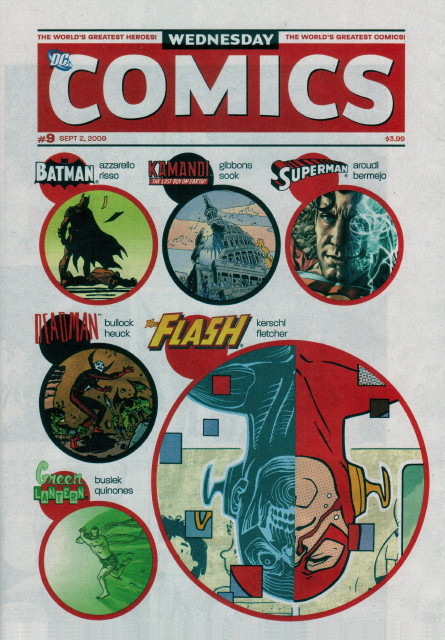
  • Wednesday Comics #9 of 12, by many hands (DC)
  • Immortal Weapons #2 of 5, by Cullen Bunn, Dan Brereton, Tom Palmer, Stefano Gaudiano & Mark Pennington, and Duane Swierczynski & Travel Foreman (Marvel)
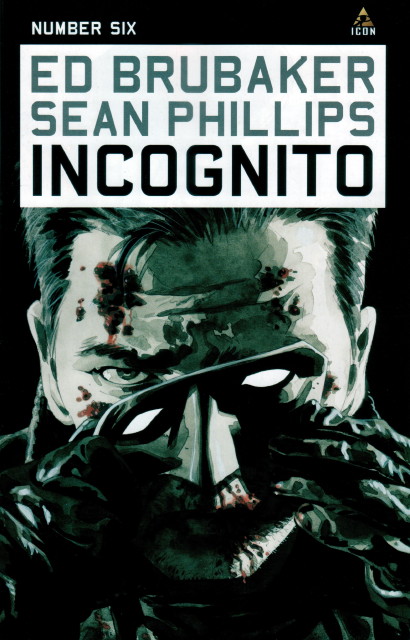
  • Incognito #6 of 6, by Ed Brubaker & Sean Phillips (Marvel/Icon)
  • Irredeemable #6, by Mark Waid & Peter Krause (Boom)
  • Sir Edward Grey: Witchfinder: In The Service of Angels #3 of 5, by Mike Mignola & Ben Stenbeck (Dark Horse)
  • The Boys #34, by Garth Ennis & Carlos Ezquerra (Dynamite)
Wednesday Comics #9 Another week, another Wednesday Comics. Green Lantern, Metamorpho and Strange Adventures all have significant developments, although the Green Lantern one seems too sudden, and I’m having a hard time keeping track of the parties in Strange Adventures (and why do the aliens all look like Baboons?).

I’m still a little baffled by where Flash is going, although this issue has a nifty stylistic gimmick involving comic strips, which I enjoyed.

Three more issues…

Immortal Weapons #2 Immortal Weapons is a 5-issue mini-series bridging the gap while Iron Fist is on hiatus (though whether it actually comes back is still uncertain), each issue spotlighting one of Fist’s fellow superhuman warriors from the mystical cities in the sky. Fist’s own series flagged a little toward the end, but it was generally quite good; Immortal Weapons is just as good, and maybe a little better. The first issue provided the biography of Fat Cobra, whose history didn’t quite match his recollection of it. This second issue focuses on Bride of Nine Spiders, a considerably creepier figure than the gregarious Cobra, and it’s told as a horror story involving one of the Bride’s eight-legged companions, and the fate of several people interested in it. Dan Brereton nails the spooky feel of the story, which would feel perfectly at home in some of the horror stories of the 1970s. Good stuff.

There’s an Iron Fist backup story running through the series, which is a pretty routine piece about the family of one of Fist’s students getting embroiled in a drug-related conflict. I guess it’s marking time for the main character before wherever his series goes next, but the series would be better-served with longer main stories, I think. Nonetheless, if you’ve any interest in Iron Fist at all, I’d suggest giving this series a try.

Incognito #6 Brubaker & Phillips’ Incognito wraps up this week. It started as a pulpy adventure yarn in which Zack Overkill, a former supervillain, was in witness protection after testifying against his boss. The story progressed as Zack learned he could get his powers back, and was conflicted about whether to use his powers for good or for bad. Predictably, eventually everyone interested finds out about him, and he ends up between a rock and a hard place.

But the series seemed a little pedestrian and manipulative – until this issue, when everything is revealed: Who Zack is and what his background is, and it’s, well, not what I was expecting, and made his story much more compelling, enough so that I hope this isn’t the end of Zack’s story, since I’d be happy to read more of it. Oddly, although the text piece Brubaker writes for each issue is titled “The Secret Ingredient is Pulp”, I’d say the secret ingredient is really… secrets. The hard-boiled suspense approach felt slightly out-of-place in Zack’s world, but once the stakes got raised and the surprising and fantastic facts behind Zack’s life were revealed, everything gelled into a much weightier story.

Brubaker and Phillips are going back to their crime series Criminal next, and I’ve caught up on what they’ve done before while Incognito was coming out. (You can do so yourself by reading the trade paperbacks: one, two, three and four.) Overall Criminal is a bit better than Incognito, although I’d say the latter series has a higher ceiling (and arguably they’ve both been lapped by Sleeper). If part of the goal of Incognito was to recruit new readers for Criminal, well their devious plan succeeded, because I’ll be picking up the new series when it shows up.

(Oh yeah, and naturally you’ll be able to read the collection of Incognito when it comes out.)

Long Week

This has been a long week.

It didn’t help that we had another mini-heat wave, or that I had trouble sleeping Thursday and Friday nights, but what really honked me off was another spoke on my bike breaking when I biked to work yesterday. Much ranting on Twitter later, I decided to try a different bike shop to repair the thing. I’ve been breaking a spoke every few hundred miles, and it sounds like I should go thousands of miles between breaks. I dunno if it’s the bike or just poor service from the previous shop, but it was clearly time for a change. So today I took the bike in and got it repaired – same day! So I can bike in to work again next week.

Which is nice because I’ve been making progress losing weight, and I think a lot of it’s because I’ve been rigorous about biking twice a week for most of the summer.

Happily, we’re now into a long weekend, the weather’s cooled off a bit, and my friend Karen’s coming to visit for a couple of days. So it should be a nice break from the daily grind.

This Week’s Haul

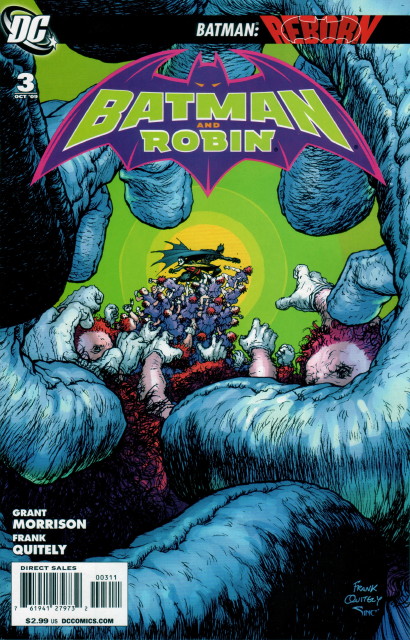
  • Batman & Robin #3, by Grant Morrison & Frank Quitely (DC)
  • The Flash: Rebirth #4 of 5, by Geoff Johns & Ethan Van Scyver (DC)
  • Green Lantern #45, by Geoff Johns, Doug Mahnke & Christian Alamy (DC)
  • Justice Society of America #30, by Bill Willingham, Matthew Sturges & Jesús Merino (DC)
  • Madame Xanadu #14, by Matt Wagner & Michael Wm. Kaluta (DC/Vertigo)
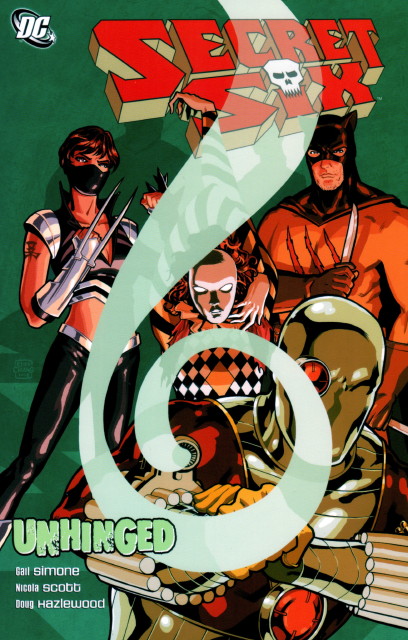
  • Secret Six: Unhinged vol 2 TPB, by Gail Simone, Nicola Scott & Doug Hazlewood (DC)
  • Wednesday Comics #8 of 12, by many hands (DC)
  • Guardians of the Galaxy #17, by Dan Abnett, Andy Lanning, Brad Walker, Victor Olazaba & Scott Hanna (Marvel)
  • The Incredible Hercules #133, by Greg Pak, Fred Van Lente & Rodney Buchemi (Marvel)
  • Nova #28, by Dan Abnett, Andy Lanning & Andrea DiVito (Marvel)
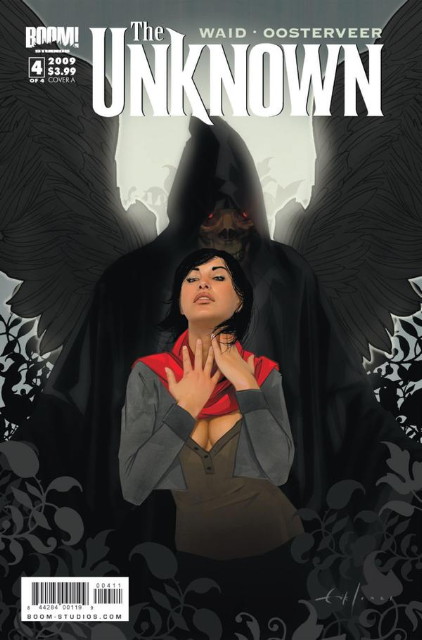
  • The Unknown #4 of 4, by Mark Waid & Minck Oosterveer (Boom)
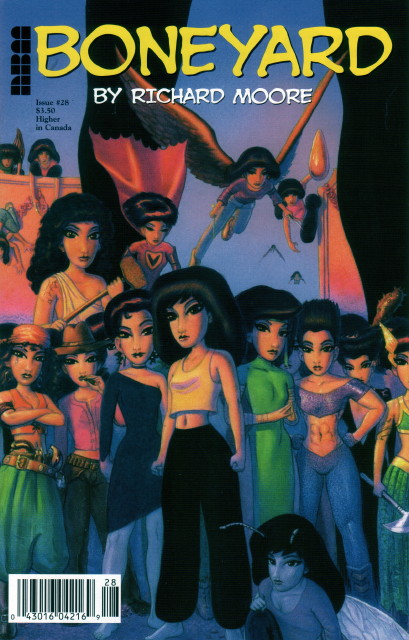
  • Boneyard #28, by Richard Moore (NBM)
Batman and Robin #3 Reading the effusive praise heaped on writer Grant Morrison by folks like Greg Burgas (who calls him the “God of All Comics”) or Chris Sims often makes me blink in surprise. Over his long career, I’ve always seen Morrison as a fine idea man, but only a pretty good writer, with haphazard plotting and characterizations that lean towards being thin and heavy-handed. Many of his stories are very good, but over the last few years his facility as an idea man seems to have declined sharply, and his ability to play out the interesting ideas he does have seems to be dwindling away even faster. In every respect, I’d say Morrison’s been lapped by Warren Ellis at this point. (I’d say Ellis’ peak is higher, too, with Planetary and Transmetropolitan being better than Morrison’s best work, JLA and The Invisibles.)

All of which is a lead-in to my disappointment with Batman and Robin #3, which wraps up the series’ initial story arc in a decidedly unsatisfying manner. The villain, Pyg, has a master plan to extort Gotham City, and he also performs some exotic surgery on his captives by fixing a grotesque read-haired mask over their actual faces and drugs them into becoming his henchmen, a fate which he threatens to inflict on the captured Robin. But Pyg is a nonentity as a villain, just another overstylized grotesque, a less-comprehensible Joker. His plan, such as it is, is explained after he’s been defeated, with little real threat of it ever coming to pass. A circus is involved, for some reason, but as a backdrop it’s irrelevant.

The best part of the series so far has been the two main characters: Dick Grayson is clearly still crushed by the apparent death of Bruce Wayne, and is not entirely comfortable going to the lengths that Wayne would go in pursuit of justice, as you’d expect since Dick was the original happy-go-lucky boy wonder, the counterpoint to the darknight detective. The new Robin is a vicious and opinionated boy who barely has any respect for his mentor, yet who is highly skilled, even if occasionally over his head and lacking in good judgment. Bringing him up should be a real challenge for Dick. Morrison only really brushes the fringe of his characters, suggesting a great deal but leaving it unexplored, being more interested in the mechanics of propelling his plot. I also suspect Bruce Wayne will be back well before the potential of this set-up could be realized even in the hands of a writer more skilled in characterization, so it may end up being a non-starter anyway. Which would be too bad, but that’s life for a comic driven more by marketing and branding than by serving the interests of the story.

I think I’ve gone into Quitely’s art before: I like his approach to drawing figures, the solidity he gives then, but I often find his characters’ faces to be grotesquely ugly (whether or not they’re supposed to be), and the skimpy backgrounds often drives me (uh) batty – it really sucks the life out of the extended fight scene here. I generally find that what I like about Quitely’s artwork I find in a more attractive package in Gary Frank’s work (although Frank also has a problem with a lack of backgrounds).

Batman and Robin is an okay comic. It’s a pretty shallow story, grotesque for no good reason, but with some good character bits. But what it really wants to be – a strong character drama focusing on the title characters – is not Morrison’s forte, and so I think it’s never really going to reach its potential. And the praise I’ve seen it receive seems far out-of-proportion compared to what the series has actually delivered. But, you know, diff’rent strokes.

Secret Six vol 1: Unhinged I’m sure I’ve read something by Gail Simone before, but nothing comes to mind. I haven’t been avoiding her writing, it just seems like she’s largely been working in areas that don’t much interest me. For example, I dropped Birds of Prey around the time she started, because I felt the concept had been largely played out, having drifted considerably from the early issues I enjoyed. And the current Wonder Woman series was a total disaster for its first year and I bailed before she signed on to the title. Her other current series, Secret Six flew under my radar, since it spun out from a spin-off of another stupid DC event series, and the name comes from an old series that I never had much interest in (honestly, I find DC and Marvel’s tendency to reclaim old names for new premises to be rather distasteful; it’s an example of branding at its worst). Nonetheless, the series has been getting good word-of-mouth in the blogosphere, so with a new paperback collection out this week (which turns out to be the second collection, although the first was of a mini-series) I figured I’d give it a try.

The premise is sort of the mercenary version of the Suicide Squad: A bunch of B-grade (and lower) villains work together to make money. Rather than engaging in the traditional criminal activities – knocking over banks, etc. – they’re for hire for shady and difficult jobs. The team is led by Scandal Savage, daughter of the immortal Vandal Savage (and saddled with an unfortunate name), and includes: Rag Doll, eccentric son of the original; Cat Man, a vicious hunter in a garish orange outfit; Deadshot, the psychopathic marksman late of the Suicide Squad; and Bane, the nutjob who once defeated Batman, who’s trying to stay off the drugs that make him immensely powerful, yet also an unreasoning brute. The sixth member of the team apparently died shortly before the volume begins, and they gain a new member for this story.

The story itself has the team head to California to break a woman out of Alcatraz (which in the DC Universe is a prison for superhumans), since she knows where to find a card which holds great and mysterious value to those in the know. A mysterious crime lord named Junior hires every Z-grade villain he can to bring them down and bring the card back to him, so the team has to run a gauntlet to get back to Gotham to get their payoff. But the card itself is only of use to one person at a time, and once they learn what it is, it sets the team at each others’ throats.

With my references to Suicide Squad, it isn’t a surprise that the story feels like it could be a Suicide Squad story, only with selfish rather than nominally noble motivations behind the team’s actions. Both series are marked by the interactions among the strong personalities – with a few weaker personalities thrown in as followers – and with the characters’ loyalties shifting (or seeming to) as they have to make difficult decisions. Their opponent, Junior, is an unusually extreme and grotesque villain, perhaps a little too over-the-top for my tastes, since we don’t really get a good feel for what makes him tick (although there may be clues in the earlier stories that I haven’t read yet). Simone also knows how to write a climax, as the volume ends with a big one with a couple exclamation points at the end.

Nicola Scott’s a solid superhero artist, whose work I haven’t seen before. I like her work here better than Frank Quitely’s in Batman and Robin, for instance, as she has most of his strengths but draws more intricate panels with nicely-rendered backgrounds. Her style is on the generic side, though, not terribly different from artists like Dale Eaglesham or Jesus Merino or Dan Jurgens.

This collection is entertaining enough that I think I’ll try the regular series for a while.

Wednesday Comics #8 This week’s Wednesday Comics round-up: In Metamorpho, Gaiman and Allred are clearly just having fun playing with the graphic construction of the story, as this week the hero and Urania the Element Girl spent a page imitating half of the periodic table of the elements – the other half will be next week. The creators’ contortions to fit into their self-imposed structures is cute, but it doesn’t leave much space for actual story, which means the thing as a whole has been pretty disappointing.

While Flash is overall the most intriguing and entertaining story in the package, I worry that it’s playing around with overlapping timelines a little too much; I’m having a hard time untangling exactly what’s going on. Although at the end of this page, it appears that Flash may be having the same problem, and it’s coming back to bite him, so that may be the point.

Most of the stories should be having their climaxes over the next 2 weeks (with their denouements in the last 2 weeks), which will determine how good the adventure strips like Strange Adventures and Supergirl end up being.

The Unknown #4 Mark Waid’s series The Unknown finishes its first story arc this week, to be continued in a new mini-series next month. The first story involved Catherine Allingham, the world’s greatest detective (a broad premise Waid also played with in his earlier series Ruse) hiring a new assistant, James Doyle (not the Governor of Wisconsin), to whom she reveals that she’s dying of a brain tumor. The pair investigate the theft of a casket which may hold the clue to proving the existence of human souls, and they follow it to a remote castle where they apparently find the door to the afterlife, to which Catherine is strongly attracted, being curious as to what she’s going to face when she dies.

Despite all this neat stuff, the story felt weirdly disjointed and unsatisfying. The mystery of the disappearing casket is resolved off-panel, and it’s not clear to me what happened to Catherine in the final encounter at the doorway: Was her brain tumor cured? Sent into recession? Or does she still just have a little more time left? Strange.

The best parts of the comic were Catherine’s presence as the ultimate representation of rationalism, yet one whose situation makes her attracted to the fantastic, and James’ presence trying to ground her in the real, even though they really do find supernatural phenomena. It’s a dynamic familiar from The X-Files, only James isn’t a skeptic, he’s just firmly grounded in our world and is not so much skeptical of the existence of the fantastic, as suspicious of the motivations behind and goals of those phenomena. Minck Oosterveer’s art is also pretty nifty, sketchy at times but remarkably solid at others, especially the EC-Comics-like creature who haunts Catherine’s visions. I suspect Oosterveer could benefit from a strong inker rather than inking his own work, though.

Waid is usually much stronger in his plotting, and not so fuzzy in his themes, so I wonder whether he’s got some master plan for pulling the pieces together and giving them more emotional resonance, or if this is an experimental series for him. Tthe series is titled The Unknown, so I guess I could see it go either way. I’m certainly interested enough to stick around for a bit, but if it ends up being one enigma after another, then I’m likely to run out of curiosity much as I did with The X-Files.

Boneyard #28 Think some nice thoughts about one of the best independent comics of the decade, whose final issue was published this week. Richard Moore apparently hadn’t intended to end Boneyard with this issue, but I guess it just isn’t selling well enough for him to devote the time to it anymore. The tale of Michael Paris, the graveyard he inherited, and all the spooks and ghouls that live therein has been part comedy, part drama, and part soap opera for some years now, but it’s always been entertaining. I enjoyed it most when it focused on the interplay of the main characters, and thus this final issue wraps up perhaps my least-favorite storyline in the series, Paris trying to save a childhood friend from an unhappy marriage and getting his fat pulled out of the fire by his vampire friend Abby. Not to my mind the most fitting end to the series, although the last couple of pages between Paris and Abby are sweet.

I’d still recommend going out and reading the earlier volumes of the series (start with the first collection and see what you think), but sadly it’s come to a premature end. A real shame.

Webcomics I Read

I love comic strips. The World Wide Web has ushered in a new golden age of comic strips. And not only do many of these strips have great artwork, but they’ve broken free of the bland mediocrity that plagues strips in the newspaper; webcomics have an adventurousness and irreverence that you won’t often find in the paper (well, maybe in Funky Winkerbean).

There are hundreds of Webcomics out there, and I couldn’t possibly read them all – nor would I want to, since many of them are not to my taste. But I read quite a few, and try new ones that look interesting as I discover them. Most strips I read have good otr even great artwork, although a few have such strong writing that it overcomes their artistic deficiencies.

Here are all the Webcomics I’m reading these days, grouped into inadequate yet hopefully-helpful cateories:

Gag-a-Day Strips

The emphasis in these strips is to provide a joke in each episode. Some of them may have an ongoing continuity, but that’s not (to my mind) their main point.

  • Basic Instructions, by Scott Meyer: A very sarcastic strip featuring the artist as protagonist, with faux-realistic illustrations of the characters. The humor’s all in the dialogue, which parodies “how to” and “self help” books by twisting well-meaning advice into silly situations involving snarky people. It took a while for it to grow on me, but some of the strips are hilarious.
  • Comic Critics, by Sean Whitmore & Brandon Harvey: A group of friends who produce a podcast critiquing comic books, it’s sort of a meta comic strip, in that it’s never clear whether their criticisms reflect the opinions of the creators (I’m assuming not), but which presents critiques of real comic books and creators (consequently, non-comics fans might not find it accessible). It has an ongoing continity, but a loose one..
  • Courting Disaster, by Brad Guigar: Guigar is better known for his Evil Inc. daily (see below), but Courting Disaster is a weekly single-panel strip about love, sex and relationships. It’s sarcastic pillories both genders more-or-less equally, but it’s not very deep. On the other hand, how much depth do you expect from a single-panel weekly?
  • Dork Tower, by John Kovalic: Long-running comic satirizing geeks, especially FRPG gaming geeks. It has some ongoing character threads, but for the most part it’s a gag-a-day strip, often with horrible puns. Kovalic’s art is pretty simple, but it’s his writing that makes the strip work.
  • Garfield Minus Garfield, by Jim Davis & Dan Walsh: The minor media phenomenon, Walsh discovered that if he subtracted Garfield from his own strip, then it became a twisted strip about the foibles of Jon Arbuckle, who talks to himself and reacts to nothing. Walsh cheats a little in his doctoring of Jim Davis’ panels, but mostly it’s amusing and clever. Davis approved of the concept and a collection has been published.
  • Inktank, by Barry T. Smith: Smith used to draw several strips, the best-known of which was Angst Technology, the chronicle of a small computer game company. He ended his other strips a few years ago, and eventually started Inktank, which is semi-autobiographical, but features the AT crew. His humor features a lot of sarcasm, which I appreciate, but his art can get a little repetitive at times.
  • The Joy of Tech, by Nitrozac & Snaggy (Liza Schmalcel & Bruce Evans): Technology industry humor, drawn in a retro style, often with a focus on Apple. Very hit-or-miss, but worth following if you follow the tech industry.
  • Last Call, by Megan Steckler: I stumbled across this one back when Steckler was updating it only occasionally, and it focused on the main character, Abby, drinking at the local bar and talking to her imaginary alter ego, Lily, a scantily-clad succubus only she can see. Since she started updating regularly, it often focuses on the relationship between Abby and her husband Beau, who are both geeks. It seems like Steckler intended to make this a bit of a gamer’s comic strip too, as Abby’s background involves working at a game store, but that aspect never really materialized.

    Anyway, it’s quirky and cartoony and irreverent, which explains why I like it, although it’s got more of a ‘home brew’ feel than many of the other strips I read.
  • Penny Arcade, by Jerry Holkins & Mike Krahulik: One of the most successful webcomics ever, Penny Arcade nominally comments on the computer gaming industry through the persons of its creators’ fictional avatars, although with regular forays into other pop culture arenas or into utter nonsense. It can be crude, bloody, and tasteless at times, and there’s rarely anything resembling an ongoing story. Some of the gags are hilarious, but it’s not one of my favorites.
  • PvP, by Scott Kurtz: Arguably the other most successful webcomic ever, it chronicles the lives of employees at a computer gaming magazine company, one of whom is an imaginary troll. Kurtz probably has his finger on the pulse of pop culture as much as any other webcomics artist, with a particular love of 70s television and of comic books of any era. Ridiculous nonsense is frequently the order of the day, but it also has an ongoing storyline. The strip often blurs the line between reality and fantasy. I’m not sure anything sums up the series better than this episode of The Adventures of LOLbat (and you can read the follow-up storyline for more such silliness). Kurtz is also a very talented artist, whose style has developed from stiff and repetitive into one that’s imaginative and flexible (see, for instance, his satire of Watchmen, Ombudsmen). Not everything in PvP works for me, but when it does work, it’s excellent.
  • Sinfest, by Tatsuya Ishida: The third-most-successful webcomics strip? Hard to say, since the author seems to keep his cards close to his chest; maybe the others just get more publicity. Nonetheless, Ishida is a fantastic artist with a twisted sense of humor, which he brings to bear in an ongoing character drama with a dose of current events satire. Strongly reminiscent of the best of Bloom Country (before Bill the Cat showed up), it’s been running for years and is worth reading from the beginning. Start with the collection.
  • XKCD, by Randall Munroe: Über-geeky strip which comments on math, computers, and romance, drawn with stick figures. The James Bond strip or the Mac sudo strip are good examples. Or maybe the regular expressions one. I’m particular partial to the one on getting some perspective. But I think my favorite has to be duty calls.

    Anyway, be sure to mouse over the image to see the tooltip for an extra punchline.

Humorous Adventure

Ongoing adventure strips with a strong humor component.

  • Evil Inc, by Brad Guigar: Guigar’s main strip, about supervillains running a corporation to, well, support supervillains. With a large cast, often-complex story arcs, it’s one of the more ambitious comics out there. Guigar’s got a cartoony style that translates very well to superheroics. The humor is frequently broad, with sight gags, character-based humor, and puns. Worth reading from the beginning – it’ll take you a while! Alternately, you can buy the collections (four published to date), which tell the story reformatted for a full-page format. (The original strips are better, though.)
  • Girl Genius, by Phil & Kaja Foglio: To be over-the-top about it, Girl Genius is the sine qua non of webcomics. To come clean I’ve been a huge fan of Phil Foglio’s writing and art for 30 years now, and I own nearly everything he’s published that I can get my hands on (most of it in hardcover). His work has been hilariously funny, devilishly inventive, utterly irreverent, and creatively and maniacally drawn.

    Girl Genius adds into this mix a complicated backstory (mad scientists co-opt the industrial revolution, and our heroine is the lost daughter of two of the greatest mad scientist heroes of the recent war), a huge cast, politics, romance, and period attire. While some of the manic energy doesn’t make the transition to this long-form story, and there are sequences that drag at times, it’s still an hugely satisfying ongoing adventure story, with laughs and drama and excitement. Updated 3 times a week, no one else does webcomics better.
  • Rocket Road Trip, by Shawn Boyles & Isaac Stewart: I just discovered this strip this week; it’s the charming story of a semi-competent monster hunter, his disfunctional family, and the monsters he hunts. It’s sort of like PVP crossed with an especially demented Calvin & Hobbes. A relatively new strip, it’s pretty funny.
  • Sidekick Girl, by Laura Cascos & Erika Wagner: I stumbled on this a few months ago and laughed my ass off. Sidekick Girl is Val, a woman who was rejected as a superhero (despite some pretty potent abilities) because she, uh, couldn’t pass the physical. She was assigned as a sidekick to Illumina, who could pass the physical, but whose lights aren’t turned up all the way in her attic. Val doesn’t wear a costume and carries a baseball bat. It’s a fine satire of superhero comics, and a must-read for any fan of the genre. Unfortunately the current story involves virtual reality D&D, but hopefully it’ll get back to its roots soon.
  • Wapsi Square, by Paul Taylor: Wapsi Square has been two rather different comic strips since it launched in 2001. The first few years it was a slice-of-life strip centered around Monica, a young anthropologist, and her eccentric gang of friends. But a few years ago it changed into a light adventure strip in which Monica learns that she and her friends need to figure out how to stop the world from ending in 2012 at the end of the current Mayan calendar. The strip has several supernatural elements (spirits, a minor deity, a sphinx, teleportation, prophecy) and the character interplay has decreased significantly.

    Overall I enjoyed the sillier, more character-driven strips of the earlier days – I think my favorite sequence is when Monica buys a new bicycle – which is surprising considering how plot-oriented I tend to be. But the more recent strips are not as funny, and I have a hard time following (or, really, caring to follow) the ins and outs of the plan to keep the world from ending. It’s a more sophisticated strip, but I don’t think it’s as much fun.

    Taylor’s artwork has also changed a lot over the years. The earliest strips are much less polished, but the most recent strips feel almost too polished, and something about the way he draws faces changed so that the characters today look a bit too artificial. Compare, for instance, this early strip (which is still quite well-drawn – look at the backgrounds), to this strip from a few years later, to this recent strip. I think the middle one is the best of the three, and I tend to prefer the more organic style of the earlier strip over the precise look of the later strip, in which the characters look a little creepy.

    So although I was very enthusastic about Wapsi Square when I first discovered it and started reading the archives from the beginning, the more recent strips just don’t excite me as much. I’d like Taylor to find a happy medium between the complex ongoing plot and the more freewheeling style of the earlier strips.

  • Plan B, by Mitz: I discovered this recently when looking at Chris Sim’s Woman of A.C.T.I.O.N., and loved it immediately. The main character is a supervillain, Veronica (her name and her code-name) who learned she was married to a super-hero, and who turned to a life of crime when their marriage broke up. The details are still being revealed. Veronica is twisted but very self-aware, and also pretty grumpy and nasty, so we see the usual superhero fights and schemes from the villain’s side, although she’s not your usual villain. Despite being a comical deconstruction of the superhero genre, there’s a heavy dose of violence and innuendo in the strip, giving it a sharp edge. It’s sort of the evil version of Sidekick Girl, and really just as good.

Serious Adventure

The hard stuff: Funny occasionally, but these are strips with serious ongoing stories.

  • Afterstrife, by Ali Graham: Megan and Stitch are two young people who pass away and find themselves in a purgatory-like afterlife. Their souls are linked somehow, and so they’re stuck with each other even though they don’t really like each other, but they have to work off their karmic debts in order to move on, and some of the rulers of this afterlife don’t want them to get away. It’s pretty serious and often tense and suspenseful, and Graham does a good job keeping my interest. Graham’s art is inventive but his figures and faces aren’t as dynamic or expressive as some other artists. It seems to be nearing a climax lately.
  • Danielle Dark, by Jay Bradley: A full-page weekly, the heroine is a vampire who was turned in the 19th century, and who moves from place to place since she doesn’t age. Despite this, it’s sort of a “young adult sitcom” with vaguely threatening overtones, with Danielle recently falling for one of her victims – who also happens to be in the witness protection program. Bradley has a nice clean style, although his facial expressions get very exaggerated at times. Early in the strip he endowed Danielle with big boobs, because they attract more prey that way, you see (and readers too, presumably).
  • FreakAngels, by Warren Ellis & Paul Duffield: Comics writer Ellis is the brains behind this weekly post-apocalyptic strip in which a group of telepaths accidentally cause the end of the world, and then set out (well, most of them) to rebuild a pocket of civilization in Whitechapel, London. They don’t really all like each other, but mostly work together towards a common cause. Naturally, the world (what remains of it) is both hostile towards and jealous of them and what they’ve built, so there are threats from every corner, including from within. The first two chapters (try the trade paperbacks) take place over just two days, so this strip could go on for quite a while. Who knows?

    Duffield has a distinctive, clean, style, with a strong sense of place and architecture, and the art is lovingly colored. He really brings the future Whitechapel to life. How he hasn’t gotten a high-profile gig at a major comics publisher, I have no idea.
  • Gunnerkrigg Court, by Tom Siddell: I’ve written before about this excellent comic, chronicling the adventures of the young Antimony Carver at the otherworldly school of Gunnerkrigg Court. It’s one of the very best out there, just a smidge below Girl Genius. Not to be missed. You can also buy the collection.

Soap Opera/Slice of Life

A little bit of everything: Humor, drama, ongoing stories, but mainly tracking the stories of their characters and their relationships.

  • Girls With Slingshots, by Danielle Corsetto: The daily adventuresof two quirky women, and their friendships and relationships. Often rather explicit in its content, it’s also silly and sarcastic. Corsetto has an attractive cartoony style with characters who look very different from one another. Probably my second-favorite strip in this category, behind…
  • Questionable Content, by Jeph Jacques: My first close encounter with soap opera webcomics, and it’s probably the best of them. It follows the lives of a group of friends living in western Massachusetts (near “Smif” college), and despite running for years, the in-strip continuity has lasted less than a year so far. The main characters are the shy Marten and the overbearing Faye, who become roommates early on. Significant characters include Marten’s girlfriend and Faye’s boss, Dora; Marten’s anthropomorphic PC Pintsize; and Hannelore, who has extreme OCD. The strips vary between charming and sarcastic, but are often frickin’ hilarious. Jacques isn’t the best artist on the Web, but he’s good enough for his subject matter, and most importantly does a fine job with expressions and body language, which is what the strip demands.
  • Least I Could Do, by Ryan Sohmer & Lar deSouza: I just started reading this one, but it’s been running for a while. It seems to be the daily adventures of self-centered and promiscuous Rayne and his cast of characters. Its earnestness takes some of the edge off its slightly distasteful protagonist, but it hasn’t won me over yet.
  • Sweet Fat Life, by Lauren & Genny: I came across this recently and other than being somewhat focused on its two protagonists being large women, it feels a lot like a slightly wonkier Girls With Slingshots. Updating has been erratic since I started reading it, and the archives are something of a grab-bag, but if it can get on a regular schedule and establish an ongoing continuity, it could develop into a good one.

I don’t have any particular approach to discovering new webcomics. Going through Comixpedia systematically seems like a way to spend a lot of time while only finding a couple of strips I want to read. I actually check out some of the strips that advertise through Project Wonderful which appears on the front pages of Wapsi Square and Girls With Slingshots, although few of them have seemed like my cup of tea. But it’s not like I have a shortage of strips to read.

What’s good out there that I ought to be reading?

My Green Thumb Turns Brown

Since I moved in to my house, I’ve planted a garden every year. Some years are better than others, and I always have a few mishaps: Some flowers die, and I’ve never been able to successfully grow peppers. But usually we get some pretty flowers and a whole bunch of tomatoes and some cucumbers out of it.

But this year has just been one mishap after another.

Since we were debating how to go about treating our building for termites, I held off planting because my garden planter is up against the building, and would have to be included in the tenting, which would likely kill all the plants. Once that was resolved, I planted some marigolds, a gerbera daisy, and a pair of cherry tomato plants. I also planted my usual assortment of herbs.

Well, the marigolds and daisy have all done really well (except for one marigold plant that didn’t quite make it), but the tomato plants have had a rough time of it. We’ve got some field mice in the yard this year which I suspect have been taking the green tomato fruits (and also licking the grease from the grease trap in the grill – ew). I finally put some netting over the plants, and that seemed to help, but one of the plants has had one of its stalks die, and the rest of it doesn’t seem to be in great shape either. So rather than having a boatload of tomatoes, we might only get a handful this year.

On top of that, the basil plants have not been doing so great, even though I bought a large pot for them this year. Usually they last until the frost sets in, but two of the three plants are looking pretty sickly, and I don’t know why. (The third one is newer than the first two, so maybe the first two were just from a bad batch?).

It’s kind of a bummer overall. We also have some squirrels who like to chew on the bark of the trees over my patio (I’ve seen them do this), which kills the branch they chew on, which means extra dead leaves in the yard in the middle of summer. Annoying. On the other hand, this gives me some incentive to prune the trees back a bit, which they usually need anyway. (Some of the dead limbs are too high for me to reach, though, even with my 20-foot extension pruner.)

On the bright side, the flowers I planted on the upstairs porch have been doing well this year, and we have some holdovers from last year that are still kicking as well. So I don’t feel like a total failure!

I’m gonna miss having the tomatoes, though.

It’s The Little Things

Guess I haven’t really been in a journalling mood lately, as all I’ve been good for are comic book posts. So to keep you in the loop, here’s all the little stuff that’s been keeping me busy when I haven’t been reading (or writing about) comics:

The biggest little news is that we’ve gone out to look at houses a couple of times in the past month. I’ve been in my house since 2001, and Debbi moved in in 2005, and it’s getting a little tight. Plus Debbi loves to look at houses. So we’ve hit about 10 open houses, even though I’m not ready to buy a new house this year. We saw a couple of houses we liked, one of which Debbi seemed to really like. We also saw a bunch of pretty mediocre houses, usually small houses which were awkwardly remodeled and/or expanded by their owners, and it didn’t work very well. It would be nice to find a house next year that we could buy, although I’m not looking forward to going through the effort of selling the current place!

We’ve been visiting with our friends. One set of friends is remodeling their house, although they’ve had a heck of a time getting the plans approved by their city. Another set of friends have infant twins, and we’ve visited them, and then gone out to lunch with them. I gotta say they seem like just about the most well-organized parents I’ve ever seen; or maybe having twins just left them without any effort to stress out about things. And we had other friends over for dinner one evening and I played with their almost-2-year-old daughter for over an hour.

I’ve been on a minor cleaning kick. I’ve been organizing my Magic cards, and then this weekend I went through all my old science fiction magazines and threw most of them out. Indeed, I went through my considerable backlog of SF magazines I haven’t read yet and declared ‘bankrupcy’ on most of them, tossing them out too, once I admitted to myself that I just wasn’t going to get to them. I marked a few stories in about a half-dozen issues to read in the near future, but that’s it. That’s a heck of a lot of paper out to the recycle bins.

I cleaned and lubed my bike chain which happily fixed the squeaking sound I was getting when pedaling, which made me very happy. I’m still biking to work twice a week, which is getting nicer as we head into cooler weather (although, honestly, it’s been a cool summer). This would sound more impressive if I didn’t have cow-orkers who were biking in 4-5 times a week (although in my defense I think I have a longer ride than most of them).

I finished China Miéville’s The Scar, which was okay, although quite long and the early parts dragged quite a bit. The second half picked up and was pretty rewarding, though. Overall I think I like the idea of (and ideas in) Miéville’s books more than the books themselves.

And of course I’ve been reading all those comic books. And playing Magic. And occasionally poker. And I plan to go to boardgaming at Subrata’s tomorrow night for the first time in a while.

No wonder I’ve felt so busy lately!

This Week’s Haul

A couple of hardcover collections this week: Avengers Forever will shelve nicely next to the other collections of Kurt Busiek’s excellent Avengers run from a decade ago (although it’s not as good as the main title was, being largely of interest only to longtime Avengers wonks like myself), while Spider-Man Masterworks continues the silver age reprints of the wall-crawler, which still hold up pretty well today.

Meanwhile, on a technical note, I’ve finally switched away from ImageManager to manage images in my WordPress install, and I’ve moved to the native image management support with Scissors for some additional functionality. So far it seems to provide exactly the same look, which makes me happy; the transition ended up being really easy.

Anyway, on with the haul:

  • The Brave and the Bold #26, by John Rozum & Scott Hampton (DC)
  • Ex Machina #44, by Brian K. Vaughan & Tony Harris (DC/Wildstorm)
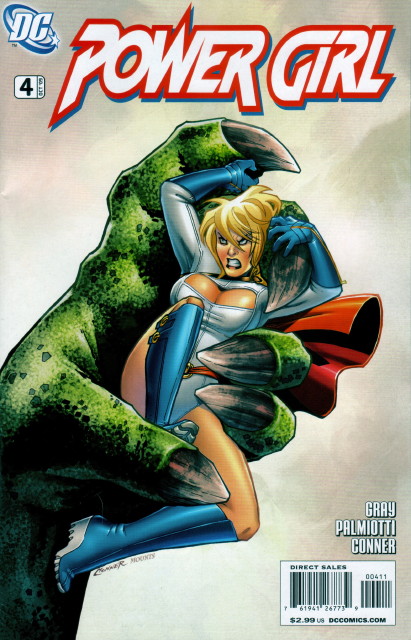
  • Power Girl #4, by Justin Gray, Jimmy Palmiotti & Amanda Conner (DC)
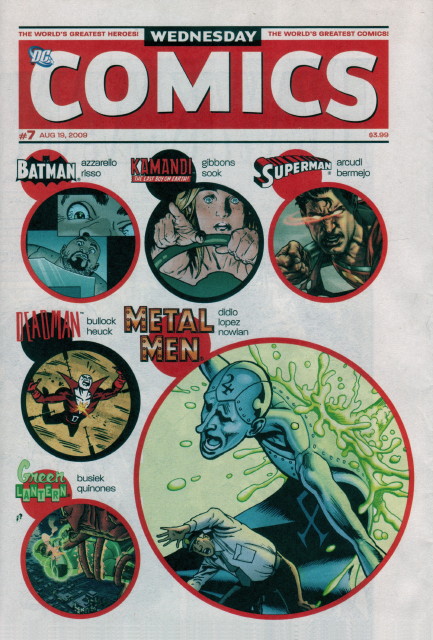
  • Wednesday Comics #7, by many hands (DC)
  • Avengers Forever HC, by Kurt Busiek, Roger Stern, Carlos Pacheco & Jesús Merino (Marvel)
  • Marvel Masterworks: The Amazing Spider-Man HC vol 122, collecting The Amazing Spider-Man #100-109, by Stan Lee, Roy Thomas, Gil Kane, John Romita & Frank Giacoia (Marvel)
  • Unthinkable #4 of 5, by Mark Sable & Julian Totino Tedesco (Boom)
  • Invincible #65, by Robert Kitkman & Ryan Ottley (Image)
  • Atomic Robo: Shadow From Beyond Time #4 of 5, by Brian Clevinger, Scott Wegener & Rick Woodall (Red 5)
Power Girl #4 Bwah-hah-hah! I was chuckling through the first half of Power Girl #4, which retreats completely from the big “let’s fight the Ultra-Humanite – again” story of the first three issues, and instead gets down to Power Girl’s personal life. Power Girl takes Terra out to see a horror movie (which PG loves but Terra hates), and PG gets hit on by a character from a TV show I don’t watch. Then they have to head out to deal with an emergency, and Terra totally doesn’t get the idea of bringing her costume with her, so she heads out to fight in her regular clothes. The villain (a young woman on an excessive environmental kick and who has magical powers) refers to PG as “busty airborne lass”, and gets taken down because she’s basically too ridiculous to win against two actual heroes.

(The one awkward thing in all this, as Greg Burgas noted, is that Terra strips down to her panties to head off to fight the monsters. While one could rationalize this by Terra not really being modest due to her backstory, or taking off her pants because her costume doesn’t have legs, it’s frankly a joke that falls flat because it feels creepy. Given that the tone of the comic is light and jokey, not all the gags are going to work, but I think the editor should have talked them down from this one.)

The second half of the story focuses on PG trying to adjust to life running her new company, and finding a new apartment. It’s fairly routine soap opera stuff, but honestly, superhero comics can use some fairly routine soap opera stuff. It shouldn’t be all about the fighting, it should be about the characters. Treating PG as a real character and not just someone who goes out and punches villains is the best way to set this comic apart from all the other superhero comics out there. I’d like to think there’s space for such a comic on the shelves today, especially with Amanda Conner illustrating it.

The one sour note aside, this issue is basically what the first issue should have been, and it’s raised my enthusiasm for the series 100%. Fun stuff.

Wednesday Comics #7 We’re over the hump in Wednesday Comics this week, so the stories should be well into their second acts, with their climaxes not far off.

Doctor Fate shows up in Strange Adventures to help Adam Strange figure out how to get back to Rann. Even though I’m not a huge Paul Pope fan, I would totally buy a Paul Pope Doctor Fate comic, especially if he can write it without having to fit it into established continuity. Heck, set it in the 1940s, that would be cool!

The writing on Hawkman just gets worse and worse and worse. Who greenlighted this? I can’t figure out how the story could start with an alien invasion, end up on an island of dinosaurs, and possibly make any sense at all when it reaches the end. What’s the point?

Recent developments in both Metamorpho and Deadman are interesting, but neither one has really distinguished itself. Though both are quirkier, neither is really any better than Metal Men, which is a pretty generic strip but is enjoyable enough.

I’m perplexed by the fact that Green Lantern is written by Kurt Busiek, since it has none of the depth of characterization which is his signature. The first half was downright boring, and now that the fighting’s started, it doesn’t look like it’ll get any better.

The “big three” strips are all poor: I’m not reading Wonder Woman at all, Superman is just awful in story and artwork. Batman has little snatches of decent stuff, but it doesn’t hold together as a story, and what story there is isn’t interesting.

Flash is still the best strip in the book, but Supergirl has been looking up recently, and Strange Adventures is in that ballpark too, after a shaky start. J.D. loves Kamandi, and I think Ryan Sook’s artwork is terrific, the story is just too routine for me to care (but boy, the artwork really is gorgeous).