This Week’s Haul

Two weeks worth of books this time, since I didn’t get around to doing an entry last week before heading to Disneyland for the weekend.

Last Week:

  • The Marvels Project #4 of 8, by Ed Brubaker & Steve Epting (Marvel)
  • Nova #32, by Dan Abnett, Andy Lanning & Andrea DiVito (Marvel)
  • Echo #17, by Terry Moore (Abstract)
  • The Secret History #7 of 7, by Jean-Pierre Pécau & Igor Kordey (Archaia)
  • Absolution #4 of 6, by Christos Gage & Roberto Viacava (Avatar)
  • The Boys #37, by Garth Ennis & Darick Robertson (Dynamite)

I skipped JSA: All-Stars, not just because I didn’t really care about following “Power Girl and the third-stringers”, but because the artwork looked pretty awful. I’ll stick with the team which at least has a few of the classic members, thanks.

This Week:

  • Booster Gold #27, by Dan Jurgens, Mike Norton & Norm Rapmund (DC)
  • Doom Patrol #5, by Keith Giffen, Justiniano & Livesay, and J.M. DeMatteis, Tim Levins & Dan Davis (DC)
  • R.E.B.E.L.S. #11, by Tony Bedard, Claude St. Aubin & Scott Hanna (DC)
  • Secret Six #16, by Gail Simone, Peter Nguyen, Doug Hazlewood & Mark McKenna (DC)
  • The Unwritten #8, by Mike Carey & Peter Gross (DC/Vertigo)
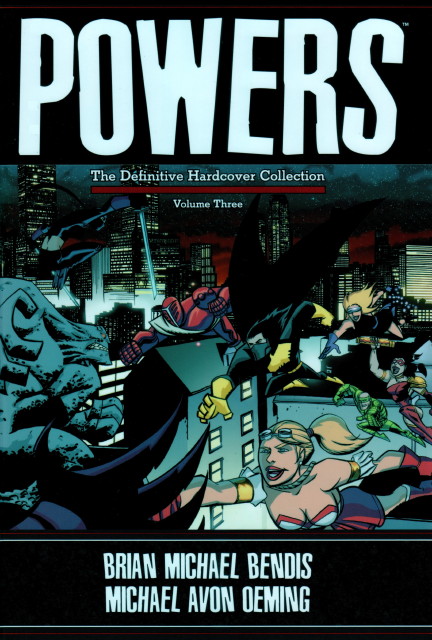
  • Powers: The Definitive Hardcover Collection vol 3, by Brian Michael Bendis & Michael Avon Oeming (Marvel/Icon)
  • B.P.R.D.: War on Frogs #4, by John Arcudi & Peter Snejbjerg (Dark Horse)
  • Phonogram: The Singles Club #6 of 7, by Keiron Gillen & Jamie McKelvie, and P.J. Holden & Adam Cadwell (Image)
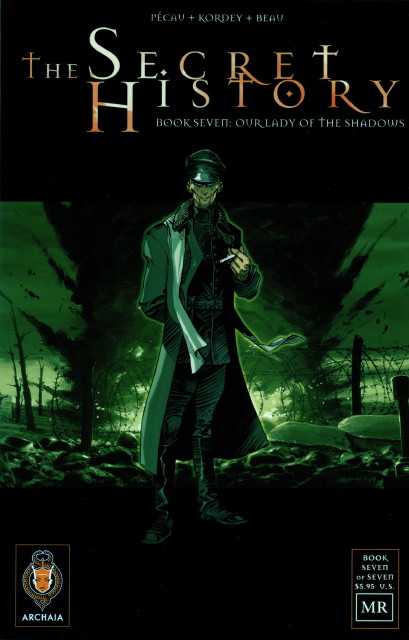
The Secret History book 7 I started picking up The Secret History back before I knew it was a translation of a European comic that Archaia was printing. It got off to a pretty good start, though (albeit way back in 2007). As the title says, the story is a shadow history in which four individuals gain immortality and great powers through runestones they acquire early in humanity’s history, and they use it to influence events over the centuries, eventually warring against each other, forming and breaking alliances, and often using catspaws to do their work.

The early issues held together pretty well, but as the series progressed the overall story became very hard to follow, and even single issues were pretty confusing in terms of figuring out who’s who and what they’re up to and why. Greg Burgas has the series sized up well, as at the end of this 7-issue series the story isn’t over. It ends abruptly, actually on something of a cliffhanger, at the end of World War I. That left me wondering why I’d bothered; there wasn’t a big finish, and I just felt like I didn’t care about any of the characters by the end – I could barely tell who they were!

The art is often quite good, but it’s not enough to make up for the story. I can’t fault author Pécau for the ambitious plot, but the execution just didn’t work for me. Even if there is a follow-up series (and I haven’t heard of one), I’m not interested enough to follow it.

Doom Patrol #5

R.E.B.E.L.S. #11

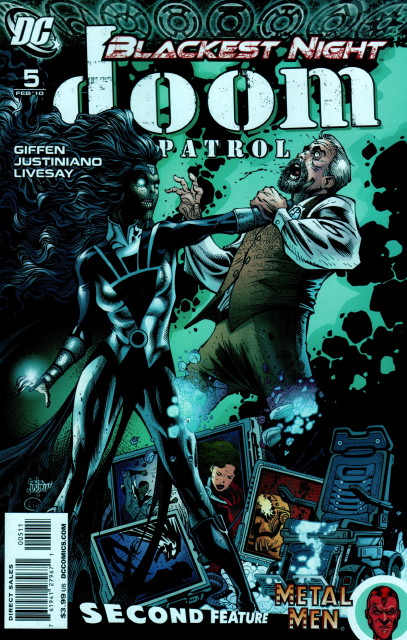
I decided to pick up this month’s Doom Patrol and R.E.B.E.L.S. to see how the Blackest Night tie-in stories begun last week shake out. The answer is: Not so well, as both are essentially big slugfests against overwhelming odds, with the heroes more-or-less cheating their way to victory. Heck, they even find the exact same resolution to their dilemma in each case! Disappointing. The most interesting element of either series – Vril Dox acquiring a Sinestro Corps ring – is discarded at the end of the R.E.B.E.L.S. issue, too. Oh well.

I’m not interested enough in either Adventure Comics or Justice League to even pick up the second part of those tie-in stories. (If Adventure had had a Legion of Super-Heroes back-up in the second part, I might have given in. But instead it has Superboy-Prime – whom I hate, as I’ve said before – in the lead story, and the Connor Kent Superboy in the backup. Whatever.)

Considering Blackest Night presented some of these series with excellent opportunities to convince new readers like me that they were worth following, it’s pretty lame that they all did such a bad job in doing so, focusing instead on the Blackest Night story arc rather than trying to sell themselves on their merits. I assume this is just a total editorial misfire, although Booster Gold does a better job than the others of presenting its merits within its own Blackest Night tie-in. Then again, I already read Booster Gold regularly.

Powers: The Definitive Hardcover Collection vol 3 The third hardcover collection of Powers is out this week, and in my opinion it contains the two best stories of this excellent series: “The Sellouts” focuses on a Justice League-like team which went commercial, and then (unofficially) broke up. When the Batman-like member is killed (on camera, his killer not appearing on the tape), detectives Walker and Pilgrim investigate, and air all the dirty laundry the team’s kept under wraps for years. Rather to the displeasure of some members of the team. For what starts as a rather routine detective story for this series, it takes a sharp turn at the end which makes it both a very different story, and one which fundamentally changes the nature of the Powers world (setting up the next series, to some extent).

“Forever” is the other arc in the volume, and it was in a way an epilogue to the first Powers series, but it’s also a crucial piece in the overall story: It fills out the background of Detective Christian Walker, who it turns out is more than merely a de-powered superhero who became a cop. But there hadn’t been much sign of this until this story. In other circumstances, that might sound unsatisfying, but Bendis uses the premise to craft an a story which both defines the nature of superheroes in the Powers universe, and to make Walker a more significant and more tragic figure than he’d been before.

While Powers is best read from the beginning, you can read this volume on its own if you’d like to try it by starting with the very best the series has to offer. In any event, with the third Powers series having started a few weeks ago, this is a good point to catch up on what’s happened before so you can fully enjoy the new one.

The 5 Stages of Internet Friendship

  1. You quietly follow their blog and/or Twitter feed (also known as lurking).
  2. You comment on their blog or respond to their tweets.
  3. You exchange e-mail with them.
  4. You friend them on Facebook.
  5. You add them to your instant messaging buddy list.

Things were a little different back in 1990, when I was new to the net:

  1. You read their posts on USENET.
  2. You send them e-mail about their posts.
  3. You publicly respond to their posts.
  4. You chat with them using talk, BITnet Relay, or perhaps IRC.
  5. You talk with them on the phone or meet them in person.

Thank goodness today we have enough social networking technology to avoid that last step! Hooray for progress, eh?

Chilly Weekend at the Magic Kingdom

We’re back from our annual Christmas trip to Disneyland, with various friends. We had nice weather for the first two days (Saturday night and Sunday), albeit a bit chilly, and then Monday the rains moved in and we spent the day bundled up under ponchos. The rain tapered off around 3 pm, and we managed to hit all our favorite rides at least twice over the trip, so it all worked out. We also had two nice meals, at the Blue Bayou restaurant in Disneyland, and at Steakhouse 55 at the Disneyland hotel, both a cut (or three) above the typical park fare.

They haven’t yet started the major renovations on the California Adventure park, which will change it from a general California theme park to one emphasizing early 20th century Los Angeles, when Walt Disney first moved to the state. (They’ll be tearing down the Golden Gate Bridge, for instance.) That will be a sad time.

The trip home was delayed a bit by the bad weather closing the Grapevine, the stretch of I-5 north of LA, for 17 hours overnight. We got to the foothills at the tail end of the shutdown and got stuck for 45 minutes, but that’s not bad, considering. We arrived home to unseasonably cold weather (apparently it didn’t break 50 today) and some kitties who were very happy to see us.

Jefferson seems to be just fine, 10 days after his dental surgery. He was scheduled for his follow-up appointment tomorrow morning, but the vet left a message that his doctor got summoned to jury duty, so I’ll have to reschedule.

That hiccup aside, tomorrow it’s back to the grind: Morning coffee, getting caught up on work after two days away, and comic books in the evening. And getting into the swing of the holidays, with putting up the tree and outside lights this weekend. Not much to complain about, really.

Regarding “Against Camel Case”

Caleb Crain’s article “Against Camel Case” in the New York Times is part informative historical information, and part silly exhortation. And through it all he doesn’t address the most important issue, that being, shouldn’t it be spelled “CamelCase”?

Actually, what I think he misses is the more interesting issue, which is that while the advent of writing initially helped to “fix” language so that it evolved somewhat more slowly (well, English, anyway), the greater use of writing for a wider variety of communication has cause the written form of the language to evolve rapidly and in unpredictable ways: The ubiquity of acronyms (LOL, WTF, IMHO and their brethren), which evolved (sort of) into L33Tspeak and text message lingo (which seems closely related in spirit, if not in derivation), which has started creeping out of the Internet and into student papers and such.

Language evolves. These things happen. I’m as pedantic as the next guy (probably much more pedantic than the next guy) about using correct grammar and spelling (typos and my meandering run-on sentences notwithstanding), but arguing for uniformity seems hopeless at best, senseless at worst. Set against some of the linguistic developments of the Internet age, camel case seems relatively innocuous.

Crain’s historical notes on the subtraction and later restoration of spaces in Latin is fascinating (separation of words by spaces was dropped completely? Wow), but I think he’s missing the forest for the trees: It’s pretty drastic to drop what is the functional demarcation between units, but not nearly as much so to drop a demarcation within a unit. “Bank of America” doesn’t mean “this is the bank of the entire nation” (there are, after all, other banks), but rather “this is a bank whose unique name is ‘Bank of America'”. That’s probably not that BofA wants their name to mean, but in practice that’s what people use the name to mean. And I expect that BofA recognized this when they changed their name (if only temporarily) to “BankAmerica”. (They might also have wanted to avoid people accidentally abbreviating their name with a term that could be pronounced ‘boh-fah’, though I have always heard people pronounce it as ‘bee-of-ay’.) The whole term is a unit, and the spacing is almost irrelevant.

Camel case is currently used in terms intended to sound trendy or cool (or that’s how I interpret it, anyway). Obviously, YMMV as to whether it sounds that way, but the intent, I think, is to convey that little extra emphasis. (Whether or not camel case is appropriate for a given company or product is another matter.) But I hardly think the loss of a few spaces is worth much fuss. At best, it might be grounds for a slippery slope argument, and we all know how much those are worth. It seems more likely that camel case is just one of Crain’s pet peeves.

The evolution of language is a fascinating thing, and it’s going to happen whether we want it to or not, and probably in ways we can’t anticipate. It’s just one more way the information era is changing and challenging the nature of our lives and our world.

This Week’s Haul

In addition to the usual comics, this week fans of superhero noir can buy the collected Incognito by Brubaker & Phillips, and fans of Alan Moore can pick up the second volume of Saga of the Swamp Thing in hardcover (containing perhaps the single best issue of that series, when Swampy descends into hell to rescue his love’s soul). Both recommended.

  • Blackest Night #5 of 8, by Geoff Johns, Ivan Reis & Oclair Albert (DC)
  • Green Lantern #48, by Geoff Johns, Doug Mahnke, Christian Alamy & Tom Nguyen (DC)
  • Justice League of America #39, by James Robinson, Mark Bagley & Rob Hunter (DC)
  • Justice Society of America #33, by Bill Willingham, Matthew Sturges & Jesus Merino (DC)
  • Madame Xanadu #17, by Matt Wagner, Amy Reeder Hadley & Richard Friend (DC/Vertigo)
  • Saga of the Swamp Thing book two HC, by Alan Moore, Stephen Bissette & John Totleben, with Shawn McManus, Ron Randall, Bernie Wrightson, Rick Veitch & Alfredo Alcala (DC)
  • Fantastic Four #573, by Jonathan Hickman, Neil Edwards & Andrew Currie (Marvel)
  • Guardians of the Galaxy #20, by Dan Abnett, Andy Lanning, Brad Walker & Victor Olazaba (Marvel)
  • The Incredible Hercules #138, by Greg Pak, Fred Van Lente & Rodney Buchemi (Marvel)
  • Immortal Weapons #5 of 5, by David Lapham & Arturo Lozzi, and Duane Swierczynski & Hatuey Diaz (Marvel)
  • Criminal: The Sinners #2, by Ed Brubaker & Sean Phillips (Marvel/Icon)
  • Incognito TPB, by Ed Brubaker & Sean Phillips (Marvel/Icon)
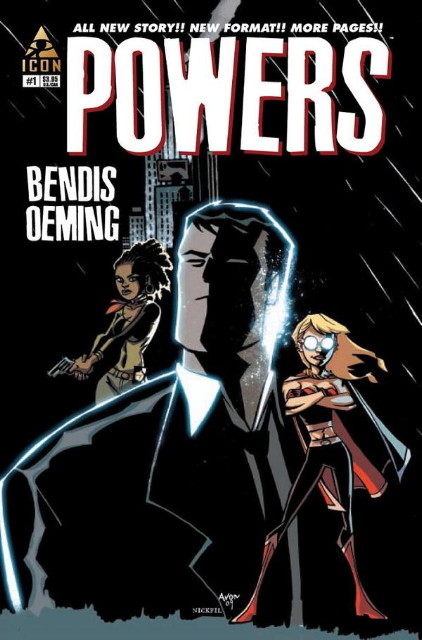
  • Powers volume 3 #1, by Brian Michael Bendis & Michael Avon Oeming (Marvel/Icon)
Justice League of America #39 This is the last week for the Blackest Night ring-giveaway tie-ins, and the last comic I’ve picked up for it that I don’t regularly buy is Justice League of America. This series was launched after the cancellation of JLA (the one best known for Grant Morrison’s run, but which ran for another 6 years or so after he left), and has been rather controversial due to musical writers, and more-provocative-than-usual drawings of the heroines (you’d think this wouldn’t be a big surprise, but apparently it was pretty bad). The current creative team consister of Mark Bagley, one of the fastest artists in the business and in some ways a throwback to the superhero artists of yesteryear, and James Robinson, best known for his great Starman series of the 90s, but who has himself been generating some controversy in his Justice League: Cry For Justice mini-series. This, along with a rotating cast, has kept me far, far away from the JLA in recent years.

This Blackest Night issue is a horrible introduction to the series for new readers coming in via the tie-in. It focuses on a group of third-string Leaguers (Red Tornado – the original third-stringer, Plastic Man, Gypsy, Vixen, Dr. Light and Zatanna) entering the decimated Hall of Justice (yes, the JLA is now headquartered in the building from the Super Friends TV series; gah), and facing the zombie villains and heroes who were entombed in the basement of the JLA’s headquarters. Zatanna’s father Zatara is among the zombies, as is Vibe, the much-loathed member of “Justice League Detroit” from the 80s. It’s all a big fight against insurmountable odds in a shadowy setting, and as such seems completely meaningless.

This may be the worst Blackest Night tie-in I’ve read, as it reduces the series – whose premise got tiresome pretty quickly anyway – to its lowest common denominator. Bagley’s art is okay, although his style has veered towards being more cartoony than I prefer. But certainly this doesn’t give me any reason to keep reading the series after this issue. Awful.

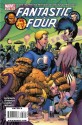
Fantastic Four #573 Mark Millar and Bryan Hitch’s run on Fantastic Four seemed to be largely overlooked critically, and didn’t really help the sales of the series. But for all that Millar is a big-name comics writer (even though his writing is 180 degrees away from what I enjoy), it’s been his successor, Jonathan Hickman, whose run – now all of 4 issues old – has been getting the word of mouth. Indeed, when I decided a couple of weeks ago to check it out, I found his first two issues, but his third issue was sold out at my usual store, and at the next store I went to, and had only one copy remaining at the third store. Honestly I’d never even heard of Hickman before, but that’s not necessarily a bad thing.

In the text page of last month’s issue, #572, Hickman makes an insightful observation:

Well, one of the biggest perceived problems I see is it’s not perceived as a book about the Fantastic Four anymore. I think, because of all the tent-pole events Marvel has been doing, and how integral to their story Mr. Fantastic has been, the book – heck, the entire FF universe – has become, by inclusion of exclusion, completely Reed-centric… almost like it’s Mr. Richards and his merry band of heroes.

I think this is spot-on: By virtue of his leadership skills and brilliant mind, Reed has always had a tendency to overwhelm everyone else. For many years, writers would take various tacks to either make the other three characters more prominent (the Thing and Human Torch’s larger-than-life personalities, John Byrne making the Invisible Woman more capable and showing his truly powerful her abilities could be), or by crippling Reed in some way (moving him off the stage for a while, making him depressed or cursed by self-doubt or playing up his problems relating to normal humans), and it worked to a greater or lesser degree. (To be fair, my clinical descriptions of how the writers handled the team dynamics don’t do justice to the actual stories, which are often quite entertaining. I’m just sayin’.) Anyway, Millar’s run was just the apex of the long-term move towards making Reed’s intellect truly world-changing, practically rendering his teammates superfluous. The first two stories in Millar’s run (which I’ve read in paperback form) focus on world-changing intellects as great as Reed’s, so any true solution to their challenges have to come from Reed himself, with his teammates being just the muscle to get the job done. Millar loves to play with world-changing intellects in his characters, but I find his portrayals of them to be grim and depressing, and considering the FF have at their best been first-and-foremost an adventure magazine, rooted in the Doc Savage pulp tradition, the book ends up not seeming like the FF.

So Hickman seems intent on pulling back from all that, and ironically he starts his run with a 3-part story focusing on Reed (the irony of which he acknowledges in the aforementioned text page), followed by this month’s issue, in which Ben and Johnny travel to Nu-World (a duplicate Earth) to deal with the long-term ramifications of one of the stories from Millar’s run, and in which we learn that Reed and Sue’s daughter Valeria is smarter than Reed himself, albeit keeping that mostly to herself.

Hickman has set himself a big challenge in trying to rework the team into a team. The Reed story is actually pretty effective in helping ground Reed in his family by showing him how his life could go if he’s not careful, and in showing him in flashback as a child interacting with his father. It’s a first step, but a good one. This issue is less effective, as the notion that Valeria is that smart is just nuts (contrasting her with Franklin being rather, well, childish – despite having been shown as mature for his age in years past – is also annoying). While I can’t fault Hickman trying to tie up loose ends from Millar’s run, I rather wonder if he’d have gotten more mileage out of just ignoring those loose ends altogether.

As a set, these four issues are not a bad start to a run, but I think Hickman’s taking it maybe a little too slow to get the FF to where he wants them to be. Maybe I’m just impatient.

Artwise, Dale Eaglesham is the regular artist on the series, and his work has improved since he pencilled Justice Society of America for DC. #573 has fill-in art by Neil Edwards and Andrew Currie. I haven’t seen Edwards’ work before, but his layouts and pencils here seem like a dead ringer for Bryan Hitch’s work. That’s not a bad thing (especially if you’re a Hitch fan), but it is a little creepy. Still, you have nothing to worry about as far as the art goes; I think these guys are up to drawing anything Hickman can give them.

By the way, the cover to the left has absolutely nothing to do with the contents of the story. I assume this was intentional, since Ben, Johnny, Franklin and Valeria were going to Nu-World on a vacation, but the trip turns out rather differently than planned, so I suspect the cover is intended to make the reader surprised by where the story goes. It’s dirty pool, though; lying about the contents is almost worse than having a generic cover which doesn’t mean anything. Nice try, though.

Powers #1 I have not been a fan of Brian Michael Bendis’ series in the Marvel Universe, but I am quite a fan of his series Powers, drawn by Michael Avon Oeming. The series’ original premise was a couple of beat cops who investigate crimes involving super-powers. The series evolved considerably through its first two runs, as we learn that detective Christian Walker used to be a hero himself before he lost his powers (and his background is very unusual indeed). Then the United States outlawed the use of powers. But then Walker gained new powers as the cosmic defender of Earth (a fact he keeps secret), and his partner, Deena Pilgrim, gained rather darker powers through a virulent drug going around the city. The second series resolved quite a few things in rather satisfying manner, and then the series went on hiatus. If that had been the end of it, it was a good note to go out on. Happily, the series has been relaunched with its third #1 issue this week.

This issue gets back to the series’ cop-detective roots, as Walker and his new partner, Enki Sunrise (no, really), investigate the death of an old man whom Walker seems to remember from a different era in his life. Walker and Sunrise have an uneasy relationship (other cops aren’t too fond of them either), but it’s nice to see that Walker seems more sure of himself these days than back when the series began; he’s really developed as a character (which is saying something, considering his background).

In many ways Powers is the original superhero noir series of the current era, and this issue looks like a good jumping-on point for people who haven’t read the earlier stories (although all of them have been collected in paperback – and many in hardcover). So if this sounds like your kind of thing, then definitely check it out. It’s good.

Thankful

Yesterday I was thankful for having a fun, low-key Thanksgiving at the house of our friends Chad & Camille, with Susan and Subrata also attending. Plus we had one toddler (S&S’s), two infants (C&C’s), and two dogs (also C&C’s), and the obligatory plenty of food, supplied by all of us. (Well, Debbi took care of our contributions.)

In the evening Debbi and I watched Up on DVD. I liked it quite a bit when I saw it in the theatre, and I liked it just as much this time. The more I think about it, the more I think it is Pixar’s best film. Its ridiculous premises are inventive and audacious, but more importantly they’re surprising; the film heads in unexpected directions and yet holds together. It works because it sticks to its emotional center, that of Carl finding meaning in his life after leaving everything he’s known behind him. It’s certainly the most emotionally resonant film in Pixar’s catalog.

Today I’m thankful for my cat Jefferson, who went to the vet for dental surgery, and who fortunately had ‘only’ an infected tooth that needed to be pulled, and nothing worse (like a tumor). He’s home now, a little groggy, has been wolfing down soft cat food and drinking lots of water, blinking at the bright lights, and slowly getting back to normal. The other cats were perplexed by his absence, and have been mostly leaving him alone since he returned.

But for a 15-year-old cat, he’s doing pretty good. He’ll be on soft food and taking antibiotics for a while, but hopefully a good night’s sleep will get his personality back to normal.

And then I’ll really be thankful.

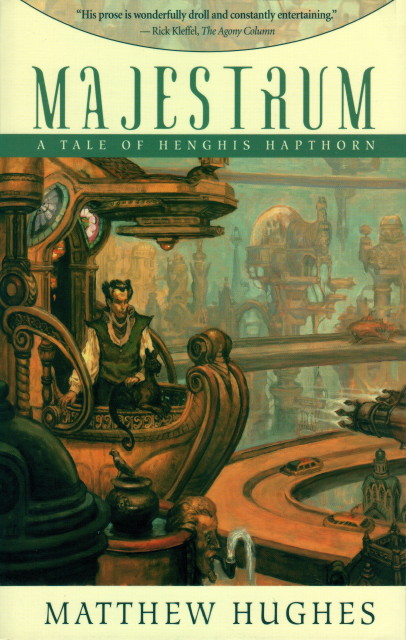
Matthew Hughes: Majestrum

The back cover touts this novel as “Sherlock Holmes meets The Dying Earth“, and it’s not far wrong: The protagonist, Henghis Hapthorn, the foremost “discriminator” of his time, is an ultra-rationalist detective in the Holmes mode (right down to the brusque attitude), and he lives in an era in which an age of science is coming to an end, to be replaced by an age of magic. The book diverges from its high concept there, however: This age is merely the latest to be ruled by science, and the pendulum has swung many times in the past (our own era has been lost to antiquity), and science still rules the day, although thaumaturges are popping up here and there, heralding the coming change. Moreover, Hapthorn himself has had several encounters with forerunners of the new age, and his most recent one turned his integrator (basically, his personal digital assistant) into a mammalian familiar, and also brought his intuitive side out into its own fully-realized personality which now shares Hapthorn’s mind. Although he tries to, Hapthorn doesn’t suffer this upsetting of his status quo with a lot of dignity.

That’s just the background for the book, which starts with Hapthorn being hired to investigate the new boyfriend of the daughter of an Old Earth noble, before coming back to be asked to look into a situation which could threaten the Archonate, the ruler of all of Old Earth. Hapthorn’s investigation explores some tangible clues involving a string of murders, as well as delving into murky details of the history of Old Earth.

Majestrum gets off to a slow start, trying to both introduce the many layers of Hapthorn and his world and get the story off the ground, but it ends up being a fun read. Hughes has a light touch to his writing that’s rare, especially among space opera type fiction like this; Hapthorn’s own dialogue is often overly ornate and self-important, but after a while Hughes starts poking fun at him for this, especially his signature phrase, “It would be premature to say.”

Hughes often seems to be evoking other stories or styles – Asimov or Piper style imperial space opera, Douglas Adams’ Dirk Gently – but the novel stands on its own without feeling like a mash-up, and I assume the evocative moments are deliberate. Ultimately the story revolves around Hapthorn and his other self learning to live with each other, Hapthorn with the knowledge that the new age will cause him to fade away, while his sharer is not yet fully formed, yet they’re two sides of the same coin, a fact neither of them fully embraces. Hapthorn himself is especially resistant, since he requires evidence and logic and is unable to take his sharer’s intuitive leaps on faith or trust. This impedance drives the story’s climax, which was a little disappointing since it seemed to undercut Hapthorn as the hero. Although it had a nifty denouement and final line.

With some fine world building, intellectual sleuthing, and a witty narrative, Majestrum is a neatly constructed book which could appeal to a wide variety of SF readers. It takes a little while to get into, but the ride was well worth some persistence.

This Week’s Haul

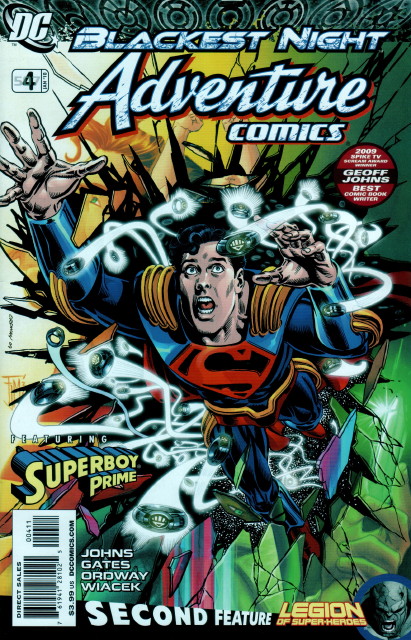
  • Adventure Comics #4, by Geoff Johns, Sterling Gates, Jerry Ordway & Bob Wiacek, and Michael Shoemaker & Clayton Henry (DC)
  • The Brave and the Bold #29, by J. Michael Straczynski & Jesus Saiz (DC)
  • The Flash: Rebirth #5 of 6, by Geoff Johns & Ethan Van Scyver (DC)
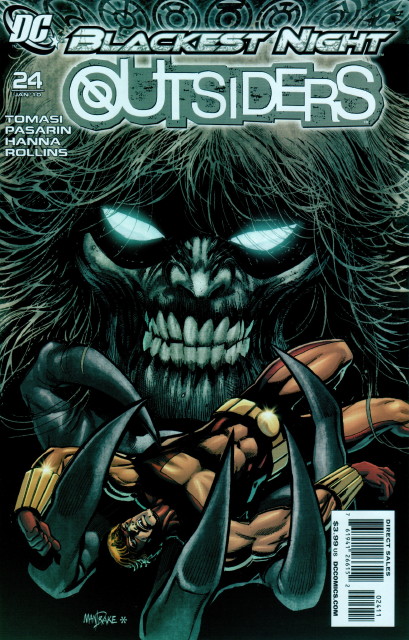
  • Outsiders #24, by Peter J. Tomasi, Fernando Pasarin, Scott Hanna & Prentis Rollins (DC)
  • Victorian Undead #1, by Ian Edginton & Davide Fabbri (DC/Wildstorm)
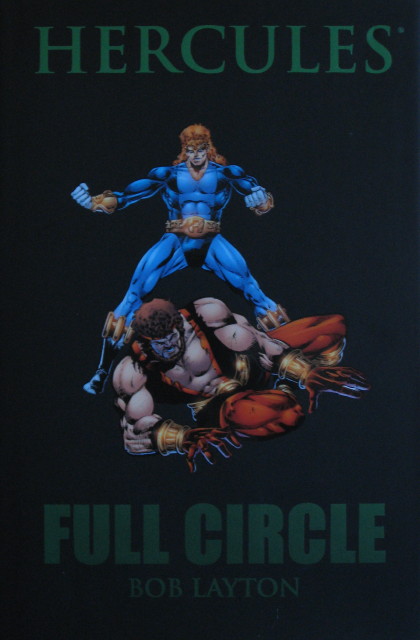
  • Hercules: Full Circle HC, by Bob Layton (Marvel)
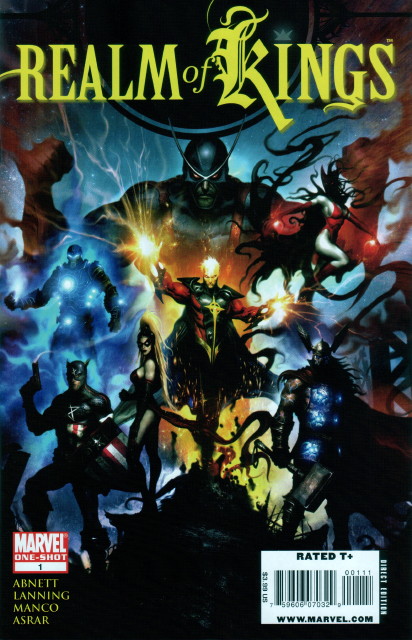
  • Realm of Kings one-shot, by Dan Abnett, Andy Lanning, Leonardo Manco & Mahmud Asrar (Marvel)
  • Echo #16, by Terry Moore (Abstract)
  • Irredeemable #8, by Mark Waid & Peter Krause (Boom)
  • Invincible #68, by Robert Kirkman & Ryan Ottley (Image)
  • Phonogram: The Singles Club #5 of 7, by Keiron Gillen & Jamie McKelvie (Image)
Adventure Comics #4 Two more books this week which tie in to DC’s Lantern ring giveaway. Adventure Comics was launched when the most recent Legion of Super-Heroes series came to an end. Its lead story features Superboy (the Connor Kent/Teen Titans version), and its backup features the Legion – the “classic” team which Geoff Johns reintroduced in Action Comics and Legion of 3 Worlds. I decided not to follow it along because I have no interest in this incarnation of Superboy.

Oddly, the lead story here is draw by Jerry Ordway, and not regular artist Francis Manapul, so as much as I like Ordway (although this isn’t his best stuff) it doesn’t give me any feeling for what the series has really been like. Plus, this issue doesn’t actually have much Superboy, but rather brings back Superman-Prime, the insufferable villain who finally got his comeuppance at the end of Legion of 3 Worlds. Honestly if I never see Prime again, it’ll be too soon.

The backup features two Legion characters who have been torn apart by the events of Lo3W, and getting back together with a little assistance from two other star-crossed lovers on the team. It’s a nice character story in its way, but it feels more like the beginning of a larger arc than just a backup tale. If Adventure Comics were all Legion, then it might be worth following, but just the backups isn’t enough to get me back on board.

Outsiders #24 Outsiders is the latest incarnation of the Mike W. Barr-penned Batman spin-off title from the 1980s, which was pretty mediocre stuff back then. This one seems more interesting, as the resurrected dead villain Terra seeks out her brother and – in a turnaround from how many of the resurrected heroes have been acting – can’t stand her new existence, and wants help in ending it. While this might be some sort of a bait-and-switch on Terra’s part, writer Peter Tomasi pulls it off pretty convincingly; the notion of what zombies think about being zombies is an often-overlooked facet of the genre. (Most of them don’t think, of course, but that’s not the case in the premise of Blackest Night.)

The other half of the story involves Katana being waylaid by her dead husband and children, and is more routine angst/combat stuff. But Fernando Pasarin’s pencils are quite good, making this a pretty solid read overall. The only downside is that it doesn’t give me – a new reader brought in via the ring giveaway – much orientation for who these Outsiders are, why they’re outsiders, or what their organization is like. But of all the Blackest Night tie-ins, this is the one I’m mostly like to give another shot.

Victorian Undead #1 Ian Edginton wrote the terrific Scarlet Traces about what happened to England and Earth after the defeat of the invaders in The War of the Worlds, so even though I’m suffering a bit of zombie exhaustion, I was willing to give him the benefit of the doubt and check out Victorian Undead, which as you can see from the cover involves Sherlock Holmes and zombies (although contrary to the cover, Holmes is not himself a zombie). The premise is that a meteor shower in the 1850s led to the rise of zombies in London, and in the 1890s Holmes and Watson have to grapple with their emergence (or maybe return – the timeline is left deliberately blank as I expect it’s one of the mysteries to be explored in the series).

Edginton injects some serious steampunk – in the form of a humaniform robot – into Holmes’ milieu, on top of the zombies. This first issue is entirely set-up, with shadowy governmental figures trying to keep a lid on things. I’m sure we all know how well that will work. Whether or not we’ll see other Victorian-era icons, I don’t know. Davide Fabbri looks like a decent artist, although with just enough of overtones of an Image style (gratuitous lines, unnecessary flourishes) for me to not fully embrace his style. But overall the series gets off to a good start, if you can stand another zombie title. Hopefully Edginton has more in mind than just “Sherlock Holmes and zombies”, though, because I don’t think that’s enough to carry the series. Zombies, after all, have been done before.

Hercules: Full Circle premiere HC I gushed a few months ago about the first hardcover collection of Bob Layton’s Hercules mini-series from the 80s. This month we get the second collection, containing the “Full Circle” graphic novel which concludes the character’s story, plus a short story and a 3-part epilogue that I hadn’t read before.

Layton’s art seems more than a bit dated today, but some of the stuff he tries to put over on the reader is amusing just for its audacity (like the supporting character “Lucynda Thrust”), and it works completely as a lighthearted buddy story. I doubt it’d be for everyone’s taste, but I’ve always loved it.

Realm of Kings one-shot I was very reluctant to pick up anything related to Realm of Kings considering what a bust War of Kings was, but something made me buy this one-shot. I’m glad I did, because it’s a neat little story: Quasar goes through the rift opened at the end of the war, and ends up on a parallel Earth in which the Avengers have given themselves over to the Great Old Ones, and who are interested in extending their reach into Quasar’s universe. While an obvious twist on the whole Marvel Zombies thing, the notion of the superheroes corrupted into becoming dark magicians could have legs. Then again, maybe it would be less entertaining if stretched out too far.

Leonardo Manco does a great job drawing the corrupted Earth and its heroes, and Abnett and Lanning have fun with the dark heroes (“What the Ftaghn?” exclaims Ms. Marvel) and figuring out how to get Quasar back where he belongs. As one-shots go, this one’s a lot of fun. Whether or not any of the rest of Realm of Kings – a collection of mini-series – will be, I have no idea, but as they mostly feature characters I don’t care about (the Inhumans, the Imperial Guard), I doubt I’ll give it more than a passing glance. Wake me when the main heroes get involved.

Echo #16 It’s time to check back in on Terry Moore’s Echo. It’s been slow going, but the story has been gradually revealing itself. Our heroine, Julie, accidentally got covered with a metallic substance which gives her odd powers she can’t really control, mainly being able to shock people with an energy zap. The creators of the metal have been after her, including hiring a mercenary Ivy, to bring her in. Julie’s also encountered a man – apparently a vagrant – who also has some of the metal, resulting in destruction and some death when they meet. After being on the run for some time, Julie’s gone with Ivy – who’s turned on her bosses and also retrieved Julie’s mentally-disturbed sister Pam – and is hiding with her.

That’s a lot of story, but it hasn’t felt like that much while reading it. It’s mostly felt like a fairly routine chase/suspense story with the mystery of the metal lurking in the background. What seems to be revealed here is where the title “Echo” comes from, as Julie is wondering if she’s able to communicate with the last – and deceased – wearer of the metal, a woman named Annie. There are also indications that Julie’s role may take on messianic overtones.

I can’t say that Echo has been one of my favorite comics – the glacial pace made me drop Moore’s previous series, the popular Strangers in Paradise – but it’s been interesting. Whether it’s all worth it will depend on whether Moore is able to bring it all to a big finish, whenever that comes. After a fashion, Echo reminds me of Jeff Smith’s current series, RASL in its tone, suspenseful structure, and fantastic mystery. To his credit, Moore has been publishing Echo nearly monthly, which makes it easier to stay attached to. And I like how Moore’s art has developed better than the caricature-dominated art Smith brings to RASL.

It’s a little odd that after 16 issues Echo is still at the point where it has more potential and actuality. Hopefully over the next year Moore will kick it into gear and turn it into something unique and exciting. But it’s not quite there yet.

(By the way, the covers tend to be much more dramatic than the contents; Julie is not nearly the ass-kicking heroine she seems to be on the cover to the left.)

The Sandman’s High Barrier to Entry

Interesting blog post at (of all places) npr.org on the high barrier to entry for new readers of Nail Gaiman’s series The Sandman.

And they’re right: The Sandman does have a high barrier to entry. I bought the series from the beginning, and while I loved the first issue, the issues following were simplistic and sometimes disgusting horror fare, and I dropped the series after about 6 issues. (Yes, I missed the original issue in which Death was introduced.) I only started picking it up a year or so later when “The Dream of a Thousand Cats” kicked off the first of several cycles of short stories in the series.

Honestly it’s difficult to introduce new readers to Sandman. Those early issues (collected in the first volume, Preludes and Nocturnes) are often not a lot of fun, Gaiman’s writing is very shaky as he hadn’t really gotten comfortable with his voice yet, and the art is erratic at best: Sam Keith’s cartoony style didn’t suit the series, and Mike Dringenberg’s muddy pencils and often-perplexing layouts were no better. The second volume, The Doll’s House, lacks focus, seeming like little more than a collection of amusing characters and gags, and has a thoroughly disappointing climax. The third volume, Dream Country, is a quartet of short stories, which are good, but not a good introduction to the series. As the NPR article says, it’s not until the fourth volume, Season of Mists, that the series really finds itself. Yet, there are many details in the first three volumes which are important to understanding the arc of the series as a whole.

I push comics at many people by lending them collections, but even though it’s great stuff, I can’t recall ever turning a new reader onto Sandman. And especially for people who aren’t comics readers, it’s not a series I’d choose to try to turn them on to comics.