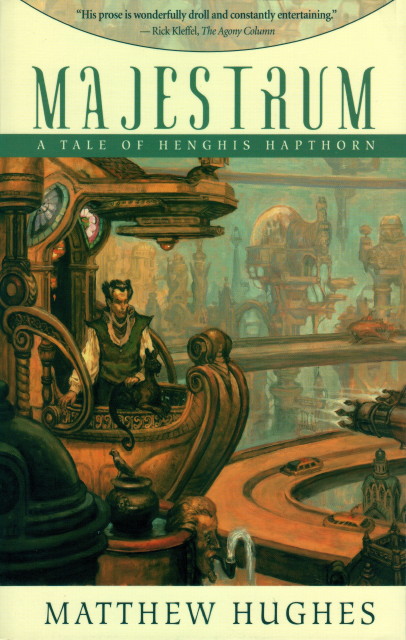
Matthew Hughes: Majestrum

The back cover touts this novel as “Sherlock Holmes meets The Dying Earth“, and it’s not far wrong: The protagonist, Henghis Hapthorn, the foremost “discriminator” of his time, is an ultra-rationalist detective in the Holmes mode (right down to the brusque attitude), and he lives in an era in which an age of science is coming to an end, to be replaced by an age of magic. The book diverges from its high concept there, however: This age is merely the latest to be ruled by science, and the pendulum has swung many times in the past (our own era has been lost to antiquity), and science still rules the day, although thaumaturges are popping up here and there, heralding the coming change. Moreover, Hapthorn himself has had several encounters with forerunners of the new age, and his most recent one turned his integrator (basically, his personal digital assistant) into a mammalian familiar, and also brought his intuitive side out into its own fully-realized personality which now shares Hapthorn’s mind. Although he tries to, Hapthorn doesn’t suffer this upsetting of his status quo with a lot of dignity.

That’s just the background for the book, which starts with Hapthorn being hired to investigate the new boyfriend of the daughter of an Old Earth noble, before coming back to be asked to look into a situation which could threaten the Archonate, the ruler of all of Old Earth. Hapthorn’s investigation explores some tangible clues involving a string of murders, as well as delving into murky details of the history of Old Earth.

Majestrum gets off to a slow start, trying to both introduce the many layers of Hapthorn and his world and get the story off the ground, but it ends up being a fun read. Hughes has a light touch to his writing that’s rare, especially among space opera type fiction like this; Hapthorn’s own dialogue is often overly ornate and self-important, but after a while Hughes starts poking fun at him for this, especially his signature phrase, “It would be premature to say.”

Hughes often seems to be evoking other stories or styles – Asimov or Piper style imperial space opera, Douglas Adams’ Dirk Gently – but the novel stands on its own without feeling like a mash-up, and I assume the evocative moments are deliberate. Ultimately the story revolves around Hapthorn and his other self learning to live with each other, Hapthorn with the knowledge that the new age will cause him to fade away, while his sharer is not yet fully formed, yet they’re two sides of the same coin, a fact neither of them fully embraces. Hapthorn himself is especially resistant, since he requires evidence and logic and is unable to take his sharer’s intuitive leaps on faith or trust. This impedance drives the story’s climax, which was a little disappointing since it seemed to undercut Hapthorn as the hero. Although it had a nifty denouement and final line.

With some fine world building, intellectual sleuthing, and a witty narrative, Majestrum is a neatly constructed book which could appeal to a wide variety of SF readers. It takes a little while to get into, but the ride was well worth some persistence.
This Week’s Haul

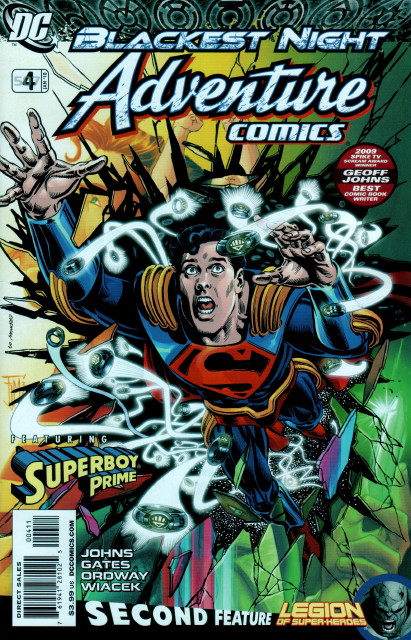
  • Adventure Comics #4, by Geoff Johns, Sterling Gates, Jerry Ordway & Bob Wiacek, and Michael Shoemaker & Clayton Henry (DC)
  • The Brave and the Bold #29, by J. Michael Straczynski & Jesus Saiz (DC)
  • The Flash: Rebirth #5 of 6, by Geoff Johns & Ethan Van Scyver (DC)
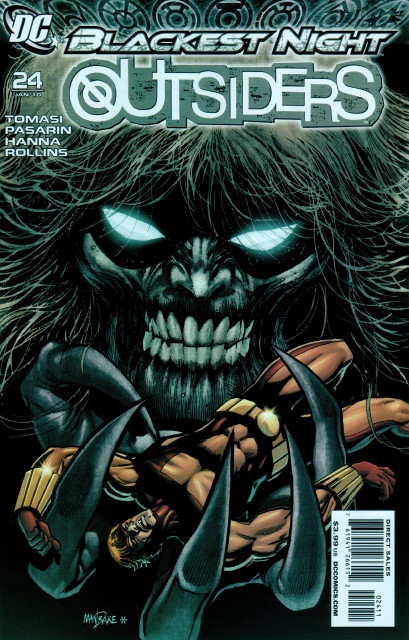
  • Outsiders #24, by Peter J. Tomasi, Fernando Pasarin, Scott Hanna & Prentis Rollins (DC)
  • Victorian Undead #1, by Ian Edginton & Davide Fabbri (DC/Wildstorm)
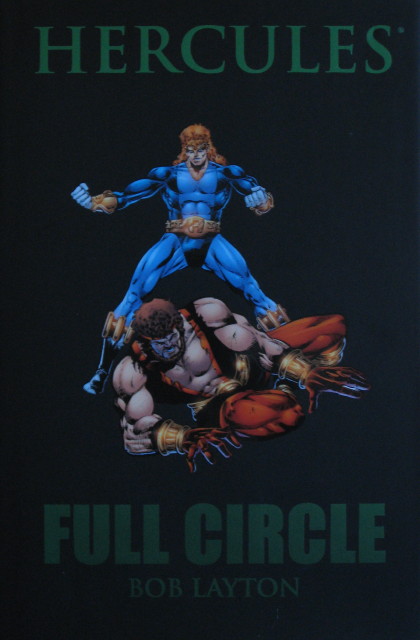
  • Hercules: Full Circle HC, by Bob Layton (Marvel)
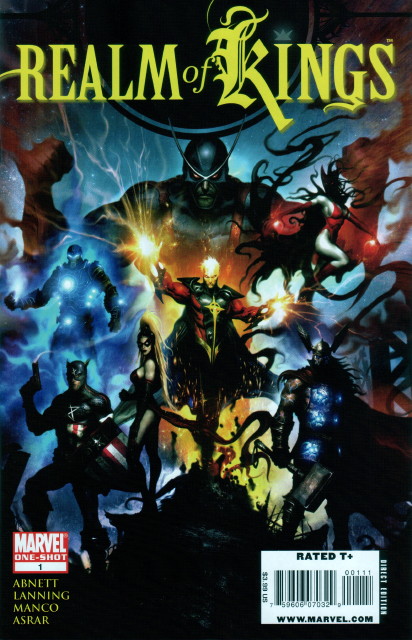
  • Realm of Kings one-shot, by Dan Abnett, Andy Lanning, Leonardo Manco & Mahmud Asrar (Marvel)
  • Echo #16, by Terry Moore (Abstract)
  • Irredeemable #8, by Mark Waid & Peter Krause (Boom)
  • Invincible #68, by Robert Kirkman & Ryan Ottley (Image)
  • Phonogram: The Singles Club #5 of 7, by Keiron Gillen & Jamie McKelvie (Image)
Adventure Comics #4 Two more books this week which tie in to DC’s Lantern ring giveaway. Adventure Comics was launched when the most recent Legion of Super-Heroes series came to an end. Its lead story features Superboy (the Connor Kent/Teen Titans version), and its backup features the Legion – the “classic” team which Geoff Johns reintroduced in Action Comics and Legion of 3 Worlds. I decided not to follow it along because I have no interest in this incarnation of Superboy.

Oddly, the lead story here is draw by Jerry Ordway, and not regular artist Francis Manapul, so as much as I like Ordway (although this isn’t his best stuff) it doesn’t give me any feeling for what the series has really been like. Plus, this issue doesn’t actually have much Superboy, but rather brings back Superman-Prime, the insufferable villain who finally got his comeuppance at the end of Legion of 3 Worlds. Honestly if I never see Prime again, it’ll be too soon.

The backup features two Legion characters who have been torn apart by the events of Lo3W, and getting back together with a little assistance from two other star-crossed lovers on the team. It’s a nice character story in its way, but it feels more like the beginning of a larger arc than just a backup tale. If Adventure Comics were all Legion, then it might be worth following, but just the backups isn’t enough to get me back on board.

Outsiders #24 Outsiders is the latest incarnation of the Mike W. Barr-penned Batman spin-off title from the 1980s, which was pretty mediocre stuff back then. This one seems more interesting, as the resurrected dead villain Terra seeks out her brother and – in a turnaround from how many of the resurrected heroes have been acting – can’t stand her new existence, and wants help in ending it. While this might be some sort of a bait-and-switch on Terra’s part, writer Peter Tomasi pulls it off pretty convincingly; the notion of what zombies think about being zombies is an often-overlooked facet of the genre. (Most of them don’t think, of course, but that’s not the case in the premise of Blackest Night.)

The other half of the story involves Katana being waylaid by her dead husband and children, and is more routine angst/combat stuff. But Fernando Pasarin’s pencils are quite good, making this a pretty solid read overall. The only downside is that it doesn’t give me – a new reader brought in via the ring giveaway – much orientation for who these Outsiders are, why they’re outsiders, or what their organization is like. But of all the Blackest Night tie-ins, this is the one I’m mostly like to give another shot.

Victorian Undead #1 Ian Edginton wrote the terrific Scarlet Traces about what happened to England and Earth after the defeat of the invaders in The War of the Worlds, so even though I’m suffering a bit of zombie exhaustion, I was willing to give him the benefit of the doubt and check out Victorian Undead, which as you can see from the cover involves Sherlock Holmes and zombies (although contrary to the cover, Holmes is not himself a zombie). The premise is that a meteor shower in the 1850s led to the rise of zombies in London, and in the 1890s Holmes and Watson have to grapple with their emergence (or maybe return – the timeline is left deliberately blank as I expect it’s one of the mysteries to be explored in the series).

Edginton injects some serious steampunk – in the form of a humaniform robot – into Holmes’ milieu, on top of the zombies. This first issue is entirely set-up, with shadowy governmental figures trying to keep a lid on things. I’m sure we all know how well that will work. Whether or not we’ll see other Victorian-era icons, I don’t know. Davide Fabbri looks like a decent artist, although with just enough of overtones of an Image style (gratuitous lines, unnecessary flourishes) for me to not fully embrace his style. But overall the series gets off to a good start, if you can stand another zombie title. Hopefully Edginton has more in mind than just “Sherlock Holmes and zombies”, though, because I don’t think that’s enough to carry the series. Zombies, after all, have been done before.

Hercules: Full Circle premiere HC I gushed a few months ago about the first hardcover collection of Bob Layton’s Hercules mini-series from the 80s. This month we get the second collection, containing the “Full Circle” graphic novel which concludes the character’s story, plus a short story and a 3-part epilogue that I hadn’t read before.

Layton’s art seems more than a bit dated today, but some of the stuff he tries to put over on the reader is amusing just for its audacity (like the supporting character “Lucynda Thrust”), and it works completely as a lighthearted buddy story. I doubt it’d be for everyone’s taste, but I’ve always loved it.

Realm of Kings one-shot I was very reluctant to pick up anything related to Realm of Kings considering what a bust War of Kings was, but something made me buy this one-shot. I’m glad I did, because it’s a neat little story: Quasar goes through the rift opened at the end of the war, and ends up on a parallel Earth in which the Avengers have given themselves over to the Great Old Ones, and who are interested in extending their reach into Quasar’s universe. While an obvious twist on the whole Marvel Zombies thing, the notion of the superheroes corrupted into becoming dark magicians could have legs. Then again, maybe it would be less entertaining if stretched out too far.

Leonardo Manco does a great job drawing the corrupted Earth and its heroes, and Abnett and Lanning have fun with the dark heroes (“What the Ftaghn?” exclaims Ms. Marvel) and figuring out how to get Quasar back where he belongs. As one-shots go, this one’s a lot of fun. Whether or not any of the rest of Realm of Kings – a collection of mini-series – will be, I have no idea, but as they mostly feature characters I don’t care about (the Inhumans, the Imperial Guard), I doubt I’ll give it more than a passing glance. Wake me when the main heroes get involved.

Echo #16 It’s time to check back in on Terry Moore’s Echo. It’s been slow going, but the story has been gradually revealing itself. Our heroine, Julie, accidentally got covered with a metallic substance which gives her odd powers she can’t really control, mainly being able to shock people with an energy zap. The creators of the metal have been after her, including hiring a mercenary Ivy, to bring her in. Julie’s also encountered a man – apparently a vagrant – who also has some of the metal, resulting in destruction and some death when they meet. After being on the run for some time, Julie’s gone with Ivy – who’s turned on her bosses and also retrieved Julie’s mentally-disturbed sister Pam – and is hiding with her.

That’s a lot of story, but it hasn’t felt like that much while reading it. It’s mostly felt like a fairly routine chase/suspense story with the mystery of the metal lurking in the background. What seems to be revealed here is where the title “Echo” comes from, as Julie is wondering if she’s able to communicate with the last – and deceased – wearer of the metal, a woman named Annie. There are also indications that Julie’s role may take on messianic overtones.

I can’t say that Echo has been one of my favorite comics – the glacial pace made me drop Moore’s previous series, the popular Strangers in Paradise – but it’s been interesting. Whether it’s all worth it will depend on whether Moore is able to bring it all to a big finish, whenever that comes. After a fashion, Echo reminds me of Jeff Smith’s current series, RASL in its tone, suspenseful structure, and fantastic mystery. To his credit, Moore has been publishing Echo nearly monthly, which makes it easier to stay attached to. And I like how Moore’s art has developed better than the caricature-dominated art Smith brings to RASL.

It’s a little odd that after 16 issues Echo is still at the point where it has more potential and actuality. Hopefully over the next year Moore will kick it into gear and turn it into something unique and exciting. But it’s not quite there yet.

(By the way, the covers tend to be much more dramatic than the contents; Julie is not nearly the ass-kicking heroine she seems to be on the cover to the left.)

The Sandman’s High Barrier to Entry

Interesting blog post at (of all places) npr.org on the high barrier to entry for new readers of Nail Gaiman’s series The Sandman.

And they’re right: The Sandman does have a high barrier to entry. I bought the series from the beginning, and while I loved the first issue, the issues following were simplistic and sometimes disgusting horror fare, and I dropped the series after about 6 issues. (Yes, I missed the original issue in which Death was introduced.) I only started picking it up a year or so later when “The Dream of a Thousand Cats” kicked off the first of several cycles of short stories in the series.

Honestly it’s difficult to introduce new readers to Sandman. Those early issues (collected in the first volume, Preludes and Nocturnes) are often not a lot of fun, Gaiman’s writing is very shaky as he hadn’t really gotten comfortable with his voice yet, and the art is erratic at best: Sam Keith’s cartoony style didn’t suit the series, and Mike Dringenberg’s muddy pencils and often-perplexing layouts were no better. The second volume, The Doll’s House, lacks focus, seeming like little more than a collection of amusing characters and gags, and has a thoroughly disappointing climax. The third volume, Dream Country, is a quartet of short stories, which are good, but not a good introduction to the series. As the NPR article says, it’s not until the fourth volume, Season of Mists, that the series really finds itself. Yet, there are many details in the first three volumes which are important to understanding the arc of the series as a whole.

I push comics at many people by lending them collections, but even though it’s great stuff, I can’t recall ever turning a new reader onto Sandman. And especially for people who aren’t comics readers, it’s not a series I’d choose to try to turn them on to comics.

Jim Butcher: Storm Front

I’d been aware of Jim Butcher’s Dresden Files series for a while, but I’d mentally filed it away along with any number of other series of novels that just didn’t seem like my kind of thing. Although the high concept – a private detective in Chicago who’s also a practicing wizard – seemed interesting enough, it struck me at a glance as being too mass market for my taste. My Dad, however, got into the books and gave me a copy of the first one, Storm Front, to see what I thought. I was still dubious, but gave it a try on my recent vacation.

It is, I’m sorry to say, a bad book.

The premise mixes noir and fantasy: Harry Dresden is a wizard who’s been put under a doom by the White Council of wizards, due to questionable behavior in the past, and if he violates any of their laws then they’ll execute him. Nonetheless he’s set up shop in the mundane world as a practicing wizard. But business is slow, since he doesn’t want to take on cases involving charlatanry. He sometimes consults with the police department, liaising with his friend Karrin Murphy.

Murphy calls him one day to consult on a particularly grisly double murder, which he confirms was performed with a nasty sort of magic. After viewing the scene, he’s met by mob boss Johnny Marcone, who wants him not to look into the case, but Dresden refuses. The same day, a woman named Monica Sells hires him to look into her husband’s disappearance, claiming that he’d been getting into serious magic before he vanished. After receiving a generous retainer, the broke Dresden takes the case.

Dresden visits the Sells’ lake house, where he confirms that Victor Sells was using magic. He’s also confronted by Morgan, the sword-wielding minion of the White Council who monitors Dresden’s activities, and who isn’t on Dresden’s side in their disagreement. Dresden continues to investigate both cases, and ends up being targeted by a mysterious wizard who sends a demon after him and who seems to be behind the murders. Dresden becomes stuck between his friendship with Murphy and his responsibility not to reveal too much about the magical world to the mundanes, which leaves him on the run from both his friends and his enemies as he tries to prevent his own murder by solving the cases first.

The basic problem with this book is that it’s just plain badly written. Told in the first person by Dresden, the narrative is often overwrought and clichéd (okay, the two tend to go hand-in-hand), with frequent single-sentence paragraphs (“I was driving for my life”) to raise the anxiety level higher in the cheapest of ways. Butcher’s turns of phrase often made me wince, and he sometimes uses words which seem inappropriate to the situation. For example, his client “beamed” at Dresden after he’d rather rudely interrupted her, a mismatch which left me scratching my head trying to figure out what he meant, and in any event yanking me completely out of the story for a moment. The overall writing style is one of lowest-common-denominator suspense, which would be fine (I’ve read plenty of that) if it didn’t keep tripping over its own feet.

The plot is a fairly trivial mystery, intended (I assume) to mainly be a vehicle to illuminate Dresden’s world. But his world isn’t really that interesting, and much of it is puzzling. Granted that not all details are going to be revealed in the first book of a series, I still wondered why Dresden seemed to be the only wizard who’d decided to set up shop among the mundanes, and what makes him different from the others that he’d do that. That seems like a fundamental element of the premise which should have been explained up-front. Butcher also seemed torn between coming up with a set of rules for how magic works in Dresden’s world (his explanation of how to make potions, for example, which was pretty interesting), versus leaving much of it unsaid because you can’t really explain how magic actually works. The Harry Potter books had a similar problem early on, and eventually stopped trying to explain everything, which is probably the right choice.

Characters’ motivations are sometimes inscrutable. Monica Sells’ behavior early in the book makes very little sense by the end, and Butcher essentially writes her out as a character near the end. Murphy’s reaction when Dresden refuses to tell her everything he knows doesn’t ring true; she ends up feeling like a false friend, which is the opposite of how Butcher tries to portray her in the first half. It would be more effective if she had been forced into that decision rather than making a choice. The strain in their relationship feels artificial, but then most of Dresden’s reactions feel artificial.

The book has its good moments, the best being the confrontation between Dresden and Marcone late in the novel. Of all the supporting cast, Marcone is probably the best-drawn, being enough of a twist on the calculating crime boss to be an interesting contrast to Dresden. Butcher’s description of the murders is also good, and his meeting with the vampire Bianca is also well-done, although it ends up being a dead end in the story.

But overall I thought Storm Front was a pedestrian story, further let down by the awkward narration. It kept reminding me of the comic book GrimJack in its mix of science and magic and detective noir, but I’d say it’s several steps down from that comic book (especially the earlier issues thereof). I guess now I know what all the hoopla is about, but I don’t think I’ll be continuing with the series.

Sunday in the City

Friday night I surprised Debbi by taking her to dinner at Sundance The Steakhouse, which we’d last (and first) visited for my birthday this year. It was as good as it was the first time!

Saturday we took the cats to the vet, Debbi taking hers in for a 2 pm appointment, then me taking mine in half an hour later. She was in-and-out and ran into me as I was arriving. It took longer for my guys to get their check-ups. Newton seems to be doing well enough given that he’s taking thyroid medication. Jefferson, however, has some really crummy teeth and his gums are looking pretty bad, including a spot that’s bleeding. He’s lost 3 pounds in the last year, and it could be because he’s having hyperthyroidism himself, or it could be because eating has been difficult because of his mouth. And the vet said there’s a chance that he could have a tumor which is bleeding. So both cats are getting blood tests, and we’ll see where to go from there. My bet is that Jefferson “just” needs some dental surgery.

Still, for 15-year-old cats, that’s not really too bad.

We had a more exciting day today, since I wanted to go up to the city for Borderlands Books‘ 12-year anniversary sale. We left early and got breakfast in San Carlos, but realized that we’d be getting to the bookstore well before their sale started, at noon. We tried going into Golden Gate Park to visit the botanical gardens, but there was no parking. However, we saw a sign on the way for the Disney Family Museum, which recently opened in the Presidio, and decided to go check that out.

Even with a $20 entry fee, I figured there was still some chance that it would be little more than a few trinkets that Diane DIsney Miller had inherited from her famous father, perhaps with some notes on his life. But in fact it was much more than that, and we spent more than two hours going through it (and could have spent more time than that).

There’s not much left inside that looks like an old Presidio building – they clearly spent plenty of money to make it a modern venue, with computerized displays in addition to the memorabilia, and even a theater in the basement. The reception area has hundreds of awards that Disney was given during his lifetime (including most of his Academy Awards) on display. Inside is an impressive collection of photos of Walt and his family, and many DIsney memorabilia, including a polo cup he won, one of the trains he built for his home, the fiddle his father played, and many of his early drawings (some the originals, most reproductions). The earliest known drawings of Mickey Mouse are among he collection.

The narrative is well-written, although the layout of the individual rooms makes it sometimes difficult to know where to start, so sometimes you experience things out-of-order. While it admirable grapples with a few of Disney’s less shining moments (such as the early 40s animators’ strike), it oddly glosses overt the construction of Disneyland, which occupied Walt for several years and was one of his greatest accomplishments.

While some have cautioned that the museum is more about Walt and less about Disney, anyone interested in either the man of his company ought to enjoy the museum. It’s a good companion experience to the biography of Disney I read a few months ago.

After the museum, we stopped for sundaes at Ghirardelli Square, and then headed to the bookstore, where I picked up a few things, and we got to see Borderlands’ two hairless cats, Ripley and Ash, the latter of whom I hadn’t met before.

The only blemish on the day was having trouble getting dinner cooked (stuffed pork chops from the supermarket that took about 25 minutes longer to bake than advertised), and watching the Patriots mysteriously hand the Sunday night football game to the Colts by not punting the ball on 4th-and-2 at their own 30, leading by 6 with 2:30 left in the game. WTF??? The Pats lost 35-34. Gah.

But that aside, it was a day of pleasant surprises, so I can’t really complain.

This Week’s Haul

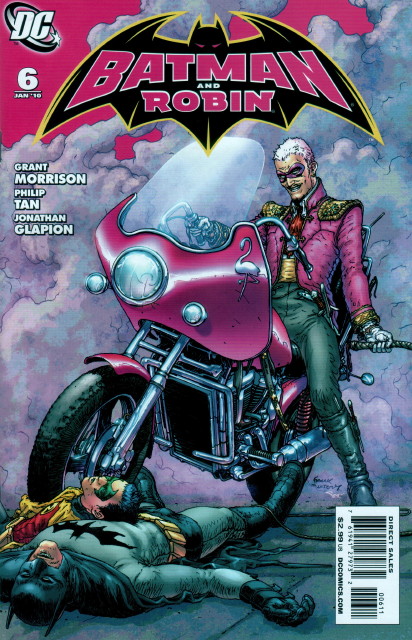
  • Batman and Robin #6, by Grant Morrison, Philip Tan & Jonathan Glapion (DC)
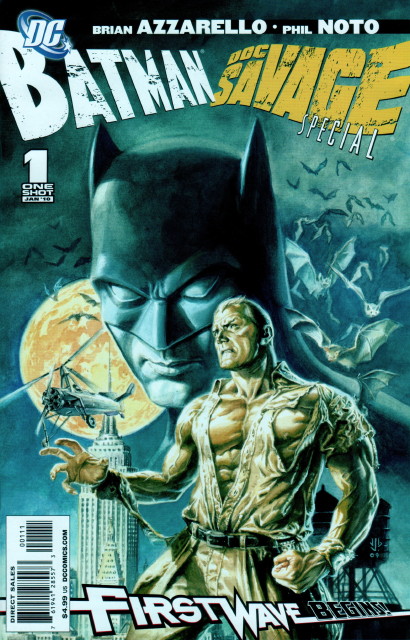
  • Batman/Doc Savage Special, by Brian Azzarello & Phil Noto (DC)
  • Booster Gold #26, by Dan Jurgens, Mike Norton & Norm Rapmund (DC)
  • Fables #90, by Bill Willingham, Mark Buckingham, Steve Leialoha & Andrew Pepoy (DC/Vertigo)
  • Green Lantern Corps #42, by Peter J. Tomasi, Patrick Gleason, Rebecca Buchman & Tom Nguyen (DC)
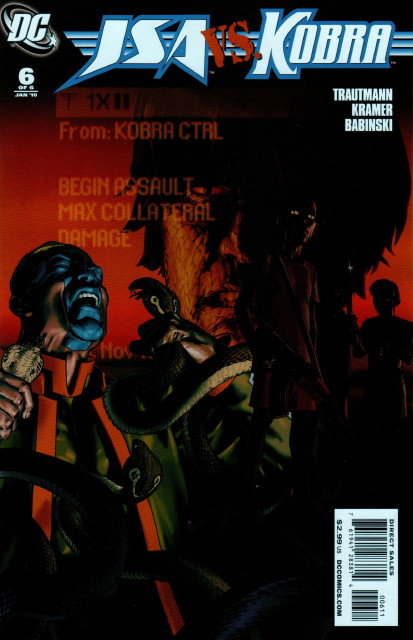
  • JSA vs. Kobra #6 of 6, by Eric S. Trautmann, Don Kramer & Michael Babinski (DC)
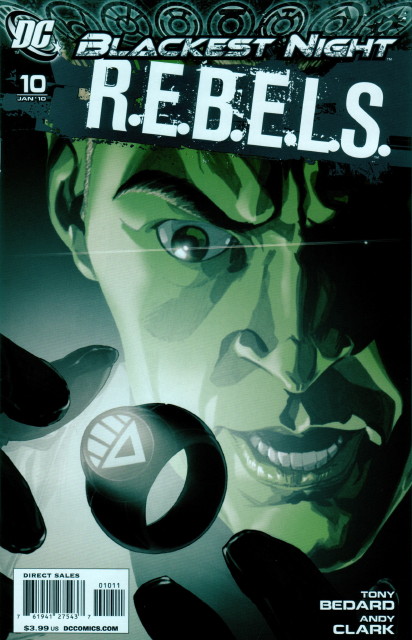
  • R.E.B.E.L.S. #10, by Tony Bedard & Andy Clarke (DC)
  • The Unwritten #7, by Mike Carey & Peter Gross (DC/Vertigo)
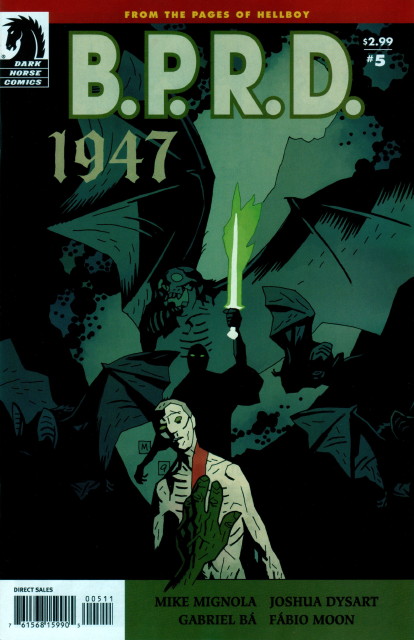
  • B.P.R.D.: 1947 #5 of 5, by Mike Mignola, Joshua Dysart, Gabriel Bá & Fábio Moon (Dark Horse)
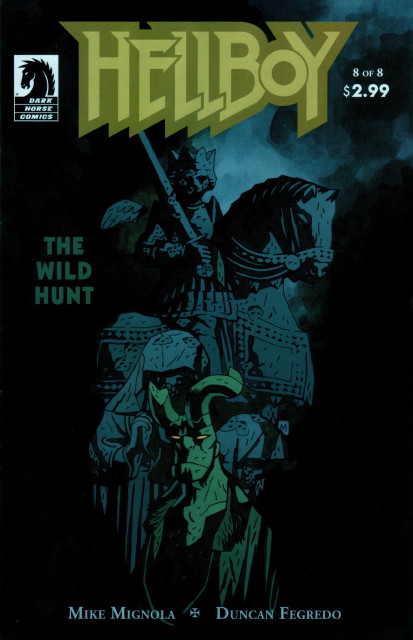
  • Hellboy: The Wild Hunt #8 of 8, by Mike Mignola & Duncan Fegredo (Dark Horse)
Batman and Robin #6 The second arc of Batman and Robin has taken some criticism due to the fairly extreme stylistic change from Frank Quitely (on the first arc) to Philip Tan (on this one). It is an extreme change, but I thought Tan was fine in issue #4; the problem is his style got progressively looser to the point where it’s actually rather grotesque in this issue. It’s still serviceable, but yeah, I can see where the complaints are coming from.

Then again, the story’s not much, either. The main villain, the Red Hood (a.k.a. Jason Todd, formerly Robin) is portrayed as a vicious counterpoint to Batman, although as a despised character who died and came back to life, it’s hard to care about his motivations. Another villain, Flamingo, shows up here to take out the Red Hood, until Batman and Robin show up to stop them both. It’s a perfect example of how Morrison seems to pack just too much into his stories at times, and Flamingo’s arrival undercuts the drama between Batman and the Hood, which was underdeveloped to start with.

So far, Batman and Robin has been more style than substance, with Morrison unable to properly develop his themes or his characters. In fits and starts he’s pulled together some interesting pieces, but hasn’t really used them effectively so far.

Batman/Doc Savage Special The Batman/Doc Savage special appears to be an introduction to something called “The First Wave”, which from the back of this issue seems to be an upcoming series by Brian Azzarello taking a group of pulp and golden age heroes and introducing them in a new setting, apparently in the present day, but with a mix of styles dating from the 1920s to today. So here we have Batman (at the beginning of his career) and Doc Savage (an established hero), to be joined later by The Avenger, The Spirit, Black Canary and the Blackhawks. I’ve always liked the notion of relaunching established characters in a different milieu, but this is perhaps not the set I’d have chosen. But Azzarello seems to write a lot of pulp-influenced stuff, and it’s his show, so here we have it.

This story involves Batman suspected of murder and Doc Savage coming to Gotham to bring him in. Batman wields a pair of guns (but not to kill), Doc uses his muscle, and the two of course come to a meeting of the minds by the end. Chris Sims’ critique of the story is mostly spot-on, although I disagree about Batman using guns, a facet of his character here that doesn’t bother me, although his wishy-washy use of them is annoying, I agree. Batman has always been a character who could use guns, but mostly hasn’t for various reasons depending on his interpretation. But Sims hits the nail on the head as far as the plot goes: It’s obvious, and dragged out. Additionally, the characters just aren’t very likeable, and Bruce Wayne in particular is portrayed in a very annoying manner (honestly I think the occasional “Bruce Wayne, airhead playboy” schtick that some writers drag out is just plain stupid, and not in the least funny).

So overall this is a pretty weak introduction of a fairly interesting series. But The First Wave will have to be a lot better than this to be worth reading.

JSA vs. Kobra #6 JSA vs. Kobra was a 6-issue miniseries which sort-of spun off from the JSA’s battles with the fictional terrorist organization Kobra from their previous regular series, which doesn’t really explain why it’s being published now. It also relates to Mr. Terrific being one of the leaders of Kobra’s good-guy opposite number, the spy organization Checkmate.

Other than the JSA, none of these organizations matters one whit to me, and the series doesn’t relate to the team’s current adventures at all. So why bother publishing this? And heck, why did I bother buying it?

It’s also not much good. Its plot strives to be a games-within-games match in which Kobra is playing several different angles at once (although to what end, I can’t figure out; if Kobra’s angling for world domination, they’re doing a crappy job of it), while the JSA tries to outmaneuver them. There’s some ongoing tension between the JSA’s co-leaders, Power Girl and Mr. Terrific, mainly over whether Terrific owes his loyalties to the JSA or to Checkmate (the latter of which has been infiltrated by Kobra spies), but it never feels very suspenseful and is resolved almost offhandedly.

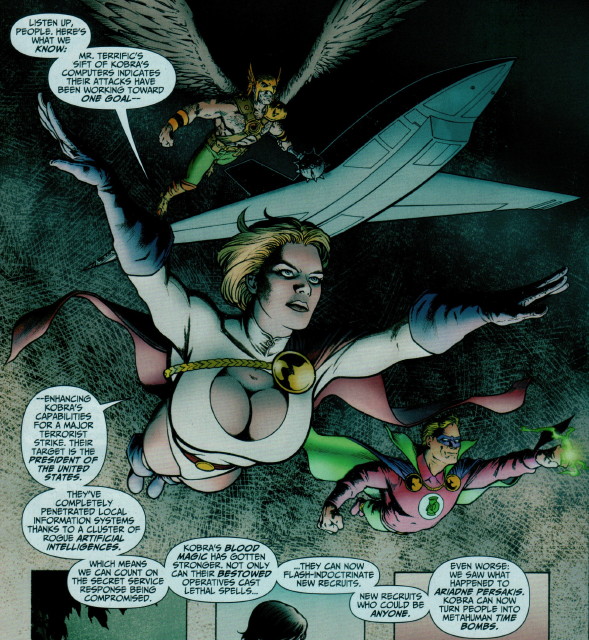
Eric S. Trautmann’s script (he’s an author I’ve never heard of before this series) is pretty mechanical, and Don Kramer’s pencils are pretty but not very dynamic. He does seem to meet one of the main criteria for a JSA penciller, though, that being an ability to put Power Girl’s chest front-and-center:

JSA vs. Kobra #6 page 12

At the end of the series, Kobra has been defeated, but obviously will come back in the future. The JSA hasn’t managed to eradicate the group, and none of the JSAers have really had any satisfying story arcs. The whole thing is played very low key despite the high stakes.

If you enjoy superhero pseudo-spy yarns, then this might be for you. Everyone else, give it a pass.

R.E.B.E.L.S. #10 R.E.B.E.L.S. #10 is one of two Blackest Night ring giveaway tie-ins this week (the other being Booster Gold #26, a series I already buy regularly). R.E.B.E.L.S. is a revival of the 90s series, which was the successor to L.E.G.I.O.N., itself a 20th century version of Legion of Super-Heroes that was launched in 1989 when the Legion was struggling to work out its continuity. If that doesn’t sound like one of the least-necessary revivals ever, then I don’t know what is.

Tony Bedard is a decent superhero writer, and Andy Clarke (whose name is misspelled on the cover – way to go DC) has an interesting style reminiscent of Steve Dillon. But issue #10 drops us ring-acquiring drive-by readers into the middle of an on-going story involving the nominal heroes (leader Vril Dox is more of an anti-hero) teaming up with some long-time DC villains to fight an even bigger long-time villain, Starro the Conqueror, who’s been transformed into a rather different entity than his already-chilling original form. (By the way, you can see an homage to the original Starro in the always-entertaining webcomic Plan B.)

The Black Lanterns are almost perfunctory to this story, which focuses on Starro enlisting the aid of Dox’s even-more-super-intelligent son, backing the R.E.B.E.L.S. into a corner, although it looks like next issue will involve a fight between Dox and the Black Lantern version of a former member of the team, as the issue ends on a cliffhanger.

Still, in a book headlined by a rather despicable character, mostly featuring other C-listers I don’t really care about, I might pick up the next issue but this isn’t enough to make me sign on for the long haul, especially since I lost interest in the original version of this team over 15 years ago. (Don McPherson liked it better than I do, though.)

B.P.R.D.: 1947 #5 B.P.R.D.: 1947 was one of the best recent stories of this long-running series, but unfortunately 1948 doesn’t follow it up as strongly. Trevor Bruttenholm mostly stays on the sidelines, and the ultimate point of the story is to drive home to “Broom” that the department’s mission means he’ll be sending a lot of people out to their deaths, and can he live with that? This last issue is pretty good in that regard, but the first four, which focus on the mission in question, were pretty tedious, hamstrung by the fact that Broom stays at home the whole time.

I guess there will be a 1949 at some point, but since I expect to bail on B.P.R.D. after the long-running “War on Frogs” storyline concludes, I may not be around to see it.

Hellboy: The Wild Hunt #8 Similarly, while Hellboy generally has been stronger than B.P.R.D. over the years, The Wild Hunt has been one of his weakest series. Not only does the mythical Wild Hunt only put in a token appearance across 8 issues, but the story involves examining Hellboy’s surprising lineage, and an equally surprising – and, honestly, rather silly – development which comes to a head in this issue. It had me shaking my head, as Hellboy has always done best by staying away from popular mythology, and bring King Arthur into the mix as happens here feels very out-of-place for the series.

Hellboy is at his best when he’s an ass-kicking, wise-cracking fighter of larger-than-life mythical monsters, but over the years Mignola has shrunk that side of his character and expanded him being pulled through various scenarios in scenes that are more talking that action, and that’s a lot less fun. It’s like Mignola’s fundamentally lost touch with the character, and that’s too bad, because he’s one of the most memorable comics creations of the last 30 years.

Regarding the Yankees’ Payroll

A couple of sharply contrasting articles about the New York Yankees and their payroll coming in the wake of their World Series victory: Sportswriter Joe Posnanski believes it’s an unfair advantage, somewhat obscured by baseball’s 3-tier playoff structure (some follow-up comments here), while Apple blogger Jon Gruber thinks the Yankees are just trying to win, which is more than can be said for some teams. My own opinion is closer to Posnanski’s than Gruber’s, although Gruber has a few good points.

(It’s very hard for baseball fans to objectively discuss this issue. Anti-Yankee bias is extremely strong throughout baseball – as a Red Sox fan, I admit to chortling gleefully whenever their season comes to a premature end. I suspect Posnanski has some of this bias, and that Gruber is colored by bias as a Yankee fan; indeed, his gloating at their championship and his past comments on sports makes me think he can’t really assess his team rationally. Then again, it’s sports; rationality isn’t required.)

I think the Yankees’ market and payroll do represent an unfair advantage, but they don’t give the Yankees a “pat hand” as Posnanski puts it. You also have to try to win, as Gruber says (and I do think there are teams that don’t try seriously to win), and you have to be skilled in your trying. The Yankees’ days in the wilderness in the 1980s were because they had fallen behind other teams in collecting talent and assembling their roster. Their approach changed in the early 1990s, which laid the foundation for their run of success since then. But once you have all three elements – a huge payroll, a desire to win, and the skills to assemble winning talent – you’re going to be a winning team most years.

There are teams which have two components, but who lack the large payroll, and they are simply and clearly at a significant disadvantage compared to the Yankees (and to a lesser extent the Red Sox). The Athletics are a popular example. The Angels are a well-run team which have been regularly run over by the Yankees and Red Sox since they won their 2002 championship. And the Rays are one of the best-run teams in baseball (a few years ago if I’d said that you would have asked me what I’ve been smoking), but not only are they at a payroll disadvantage, but they’re in the same division as the two richest teams in baseball and so were on the outside looking in coming the 2009 playoffs. (The Blue Jays are in some ways the Rays writ small.)

To look at it another way, you could be the best-run team in baseball, but given their financial resources, if the Yankees and Red Sox are among the top five best-run teams, then their payrolls give them a huge ability to cover for their mistakes and outbid other teams for the top free agent talent, that they’ve just got a huge built-in advantage over you.

Revenue and payroll are not the whole story, but they’re a significant factor.

There have been some interesting articles about market size written over the years. The seminal work, by Mike Jones, seems to no longer be available. Nate Silver wrote some articles in 2007 keying off of that work, but you have to be a Baseball Prospectus subscriber to read them. (If you are, you can find them here: One, two, three, four.) One point I recall from Jones’ original article was that the New York City area is a large enough market to support four teams, maybe as many as five or six, teams, each with a revenue stream competitive with other Major League teams. NYC is a really big market, folks.

And that’s kind of Posnanski’s point: You can’t really underestimate how big the New York market is, and how much that plays into the success of the Yankees. The Yankees have been a well-run franchise for nearly 20 years, and that counts for a lot, but their market counts for an awful lot as well.

I agree with Gruber that the Steinbrenners’ drive for success and excellence is admirable (is it, though, any more admirable than Oakland Raiders owner Al Davis’ stated desire to win?). Also admirable is the fact that they put their revenue back into the team, creating a feedback cycle of economic and on-the-field success. Not every team does this. (Gruber seems to imply by omission that the Yankees are special in this way, which I think understates what many other teams have done with much less.) And I’m certainly in favor of putting the earnings of baseball back into the game, and ultimately funneling much of it to the players who are, after all, where the true value in the game is created.

It’s not that I blame the Steinbrenners or the Yankees for this state of affairs. I do believe there are some structural problems in the business of baseball, for which the Yankees are somewhat culpable as co-owners of Major League Baseball (how much they specifically are culpable I can’t tell). But having purchased the most lucrative property in baseball and owned it for nearly 40 years now, I can’t fault them for exploiting what they’ve got for the greatest gain and success possible.

But I don’t think we can or should paper over the fact that the Yankees do have a large built-in advantage over every other team in baseball. (And I readily admit that the Red Sox have the second-largest built-in advantage, although the margin between #2 and #3 is much smaller than that between #1 and #2.) I think this is unfair, and it does make the Yankees’ successes less impressive by comparison with those of other teams. (I wonder who the team of the decade would be if you somehow adjusted for market and/or revenue stream? The Cardinals?)

I don’t know of a solution to this problem. Revenue sharing will never be big enough to have an impact. MLB isn’t going to put 2-3 more teams in New York City. (Look at how difficult it’s been just for the Athletics to move to a county which doesn’t even have another Major League team, since the Giants ostensibly claim the San Jose area as their market.) A salary cap would punish the players unfairly. What else is there?

In any event, complaining about the Yankees’ built-in competitive advantage will never go away, and that’s because it really exists.

The Pernicious Cold

The cold that kept me out of work for two days last week has been sticking around. Friday it knocked Debbi out of work for a day. Saturday she felt better, but I was very congested and actually spent most of the day feeling rather dizzy. Other than a trip to the supermarket, we stayed home all day. Sunday I felt better but Debbi felt worse, and we stayed home and watched football most of the day, but I did feel good enough to go to my book discussion group in the afternoon.

We’re both slowly feeling better, and have returned to work this week. I’m still congested and have a bit of a post-nasal-drip cough, but otherwise feel fine. I plan to go to frisbee tonight, although I might not make it through the whole evening. Debbi seems to be getting better, but skipped her aerobics class last night and then didn’t sleep very well.

Friends of ours have told us that this cold is a stubborn one, and that it hangs around for a while. Other friends have theorized that we actually have the flu. I’ve known people with the swine flu and to a man it’s knocked them out for a week or more and sounded absolutely miserable. This is a particularly mild strain, if so. It might also be the garden-variety flu, for which we’ve both had shots, and perhaps the shots only offered partial protection. Who knows. The fact that it feels like a cold and I often get a cold in early November, combined with Occam’s Razor, makes me think it’s just a nastier-than-usual cold.

Assuming no resurgence of symptoms, though, I’m hopeful that we’ll be entirely well by the weekend.

Karl Schroeder: The Sunless Countries

After Pirate Sun, which brought to a close the events in the first three books of Virga, I wasn’t sure whether Karl Schroeder planned to write more in the universe or if that was it (at least for now). While there were some loose ends, it formed a loose trilogy around three characters, Hayden Griffin, Venera Fanning, and her husband Admiral Chaison Fanning, as they embarked on an odyssey through Virga – a 5000-mile-wide, pressurized balloon in space – to stop their home nation of Slipstream from being destroyed by a more powerful rival. Along the way we learned a lot about how Virga works, and the wide diversity of civilizations that live within it.

As it turns out, there is more, and The Sunless Countries is the first book with a protagonist not from Slipstream, thus presenting a somewhat different view of Virga. Leal Maspeth is a young historian in the city of Sere, a collection of wheels in the sunless counties of Virga, the giant pressurized balloon within which the series takes place. Leal has been frustrated by not being able to crack the faculty of the university, and even more frustrated with the Eternists who are in power in Sere, a party who believe that Virga has always existed, rather than having been constructed by humans (and others) thousands of years ago. Sere is visited by Hayden Griffin, the heroic Sun Lighter, whose deeds in creating a new sun for his nation of Aerie have made him famous, but who has an uneasy relationship with the government.

Worse than the Eternists, something is lurking out in the dark, something which is probably responsible for disappearing ships around Sere and whose origins may hearken back to the origins of Virga. The government slowly moves to action, more for show than for effect, and Leal thinks she has some idea of what’s going on. Unfortunately, her theories run contrary to Eternist dogma, and her hopes of proving herself right fade when the government takes over the university to reconstruct it along their own ideals, barring people from the library.

Schroeder continues to explore the ramifications of living in Virga, this time focusing on a relatively isolated nation without a sun, and what being surrounded in perpetual darkness means. His characters are always well-realized, as none of the protagonists of each novel feels much like any of the others. Leal actually feels a little more generic than the others, especially by contrast with Griffin, who has grown up a lot since he starred in the first book, and who is a leader but arguably not a natural one. Leal’s backstory involves deceased parents and a frustrated career as a scholar, making her a melancholy figure, but one whose beliefs strongly oppose those of the Eternists.

Schroeder uses Leal and the Eternists to score some social commentary points, as the Eternists conduct a referendum about the nature of truth, such that any disputed truths in Sere will be decided by public vote. It’s an incisive commentary on the dangers of direct public government, as well as a grenade lobbed at the opponents of scientific principles, such as creationists. Tyranny of the majority, when that majority votes based on irrational belief rather than rationality and evidence is a frightening and dangerous thing.

The Sunless Countries also delves deeper into the origins and history of Virga, and what lies outside it, the post-singularity phenomenon named Artificial Nature. Schroeder’s take on posthuman society is a little different from what I’ve seen elsewhere, arguably taking that portrayed in Charles Stross’ Accelerando a step further. He’s also starting to work through the implications of posthuman cultures living alongside human cultures, a scenario whose surface has only been scratched in the fiction I’ve read so far.

The novel works much better when dealing with the political, historical and science-fictional elements than it does in its character-based drama: Its setting and the exploration thereof is so rich and deep that it seems Schroeder can keep plumbing it forever. On the other hand, Leal is pushed into a position where she has to decide among several unsavory options, one of which would fulfill her dreams at the cost of her integrity, but the decision feels a little too mechanical, not as heartfelt as it could have, not to me, anyway.

Despite that, The Sunless Countries is probably the second-best of the series so far, behind Queen of Candesce. It’s clearly the first of a longer story (a second trilogy?) and it ends on something of a cliffhanger, but the potential for more neat stuff is so clearly evident that you can believe I’ll be around for the rest of the story. The Virga series is some of the very best hard SF being published today.

Torchwood Season One

It took a while, but we recently finished the first season of Torchwood, the Doctor Who spin-off about a team in Cardiff, England defending the planet against alien incursions, and featuring Captain Jack Harkness, the occasional guest-star of Who. As I’ve done with Who, I’ll list the first season episodes in order of most to least favorite, and as usual my comments below will contain spoilers.

  • Captain Jack Harkness (written by Catherine Tregenna)
  • Ghost Machine (Helen Raynor)
  • Out of Time (Catherine Tregenna)
  • They Keep Killing Suzie (Paul Tomalin & Dan McCulloch)
  • End of Days (Chris Chibnall)
  • Countrycide (Chris Chibnall)
  • Random Shoes (Jacquetta May)
  • Greeks Bearing Gifts (Toby Whithouse)
  • Combat (Noel Clarke)
  • Everything Changes (Russell T. Davies)
  • Small Worlds (Peter J. Hammond)
  • Cyberwoman (Chris Chibnall)
  • Day One (Chris Chibnall)

A friend of mine said on Facebook that you have to look at Torchwood as a guilty pleasure. That would be fine – since much of this season is very poorly written – except that I already tend to see Doctor Who as a guilty pleasure, and Torchwood is a big step down from it, so where does that leave it?

The most frustrating thing about the show is that the Torchwood team are mostly incompetent, which is a big change from most shows of this type where the government organization protecting us from the unknown is instead highly competent. But this isn’t really a theme of the show, it’s just a lever used for the stories: The characters are incompetent, so they do stupid things, and that results in problems.

So, for example, in “Cyberwoman”, Ianto has been hiding his half-cyberized girlfriend in the basement of Torchwood since the Battle of Canary Wharf back in Doctor Who season three. He doesn’t really have a plan to reverse her condition, and he certainly doesn’t trust that his co-workers would help him. Naturally it all goes disastrously wrong once she gets loose. Or the first episode, “Everything Changes”, when the characters are making selfish use of the alien artifacts that Torchwood has access to even though Captain Jack’s told them not to. All this would make more sense if the team were more of a research organization, but that’s not really what they do, and it’s certainly not what they’re set up to do. This pattern continues through the season finale, “End of Days”, when the whole team turns against Jack to do something remarkably stupid which puts the whole world at risk. I can’t count the number of times I said, “Maybe next time you’ll listen to Jack!” at the television during the season.

Not that Jack is a whole lot better, since he’s written very erratically. He’s certainly the most competent character in the group (although Tosh is okay; she’s a fair sight better than Gwen, Ianto and Owen), but he also swerves from being empathetic to being very callous and uncompromising. It’s like the writers couldn’t decide if they wanted him to be a tough-as-nails leader, or more of a heroic figure like the Doctor.

The season’s rocky start has one good episode, “Ghost Machine”, and a decent one, “Countrycide”. The former is an atmospheric story about a device that can show echoes of the past, while the latter is a creepy horror story whose punchline is very different from what you’d expect. But neither of these are episodes to build a season on; in a better show, they’d be meat-and-potatoes episodes rather than the standouts. And they’re amidst dumb episodes like “Cyberwoman” or the immeasurably stupid “Day One” with its sex-obsessed alien killer (gah!), or the faerie-inspired but muddily-plotted “Small Worlds”.

The series does get better as it goes on, though. “They Keep Killing Suzie” features the forgotten Torchwood member from the first episode coming back to cause trouble, a well-constructed episode that unfortunately peters out with a pointless chase sequence at the end. “Out of Time” involves some people from 1953 brought forward to the present and having to adjust to a very different era. It’s one of the more thoughtful episodes in dealing with this premise seriously. And the best episode of the season is “Captain Jack Harkness”, in which Jack and Tosh are thrown back to 1941 during the dawn of World War II and have to figure out how to get back even as Tosh is the subject of anti-Japanese sentiment. They also meet, well, Captain Jack Harkness of that era, who’s not at all what they were expecting.

That episode sets up the last episode, “End of Days”, in which the mysterious goings-on turn a promising set-up into the team turning against Jack pointlessly and resolving into another stupid monster story. It’s a bombastic story but it’s frustrating and not very satisfying. And it ends with Jack disappearing to adventure with the Doctor at the end of his third season, which makes the series feel even more like a spin-off which is subordinate to its original series.

Torchwood has all the ingredients to be a solid series, perhaps a little derivative of The X-Files, but with a flaboyant, unusual star character, an inventive visual look to the team’s headerquarters, and an unusual pedigree. But the writing just doesn’t follow through on the series’ premise, and rarely delivers stories that either make much sense on their own terms, or involve characters doing things that seem sensical. Overall, it’s mediocre, and never truly great.