This Week’s Haul

  • The Brave and the Bold: The Book of Destiny HC, by Mark Waid, George Pérez, Jerry Ordway, Bob Wiacek & Scott Koblish (DC)
  • Justice Society of America #18, by Geoff Johns, Alex Ross, Dale Eaglesham, Jerry Ordway, Mick Gray, Kris Justice & Nathan Massengill (DC)
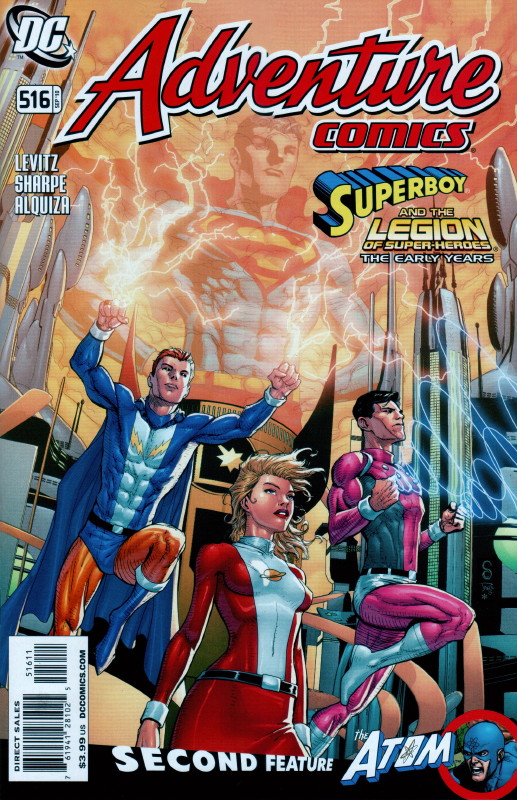
  • Legion of Super-Heroes #45, by Jim Shooter, Francis Manapul & Livesay (DC)
  • Madame Xanadu #3, by Matt Wagner & Amy Reeder Hadley (DC/Vertigo)
  • Final Crisis: Superman Beyond 3D #1 of 2, by Grant Morrison, Doug Mahnke & Christian Alamy (DC)
  • newuniversal: Conqueror #1, by Simon Spurrier & Eric Nguyen (Marvel)
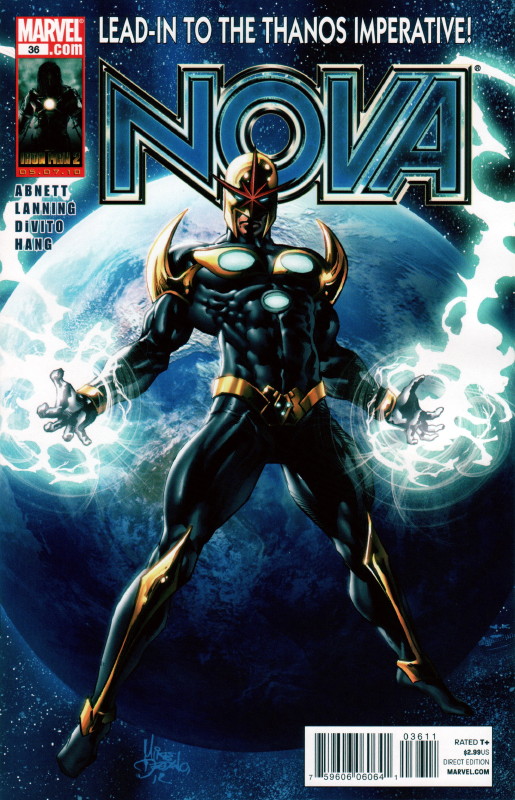
  • Nova #16, by Dan Abnett, Andy Lanning, Wellington Alves & Scott Hanna (Marvel)
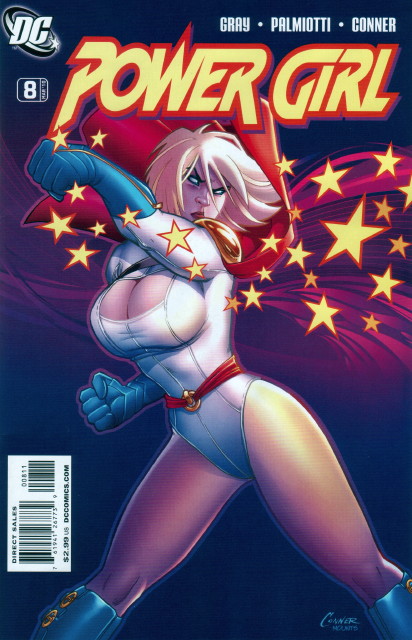
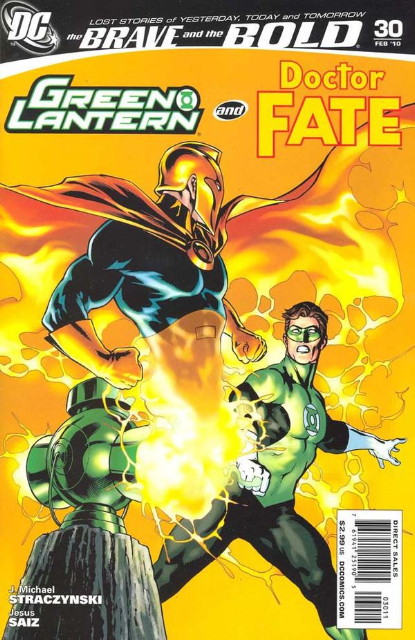
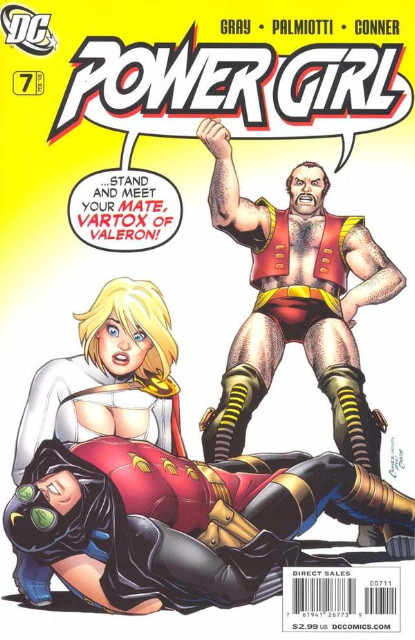
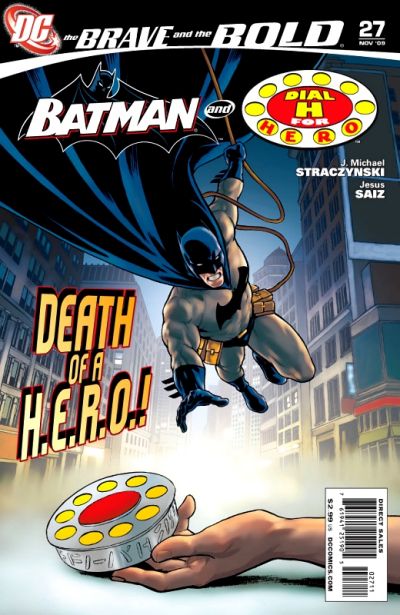
The Brave and the Bold vol 2: The Book of Destiny Although I loved the first volume in Mark Waid and George Pérez’s The Brave and the Bold (The Lords of Luck), I was not nearly as enthusiastic about the second one. Although The Book of Destiny reads better in collected form than as individual issues, it still shows all of its warts: It’s got a hodge-podge of characters thrown together for shakier-than-usual reasons (Ultraman?), and a plot whose villain’s motivation feels insufficiently crafted, with a sudden reversal at the end which also doesn’t work for me. But the big problem is that Waid’s characterizations - usually his strong suit - fail him badly here. His depiction of Power Girl in the first chapter is about as ham-handed as I can recall seeing, and the Flash/Doom Patrol story also features one-note characterizations which often feel contrived and out-of-place.

The best story in the volume is the short Hawkman/Atom yarn, although the beginning of the Superman/Ultraman one is pretty funny. And of course Pérez’s artwork is great, as usual, and if you’re losing George Pérez in the middle of a story - as happened here - you can’t do much better than replacing him with Jerry Ordway, who gets to pencil the finale.

It’s the artwork that motivated me to pick up the hardcover of this - well, that and the fact that I already owned the first volume in hardcover - but anyone else who wants to read the back half of the Waid/Pérez run on this title would probably do better to wait for the (cheaper) paperback. Overall, it was a big disappointment compared to the terrific first half.

Final Crisis: Superman Beyond #1 Superman Beyond 3D is a 2-part story spinning out of Final Crisis #3, in which a Monitor, Zilla Vallo, plucks Superman from the side of Lois Lane’s hospital bed to take him outside reality on a quest to save her. She’s recruited several of his counterparts from parallel worlds to help: Ultraman, Captain Marvel, Overman (from a world in which the Nazis won World War II) and Quantum Superman (based on a combination of Captain Atom and Doctor Manhattan, it seems like). They end up in limbo - the place where forgotten characters go to live forever in obscurity - and learn about their nemesis, Mandrakk.

I’ve been pretty down on Final Crisis so far, and unfortunately this issue fits right in with that: It’s a bunch of gosh-wow stuff thrown together so that it makes no sense. Why bring together the five Supermen? Who thought bringing in Ultraman would be a good idea? (Although if you’re an Ultraman fan, that means you can get a double dose this week.) What exactly are they supposed to accomplish? Who is Zilla Vallo and why is this her fight? Why go to limbo? To be fair, it’s the first issue and arguably Morrison is going to explain it all in the second issue. Unfortunately, his track record suggests that a lot of it won’t be explained at all, it’s just there for the gosh-wow factor, but that’s not the reaction it gets from me.

Much of it also feels like old territory, too. The form of Limbo is certainly old news, whether it feels like it’s from Morrison’s own Animal Man of 20 years ago, or the Supremacy from Alan Moore’s Supreme, and in any event it feels a lot like the Bizarro world from All-Star Superman, and the concept seems like just a more depressing version of . Morrison references the Bleed, which is a Warren Ellis interpretation of the multiverse, and Morrison doesn’t add anything new to it here. And on top of this we have the silliness with some pages being in 3-D - a pair of 3-D glasses are included - which adds nothing to the story. (At least it wasn’t all in 3-D, or I’d have passed on it entirely.)

So the story isn’t very much. The art is sometimes very good, and sometimes rather iffy. I think I liked Doug Mahnke’s work best back when he was drawing The Mask, since his sense of shape and form gave his books a very solid feel, the exact opposite of the Image style which was prevalent in those days. He’s changed quite a bit since then, working more with shadows and layouts, and I think it hasn’t been a change for the better. Some of his pages look great - especially the two-page spread in which Zilla Vallo contacts Superman - but others look very awkward: Any page in which a character is grimacing or gasping or shouting or gritting their teeth, and their faces just look deeply unnatural (which means that Ultraman always looks unnatural).

It’s weird to think that Grant Morrison, who’s usually one of the more innovative ideas men in comics, seems to be retracing the steps of Warren Ellis, Alan Moore, and himself, but that seems to be what’s happening. But this could still be a pretty good story, except that Morrison seems to have lost sight of giving the readers a reason to care. Superman’s supposedly doing this to save Lois, but what ‘this’ is he doing? And the adventure is all too metaphysical to have any emotional resonance (not really surprising, as emotional resonance has never been Morrison’s strong suit). Is this story really going to matter? My guess is no.

newuniversal: Conqueror newuniversal: Conqueror is another one-shot providing background to Warren Ellis’ newuniversal series, this one taking place in 2689 B.C., when a White Event has given several individuals in this primitive world the powers of the New Universe heroes we’re seeing play out in the main title. In this story, one of the empowered characters has gone badly wrong, and he’s manipulating the others for his own end, to the detriment of the timeline. The beings from outside the timeline are trying to warn the others, and this issue is mostly about the Star Brand character - the Conqueror of the title - trying to figure out what’s going on.

It’s a story of small scope, and it works on those terms, although I found the ending to be too abrupt and unsatisfying. Eric Nguyen’s art has a sketchy quality to it, but it works for me in the gloomy atmosphere it brings to the story - although as with many artists these days (it seems), he needs to work on drawing background so the story doesn’t seem like it’s taking place in mid-air.

newuniversal is quietly becoming one of the more intriguing mainstream comics. I hope Ellis keeps with it and sees it through to a conclusion. (Of course, I’m still waiting for that last issue of Planetary…)

This Week’s Haul

A small week, but one chock-full of geeky goodness. Which seems fitting, since this is my 500th post to Fascination Place!

  • The Brave and the Bold #16, by Mark Waid & Scott Kolins (DC)
  • Final Crisis: Legion of 3 Worlds #1 of 5, by Geoff Johns, George Pérez & Scott Koblish (DC)
  • Tangent: Superman’s Reign #6 of 12, by Dan Jurgens, Jamal Ingle & Robin Riggs, and Ron Marz, Fernando Pasarin & Scott McKenna (DC)
  • Marvel Masterworks: The Amazing Spider-Man vol 101 HC, collecting Amazing Spider-Man #88-99, by Stan Lee, John Romita & Gil Kane (Marvel)
  • Guardians of the Galaxy #4, by Dan Abnett, Andy Lanning, Paul Pelletier & Rick Magyar (Marvel)
The Brave and the Bold #16 Mark Waid’s run on The Brave and the Bold comes to a quiet end with a decent team-up of Superman and Catwoman. I’m not a big fan of Scott Kolins’ artwork these days - it seems like it’s getting increasingly less polished in its finishes, which I find rather off-putting - but it’s okay. The series never quite recovered from its stumbles starting with issue #7, nor the loss of George Pérez’s artwork, so it feels like it kind of limped to a finish. The first 6-issue story was terrific, though.

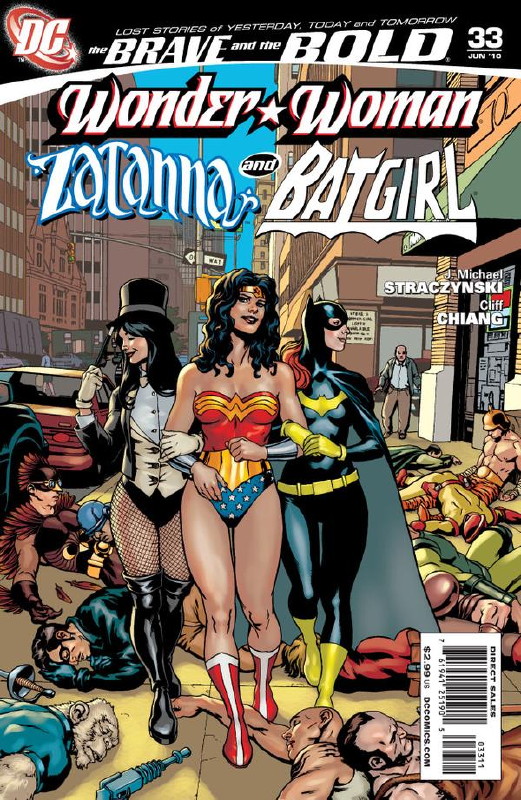
But the series is continuing with some fill-ins by Marv Wolfman, and then I guess J. Michael Straczynski is going to be the next regular writer. It’ll be interesting to see how that turns out, since Straczynski is a very low-key writer (in his comics work, anyway) and B&B always feels like it should be full of bombast and improbable, wild creativity.

Final Crisis: Legion of 3 Worlds #1 If ever there was a series made for fanboys, it’s Final Crisis: Legion of 3 Worlds. Boy, where to even begin? Well to start with, it’s drawn by George Pérez, who’s probably my favorite comics artist ever, and who’s noted for packing an amazing amount of detail into each panel, but who’s hardly ever drawn the Legion of Super-Heroes (nor, often, Superman). And the art is just gorgeous, as you’d expect.

The story all by itself has so many back-references to the history of the Legion and this decade’s DC continuity that anyone unfamiliar with it probably isn’t part of the target audience: The Time Trapper plucks Superboy Prime out of the time stream in the wake of the Sinestro Corps War and sends him to the 31st century, where the world is picking up the pieces in the wake of the defeat of Earth-Man during the recent Action Comics story “Superman and the Legion of Super-Heroes”. Prime visits the Superman Museum, where he learns about the Legion and how Superman - whom he hates - inspired the team and the creation of the United Planets, and also about the Legion of Super-Villains, whom he breaks out of prison to they can help him tear down everything Superman inspired.

Meanwhile, the Legion are being interrogated by the UP’s governing body, since many of them feel the Legion is no longer needed. Their one-time backer, R.J. Brande, shows up to speak in support of them, and it seems to be working, until he’s abruptly murdered, and the fact that he’s actually a Durlan is publicly revealed. This throws the UP into chaos. Other Legionnaires are busy finding and/or rescuing their missing teammates, but several of them can’t be found. Amidst all of this, they find out about Prime’s missing, and they summon Superman from the 20th century. Brainiac 5 reasons that the best way to fight the villains is to recruit their counterparts from two parallel worlds, and while Superman thinks that will help, he also thinks that Prime can’t merely be stopped, nor should he be killed, but that they need to find some way to redeem him, to bring him back to the hero he was during the Crisis on Infinite Earths.

If that made your head spin, then this series might not be for you, but as a longtime Legion fan, I enjoyed the hell out of it.

Now, to enjoy it you do basically have to avoid worrying about continuity, as there are continuity errors all over the place, and I assume it’s because Geoff Johns just didn’t want to bother dealing with all the little details which would prevent it from being a fun story, not least because he clearly wants to tell a story about the Legion he grew up with. Just a few of the differences I spotted:

  • The “classic” Legion clearly spins off from the end of Paul Levitz’ run on the book, and Keith Giffen’s “Five Years Later” stories never took place. For instance, the Legion remembers Superman as having been a member, so the Pocket Universe stories never took place, and Mon-El is his original self, rather than his FYL “Valor” self. I think FYL started out strong but fizzled after half a year or so, so I don’t mind this being pushed out of continuity.
  • The panel depicting the Zero Hour rebooted Legion shows some characters who are dead in that continuity, such as Monstress and Leviathan.
  • The Mark Waid/Barry Kitson Legion (the one currently being depicted in the ongoing Legion series) shows Supergirl as a member, even though she departed a while ago.
  • Superboy Prime is still Superboy, even though he’d had adventures as Superman Prime during Countdown - another example of Countdown being basically willfully disregarded by later series (which isn’t such a bad thing, as it was awful).

There are a lot of interesting things that bringing the three Legions could result in. For instance, maybe one of them is the Legion of Earth 2. Or having characters meet who are substantially different among the worlds, such as Princess Projectra and Sensor. I don’t expect them to clear up which Karate Kid stayed in the 20th century at the end of “The Lightning Saga”, though. Honestly I don’t think anyone at DC editorial has any idea why they bothered with that plot thread, anyway, since it ended up going nowhere.

The biggest risk the series runs is that of not just having a single large cast of Legionnaires, but three of them, and characterization getting lost in the shuffle - always a risk with any Legion series. But the most encouraging thing is Superman’s stated goal at the end of the issue: Not to just to stop Prime, but to redeem him. I’ve been pretty unhappy with how this character has been treated, and finding a way to redeem him would be a challenge well worthy of a 5-issue series illustrated by George Pérez. Here’s hoping Geoff Johns can pull it off; he’s off to a good start.

(Oh, one more thing: There’s no apparent connection between this series and Final Crisis that I can see. Maybe they’ll work it in there somehow, but I rather hope it ends up standing on its own.)

Anyway, yes, I’m a big Legion geek. I don’t think that “my” Legion will ever truly appear again, but I do enjoy reading good Legion stories.

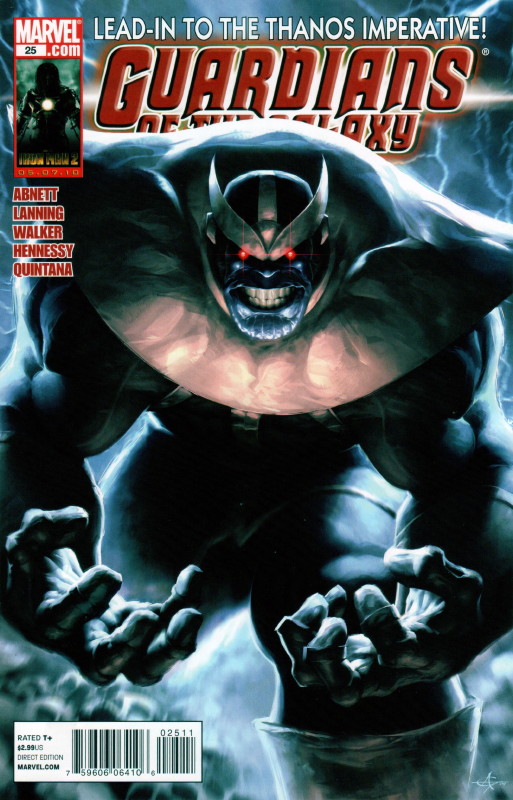
Guardians of the Galaxy #4 Guardians of the Galaxy is saddled with a Secret Invasion crossover in its 4th issue, much like Nova got stuck with an Annihilation: Conquest crossover in its 4th, but this one makes even less sense since the Guardians don’t operate on Earth, which is where the invasion is taking place! but Abnett & Lanning play a neat trick by locking the Guardians on their extradimensional home base of Knowhere, and revealing that there are shape-shifting Skrulls infiltrating that place, too! Plus, the Guardians find that many inhabitants of Knowhere don’t really trust or like them, and a couple of the Guardians members are acting a little oddly. From the issue’s last panel, it looks like things are really going to blow up next month, so this might be pretty good as non-crossover crossover stories go. If nothing else, DnA are taking every opportunity to keep advancing the Guardians’ own story in the middle of all this.

This Week’s Haul

  • The Brave and the Bold #12, by Mark Waid, Jerry Ordway & Bob Wiacek (DC)
  • Countdown to Final Crisis #2 of 52 (backwards), by Paul Dini, Sean McKeever, Keith Giffen & Scott Kolins (DC)
  • Salvation Run #6 of 7, by Matthew Sturges, Sean Chen & Walden Wong (DC)
  • Suicide Squad: Raise the Flag #8 of 8, by John Ostrander, Javier Pina & Robin Riggs (DC)
  • Tangent: Superman’s Reign #2 of 12, by Dan Jurgens, Jamal Ingle & Robin Riggs, and Ron Marz, Fernando Pasarin & Jesse Delperdang (DC)
  • Annihilation Conquest #6 of 6, by Dan Abnett, Andy Lanning, Tom Raney & Scott Hanna (Marvel)
  • The Perhapanauts #1, by Todd DeZago & Craig Rousseau (Image)
The Brave and the Bold #12 The second story arc of The Brave and the Bold wraps up in disappointing fashion: George Pérez left the book after #10, and while Jerry Ordway is another of my five favorite pencillers, I don’t think he works as well with the madcap adventure yarns that Mark Waid is writing here as well as Pérez did. And this six-issue arc wasn’t that interesting: It involved a villain named Megistus collecting mystical artifacts in order to reshape the universe, which is not exactly a new storyline, and served to be little more than an excuse to romp randomly through the DC universe - much less interesting than the coherent single story of the first six issues. Worst of all, Megistus’ motivations are supposed to be an attempt to avoid the upcoming Final Crisis (assuming he was telling the truth, that is), which is as disappointing a tie-in as I can recall in recent memory. Sigh.

Not that it hasn’t been an enjoyable arc on some levels - there have been some good character bits and the gorgeous artwork - but it’s just not nearly as good as the first arc. I can see that Waid was trying to do something a little different, but I think a multi-character team-up book needs a tight framework in which to operate or else it just falls apart. Indeed, I think such books succeed best when a hodge-podge of characters are pulled together into a very tight, sensical story, but the loose framework of this second arc made it feel much less coherent, and thus much less enjoyable.

Suicide Squad: Raise the Flag #8 Two other series concluded their arc this week, with much greater success. Suicide Squad: Raise the Flag marks John Ostrander’s return to one of his more artistically successful series. The Suicide Squad is a covert government organization which forcibly recruits villains to go on missions; if they succeed, their sentences are reduced; if they fail, they probably end up dying on the mission anyway. This series picked up where the original series left off, even bringing back a character long assumed deceased. After careful set-up taking us back to the days of the earlier series, we’re also introduced to the tension between Amanda Waller, the leader of the Squad, and General Wade Eiling, an SOB who eventually had his brain transplanted into the body of an invulnerable, super-strong android.

Ostrander always made the Squad work because not only was his unflinching in killing off some of the characters - including the occasional major one - but he maintained a careful balance of distrust and respect among the main characters, both heroes and villains, and dug deeply into their motivations. Everyone here has some sort of pathology, as you might expect from people who dress up in spandex to commit or fight crimes. A couple of the heroes attached to the Squad are a little less nutty than the others - Bronze Tiger is arguably the most ‘pure’ of the heroes - but everyone has a point of view of an agenda which brings them into conflict with the others at some point.

Anyway, this story wraps up with a mission - to which Eiling is now attached as a convicted villain - going horribly wrong. Of course, this being the Squad and not the Justice League, a decidedly different form of mayhem ensues, and it all wraps up rather neatly. Nifty character bits abound, especially those involving Deadshot and the new Captain Boomerang, the writing is sharp, and the art is mostly terrific, although inker Robin Riggs pencils a few of the last pages, and they’re noticeably stiff next to those of Javier Pina.

But all things considered, this series is made of win. If it results in a new Suicide Squad ongoing series, I would totally be on board with it.

Annihilation Conquest #6 The first Annihilation series was totally awesome, and consequently was a hard act to follow. Annihilation Conquest doesn’t quite reach its heights, but it’s still a heck of a lot of fun.

Basically, the Phalanx takes over the Kree empire, seals it in an impenetrable bubble (dozens of light-years wide!) and starts infecting all beings inside with its technovirus, including Nova, Drax, Gamora, Blastaar, etc. Pockets of rebellion persist, primarily a team of misfits led by the former Star-Lord who seek to bring down the Babel Spire which is generating the field. Meanwhile Quasar - sister of the most recent Captain Marvel - find the High Evolutionary and a resurrected Adam Warlock (again?) and strives to enlist them, but the Evolutionary betrays her and puts the mind of the Phalanx’s leader - whose identity might elicit a groan from longtime Marvel readers, but seems almost obligatory to me - in Adam’s body.

In the conclusion, Nova shows up with the cavalry, Star-Lord’s team makes its last stand, and Ronan the Accuser implements his final solution to the problem of the Phalanx infestation. As grand, “last, desperate hope” climaxes go, this one is pretty good. A lot of people really loved Star-Lord’s strike force, especially Groot and Rocket Raccoon, but I enjoyed the weightier characters, such as Nova and Wraith (I wish we’d seen more of the latter). I appreciate Star-Lord as a sort of tragic hero, having lost all his powers in defending the galaxy from an insane Herald of Galactus, but I don’t think the rest of his team is a very good foil for his character. I guess we’ll see how well it works in a longer form in the upcoming Guardians of the Galaxy series, though.

Overall, Marvel’s revitalization of their space characters has been a smashing success, relying on good stories, clever plotting, and well-defined characters who stay in character. The mess which is the rest of Marvel’s line of titles would do well to watch what these guys are doing, because they’re doing it right.

This Week’s Haul

Okay, last week’s haul. I’ve gotta stop being so busy on Thursdays-through-Sundays…

  • The Brave and the Bold: The Lords of Luck vol 1 HC, by Mark Waid, George Pérez & Bob Wiacek (DC)
  • Countdown to Final Crisis #21 of 52 (backwards), by Paul Dini, Sean McKeever, Keith Giffen, Jamal Igle & Mark McKenna (DC)
  • Justice Society of America #11, by Geoff Johns, Alex Ross, Dale Eaglesham, Ruy Jose & Drew Geraci (DC)
  • Annihilation Conquest #2 of 6, by Dan Abnett, Andy Lanning, Tom Raney & Scott Hanna (Marvel)
  • Marvel Masterworks: Spider-Man vol 86 HC, collecting Amazing Spider-Man #78-87, by Stan Lee, John Romita, John Buscema & Jim Mooney (Marvel)
  • Invincible #47, by Robert Kirkman & Ryan Ottley (Image)
  • Lobster Johnson: The Iron Prometheus #4 of 5, by Mike Mignola & Jason Armstrong (Dark Horse)
  • Rex Mundi: Crown and Sword vol 4 TPB, by Arvid Nelson & Juan Ferreyra (Dark Horse)
  • Atomic Robo #3 of 6, by Brian Clevinger, Scott Wegener & Joshua Ross (Red 5)
The Brave and the Bold vol 1: The Lords of Luck HC Although I’ve been down on the two most recent issues of The Brave and the Bold, the first 6-issue story arc was killer: Batman and Green Lantern in Las Vegas, Green Lantern, Supergirl and Lobo in space, the Book of Destiny, the Lords of Luck, the Fatal Five, and Batman outsmarting the whole Legion of Super-Heroes. And of course that gorgeous George Pérez artwork. Now you can own the whole story in a spiffy hardcover collection with a few pages of annotations by writer Mark Waid.

Or you can wait for the inevitable paperback edition. But I didn’t.

Rex Mundi vol 4: Crown and Sword TPB Rex Mundi seems to be coming together - at last - with this latest volume. Juan Ferreyra’s a good artist, although maybe not detail-oriented enough for my tastes (lots of panels relying more on coloring than linework for their backgrounds, for instance), but the range of facial expressions he draws is impressive. Mainly, though, Arvid Nelson’s story is finally really moving. To recap, the story takes place in an alternate Europe in 1933 in which the Protestant Revolution failed, and sorcery works. Our hero, Dr. Julien Saunière, is seeking the answers to a centuries-old mystery about the Catholic Church and the kings of France. With both the Church and the Duke Lorraine following his every move, he seems to be getting closer, even as the fecal matter hits the fan in the form of war breaking out across Europe. Nelson turns the Axis/Allies alliances on their heads, although the Axis in this setting bears little relationship to the one from our World War II.

So my interest has been revived in the story. I think it would wear a bit better if the story were more character-oriented, although if Nelson has a bang-up ending in mind for the overall story then it could be just fine. I tend to be rather cynical when it comes to ongoing comic books, since it seems like nothing ever gets resolved (I have this problem in spades with TV shows, too), and it’s hard to see the current story going on for more than 2 or 3 more volumes. Nelson could throw a wrench in the works and send the story off in some substantially different direction, but that would be odd since so far the story has tracked steadily in a single direction. But it could happen.

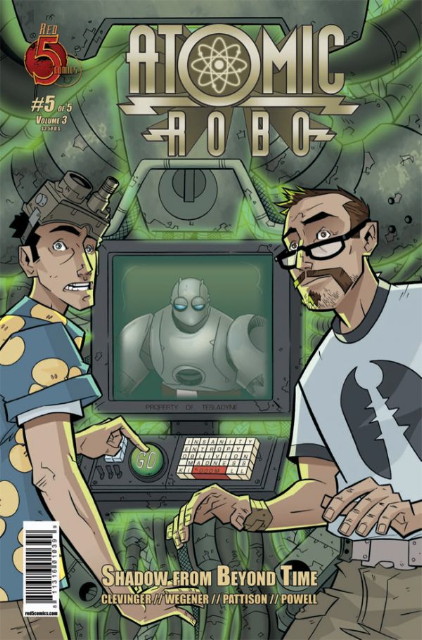
Atomic Robo #3 There’s something about Atomic Robo that I don’t get.

The problem might be that it’s just one of several books being published today with the general theme of “adventurers with nonhuman backgrounds who tackle scientific/supernatural threats”. The best-known of these is the burgeoning Hellboy franchise at Dark Horse, of course. But Burlyman’s Doc Frankenstein is right in there, as are The Perhapanauts and The Umbrella Academy. All of these books have more of a pulp-magazine adventure feel than a superhero feel, and the characters often act on their own or outside of the public eye. I think Hellboy is the most popular mainly because he predates the rest of the current generation by a decade or so (plus he’s been in a feature film).

But Atomic Robo doesn’t really stand out. It seems to focus on the outright mayhem part of the adventures more than the other titles, but that doesn’t leave a lot of room for characterization, and the plots are very simplistic.

Robo himself is a smartass, and a little melancholy about some elements in his past, but that’s about all I’ve gleaned about the long-lived protagonist of the series, who was constructed by Nikola Tesla in the early 20th century. The stories don’t have much of a period feel, and this issue - about a mobile pyramid threatening Egypt - takes place in the present day. (It also ends with a big explosion, so abruptly I wondered there were pages missing.) We’re getting very brief vignettes about Robo, but not much depth. I think the creators have greater plans for the character, but I don’t think they’ve led with their best foot forward in this mini-series.

Still, with three issues to go there’s still time for that to change.

This Week’s Haul

Wow, was this a big week:

  • Aquaman: Sword of Atlantis #57, by Tad Williams & Shawn McManus (DC)
  • The Brave and the Bold #7 by Mark Waid, George Pérez & Bob Wiacek(DC)
  • Countdown #28 of 52 (backwards) by Paul Dini, Tony Bedard, Keith Giffen, Al Barrionuevo & Art Thibert (DC)
  • The Death of the New Gods #1 of 8 by Jim Starlin & Matt Banning (DC)
  • Ex Machina #31, by Brian K. Vaughan, Tony Harris & Jim Clark (DC/Wildstorm)
  • SHAZAM: The Monster Society of Evil HC, by Jeff Smith (DC)
  • Marvel Masterworks: The Avengers vol 84 HC, collecting The Avengers #59-68, by Roy Thomas, John Buscema, Gene Colan & Barry Smith (Marvel)
  • Primordia #1 of 3 by John R. Fultz & Roel Wielinga (Archaia)
  • The Umbrella Academy: The Apocalypse Suite #2 of 6 by Gerard Way and Gabriel Bá (Dark Horse)
  • The Boys #11 by Garth Ennis & Darick Robertson (Dynamite)
Aquaman #57 So the latest Aquaman series comes to an end, with neither a whimper nor a bang. Both writers Kurt Busiek and Tad Williams took their sweet time developing the background of Arthur Curry, the new Aquaman, though at least Williams managed to tie up all the loose ends of previous writers in the series (although he left a few of his own). Although I was disappointed with Shawn McManus’ evolution of his art style as we saw in this series, it was overall enjoyable enough.

Aquaman has become something of a joke when talking about big-name superheroes. “Wow, he can swim and talk to fish, what a maroon!” “He can’t keep his own series, why does anyone bother?” “Okay, he was decent when Peter David and Grant Morrison were writing him, but otherwise he’s such a wuss!” And yet, DC keeps trying and trying with him, and his series actually last a pretty long time, as series go:

  • 4-issue mini-series by Neil Pozner and Craig Hamilton from 1986 is very well regarded.
  • 5-issue mini-series in 1989 paved the way for:
  • 13-issue series from 1991-1992. While this didn’t do so well, it wasn’t long before we got the:
  • 77-issue series from 1994-2000, which was first written by Peter David (this is when Aquaman lost his hand) and had an interesting denouement by Dan Jurgens and Steve Epting.
  • Finally, the current series launched in 2003 and lasted 57 issues with at least 4 distinct creative teams in 2 changes in direction.

A lot of characters would kill to have that amount of exposure over the last 20 years. So Aquaman might be something of a joke to some fans, but clearly there’s some market out there for him. I bet he’ll have his own series again before the decade is out.

The Brave and the Bold #7 Although I lovedlovedloved the first 6-issue story in The Brave and the Bold, issue #7 fell completely flat for me, and the main reason was the characterization: Power Girl came off as a complete clod, and seemed completely out-of-character. Power Girl to me is strong and assertive, yes, but she’s not head strong and mindlessly aggressive as Mark Waid portrays her here. While she’s willing - even happy - to punch things when punching is necessary, and she can get frustrated at times, she’s often entirely reasonable and quite thoughtful, none of which is in evidence here. Instead she’s played as a humorous contrast to Wonder Woman, for whom Waid plays up the peaceful, reasonable side as she tries to keep Power Girl from going off half-cocked. Neither heroine comes off well in this story.

And the story itself is a one-issue tale which ties in obliquely to the Book of Destiny from the first storyline, and since it’s a pretty lightweight adventure, the characterization missteps means it really doesn’t work at all. It has a few of Waid’s trademark neat ideas, but that’s truly too little, too late. It’s a big disappointment.

The Death of the New Gods #1 Once upon a time there was a comics artist named Jack Kirby who created some pretty amazing characters, stories and artwork at a little up-and-coming company called Marvel Comics. In the 1970s he found himself disagreeing with some of Marvel’s policies and directions so strongly that he left the company that had been built on the back of his labor and moved to DC Comics, the heavyweight in the industry at the time. There he was given practically carte blanche to create a bold new direction for DC, although he mostly had to work around the established characters to do so. Although I think his ride there was a lot bumpier than he’d hoped, he still created dozens of characters and a milieu often referred to as the Fourth World, a world of gods, demons, scientists, monsters, and men from the past, present and future.

Although I realize many people have a fondness for Kirby’s 70s work at DC - which was essentially his swan song as a major creative force in the industry - frankly I think it was pretty awful stuff. As an artist and designer, Kirby was well past his prime, and his art looked pretty comical compared to his heyday at Marvel. He handled the scripting duties for many of his books, a task for which he was especially poorly suited - his dialogue at its best seems stilted, and often it just seems ridiculous. But worst of all, all the characters are basically just dumb. Darkseid is about as generic a villain as exists in mainstream comics, of all the New Gods only Mister Miracle is at all interesting (and he’s saddled with that ridiculous red-yellow-and-green outfit), and the various ancillary creations (OMAC, Kamandi, Project Cadmus, etc.) were not much good, either, feeling dated soon after they appeared. (John Byrne is a fan of almost everything Kirby’s done and keeps reviving Kirby’s 70s creations. While his OMAC mini-series was excellent, his other such revivals have been dodgy at best, in my opinion. In particular the integral use of Darkseid and company in his Generations III series really crushed the life out of its story, I thought.)

All of which brings us to Jim Starlin’s Death of the New Gods, which is either an idea whose time has come, or one of the supreme pointless endeavors in DC history. Maybe both. The story spins out of Countdown (a bad start right there) in which at least one New God has died, and the carnage starts right quick in this first issue, with one of the major New Gods being taken down in the first cliffhanger (to the dismay and anger of some).

Starlin was one of the best writers around at one time; his Dreadstar series was one of the best comics of the 80s. But I think those days are long past, as I’m hard-pressed to think of a series he’s done in recent years which set the world (well, my world, anyway) on fire, especially when he’s playing with corporate characters rather than his own creations. Death of the New Gods starts off being more portentious than exciting, and though it will play out over 8 issues, the combination of irrelevant characters and a writer/artist who I think is no longer at the top of his game, as well as the tie-in with a weak maxi-series “event”, doesn’t bode well for it being much good, and the leisurely pace of the first issue doesn’t help, either.

SHAZAM!: The Monster Society of Evil Jeff Smith is the creator of one of the best independent comics of the 90s, Bone. His latest project is SHAZAM!: The Monster Society of Evil, a new take on the classic Captain Marvel character, starting with his origin and his first adventure. Smith is so earnest and bring so much energy to his work that the sheer enthusiasm behind the book makes it a joy to read, and as always his artwork is terrific.

The story does falter in places. For instance, Captain Marvel seems to be a separate person from Billy Batson, but he sometimes acts like he’s inexperienced, and it’s not clear what’s going on. Also, Sivana makes a valuable deduction, but there’s no sign of how he does it - arguably he got tipped off, but that’s pretty weak reasoning. And the plans of the Monster Society don’t really make a whole lot of sense - why do they have to wait so long, and meet such byzantine conditions, to do what they want? I guess Smith is just trying to evoke the sense of relative silliness of the original Captain Marvel stories from the 1940s, and it doesn’t stop the book from being fun, but it make it feel like less than it could have - and should have - been. Smith was much tighter with his plotting in Bone.

Still I enjoyed it. Mary Marvel is a riot, the Monster Society’s main threats are perfectly menacing, Sivana is his usual conniving, snivelling self, and in perhaps his best moment, Smith turns Mr. Talky Tawny - Captain Marvel’s tiger friend - into a character with dignity and some depth.

DC’s had a difficult time integrating Captain Marvel into their mainstream continuity, possibly because his happy-go-lucky world of bright colors and improbable characters just doesn’t mesh with the more serious characters and concerns of the DC universe. He feels more at home in his own milieu, and for that as much as anyway, we can thank Jeff Smith for giving him a place where he can be himself.

Comics I Didn’t Buy:

Apparently a new issue of Fables came out this week and I missed it. I’ll pick it up next week.

I passed on Marvel Zombies vol 2 #1 (Marvel, natch). The first series - written by the irrepressable Robert Kirkman - was amusing and surprisingly gory for a Marvel comic, but I think it pretty much explored everything worthwhile about this particular schtick. I might thumb through this series in the store, but I don’t want to spend money on it.

I also thumbed through the Capes vol 1: Punching the Clock TPB (Image), which is also written by Kirkman, with art by Mark Englert. This takes place in the Invincible universe, and it’s about a superhero company - heroes who, as the title says, punch a time clock and work regular hours. It seemed like a pretty lightweight story, with awkward dollops of sexual innuendo, but mainly I passed on it because Englert’s artwork just didn’t work for me. It reminded me a lot of Erik Larsen’s art, which is too cartoony and exaggerated for my tastes, only I don’t think Englert has Larsen’s sense of form or layout; everything looked very stiff.

This Week’s Haul

  • Aquaman: Sword of Atlantis #55, by Tad Williams & Shawn McManus (DC)
  • Booster Gold #1, by Geoff Johns, Jeff Katz, Dan Jurgens & Norm Rapmund (DC)
  • The Brave and The Bold #6, by Mark Waid, George Pérez & Scott Koblish (DC)
  • Countdown #37 of 52 (backwards), by Paul Dini, Adam Beechen, Keith Giffen, David Lopez, Mike Norton, Don Hillsman II, & Rod Ramos (DC)
  • Armageddon Conquest: Quasar #2 of 4, by Christos N. Gage, Mike Lilly, Bob Almond & Scott Hanna (Marvel)
  • Invincible: My Favorite Martian TPB vol 8, by Robert Kirkman & Ryan Ottley (Image)
  • Invincible #42-44, by Robert Kirkman & Ryan Ottley (Image)

Booster Gold #1If you were on board for Keith Giffen’s Justice League series or last year’s 52 series, then you know that Booster Gold is a glory-hound hero who does the right thing while trying to promote his image and get rich. He’s a bit of a comical character, whose history has gotten rather tortured as his powers have changed, his best friend has been killed, and he’s helped save the timestream.

If you’re a True Believer, though, you know that Booster Gold was the first superhero created after the Crisis, way back in 1986. Created by Dan Jurgens, a writer/artist with a clean line who’s probably best-known for killing off Superman, Booster was a frustrated ex-football player from the 25th century who came back to our time to become the hero he always imagined himself. He set himself up in Metropolis and went toe-to-toe with Superman for popularity. It was a nifty premise, and the first Booster series - which ran 25 issues - did a good job of exploring Booster’s past and present (and future). Jurgens’ writing and art always seem just a little stiff to me, but you can’t fault his enthusiasm or cleverness.

It seems that Booster’s popularity has finally reached the point where it’s time for him to get his own series, but how do you relaunch a character who’s, well, done it all? Apparently by having him do it all again: Booster is recruited by Rip Hunter, Time Master to help repair damage in the fabric of time, which someone may be exploiting to destroy the Justice League. He’s finally convinced to side with Hunter rather than joining the JLA himself, but at a price. It’s an interesting premise - one which might wear thin quickly, but which suggests that perhaps there’s a goal at the end of the road, rather than a series of one-off adventures. Which would be nice.

Jurgens returns on art, credited with the “layouts”, which usually means the final art more reflects the style of the guy doing the finishes - by Norm Rapmund in this case - but it looks like Jurgens’ art through-and-through. Geoff Johns co-writes with Jeff Katz, which I suspect means that Katz is doing the bulk of the writing while Johns is present to lend some name recognition to the book. Hard to tell. All things considered, it’s not a bad start.

The Brave and the Bold #6B&B wraps up its first storyline, “The Lords of Luck”, with one final set of guest stars as our heroes take on some bad guys who know every move they have planned - almost. It’s almost anticlimactic after the big Legion issue last month, but this has been a great series. I guess Waid and Pérez have one more storyline planned before Waid heads off to become editor-in-chief of Boom! Studios.

But I think it’s going to be a while before either creator manages to top this one. This has been a great series so far.

Invincible #44Okay, I broke down and decided to add Invincible to my monthly reads. I picked up the latest TPB and the latest three issues, which gets me all up-to-date on the story.

I’m pretty impressed with how Robert Kirkman juggles the large cast, characters who come and go, relationships that shift over the course of a year or two, villains who sometimes get their final rewards and others who keep coming back, he does a good job of keeping you guessing. I think sometimes he’s a little too brutal in handling the characters, and that certain characters get the short end of the stick in their exposure, but nobody’s perfect.

It takes a lot for a serial story which isn’t headed to some sort of definitive conclusion to keep my hooked. I’ve read through four years’ worth of Invincible this year, and it looks like it might be that book.

Oh, and Ryan Ottley’s art just keeps getting better and better.

This Week’s Haul

  • Aquaman: Sword of Atlantis #54, by Tad Willians & Shawn McManus (DC)
  • The Brave and the Bold #5, by Mark Waid, George Pérez & Bob Wiacek (DC)
  • Countdown #41 of 52 (backwards), by Paul Dini, Adam Beechen & Dennis Calero (DC)
  • World War Hulk #2 of 5, by Greg Pak, John Romita Jr. & Klaus Janson (Marvel)

Brave_and_the_Bold_5.jpgI still can’t say enough good things about The Brave and the Bold. This time around we get Batman and the Legion of Super-Heroes, the Legion being one of the very few team books that George Pérez has never drawn regularly; other than a few covers and in Crisis on Infinite Earths, I’m not sure he’s ever drawn them professionally. Here he gets to draw the current version, and he does a bang-up job, as you’d expect: Futuristic cities, two dozen costumes, lots of debris, all the stuff you love from George Pérez.

Waid sets up the scenario perfectly: Batman arrives in the 31st century by accident, his body merged with the villain Tharok. Brainiac 5 splits them, but Batman’s travels have resulted in some unfortunate side-effects, which all the heroes have trouble dealing with. Batman gets tired of Brainy’s sanctimonious nature (this version of Brainy is an egotistical prig), cold-clocks him, and escapes, leading the Legion on a merry chase through the future Metropolis. While I get tired of the “Batman is just so clever he can take on anyone” stuff that DC puts Batman through these days, it’s still a lot of fun when done well, as it is here.

We also get to check in on what Supergirl, Green Lantern and Adam Strange are up to, and the series ends up a big cliffhanger, presumably to wrap up next issue. I can’t wait!

World_War_Hulk_2.jpgWorld War Hulk continues, with the usual gambits by the Hulk’s adversaries being tried and exhausted in pretty short order.

Given what a mess the Marvel Universe is these days, I’m really curious to see how this resolves, but I know that if they use one of the usual Hulk gambits (turning him back into Banner, or send him to another dimension, or make him revert to being a brute, or whatever) then it’s going to be a big waste of time.

Anyway, another good issue of ass-kicking. I have a suspicion that Doctor Strange isn’t going to come out of this series in very good shape, which would be a shame since he’s the one admirable figure of the ones the Hulk is hunting in that he resisted the Superhero Registration Act. He’s also the one who’s probably fairly expendable from a marketing standpoint. But we’ll see.

Incidentally, Marvel editor Tom Brevoort posted Mark Millar’s original pitch for Civil War. Although the thing is really wrong-headed all around (I’m no fan of Mark Millar’s writing, I freely admit), it’s interesting to see that World War Hulk was part of the plan from the get-go. I sure am glad they avoided an invasion of “Hulk Babies”, though. Anyway, Marvel fans might want to give it a look. (via Comics Should Be Good)

This Week’s Haul

  • Aquaman: Sword of Atlantis #53, by Tad Williams & Shawn McManus (DC)
  • The Brave and The Bold #4, by Mark Waid, George Pérez & Bob Wiacek (DC)
  • Countdown #45 of 52 (backwards), by Paul Dini, Jimmy Palmiotti, Justin Gray, J. Calafiore & Mark McKenna (DC)
  • Ex Machina #29, by Brian K. Vaughan, Tony Harris & Jim Clark (DC/Vertigo)
  • Justice League of America #10, by Brad Meltzer, Ed Benes & Sandra Hope (DC)
  • Annihilation Conquest Prologue, by Dan Abnett, Andy Lanning, & Mike Perkins (Marvel)
  • Incredible Hulk #107, by Greg Pak, Gary Frank & Jon Sibal (Marvel)
  • Boneyard #25, by Richard Moore (NBM)
  • Captain Clockwork: Chronology by Glenn Whitmore (Captain Clockwork)

Aquaman is reportedly on the chopping block. In a way this is too bad, because I’d like to actually read the end of this current story, but it’s been dragging on so long and so aimlessly that I can’t work up too much sympathy.

Gosh how I love The Brave and The Bold: Punchy, funny writing, inventive threats, and plenty of tension. Really, Mark Waid has reinvented the sorts of stories that populated comics in my childhood, but updated them and made them feel less ludicrous. They’re just fun. Now granted, this is one long story (I don’t know how many issues it’s going to run), but it’s pretty much the cream of the crop in mainstream superhero comics today.

On the other hand, Justice League of America ends “The Lightning Saga” in a particularly unsatisfying manner: Not only did the Legion of Super-Heroes have hardly any relevance to the story, but the JLA and JSA didn’t really have any, either! Graeme McMillan at Comix Experience sums up the mess; here’s an excerpt with the spoilery bits removed:

Justice League of America #10 is an Awful ending to the JLA/JSA crossover. [...] The fact that we’re seeing an entirely different Legion of Super-Heroes from the ones who have their own series isn’t really given any attempt at explanation (There’s one line of dialogue which kind of suggests that they’re from Earth-2? Maybe?). Why this alternaretroLegion came back in time to [...] is given no attempt at explanation, either; instead, we’re given scenes that hint that the Legion had an ulterior motive, but, of course, that’s not explained either. It’s hard for me to say how truly sloppy this final chapter is, even compared with the earlier parts of this story. It’s truly fan-fiction that somehow got published by a real company, with all the entitlement and lack of logic or respect for the reader that that implies. [...] [G]oddamn if [DC's] not making it hard to care with the shitty comics that they’re putting out right now.

“It’s truly fan-fiction that somehow got published by a real company”. That’s exactly right.

Greg Burgas savages this issue in much greater detail over at Comics Should Be Good. If you bothered to read “The Lightning Saga”, you should read his critique. His point about there not being a villain (or any sort of antagonist) in the story is also well-taken, and is another indication that this truly is just fan fiction.

My enjoyment of Nova has not only gotten me interested in last year’s Annihilation event from Marvel (but I’ll wait for the trade paperbacks to come out), but in the new Annihilation Conquest event. The reason I’m interested is that it seems like it’s only an “event” in name, but it’s really just a framework for the creators to play in a separate area of the Marvel Universe (i.e., deep space) within a larger story. That sort of thing can be a lot of fun. Beats the heck out of what’s going on on Earth in the MU.

Incredible Hulk is running a sort-of side story to World War Hulk, involving some occasional allies of the Hulk (Hercules and Angel in this case), and Amadeus Cho, a teenager who’s the 7th-smartest person in the world. It’s more comical than dramatic, and it feels unnecessary other than to mark time in the regular book while WWH is going on. Nice art (as usual) by Gary Frank, though.

Captain Clockwork: Chronology is a trade paperback-sized black-and-white volume starring Glenn Whitmore’s character, who is really four heroes who operate in different time periods, between World War II and the mid-21st century. I reviewed the special a couple of months ago, and this is more of the same; indeed, it collects the special, some earlier-published stories, and a few new ones, in a nice squarebound $12.95 package. The sometimes-befuddling artwork would be fine except that the stories are likewise befuddling: The first three Clockworks all have the same name and all resemble each other (except that the third one has a goatee), and individual stories often confused me, especially in their resolution. The whole is greater than the sum of its parts in that there is a larger story being told, but it’s a loose story and not entirely satisfying.

Overall, I think Whitmore needs to tighten up both his writing and his drawing for this to be a worthwhile ongoing project. I’d consider buying a second volume, but I’d want to see some substantial improvement when thumbing through it before plunking down the money.

This Week’s Haul

Once again, I present last week’s haul this week:

  • Aquaman: Sword of Atlantis #51, by Tad Williams, Shawn McManus & Waldon Wong (DC)
  • The Brave and the Bold #3, by Mark Waid, George Pérez & Bob Wiacek (DC)
  • Ex Machina #27, by Brian K. Vaughan, Tony Harris & Jim Clark (DC/Wildstorm)
  • World War III one-shots #1-4 (DC)
  • 52 #50 of 52 (DC)
  • Justice League of America #8, by Brad Meltzer, Shane Davis & Matt Banning (DC)
  • Invincible Ultimate Collection vol 2 HC, by Robert Kirkman & Ryan Ottley (Image)
  • Evil Inc. Annual Report vol 2 TPB, by Brad J. Guigar (Lulu Press)
  • Hero by Night #2, by D.J. Coffman & Jason Embury (Platinum Studios)

Aquaman is a little better this month than last. I still don’t think McManus’ efforts here are as strong as in days past, but they’re better; maybe he was stretched doing a double-sized issue. Maybe inker Wong is having a strong influence. I dunno.

The Brave and the Bold: Best superhero comic on the market? Maaaaybe.

Ex Machina is definitely picking up. I’m genuinely looking forward to what comes out of the current story.

52 this week is “World War III”, where Black Adam goes to war against the world and its heroes (and villains), and does a terrific amount of damage in the process. It’s not bad. That said, the four spin-off specials are not essential. DC claims they published them because the story of World War III was too big to fit into one issue of 52, and they could cover more characters and provide more context with the extra space. It’s all horse-hockey of course, but I got suckered in anyway. If you do decide to pick up the set, I suggest reading the specials before the actual issue of 52.

Has there been, in recent memory, a more cynically packaged (even “marketed” seems too kind a term) comic than the current Justice League of America series? Meltzer is another in DC’s stable of “hot” writers (who all seem interchangeable to me), the covers are provided by “hot” artist Michael Turner (the anatomical deficiencies in whose art could fill a while entry), and the series took half a dozen issues just to introduce the new team. The artwork of Shane Davis (whom I’ve never heard of before) is out of the Jim Lee/Image Comics school of pencilling, with muscular figures, generic backgrounds, and lots and lots of crosshatching. Overall, a decidedly mediocre combination.

That said, this issue is the first part of a crossover story with Justice Society of America (also not a very good comic, but at least an earnest one), which will also feature the Legion of Super-Heroes. Since the character of Starman is one of the best features of JSA, and I’m perhaps overly optimistic that a Legion/time travel story could be a lot of fun, I’m going to give it a read. The first installment suggests that Starman and Karate Kid are time-lost heroes who are part of a contingent sent back to the 20th century on some mysterious mission, and who have lost their memories. Since the story is called “The Lightning Saga”, my guess is that Lightning Lad/Lightning Lass/Lightning Lord (and maybe the Legion of Super-Villains) will figure in it, as well. Especially since this first chapter seems to be titled “Lightning Lad” (in Interlac).

(Incidentally, the idea that Batman could take down Karate Kid is fairly laughable, but that’s the conceit that DC’s built up around Bats these days.)

The second volume of Invincible seems like the almost-obligatory resting-up-from-the-first-volume/laying-the-seeds-for-the-third-volume collection. It’s still fun, but nothing like the first volume. Kirkman’s attention to the supporting cast and the increasing number of details of their lives is enjoyable, but I hope there’s a big bang in the third volume to deliver the payoff.

This Week’s Haul

  • Aquaman #50 (DC)
  • The Brave and the Bold #2 (DC)
  • 52 #46 of 52 (DC)
  • Justice Society of America #4 (DC)
  • Red Menace #5 of 6 (DC/Wildstorm)
  • Ms. Marvel #13 (Marvel)
  • Hero by Night #1 of 4 (Platinum Studios)
  • Athena Voltaire: Flight of the Falcon #4 of 4 (Ape)

I’m quite disappointed in Aquaman #50. Not because Tad Williams does such a ham-handed job of tying off Kurt Busiek’s dangling storylines - that’s only to be expected, really - but because of Shawn McManus’ artwork. I’ve been a fan of McManus’ art for years, dating back to his terrific work on The Omega Men (20 years ago!): His quirky figures and lush textures have always seemed like a great accompaniment to some of the strange stories he’s been asked to illustrate. I’d have thought he’d be a shoo-in to do some great Aquaman work. But he’s completely changed his style since last I saw him: The textures and use of blacks are gone, and he’s got a more cartoony style employing simple linework, making extensive use of outlines without filling in all the details of the figure, and more dramatic layouts. It’s almost the exact opposite of what I’d been looking forward to.

Williams’ story has some potential, but there’s a lot of thrashing about in this extra-long issue without a lot of progress, so he’s going to have to kick it into gear to keep me interested. Especially since he apparently isn’t going to have my natural enjoyment of McManus’ art as an additiona incentive. What a bummer.

By contrast, The second issue of The Brave and the Bold pairs Green Lantern with Supergirl, and while Mark Waid maybe overwrites Kara’s teenage exuberance, he completely nails Hal Jordan’s reactions to her flirting with him. Waid also pulls out all the stops in envisioning a planet based around gambling and what it would take to keep it going given all the technology available in the DC universe, and of course George Perez goes for broke on the illustrations. After just two issues, this may be the best superhero comic being published right now.

JSA wraps up its first story arc with another Vandal Savage yarn, and it feels just like any number of first-JSA-story-arcs from the last 30 years. Geoff Johns can do better, but it seems like he just wants to write a straightforward JSA series. And y’know, there have already been plenty of those, and at this point they all feel like they’re past their expiration date.

Ms. Marvel #13 takes the interesting tack of showing how our heroine can disagree with Iron Man’s point of view regarding the Civil War, yet still buy into the basic premise of the Superhero Registration Act. Unfortunately it feels like writer Brian Reed feeling uncomfortable with Ms. Marvel buying into the Act, but being unable to do much about it, so it feels overwritten and contrived - despite it being a lot of fun to see Marvel paste Iron Man one. However, after a year of drifting around, the issue does grapple with that fact head-on and thus shows some signs that the series might gain some focus. It needs nothing more, not even new artist Aaron Lopresti’s polished artwork.

Hero By Night is a mini-series about a young man who finds the headquarters of a long-dead hero, and who will supposedly learn the dangers of taking up his mantle. It’s got potential, but the lead character isn’t very interesting. The cartoony artwork isn’t to my taste, either.

I hope to write a slightly longer entry on the first Athena Voltaire series in the next few days.

Next Page »