This Week’s Haul

A small week, but one chock-full of geeky goodness. Which seems fitting, since this is my 500th post to Fascination Place!

  • The Brave and the Bold #16, by Mark Waid & Scott Kolins (DC)
  • Final Crisis: Legion of 3 Worlds #1 of 5, by Geoff Johns, George Pérez & Scott Koblish (DC)
  • Tangent: Superman’s Reign #6 of 12, by Dan Jurgens, Jamal Ingle & Robin Riggs, and Ron Marz, Fernando Pasarin & Scott McKenna (DC)
  • Marvel Masterworks: The Amazing Spider-Man vol 101 HC, collecting Amazing Spider-Man #88-99, by Stan Lee, John Romita & Gil Kane (Marvel)
  • Guardians of the Galaxy #4, by Dan Abnett, Andy Lanning, Paul Pelletier & Rick Magyar (Marvel)
The Brave and the Bold #16 Mark Waid’s run on The Brave and the Bold comes to a quiet end with a decent team-up of Superman and Catwoman. I’m not a big fan of Scott Kolins’ artwork these days - it seems like it’s getting increasingly less polished in its finishes, which I find rather off-putting - but it’s okay. The series never quite recovered from its stumbles starting with issue #7, nor the loss of George Pérez’s artwork, so it feels like it kind of limped to a finish. The first 6-issue story was terrific, though.

But the series is continuing with some fill-ins by Marv Wolfman, and then I guess J. Michael Straczynski is going to be the next regular writer. It’ll be interesting to see how that turns out, since Straczynski is a very low-key writer (in his comics work, anyway) and B&B always feels like it should be full of bombast and improbable, wild creativity.

Final Crisis: Legion of 3 Worlds #1 If ever there was a series made for fanboys, it’s Final Crisis: Legion of 3 Worlds. Boy, where to even begin? Well to start with, it’s drawn by George Pérez, who’s probably my favorite comics artist ever, and who’s noted for packing an amazing amount of detail into each panel, but who’s hardly ever drawn the Legion of Super-Heroes (nor, often, Superman). And the art is just gorgeous, as you’d expect.

The story all by itself has so many back-references to the history of the Legion and this decade’s DC continuity that anyone unfamiliar with it probably isn’t part of the target audience: The Time Trapper plucks Superboy Prime out of the time stream in the wake of the Sinestro Corps War and sends him to the 31st century, where the world is picking up the pieces in the wake of the defeat of Earth-Man during the recent Action Comics story “Superman and the Legion of Super-Heroes”. Prime visits the Superman Museum, where he learns about the Legion and how Superman - whom he hates - inspired the team and the creation of the United Planets, and also about the Legion of Super-Villains, whom he breaks out of prison to they can help him tear down everything Superman inspired.

Meanwhile, the Legion are being interrogated by the UP’s governing body, since many of them feel the Legion is no longer needed. Their one-time backer, R.J. Brande, shows up to speak in support of them, and it seems to be working, until he’s abruptly murdered, and the fact that he’s actually a Durlan is publicly revealed. This throws the UP into chaos. Other Legionnaires are busy finding and/or rescuing their missing teammates, but several of them can’t be found. Amidst all of this, they find out about Prime’s missing, and they summon Superman from the 20th century. Brainiac 5 reasons that the best way to fight the villains is to recruit their counterparts from two parallel worlds, and while Superman thinks that will help, he also thinks that Prime can’t merely be stopped, nor should he be killed, but that they need to find some way to redeem him, to bring him back to the hero he was during the Crisis on Infinite Earths.

If that made your head spin, then this series might not be for you, but as a longtime Legion fan, I enjoyed the hell out of it.

Now, to enjoy it you do basically have to avoid worrying about continuity, as there are continuity errors all over the place, and I assume it’s because Geoff Johns just didn’t want to bother dealing with all the little details which would prevent it from being a fun story, not least because he clearly wants to tell a story about the Legion he grew up with. Just a few of the differences I spotted:

  • The “classic” Legion clearly spins off from the end of Paul Levitz’ run on the book, and Keith Giffen’s “Five Years Later” stories never took place. For instance, the Legion remembers Superman as having been a member, so the Pocket Universe stories never took place, and Mon-El is his original self, rather than his FYL “Valor” self. I think FYL started out strong but fizzled after half a year or so, so I don’t mind this being pushed out of continuity.
  • The panel depicting the Zero Hour rebooted Legion shows some characters who are dead in that continuity, such as Monstress and Leviathan.
  • The Mark Waid/Barry Kitson Legion (the one currently being depicted in the ongoing Legion series) shows Supergirl as a member, even though she departed a while ago.
  • Superboy Prime is still Superboy, even though he’d had adventures as Superman Prime during Countdown - another example of Countdown being basically willfully disregarded by later series (which isn’t such a bad thing, as it was awful).

There are a lot of interesting things that bringing the three Legions could result in. For instance, maybe one of them is the Legion of Earth 2. Or having characters meet who are substantially different among the worlds, such as Princess Projectra and Sensor. I don’t expect them to clear up which Karate Kid stayed in the 20th century at the end of “The Lightning Saga”, though. Honestly I don’t think anyone at DC editorial has any idea why they bothered with that plot thread, anyway, since it ended up going nowhere.

The biggest risk the series runs is that of not just having a single large cast of Legionnaires, but three of them, and characterization getting lost in the shuffle - always a risk with any Legion series. But the most encouraging thing is Superman’s stated goal at the end of the issue: Not to just to stop Prime, but to redeem him. I’ve been pretty unhappy with how this character has been treated, and finding a way to redeem him would be a challenge well worthy of a 5-issue series illustrated by George Pérez. Here’s hoping Geoff Johns can pull it off; he’s off to a good start.

(Oh, one more thing: There’s no apparent connection between this series and Final Crisis that I can see. Maybe they’ll work it in there somehow, but I rather hope it ends up standing on its own.)

Anyway, yes, I’m a big Legion geek. I don’t think that “my” Legion will ever truly appear again, but I do enjoy reading good Legion stories.

Guardians of the Galaxy #4 Guardians of the Galaxy is saddled with a Secret Invasion crossover in its 4th issue, much like Nova got stuck with an Annihilation: Conquest crossover in its 4th, but this one makes even less sense since the Guardians don’t operate on Earth, which is where the invasion is taking place! but Abnett & Lanning play a neat trick by locking the Guardians on their extradimensional home base of Knowhere, and revealing that there are shape-shifting Skrulls infiltrating that place, too! Plus, the Guardians find that many inhabitants of Knowhere don’t really trust or like them, and a couple of the Guardians members are acting a little oddly. From the issue’s last panel, it looks like things are really going to blow up next month, so this might be pretty good as non-crossover crossover stories go. If nothing else, DnA are taking every opportunity to keep advancing the Guardians’ own story in the middle of all this.

This Week’s Haul

  • The Brave and the Bold #15, by Mark Waid & Scott Kolins (DC)
  • Legion of Super-Heroes #44, by Jim Shooter, Sanford Greene & Nathan Massengill (DC)
  • Madame Xanadu #2, by Matt Wagner & Amy Reeder Hadley (DC/Vertigo)
  • Sparks #2 of 6, by Christopher Folino & J.M. Ringuet (Catastrophic)
  • Invincible #51, by Robert Kirkman & Ryan Ottley (Image)
Legion of Super-Heroes #44 I haven’t been much of a fan of Francis Manapul’s artwork on Legion of Super-Heroes: The faces all look the same, the stylings are too Image-like for my tastes. It’s readable, but pretty blah.

This month’s issue features art by Sanford Greene & Nathan Massengill, and they’re a step down from Manapul’s art: Hardly any detail, sketchy renderings, generic faces which somehow also manage to be inconsistent from panel to panel - it’s not good, and not appropriate for the Legion, which ought to have a high-tech look, not a sketchy, rough look. What was the editor (Mike Marts) thinking? I hope they’re just a one-issue fill-in (maybe because the Dreaded Deadline Doom was creeping up and Marts just needed someone to get the job done) and not the new regular art team.

Meanwhile, Jim Shooter’s story continues to teeter between moments of embarrassing dialogue and sitcom-like scenarios, and decent action with decent characterization. It feels like if he just tried to be less hip and instead focused on making likable characters then it would be a fun adventure book. You know, like the Legion he wrote 30 and 40 years ago. Sure, the book’s moved on since then, but writing heroes doing heroic things isn’t really a dated idea.

Madame Xanadu #2 I was unimpressed by the first issue of Madame Xanadu, and the second issue is - surprise! - 100% better! The first issue was pure set-up, instilling in me a fear that we’d be in for several more issues of languid set-up with an uncertain payoff. Fortunately, writer Matt Wagner sets things moving in the second issue, with the fall of Camelot, Neume’s betrayal of Merlin, and her own downfall as a result, which makes me considerably more interested in seeing what happens next issue.

Why the heck can’t comics writers these days just jump right into the good stuff and fill in the set-up later? Isn’t that part of Storytelling 101? Wagner could have basically left out issue #1, or compressed the first two issues down to one. We’re still just covering the backstory of the character here, so the loss of dramatic impact would have been minimal, since the key point is to keep things moving.

Anyway, despite the misfire of a beginning, I’m not curious to see how it will play out. I hope it won’t turn out to be a “Madame Xanadu through the ages” sort of story, but that it will fairly quickly get us up to the present day and move the character forward rather than playing around in the past. But we’ll see.

This Week’s Haul

  • DC Universe 0, by Grant Morrison, Geoff Johns, George Pérez, Doug Mahnke, Tony Daniel, Ivan Reis, Aaron Lopresti, Philip Tan, Ed Benes, Carlos Pacheco, J.G. Jones, Scott Koblish, Christian Alamy, Oclair Albert, Matt Ryan, Jeff de los Santos & Jesus Merino (DC)
  • Action Comics #864, by Geoff Johns, Joe Prado & Jon Sibal (DC)
  • Legion of Super-Heroes #41, by Jim Shooter, Aaron Lopresti & Matt Ryan (DC)
  • Ex Machina #36, by Brian K. Vaughan, Tony Harris & Jim Clark (DC/Wildstorm)
  • Glamourpuss #1, by Dave Sim (Aardvark-Vanaheim)
DC Universe 0 DC Universe 0 is the prologue to the upcoming Final Crisis, and is - sorta - the bridge from Countdown to that series. But I think Valerie D’Orazio is right when she says it’s really an ad: It’s a 50-cent advertisement for upcoming storylines in the DC universe, such as Final Crisis, “Batman R.I.P.”, and stuff I care about even less (and honestly my level of caring about those two stories isn’t very high).

This comic is basically a series of vignettes each illustrated by a different art team, with a disembodied narrator sorta tying it all together (but not really). So there’s not really a story here, just the hints of several different stories. The art is generally strong, but of course it changes every few pages. The overarching portent is that evil is somehow on the verge of winning the day over good, a notion which hearkens back to Alan Moore’s run on Swamp Thing, but which is too abstract to have any meaning to me as a reader.

Overall this issue feels completely unnecessary. In years gone by, other writers might have managed to cover this ground in 2 or 3 pages, but DC seems bent on drawing things out as long as possible these days. So we end up with stuff like this, which seems destined for the recycle bin.

Action Comics #864 Despite its problems, I enjoyed “Superman and the Legion of Super-Heroes” enough to keep buying Action Comics for a little while, although promos for upcoming issues make me worry that it’s going to be one big event after another, which will probably drive me away.

Anyway, this issue is also a sort of introduction to Final Crisis, specifically a lead-in to the Legion of Three Worlds mini-series, which intrigues me since I’m a longtime Legion fan, having read all three of the Legions which will be involved in that series. This issue opens with Batman visiting Superman’s Fortress, where Superman is talking with Lightning Man from the Legion, reminiscing about old times. Batman and Lightning Lad get on like oil and water, especially once the bodies of two Legionnaires - who were killed in Countdown - turn up. We also briefly visit with the JSA’s Starman, who’s also a former Legionnaire.

The more I read of Geoff Johns’ writing, the more it seems like its hallmark is putting in as many nifty ideas as he can come up with - especially of the “mining DC’s past” variety - but not really plumbing any of them in depth. Mark Waid went further with the “Batman and the Legion of Super-Heroes” idea in one issue of The Brave and the Bold than Johns does here. Really, one could probably do a good 6-issue story with such an idea. So this issue ends up feeling like no less an advertisement for an upcoming series than did DC Universe 0, which is too bad, because even as a bridge between two Superman arcs, this could have been a much more insightful story than it was.

It was better than DC Universe 0, though, if for no other reason than the scene in which Lightning Man wonders aloud how Batman would have turned out had the Legion contacted him in addition to Superman back when they were teenagers.

Glamourpuss #1 For those who don’t know, Dave Sim is the creator/writer/artist of Cerebus, the longest-running self-published comic book in history. Originally a parody of Conan the Barbarian, Cerebus evolved to parody many aspects of popular culture, and later became a platform from which Sim proclaimed his social and political opinions at great length. The pros and cons of Cerebus are outside the scope of this review, but in short I’ll say that it produced what I think is one of the ten best graphic novels I’ve ever read (Jaka’s Story), and a whole lot of near-unreadable claptrap.

Glamourpuss is Sim’s first comic since Cerebus ended its 300-issue run in 2004.

And it is, frankly, a really bad one.

Sim is still an excellent artist: He reproduces a variety of glamour magazine photos in linework, and also reproduces many panels from the comic strip Rip Kirby. Even if the work isn’t original, it’s still impressive in its attention to detail. Sim can really draw.

Unfortunately, this is a comic book without a story. Rather than assembling a story to which he can apply his prodigious artistic skills, Sim strings together a series of unrelated panels and adds text which is nothing more than a monologue in which he discusses his intention to do a book of “cute teenaged girls in his best Al Williamson photo-realism style”, and goes on to talk at some length about his love for Alex Raymond’s and John Prentice’s art on Rip Kirby.

And boy, I couldn’t care less.

I have some interest in the analysis of comic art, to be sure, but this is little more than navel-gazing; a couple of cheap gags, but otherwise nothing really entertaining. I’d much rather read a prose piece about the strip with some key illustrations, with more historical context about Raymond, Prentice, and the strip itself. But Sim’s thoughts about his admirations for the artists and his striving to emulate them are not worth three dollars, or even the time it took to read this issue.

I keep wondering who exactly Sim’s target audience for this series is, or how long he expects it to keep going. I even wonder if he’s chuckling to himself as having ‘put one over’ on his readership. Probably not. I think this is a perfectly earnest effort to express his admiration for this art style, to have some fun flexing his artistic muscles, and figuring that there are a few thousand people out there who will find it all as interesting as he does.

And he might be right, but I’m not one of those people, and I won’t be back for a second issue (though Jog apparently will be).

This Week’s Haul

  • Action Comics #863, by Geoff Johns, Gary Frank & Jon Sibal (DC)
  • Countdown to Final Crisis #4 of 52 (backwards), by Paul Dini, Sean McKeever, Keith Giffen, Jamal Ingle & Keith Champagne (DC)
  • Metal Men #7 of 8, by Duncan Rouleau (DC)
  • Clandestine #3 of 5, by Alan Davis & Mark Farmer (Marvel)
  • The Twelve #4 of 12, by J. Michael Straczynski, Chris Weston & Garry Leach (Marvel)
  • The Boys #17, by Garth Ennis & Darick Robertson (Dynamite)
  • Project Superpowers #2 of 6, by Alex Ross, Jim Krueger & Carlos Paul (Dynamite)
Action Comics #863 Action Comics this week wraps up “Superman and the Legion of Super-Heroes”. It’s been a strange nostalgia trip for us 70s Legion fans, starting with “The Lightning Saga” and now this one.

To summarize, as a boy Superman was recruited by the Legion - a group of teenaged heroes who live in the 30th century - to become a member, and to give him a sense of belonging to a group of his peers. However, this isn’t the Legion of his 30th century, since that’s presumably the group currently being published in Legion of Super-Heroes. Rather, this is the Legion whose adventures were published in the 1950s through the late 80s. Only in this world Karate Kid never died (instead he gets to die in Countdown to Final Crisis, but that’s another matter), and the Magic Wars never brought the 30th century to its knees, and thus the Five Years Later stories never happened. Rather, Superman grew up and stopped going to the 30th century. And the Legion grew up, too, without him.

In “The Lightning Saga” a few Legionnaires came back to the 20th century to bring the Flash back to his time. Karate Kid and Starman stayed behind. And then Brainiac 5 contacts Superman and brings him into the future to help overthrow the future Justice League, a group of former Legion rejects led by Earth-Man, who can absorb the powers of other heroes. The rejects have convinced Earth that Superman was a human like them who fought for human rights and that they should kick all the aliens off of Earth - a bummer for the Legion since they’re mostly aliens. When Superman arrives he finds that the sun has been turned red, so he loses his powers, and that other planets are preparing to stage an all-out war against the xenophobic Earth.

All of this is pretty silly, and it gets sillier in this issue, which features such elements as a complete disregard for the speed of light, and Superman gaining and losing his powers instantly depending on the sun’s color (I thought Superman acted more like a solar battery rather than the sun acting like a magic on/off switch like it did in the 1950s, but admittedly I don’t follow too closely). From a structural standpoint, it’s never clear why Superman needed to be involved in this story at all, as he has only a marginal effect on the outcome (besides throwing the final punch). Thematically he witnesses what happens when his name is used to evil purposes, but a thousand years down the line there’s not a whole lot he can do about that.

I sound like a sourpuss, but despite the continuity confusion and story silliness, I actually enjoyed the story and it was consistently near the top of my reading stack each month. Johns may have written a very loose story, but I was genuinely interested in what the heck was going on, and it features plenty of rah-rah heroism to make it actually feel good. Plus as a fan of the Legion from the 1970s, I enjoyed seeing “my” Legion back again; their backstory may not make any sense, but by-and-large they acted like the Legion I loved, and in a way that’s more important. So as self-indulgent, ultimately-meaningless stories go, it was a fun read.

I’m conflicted about penciller Gary Frank’s art. His style has evolved over the last 10 years from a clean-lined cartoonist to a strict realist, rendering his figures in careful detail. However, he’s another artist who rarely draws backgrounds, which means his panels are often missing a sense of place. The cover of this issue (at left) is a good overview of his style in all these regards, actually. Still, he does have a strong feel for facial expressions and draws some nice action scenes which keeps the story moving along. (He also draws a terrific Dawnstar.) Overall it’s a net win, although I think if he fleshed out his panels a bit more then he could move up into Dave Gibbons territory as an artist.

I guess this Legion will next pop up later this year in something called Final Crisis: Legion of Three Worlds, which might explain why there are all these Legions running around. Or not. Still it’ll be drawn by George Pérez, and that’s enough to get me to check it out. (There’s an interview with Geoff Johns about it here.)

Countdown to Final Crisis #4 As I feared after last week, Countdown to Final Crisis undoes all of the ballsy moves they put in place in the last few weeks by revealing that it all happened on an alternate Earth. So Karate Kid and Una die for nothing (not that their presence in the book ever made the least sense at all), we we’re not back to the silly Dark Mary Marvel stuff, which also makes no sense.

Who thought all this was a good idea?

This Week’s Haul

  • Action Comics #862, by Geoff Johns, Gary Frank & Jon Sibal (DC)
  • Countdown to Final Crisis #9 of 52 (backwards), by Paul Dini, Justin Gray, Jimmy Palmiotti, Keith Giffen, Tom Derenick & Wayne Faucher (DC)
  • Fables #70, by Bill Willingham & Niko Henrichton (DC/Vertigo)
  • Justice Society of America #13, by Geoff Johns, Alex Ross, Fernando Pasarin & Richard Friend (DC)
  • Legion of Super-Heroes #39, by Jim Shooter, Francis Manapul & Livesay (DC)
  • Thor #6, by J. Michael Straczynski, Oliver Coipel & Mark Morales (Marvel)
  • The Clockword Girl #3 of 4, by Sean O’Reilly, Kevin Hanna & Grant Bond (Arcana)
  • The Many Adventures of Miranda Mercury #295 (#1) of 6, by Brandon Thomas, Lee Ferguson & Marc Deering (Archaia)
  • Mouse Guard: Winter 1152 #3 of 6, by David Petersen (Archaia)
  • Primordia #3 of 3, by John R. Fultz & Roel Wielinga (Archaia)
  • The Secret History #5 of 7, by Jean-Pierre Pécau & Leo Pilipovic (Archaia)
  • RASL #1, by Jeff Smith (Cartoon)
  • Project Superpowers #1 of 6, by Alex Ross, Jim Krueger & Carlos Paul (Dynamite)
Legion of Super-Heroes #39 Three issues into Jim Shooter’s return to the Legion of Super-Heroes, results are mixed. His characterizations have been brutally heavy-handed at times, and it’s still not at all clear to me where his long-form story arc, “Evil Adventus”, is going: So far we’ve gotten an invasion of Neptune’s moon Triton by unknown aliens, and Lightning Lad having trouble holding onto the reins of Legion leadership.

Issue #39 is somewhat better: It focuses largely on Princess Projectra, the illusion-caster whose world was destroyed during Mark Waid’s run on the book, and who is now a princess without subjects. Shooter effectively subverts Projectra’s own heavy-handed characterization to help her character grow a little, and it’s easily the best sequence he’s yet written in his return. There’s also an enjoyable sequence with several Legionnaires cleaning up some escaped alien pets, although it doesn’t seem to move the story forward.

Francis Manapul is a decent Image-style penciller (if that’s not an oxymoron), although I find his layouts o be awkward, keeping the story from really flowing. He and Shooter combine for the issue’s low point, in which two of the female Legionnaires have a midnight conversation while in skimpy undergarments, and one of them then seduces a male Legionnaire in short order. The whole scene felt uncomfortable and pointless.

So all things considered I’m not as enthusiastic about Shooter’s run as I was at first, though I’m giving him a lot of latitude for being rusty as a comic book writer. Signs point to “getting better”, but I’d be a lot happier if he’d completely abandon the occasional attempts to present an “adult” comic book.

The Many Adventures of Miranda Mercury #295 The Many Adventures of Miranda Mercury’s central conceit is that it’s #295 in a long-running series (the first 294 have never been published), and is the first issue of the six-issue sequence which will lead to the end of the series. It’s a little silly, but it’s no less silly than lots of what’s in Robert Kirkman’s Invincible and that’s a very good series. If comics can’t be silly once in a while, what’s the point?

This issue is mostly a run-of-the-mill adventure in which Miranda and her aide, Jack Warning, capture a high-tech Rubik’s cube which actually contains an alien genie, and they want to do the impossible and open it, so the opener can get his heart’s desire. At the end of the story we find out why this is the beginning of the end for Miranda.

It’s an extremely well-crafted story, and it’s been getting good reviews around the Web: Brandon Thomas’ script flows nicely, with excellent pacing and dialogue. Lee Ferguson’s pencils are just as good, if not better, with colorful designs, a terrific sense of motion, and a (presumably deliberate) throwback style to the days of adventure comic strips. This is a fun comic book, and I hope the last 5 issues are as good.

Archaia Studios Press seems today to be much where Dark Horse was twenty years ago: A small company which somehow is managing to attract some top-class talent with fun story ideas, and which is getting a lot of notice as a result. ASP does unfortunately have a problem with shipping items in a timely manner, which will probably limit the company’s success until they iron out these issues. But I can’t complain about the quality of their content so far.

RASL #1 Jeff Smith’s Bone was one of the best comics of the 90s, and after doing a 4-issue SHAZAM! mini-series for DC, Smith is back with a new ongoing series, RASL. RASL is about a thief who can apparently walk between dimensions - though he doesn’t have full control over the power, which he calls going into “The Drift” - and who sprays the letters “RASL” on the walls of his targets. In this issue, something goes wrong and he ends up in the wrong world being pursued by a man with a gun, with the suggestion that he knows who sent the man. He runs away and ends up in a desert landscape. So it’s a bare introduction to the premise, and not much clue of where it’s going to go from here.

RASL could hardly be more different from Bone: The latter was comical and romantic, while this one is hard-hitting and noir-ish. That’s certainly not bad, but it was surprising to me. The fantastical elements of the premise remind me a little of Quicken Forbidden (and whatever happened to that series, I wonder?), but no doubt Smith will put his own stamp on the series soon enough.

So I still have little idea what to expect from RASL, but I’ll certainly be back for more.

This Week’s Haul

This week’s entry revolves around a trio of writers, all of whom have been in the industry for more than 30 years.

  • Action Comics #860, by Geoff Johns, Gary Frank & Jon Sibal (DC)
  • The Brave and the Bold #9, by Mark Waid, George Pérez, Bob Wiacek & Scott Koblish (DC)
  • Countdown to Final Crisis #18 of 52 (backwards), by Paul Dini, Sean McKeever, Keith Giffen & Scott Kolins (DC)
  • Countdown to Adventure #5 of 8, by Adam Beechen, Allan Goldman & Julio Ferreira and Justin Gray, Fabrizio Fiorentino & Adam DeKraker (DC)
  • The Death of the New Gods #4 of 8, by Jim Starlin & Art Thibert (DC)
  • Legion of Super-Heroes #37, by Jim Shooter, Francis Manapul & Livesay (DC)
  • Thor #5, by J. Michael Straczynski, Oliver Coipel & Mark Morales (Marvel)
  • Atom Eve #1 of 2, by Benito Cereno & Nate Bellegarde (Image)
Countdown to Final Crisis #18 Countdown to Final Crisis has maybe its best issue yet, as the whereabouts of Ray Palmer (the original Atom) are revealed, including the backstory of what he’s been up to, an explanation of why the Atom - of all people - is important to the well-being of the multiverse (hint: he’s a scientist) and even ending on a surprising cliffhanger. I guess you can read this issue in one of two ways: Either that it’s sad that it took 35 issues for something to actually get resolved, such that the reader wonders why all the fuss was necessary, or else it’s an indication of Keith Giffen’s influence as “story consultant” telling head writer Paul Dini and the editors to get on with it already. I’m not always Giffen’s biggest fan (I don’t have much good to say about his run on Legion of Super-Heroes with Paul Levitz in the 80s, for instance), but if nothing else he has a traditional approach to storytelling: Start off with a big event and keep the story moving from there. And that’s what’s really been missing from Countdown, which started slowly and then nothing happened for half the series.

It may be too little, too late to save this series, but at least there are signs of life.

The Death of the New Gods #4 Jim Starlin is another guy who even when he’s not at the top of his game can usually be counted on to get the fundamentals of storytelling, and he’s coming through in The Death of the New Gods. I expressed my reservations about the whole New Gods thing when the series started, but it’s actually turning out to be entertaining, and I think it’s because it’s not a New Gods story, it’s a Jim Starlin story.

Starlin often likes to have a big mystery in his stories, and here it’s the big question: Who’s killing the New Gods? Metron comes face-to-face with what is presumably either a giant clue, or the answer itself, but my lack-of-caring about the New Gods means that it means nothing to me. That could be the series’ fatal flaw as far as I’m concerned, but with 4 issues left, no doubt Starlin has a lot more up his sleeve.

The other interesting development is that while the story so far has focused on Mister Miracle, Starlin is setting it up to end up as a Superman story, which makes sense if the series lives up to its title: Superman might be the only one left to witness the death of these powerful beings. Starlin doesn’t often play around with structure in his stories, so I’m curious to see where he takes this angle.

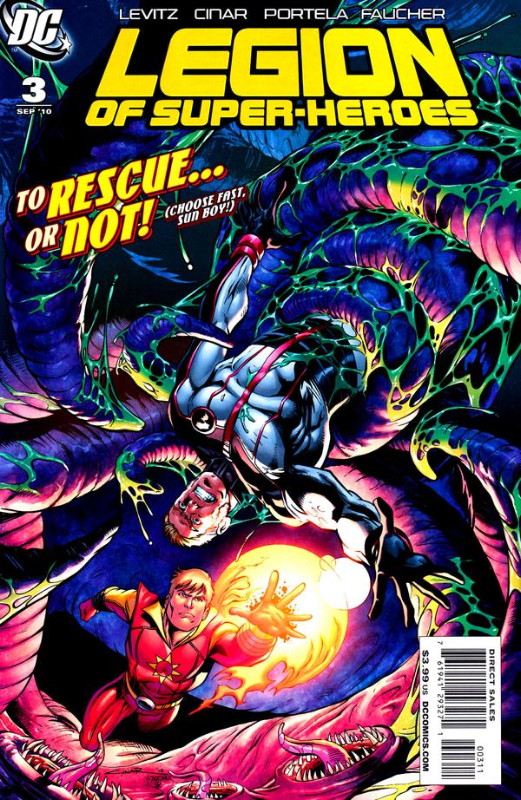
Legion of Super-Heroes vol 5 #37 After 30 years, Jim Shooter returns to write Legion of Super-Heroes. His last issue was Superboy and the Legion of Super-Heroes #224 back in 1977, since when he done little things like be Editor-in-Chief of Marvel Comics during the 1980s. The word on the street is that there was tremendous opposition to Shooter getting this writing gig - he’s reportedly made a lot of enemies in the comics biz - but as a fan I say “Good for him!”

Greg Burgas has a pretty good review of the issue as a reader who (unlike me) isn’t much of a Legion fan: Shooter introduces the characters along with some of their personalities, and starts setting up a large storyline about aliens invading the solar system, only no one knows who they are, and the Legion is both in disarray thanks to having an unexperienced leader (Lightning Lad, who’s filling the shoes of Cosmic Boy and Supergirl, both of whom have left the team) and a strained relationship with the United Planets. Joe McCulloch makes some good points too regarding the awkward dialogue in the story, with the supposedly-teenaged characters coming across as if they ought to seem “hip” or “futuristic”, but instead just seem silly.

I say “supposedly-teenaged” because there’s always been a bit of nudge-nudge-wink-wink-wink about teenaged superheroes, especially the Legion and the X-Men, who always seem smarter, wiser and more responsible than the vast majority of people their age. Very few writers ever make even a passing attempt to either explain this peculiarity or run with it as a story point. Anyway, I bring all this up because new artist Francis Manapul gives the characters some beefed-up physiques (see cover at left), making it even harder to take them seriously as anything younger than young adults.

Despite these kvetches, this is a pretty good start: There’s nothing here that can’t be seen as a writer trying to get a feel for the characters in his first issue, while setting up an ambitious story. Seeing Lightning Lad get overwhelmed so quickly, without someone right there to help him keep things under control is really my biggest beef with the story. Manapul’s pencils are pretty good, although Livesay’s inks might work better if they pulled the pencils in a more classic, rather than Image-esque, direction - someone with a heavier line to provide more depth and delineation.

As Burgas says, the issue feels like Shooter is basically throwing a whole bunch of stuff in the air and we’ll have to see where it lands. However, signalling that this is going to be an ambitious story arc is a great way to make the reader reserve judgment on the inaugural issue. I’m definitely interested in seeing what Shooter’s got planned, and I certainly hope that he’s given every opportunity to get his bearing and produce a decent run on Legion. And if the Legion is the sort of comic that interests you, then you might want to check it out.

This Week’s Haul

Ahh, finally all caught up.

  • Countdown to Final Crisis #22 of 52 (backwards), by Paul Dini, Tony Bedard, Keith Giffen, Carlos Magno & Rodney Ramos (DC)
  • Countdown to Adventure #4 of 8, by Adam Beechen, Allan Goldman & Julio Ferreira, and Justin Gray, Fabrizio Fiorentino & Adam DeKraker (DC)
  • The Death of the New Gods #3 of 8, by Jim Starlin, Matt Banning & Mark McKenna (DC)
  • Supergirl and the Legion of Super-Heroes #36, by Tony Bedard & Dennis Calero (DC)
  • Doc Frankenstein #6, by Andy and Larry Wachowski & Steve Skroce (Burlyman)
Supergirl_and_the_Legion_36.jpg Supergirl and the Legion #36 not only wraps up Bedard and Calero’s “bridge” run between Mark Waid’s run and Jim Shooter’s run (which starts next month), but also ends the “Supergirl” portion of the title, as she returns to the 21st century in this issue. It’s been a reasonably enjoyable run, but it feels like it ends with a whimper and not a bang, which is too bad. Still, I can understand clearing the decks for a new writer like this.

I’m looking forward to seeing what Shooter brings to the book in his return to both the title and to writing comics generally. On the other hand, I’m also interested in finding out what Cosmic Boy’s actually been up to given the tasty teaser that Mark Waid left us with, when Cos was apparently recruited by a team of heroes from the 41st century and went with them. While I couldn’t really fault Shooter if he shrugged off that story element because it didn’t interest him, I’d be even happier if it did interest him.

Doc Frankenstein #6 I don’t think an issue of Doc Frankenstein has come out since I started writing in this space - small presses often have trouble keeping on-schedule, so this isn’t really a big surprise. I’m an unusually patient reader when it comes to the small presses. Anyway, Doc Frankenstein is written by the Wachowski Brothers - the guys behind the film The Matrix - this began as a “high concept” comic in which Frankenstein’s monster survived into the present day and became a scientific and engineering genius with a large following, but one whose very existence is perceived as an atrocity by the church, which is constantly trying to destroy him.

It started off bright, but has gotten bogged down in the minutae of Frankenstein’s history, and this issue is perhaps the worst one yet, with an extensive and boring excursion into the history of Jesus Christ (I think it’s supposed to be funny and irreverent, but it’s not).

Steve Skroce is a really good artist - his style reminds me a lot of Bryan Talbot’s - and some of his drawings here are very impressive, but he’s really wasted on this unfocused story, which also is squandering a fairly nifty idea (albeit one which was also plumbed - though not much more successfully - in Grant Morrison’s Seven Soldiers mini-series).

This Week’s Haul

Still catching up on recording my weekly haul. Two large weeks in a row didn’t make it easy to keep up, since it look quite a while just to read everything (which is sort of the point, right?). This is the haul for 21 November 2007, Thanksgiving week:

  • Action Comics #859, by Geoff Johns, Gary Frank & Jon Sibal (DC)
  • The Brave and the Bold #8, by Mark Waid, George Pérez & Bob Wiacek (DC)
  • Countdown to Final Crisis #23 of 52 (backwards), by Paul Dini, Keith Giffen, Tom Derenick & Wayne Faucher (DC)
  • Countdown to Mystery #3 of 8, by Steve Gerber, Justiniano & Walden Wong, and Matthew Sturges & Stephen Jorge Segovia (DC)
  • Ex Machina #32, by Brian K. Vaughan, Tony Harris & Jim Clark (DC/Wildstorm)
  • Annihilation Book 3 TPB by Keith Giffen, Andrea DiVito, Christos N. Gage, Giuseppe Camuncoli, Stephano Landini, Stuart Moore, Mike McKone, & Scott Kolins (Marvel)
  • The Incredible Hulk #111, by Greg Pak, Jeff Parker & Leonard Kirk (Marvel)
  • The Umbrella Academy #3 of 6, by Gerard Way & Gabriel Bá (Dark Horse)
  • Castle Waiting #9, by Linda Medley (Fantagraphics)
  • The Boys #12, by Garth Ennis & Darick Robertson (Dynamite)
  • Invincible #46, by Robert Kirkman & Ryan Ottley (Image)
Action Comics #859 “Superman and the Legion of Super-Heroes” in Action Comics is turning out to be a pretty entertaining story: We find out why the Legion is persona non grata in the 31st century, and who their antagonists are. And it doesn’t look good so far, as several more Legionnaires fall to the enemy. How Superman figures into all this is probably the neatest part of this story, as the enemy has twisted Superman’s legacy to their own ends, and imagining how he feels about that - and knowing that no one other than the Legion believes the truth - is a compelling notion. What would be worse than finding out that you’ve been forgotten a thousand years in the future, than to learn that your name means something the opposite of what you worked to achieve?

So it’s a cool set-up. I hope Geoff Johns can avoid the clichéd ending to wrap it up. For instance, the “Some super-villain’s mind-controlled everyone” ending, or the “Superman beats the main antagonist into submission thereby winning the goodwill of the public” ending.

Annihilation Book 3 I’ve thoroughly enjoyed Annihilation, of which Volume 3 is the final volume. It’s even better than Annihilation Conquest, which is currently running and also entertaining.

The premise of Annihilation is that Annihilus - the extremely powerful armored insectoid who’s faced the Fantastic Four in the past - learns that our universe is gradually expanding into the Negative Zone where he rules, and he convinces virtually the entire Negative Zone to launch a massive attack on our universe. The emerge through the Crunch, the edge of the universe containing the energies of the universe’s creation, and in doing so destroy a high-security prison - the Kyln - and set a variety of nasty creatures free.

The first two volumes collect a number of mini-series spotlighting individual characters dealing with the “Annihilation Wave” - the influx of Annihilus’ forces, who begin by rampaging through the Skrull galaxy. The Nova Corps are destroyed and Richard Ryder is last as the last Nova centurion. The Super-Skrull tries to take the fight to the Negative Zone. The Silver Surfer learns that two creatures freed from the Kyln are nearly as old and as powerful as Galactus, and he returns to Galactus’ service to try to draw him away from the Annihilation Wave. And Ronan the Accuser returns from exile when he learns that the Wave is bearing down on Kree space.

This final volume resolves everything, as Nova leads the resistance against the Annihilation Wave and things go exceedingly poorly, even more so once Annihilus enlists the help of Thanos to tame the power of Galactus for himself.

I’ve always been a little skeptical of Keith Giffen as a writer. I was not a fan of his run with Paul Levitz on Legion of Super-Heroes, and I really hated his sense of humor that he applied to DC in the late 80s and early 90s, such as on Justice League and Ambush Bug. I thought it was, well, rather childish. But as the mastermind (it seems) behind Annihilation, I’m most impressed with his ability to write dark space adventure. Not only does he have real skill at slowly ratcheting up the tension of the story, but he does a great job of handling the myriad characters and making them all seem unique and driven in their own ways: Nova is a pure hero, the Silver Surfer is a tortured hero, Drax the Destroyer is a programmed killing machine who nonetheless does the right thing when not under the thumb of his programmed imperatives, Ronan is a true patriot who believes in doing whatever is best for his people no matter what the cost, and even the villains all have different shades of character and motivations. In short, Giffen is doing today what Jim Starlin did in his heyday on books like Captain Marvel, Warlock and Dreadstar.

(Incidentally, I think that Starlin brought to Marvel in the 70s what Jack Kirby tried to bring to DC in the 70s, except that Starlin actually succeeded in creating a compelling little mythology within the Marvel Universe, whereas all Kirby did was create a surreal and silly little pocket of colorful costumes within the DC Universe.)

Perhaps most importantly, Giffen delivers the true payoff in this concluding volume with both triumphant character moments and dramatic battles. Perhaps the best single moment is when Nova and Ronan talk when things seem darkest, and Ronan the Kree patriot says to Nova the human hero, “Were you Kree, I would call you brother.” Ronan, Drax, the Silver Surfer and Nova all get their moment of triumph (Ronan’s is the best, while the Surfer has to wait for one of the epilogues), and it’s all a lot of fun.

Andrea DiVito has a solid, dynamic art style which serves the story well. There are plenty of full-page and two-page spreads to keep the action moving, and he handles the large cast with their various eccentric designs quite well. The guy must be a machine to have pencilled and inked this whole story himself, although I imagine he had plenty of lead time, too.

Overall, Annihilation is one of the best things Marvel’s published in years. It once again proves the theory that comics are best when they involve assembling great creators when letting them produce great stories, a lesson that Marvel seemed to have learned with “Heroes Reborn” back in 1999, but seems to have forgotten again these days given stuff like Civil War and its aftermath. I’m glad Giffen was able to play with this corner of the Marvel Universe, though, because this was well worth the time it took to read it.

(If you want to read more without reading the story, the whole series is summarized in the Wikipedia entry.)

This Week’s Haul

  • Action Comics #858, by Geoff Johns, Gary Frank & Jon Sibal (DC)
  • Countdown to Final Crisis #26 of 52 (backwards), by Paul Dini, Justin Gray, Jimmy Palmiotti, Keith Giffen & Scott Kolins (DC)
  • Countdown to Adventure #3 of 8, by Adam Beechen, Eddy Barrows & Julio Ferreira, and Justin Gray & Fabrizio Fiorentino (DC)
  • Countdown to Mystery #2 of 8, by Steve Gerber, Justiniano & Walden Wong, and Matthew Sturges & Steven Jorge Segovia (DC)
  • The Death of the New Gods #2 of 8, by Jim Starlin & Matt Banning (DC)
  • Justice Society of America #10, by Geoff Johns, Alex Ross, Dale Eaglesham, Ruy José & Drew Geraci (DC)
  • Supergirl and the Legion of Super-Heroes #35, by Tony Bedard & Dennis Calero (DC)
  • Annihilation: Book Two TPB, by Keith Giffen & Renato Arlen, Javier Grillo-Marxuach & Gregory Titus, and Simon Furman & Jorge Lucas (Marvel)
  • Annihilation Conquest: Quasar #4 of 4, by Christos N. Gage, Mike Lilly & Bob Almond (Marvel)
  • Mouse Guard: Winter 1152 by David Petersen (Archaia)
  • The Secret History Book Three: The Grail of Montségur by Jean-Pierre Pécau, Goran Sedzuka & Geto (Archaia)
  • The Secret History Book Four: The Keys of Saint Peter by Jean-Pierre Pécau & Leo Pilipovic (Archaia)
  • The Perhapanauts: First Blood TPB, by Todd Dezago & Craig Rousseau (Dark Horse)
Action Comics #858 Action Comics is continuing the latest weirdness at DC Comics: The “return” of the “original” Legion of Super-Heroes, as prefaced in the awful “Lightning Saga” in JLA and JSA earlier this year. This issue kicks of “Superman and the Legion of Super-Heroes”, in which Brainiac 5 sends an automated time bubble back to the 20th century to recruit superman to help with some disaster in 3008. He also fixes Superman’s memory so he remembers the Legion (without explaining why Superman remembered them perfectly clearly in the Lightning Saga), triggering a reminiscence of Supes being recruited into the Legion as a boy. He’s then catapulted forward where he finds that things are in bad shape indeed, and that the rest of the Legion had a really good reason to not want Superman brought into the fray.

I’m not a real big fan of either Geoff Johns or Gary Frank. In Johns’ case, I find his characterizations bland and his stories so even-keeled that one hardly notices when they pass their climactic moment. In Frank’s case, I think it’s mostly his association with the tedious and dull Supreme Power series over at Marvel, and that’s not really his fault. His designs and rendering are actually quite strong, although I wish his characters weren’t so… toothy. Reservations aside, this issue is a fine example of hooking your readers and drawing them in: Why did the Legion vanish from Superman’s life when he became an adult? Why did they contact him now? And how’s he going to get out of this one? The success or failure of this story will primarily rest on answering those questions.

All of this completely shoves aside he question of how this Legion reconciles with the other in-continuity Legions which have been around for the last 15 years, which have all be in-continuity, too. My bet is that most or all of them have been from the futures of parallel Earths, now that we have them back thanks to Infinite Crisis. Which is not a very satisfying answer, but DC’s continuity isn’t exactly about satisfaction these days.

Rachelle has some nice scans of this issue, although she also spoils the cliffhanger at the end, so view at your own risk.

Anyway, if this sounds at all interesting, I would in fact recommend it. The art is nice, Johns does a fine job of recapping who the Legion are and why they’re important without going into the nitty-gritty details that casual readers won’t care about, and like I said it ends on a compelling cliffhanger. Maybe this story will be Johns art his best>?

Countdown to Mystery #2 Three Countdown books this week. Countdown itself has been renamed Countdown to Final Crisis, and the story is mainly a recap of what’s going on. Since the answer is basically “nothing much” you can draw your own conclusions. (There’s some reason to believe that Final Crisis will reboot the DC Universe again. While Crisis on Infinite Earths rebooted things while DC was at its creative apex, a reboot now feels like editorial admitting that things are so screwed up that it’s not salvageable. Which ironically is exactly the opposite message delivered by Infinite Crisis. But nothing DC does these days can really surprise me - I’m that cynical about it.)

Countdown to Adventure is the best of the three, a little on the grim side to my tastes, but at least it’s exciting and the heroes (Adam Strange, Starfire and Animal Man) are likable. The backup story with Forerunner is vaguely interesting since she’s visiting a new parallel Earth, but the use of Dark Angel as the villain is a big snooze.

Countdown to Mystery is somewhere in-between. Steve Gerber’s Doctor Fate is not without interest, although it’s slow and feels like he’s trying to impose some structure onto Fate’s magic, which always seems like it’s just a bad idea when it comes to magic in fiction. So I’m on the fence about it, but it could turn out to be good. The backup story involving Eclipso, however, is just vile: Eclipso corrupts Plastic Man and then sets her sights on the Creeper. It’s borderline-unreadable. Yuck.

Justice Society of America #10 Geoff Johns is a busy guy - I may not be his biggest fan, but I sure can’t complain about his work ethic. After last issue’s prologue, this issue launches full-on into “Thy Kingdom Come”, in which the Kingdom Come Superman from Earth-22 is pulled into Earth-1. He resembles Power Girl’s late cousin, leaving her confused and disappointed, and Starman knows him, having been to Earth-22 for the events of Kingdom Come. This Superman is pretty messed up, having seen a lot of death and destruction on his world, much of it due directly or indirectly to him, and he feels responsible even for that which he wasn’t responsible for. This could play out any of several different ways, and I hope Johns surprises us rather than ending the story with a silly “Superman on a rampage” fight.

The real potential of this story is that it could make the JSA matter again. The JSA has felt for a long time like a team whose time is long since past, and the array of bland writers and artists who have been helming the book for the last ten years haven’t helped. Just because the team has multiple generations of heroes doesn’t mean it’s anything more than a generic superhero book. (Contrast with the 1970s revival of All-Star Comics, which is the finest example of multigenerational superheroes I’ve yet seen.) It would only take a little adventurousness to give this JSA series some depth and feeling, and the KC Superman could give it that.

Incidentally, I’ve given penciller Dale Eaglesham the short shrift when talking about this series: His simple linework is winning me over: His facial expressions are getting stronger with every issue, and unlike many artists he draws full backgrounds, making it feel like his characters are inhabiting a fully-realized world. This issue opens with a full-page panel with Power Girl, Cyclone and Ma Hunkel, and Cyclone’s expression is just perfect. It’s followed by a double-page spread with Superman and the original JSAers in their meeting room, and it’s equally powerful. Later on, there’s another nearly-full-page panel of Superman’s first public appearance, and while the focus is entirely on Superman, the backgrounds are fully-rendered and the composition is great. While Eaglesham’s style isn’t entirely to my taste, I definitely have to applaud him for putting so much effort and detail into his work, without compromising basic storytelling. Honestly it seems like there aren’t a lot of artists around today who can do all that.

Mouse Guard: Winter 1152 #2 Archaia Studios Press has been bunching up their releases lately, with two issues of another series I don’t read coming out last week, and two issues of The Secret History this week. I suspect ASP is growing a little faster than it can keep up with, so some stuff is getting delayed due to lack of manpower or capital. That’s just my guess, though. I’m pretty forgiving of small presses and their delays, although I am an unusually committed comics reader. Surely a regular schedule would serve the company’s cash flow better, though.

I’m mostly enjoying The Secret History, although it delves too far into historical details I’m entirely unfamiliar with. The general storyline is okay (four powerful individuals influencing world events from prehistory through today) and the art is excellent (even with a different artist each issue), so I’m willing to follow it through its 7-issue run. I just wish it were more accessible.

David Petersen keeps a perfectly regular schedule with Mouse Guard, and the second issue of the new series came out right on time, so he’s bucked the trend there.. The series has been a surprise hit and has gotten lots of critical acclaim. I enjoy it myself, and can certainly recommend it as well-drawn entertainment, albeit maybe not for preteens since the violence does get a little rough sometimes.

The Perhapanauts vol 1: First Blood The Perhapanauts resembles Mike Mignola’s B.P.R.D. in that it’s a team of operatives who investigate paranormal phenomena and deal with them if necessary. This team is a little more out there than B.P.R.D., with Bigfoot and El Chupacabras as team members, along with a telepath, a ghost, and a mysterious guy whose background is kept secret. They can time travel and dimension hop with minimal difficulty, although they also face some pretty rough opposition as a result.

Nonetheless, the series feels a lot like Mignola’s work, which isn’t bad, but being “B.P.R.D. lite” isn’t a real strong recommendation. Moreover, this first volume ends on a cliffhanger, which is a pretty lousy way to treat new readers. Johanna Draper Carlson likes the series more than I do, I just thought it was pretty lightweight.

Jim Shooter to Return to Legion of Super-Heroes

Wow, it’s for real: Jim Shooter is going to write the Legion for the first time in 30 years.

Read an interview with Shooter on Newsarama.

When I started buying the Legion, way back in 1976, Shooter was on his way out (he’d soon become Editor-in-Chief of Marvel Comics), but he wrote the first three Legion comics I ever bought (including his last two). It’s been a while since he’s written any comics, I think, so it’ll be interesting to see how it pans out.

Next Page »